
April 22, 2026
Season 4 Episode 370 | 26m 30sVideo has Closed Captions
Reaction grows to Gov. Beshear's comment about UK's leadership.
More reaction to Gov. Beshear's comment about losing confidence in UK's leadership. Candidates for U.S. Senate explain what sets them apart from their competition. How legislation could advance research of psychedelics in Kentucky. Students at a southcentral Kentucky high school learn practical living skills.
Problems playing video? | Closed Captioning Feedback
Problems playing video? | Closed Captioning Feedback
Kentucky Edition is a local public television program presented by KET
April 22, 2026
Season 4 Episode 370 | 26m 30sVideo has Closed Captions
More reaction to Gov. Beshear's comment about losing confidence in UK's leadership. Candidates for U.S. Senate explain what sets them apart from their competition. How legislation could advance research of psychedelics in Kentucky. Students at a southcentral Kentucky high school learn practical living skills.
Problems playing video? | Closed Captioning Feedback
How to Watch Kentucky Edition
Kentucky Edition is available to stream on pbs.org and the free PBS App, available on iPhone, Apple TV, Android TV, Android smartphones, Amazon Fire TV, Amazon Fire Tablet, Roku, Samsung Smart TV, LG TV, and Vizio.
Providing Support for PBS.org
Learn Moreabout PBS online sponsorship[MUSIC] The governor speaks out again about the federal judge who will lead the UK School of Law.
[MUSIC] >> It's important to keep ourselves, the workers, and our fellow travelers safe.
>> Warmer weather means more road work and more danger for road workers.
[MUSIC] >> If you've never been to the Derby, you've never lived.
>> And ten days before the run for the roses, Churchill's TRACK chief talks about how Louisville always ends up in the winner's circle.
[MUSIC] >> Production of Kentucky edition is made possible in part by the KET Millennium Fund.
>> Good evening and welcome to Kentucky edition for this Wednesday, April the 22nd.
I'm Renee Shaw and we thank you for winding down your Wednesday with us.
Kentucky's 2026 primary election is less than one month away.
On Monday night's Kentucky.
Tonight, we heard from Republican and Democratic candidates hoping to become Kentucky's newest U.S.
senator.
After the program, we caught up with the candidates in Ket's lobby.
Republican Daniel Cameron shared why he chose to participate.
>> Well, this is another venue and forum to get our message out, which is one in which we are talking about things that the voters care about, whether it's keeping more money in their pocket through the lowest tax rate that we possibly can get, whether it's energy independence or the Save America Act, or securing our southern border, or standing up for the law enforcement community, or, frankly, getting health care costs down through lowering prescription drug prices.
These are the issues that I've been talking about, and I've been consistent on it over the course of this campaign.
And I wanted another opportunity to be able to to talk about those things.
>> Two of Cameron's challengers, Congressman Andy Barr and businessman Nate Morris, did not accept Keat's invitation to participate.
Three Democrats also agreed to be here.
Charles Booker Amy McGrath and Dale Romans each shared with us what they think makes each of them stand out.
>> You know, I've been telling people all over Kentucky this feels like Rocky three in some ways, because we've been telling a story that has been years in the making.
And I think the most powerful aspect of this campaign and my candidacy is that I haven't changed.
The things I'm running on are things I've stood on for years.
I've marched in the streets for them.
I've stood in the halls of government for them.
What has changed is everything around us.
The political atmosphere is totally different.
Donald Trump has flipped everything upside down, and this is an open seat at a time when everybody is sick and tired of being sick and tired.
And so essentially what this campaign is, is a testament to regular people who've been speaking up for years.
And this is our time.
>> I think, right now, given the fact that this is such a consequential year with everything that's going on, and this is an open seat where Kentuckians have a real opportunity here.
I'm somebody who has served my country, and I think right now, the fact that we are in a war, we need a senator who has some national security experience and also can speak to and listen to and hear not just Democrats, but also moderates and independents in a state like Kentucky.
That's how we win.
And we've seen this, of course, we have this really great Governor Andy Beshear, who's won twice here as a Democrat, and he's done that by speaking to everyone.
And so that's my approach.
>> I think it has to be the right Democrat.
I think it has to be one that is a moderate and is in the lane where most of us are.
That isn't far left, that hasn't run in two races each and been beaten distance both times.
I think it needs to be a fresh face.
I think Kentucky is ready for something different, a non-politician that can go up there and only work for Kentucky.
I'm not looking to build a lifelong political career.
I want to go up there for 1 or 2 terms and really get some stuff done and work on the projects that affect Kentucky.
And that's why I'm not talking about, you know, these political taglines raising minimum wage, which would be nice, but it's not enough.
There's a very small percentage of us work for minimum wage, Medicare, Medicaid for all.
It's not realistic and it won't work.
Those are all political taglines that our advisors tell us to see because they sound good to the public and they poll, well.
I want to go up there and work on the things that can really affect Kentucky.
>> Now, you can see Monday night's discussion in its entirety online and On Demand.
It is streaming at ket.org.
Johnny Nash KY.
Tonight, our candidate conversations continue next Monday as we welcome several candidates for the U.S.
House and Central, Kentucky's sixth Congressional District.
Hear from them and send us your questions.
That's Kentucky tonight, Monday night at eight eastern, seven central right here on KET.
As we told you yesterday, Governor Andy Beshear posted on social media that he had lost confidence in the University of Kentucky's leadership.
The governor is saying more today.
The governor was critical of the decision to appoint U.S.
District Judge Greg Van Tatenhove as the new dean of the University of Kentucky Law School.
Van Tatenhove is judge for the Eastern District of Kentucky and was appointed by President George W Bush back in 2005.
The Courier Journal reports that a majority of UK law faculty felt Van Tatenhove was, quote, unacceptable as a candidate, while three other finalists were considered acceptable.
Van Tatenhove will take the job on July 1st.
Today, the governor said he's heard from people who agree with him.
He posted this today, quote, I have received countless calls and messages agreeing that the University of Kentucky needs to reconsider its recent actions.
The fact that a political party defended the law school.
Dean's appointment is telling Kentuckians deserve a nonpartisan university that doesn't waste taxpayer dollars.
We also deserve real oversight that will tell U. K s administration know when it is making a mistake, end quote.
Today, Kentucky House Speaker David Osborne, a Republican, offered this comment, quote, whatever is driving this disagreement, seeing it play out on social media represents a troubling departure from the restraint that should guide interactions between the executive branch and independent institutions.
Doctor Capilouto leadership, through budget and policy discussion has been steady, thoughtful and solutions oriented.
Additionally, the incoming law school dean is a man who is widely respected among judicial and legal communities.
After decades of principled leadership, sound judgment, and an unwavering respect for the rule of law.
End quote.
Yesterday, the governor was also critical of the decision to hire outgoing athletics director Mitch Barnhart as an executive in residence for the UK Sports and Workforce Initiative, at a salary of $950,000 a year.
In his post, the governor said the job had, quote, no defined duties.
In other news, five months after the deadly UPS plane crash in Louisville, Mayor Craig Greenburg is praising the first responders for their actions.
After the crash, the mayor recognized 40 different city agencies during yesterday's ceremony.
>> Since the first moments following that crash, you and your brave colleagues were on site working to save people to get our community going forward.
Again.
Remediation and recovery took months is still going on in some ways.
You all were there from the earliest moments, folks from Jefferson County, all across our city and county and folks from surrounding counties as well.
We thank all of you.
It was an incredibly difficult and challenging time.
And in these moments of tragedy, I always try to look for silver linings, for opportunities, for hope and optimism in the face of tragedy.
And one of those areas.
Following this deadly crash was the positive feedback that I received from all over the country.
Folks that have worked on sites devastating sites like this in many other states and many other cities.
And the feedback I received over and over again was what a world class job each and every one in your of your agencies, of your colleagues did in response to this tragic incident.
>> The UPS crashed shortly after takeoff, killing all three crew members and 12 people on the ground yesterday.
Kentucky is taking steps to research how psychedelics could be used to treat drug addiction.
Yesterday, we heard from Brian Hubbard, who was once the executive director of Kentucky's Opioid Abatement Advisory Commission.
In that role, he proposed the State use opioid settlement money to fund studies involving a powerful drug called ibogaine.
That didn't happen.
Instead, Hubbard resigned in 2023 and is now the CEO of Americans for ibogaine.
Our Emily Sisk has part two of her interview with Hubbard, which comes as the Kentucky General Assembly just passed legislation to advance research of ibogaine right here in the Commonwealth.
>> I want to take a second to talk about even just your history with ibogaine in Kentucky.
You know, you were ahead of the Opioid Abatement Advisory Council and you pushed for Kentucky to pursue ibogaine research.
This was just a few years ago.
That did not happen.
And now we fast forward to today.
The legislature has passed.
Senate Bill 77 sets up a framework for clinical research of ibogaine.
No funding yet, but it sets up the framework.
So it seems that especially the Republican supermajority in the legislature now has some appetite for what you wanted to do back in the past, but doing it a little bit in a different way.
Why do you think it didn't happen then when you were when you were the head, what did it take to make it happen now?
>> So in 2018, I read an article at Scientific American where researchers at New York University had discovered that what we call the magic mushroom, or the active ingredients of psilocybin, had created a dramatic reduction in alcohol use among folks who had been alcoholics for years.
So when I got the opportunity, thanks to former Deputy Attorney General Barry Dunn under then Attorney General Daniel Cameron to lead the Kentucky Opioid Commission, I reached out to an author by the name of Julia Rabalais.
I had read her work and Substack publications, and she discussed how her own use of psychedelics had helped her overcome an adult lifetime of treatment resistant anxiety and depression, a near fatal eating disorder, and her own disbelief in a higher power.
I said, hey, what can you tell me about the world of psychedelics and whether there's anything that has special application to opioid dependency?
She said.
Have you ever heard of ibogaine?
When I was told about ibogaine and what it could do through the recovery story of a lady by the name of Juliana Mulligan?
When I heard her story, I said on my inside, I'm going to do everything I can to learn as much as I can to understand whether this is valid and credible.
And if it is, I am going to ask Attorney General Cameron to give us an opportunity through the Kentucky Opioid Commission, to explore setting aside 5% or $42 million.
At that time, the state's total settlements were about $842 million.
Let's set aside 5% of this money to determine whether there is a potential therapeutic breakthrough we can foster for the opioid epidemic in Kentucky.
So on May the 31st of 2023 on the lawn of the Kentucky State Capitol, I had the privilege of announcing as the first chairman of the Kentucky Opioid Commission that we were going to pursue an exploration of setting aside $42 million to create a public private partnership to drive ibogaine all the way through the FDA's drug development process.
And anybody today can go online and look up three public hearings held at the Kentucky Supreme Court Administrative Office of the courts in 2023.
Former Texas Governor Rick Perry testified.
In that video.
We had a video message from a tribal leader in Gabon expressing solidarity with Kentucky on the pursuit of this project.
It was phenomenal.
And then at the University of Kentucky's request, and what was a true jokey Smurf open the box moment, they demanded a hearing in October of 23 because their position was.
The FDA will never approve this trial because of the cardiac risk associated with it.
All drugs come with risk.
As long as risk can be mitigated, the FDA will consider approving a trial for any medication, and there is no reason to assert that the cardiac risk for ibogaine is a disqualifier.
And so now we come full circle with the conversation I get to have with you for the very first time on Kentucky television.
Just last Wednesday.
In true and customary form, the Kentucky Legislature overrode Andy Beshear to make Senate Bill 77, which is the Kentucky Ibogaine Initiative, as originally proposed, the law of the state.
And this is just the beginning.
We are not going to stop until the people of this state are at the front of the line to overcome an opioid epidemic that began here.
>> In the moments that we have remaining.
Two two final questions, is there anything you would have done differently in Kentucky as far as suggesting to utilize the opioid settlement money?
Because that seemed to kind of be where the discrepancy or where the issue was.
Looking back now, would you have done any of that differently?
So Kentucky could have been on the fast track and been the first to do this?
>> I'll tell you what I would have done differently.
I had a lot of internal interference, as did my staff while this project was pursued.
I think that if I had it to do all over again, instead of forbearing with that interference, instead of forbearing with that difficulty, I would have requested a meeting with Attorney General Cameron to tell him about the difficulties that I was facing, so that I would have had a much freer hand to engage press, not just at the local level, but at the national media, to advertise and to celebrate what we were doing so that we could have created the kind of political momentum around Kentucky that has been generated nationally to produce the executive order from President Trump.
>> For folks who might be watching, when could they expect to see ibogaine treatment available?
What is it going to take?
How long might it take to get to that point?
>> Well, the first thing that we have to initiate is an FDA drug development trial.
Texas is well on its way to initiating that process with the executive order of President Trump.
The federal government has been specifically directed to align resources, regulations and technical technical support in partnership with the states to create a federal, state, FDA ibogaine drug development trial that will play out nationally.
It is my hope that within the next 18 months, that phase one trial will begin, or perhaps even start right into phase two, so that every state that is a participant in this trial framework can put its people to the front of the line.
And while Kentucky's measure is not currently funded, the potential is there to fund it.
In 2027, perhaps even with opioid funds.
I always wished for Kentucky to be the leader of this endeavor.
It was a wonderful chance for this state of all of them, for the opioid epidemic began to lead the whole country out of it.
And while it's not the first, it still has the opportunity to be among the first.
>> Well, Mr.
Hubbard, we will keep following all the updates with ibogaine, but we so appreciate your time and telling us all about the developments.
Thank you so much for being with us.
>> Thank you.
>> And thank you, Emily.
As part of the new law that came from Senate Bill 77, the Kentucky Department of Agriculture can partner with drug developers to conduct clinical trials involving ibogaine.
[MUSIC] As the school year soon comes to an end, teachers are sharing lessons teens will need beyond just high school.
Today was what's called a Flex Wednesday at Bowling Green High School, where students get to learn about things outside their regular classes.
The theme was practical living skills, including personal finance, health and wellness, career prep and home repairs.
Students did quick rotations between classrooms and workshops to learn skills like the Heimlich maneuver.
>> You could be anywhere and notice that somebody's choking or as a parent, when they grow up and they have their own kids, you might not have anybody around and your kid starts choking.
And so what do you do?
Just having the basic knowledge of what to do besides calling 911 can help save their life.
Everybody, this morning, before we went into different stations, learned about the importance of having a good signature.
And a lot of the kids that are at this age right now, they might have missed cursive.
So we talk about, if you don't know cursive, what are some good ways to to still have a decent signature?
And they got to practice that today.
We talked about some financial stuff today, budgeting and that kind of thing.
There, there are other stations that have to deal with quick meals that are affordable that they can make in Crockpots or, you know, like dorm kind of things.
So just lots of different types of things that might help them in their everyday life as they move forward.
>> Makes sense.
Marty Watson is also the archery coach, so she's CPR certified her Co-instructor.
Jennifer Allen is an EMT and teaches at the Medical Arts Academy.
Teachers chose what they wanted to present today based on their skills and hobbies outside the classroom.
There was also an outdoor workshop on car care and maintenance.
>> When people find out I'm in high school principal, one of the things they kind of ask me is, why don't you teach kids this and that?
And the other thing in high school, and while we do a great job of teaching math, science, social studies, and English, I think we're missing an opportunity if we don't dive into some unique topics like practical living skills with students.
>> My other tips and lessons included laundry care, budgeting basics, and car seat safety.
All good things.
Kentuckians may notice an increase in highway work zone areas across the state.
With construction season well underway to keep roads safe for both drivers and road workers, the National Work Zone Awareness Week was created.
>> Last year.
There were 13 fatalities in Kentucky's work zones for.
For our industry, the fortunate part was none of those were workers.
But the unfortunate part is 13 people lost their lives in work zones.
So that's important.
There are over 150 crashes in the work zones around Kentucky last year.
A work zone can be anything from a flagger out, slowing traffic down, or trying to get them to shift to a lane to a major interstate type of work where you see the concrete barrier walls, and certainly in between those two extremes are the barrels and cone work zones that you'll see pretty regularly, but it can be anything from a very small blockage or a shoulder, a shoulder blockage to do some very minor work to a major blockage of a lane, or even a whole side of an interstate to completely rebuild that piece of roadway.
So recent information shows that there are three contributing factors, or the top three contributing factors of crashes in work zones.
The first is distracted driving.
So we encourage drivers to put the phone down, keep their eyes on the road.
The second is impairment.
So certainly do the proper thing and don't be using drugs or alcohol when operating a vehicle.
And then the third, of course, is speed.
And so we encourage people to observe the speed limit to to keep themselves safe, to keep their fellow travelers safe and to keep the workers safe.
The camera law that went into effect last year was a law that's intent is to try to slow people down in the work zone.
There's there's research that shows that a vehicle traveling slower is less likely to create injury, both for the workers and the drivers.
So it's important to keep people slowed down.
It allows them more time to interact or react to changes in the work zone.
The deterrent is that if you get caught speeding while an officer is present, they can issue a citation for $500.
You know, what I like to tell people is that at 60 mile an hour, you're covering a basketball court every second and you're covering a football field every three seconds.
So when you glance down at your radio, when you glance down at your phone in a work zone, you're covering that distance without seeing what's going on in front of you or around you.
So it's really important to pay attention and to slow down.
You know, the delay that you're going to realize in a work zone at best is going to add a few minutes to your commute.
And while I know we're all in a hurry, it's important to keep ourselves, the workers, and our fellow travelers safe when passing through these work zones.
>> A sports note now next Saturday is the 152nd Kentucky Derby at Churchill Downs.
And it isn't all about the horses and the hats on the next inside Louisville with Kelsey Starks, she sits down with racetrack president Mike Anderson, who talks about the economic impact and the international exposure.
>> Let's talk a little bit about the economic impact of Derby Week and its impact not only on Louisville, but as this to the state as a whole.
>> Yeah.
So the Louisville tourism came out earlier this year with an estimated economic impact of over $400 million.
And I think this is like the fourth or fifth year in a row that that they've estimated over $400 million.
So what does that mean?
It means filling up our hotels, filling up our restaurants, helping small businesses out.
So it's an incredible boost to our economy during this period of time.
And if you look at the list from Louisville tourism, the next biggest economic impact is like $70 million.
So the derby itself, the magnitude of of the people that we bring in, the impact is, is off the charts.
And we're going to continue to try to do that and bring more people in and bring more activity to the city and to the state.
So it's the numbers speak for themselves 151 consecutive years, and it's the longest continuously held sporting event in North America.
I don't want to ever take that for granted.
I don't want the community to ever take that for granted.
We've been given a gift.
So in 1875, when we had 10,000 people show up at the very first Kentucky Derby, no one knew at that time what that meant.
But it has grown and matured and grown.
And really, there's no other sporting event in the nation that can that can say, we've got the best because it's here, it's in town.
It's not the Super Bowl, which travel city to city.
Louisville, Kentucky is on the map nationally with this event every year.
And we should embrace it like we have.
And we've done a good job, but we should never take it for granted because I can't imagine Louisville, Kentucky without the Kentucky Derby.
>> What would you tell somebody if you were describing the Derby, Churchill Downs Derby Week, even to somebody who's never been there?
>> It's an emotion.
It's a feeling.
It's it's almost indescribable.
Unless you're there and experience it.
So if you've never been to the Derby, you've never lived.
I think that's the gut emotion of whether you're from Louisville, Kentucky, or from a different part of this world.
I hear it all the time.
I get letters every year from people about their experience, and it's really indescribable for me to say.
But it's it's such an emotion that I want people to experience, everyone to experience.
>> You can get in the Derby spirit and learn more about the history of the Kentucky Derby, and how the track is balancing tradition with modern innovation.
That's on the next inside Louisville with Kelsey Starks this Sunday at 12 noon eastern, 11 a.m.
central right here on KET.
There are signs air quality and Louisville is getting worse.
That's according to the American Lung Association state of the air report.
It says Louisville is one of the worst 25 cities in America for air pollution, and the number of unhealthy days is growing.
What does that mean for people who live in Kentucky's largest city?
We'll take a closer look at that tomorrow and much more on Kentucky Edition, which we hope you'll join us again for at 630 eastern, 530 central, where we inform, connect and inspire.
Connect with us all the way, as you see on your screen through the social media channels, on the PBS app.
And of course, stream us anytime, anywhere online at KET dot o r g. Thanks for joining us tonight.
I'm Renee Shaw and I'll see you again.
Take really good care.
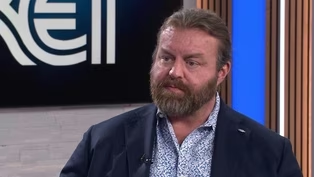
Discussion on Ibogaine-Related Legislation in Kentucky
Video has Closed Captions
Clip: S4 Ep370 | 8m 6s | Former head of Kentucky's Opioid Abatement Commission discusses ibogaine legislation. (8m 6s)
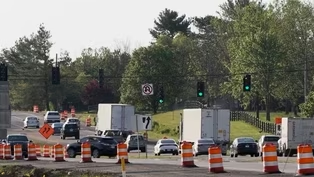
National Work Zone Safety Week
Video has Closed Captions
Clip: S4 Ep370 | 2m 53s | Week dedicated to raising awareness about driver and road worker safety. (2m 53s)
Providing Support for PBS.org
Learn Moreabout PBS online sponsorship New Episode
- News and Public Affairs

Top journalists deliver compelling original analysis of the hour's headlines.

- News and Public Affairs

FRONTLINE is investigative journalism that questions, explains and changes our world.
 New Episode
 New Episode
 New Episode
 New Episode

 New Episode
 New Episode
 New Episode
 New Episode
Support for PBS provided by:
Kentucky Edition is a local public television program presented by KET