
March 27, 2026
Season 4 Episode 352 | 26m 30sVideo has Closed Captions
Lawmakers are fast-tracking bills in the final days of the session.
Lawmakers advance a bill that amends a 2025 law regarding private communication between school staff and students. A measure on hiring and firing at public universities moves forward. An omnibus elections bill passes the Senate along party lines. Why an arrest warrant for former Gov. Bevin is no longer active. Western Kentucky gets big economic news.
Problems playing video? | Closed Captioning Feedback
Problems playing video? | Closed Captioning Feedback
Kentucky Edition is a local public television program presented by KET
March 27, 2026
Season 4 Episode 352 | 26m 30sVideo has Closed Captions
Lawmakers advance a bill that amends a 2025 law regarding private communication between school staff and students. A measure on hiring and firing at public universities moves forward. An omnibus elections bill passes the Senate along party lines. Why an arrest warrant for former Gov. Bevin is no longer active. Western Kentucky gets big economic news.
Problems playing video? | Closed Captioning Feedback
How to Watch Kentucky Edition
Kentucky Edition is available to stream on pbs.org and the free PBS App, available on iPhone, Apple TV, Android TV, Android smartphones, Amazon Fire TV, Amazon Fire Tablet, Roku, Samsung Smart TV, and Vizio.
Providing Support for PBS.org
Learn Moreabout PBS online sponsorshipmusic >> An appeals court makes a decision about former Governor Matt Bevin.
Arrest warrant.
[MUSIC] >> And with today's announcement, we're making history once again in Western Kentucky.
[MUSIC] >> What a $1.7 billion project means for McCracken County.
>> There are serious conversations starting.
I think it was in January about the closure of KSU.
>> A Senate GOP rescue plan throws Kentucky State University a lifeline.
More on that bill and others before the Kentucky General Assembly and tonight's reporter's notebook.
[MUSIC] >> Production of Kentucky Edition is made possible in part by the KET Millennium Fund.
[MUSIC] >> Good evening and welcome to Kentucky edition for this Friday, March the 27th.
I'm Renee Shaw, and we're grateful that you're jump starting your weekend with us.
Today marks day 55 of Kentucky's 60 day legislative session.
State lawmakers have just two more days to pass veto proof legislation.
That means fast tracking some measures before the ten day veto period begins.
Our June Leffler was following the debates on the Senate floor today, and she has this that kicks off tonight's legislative update.
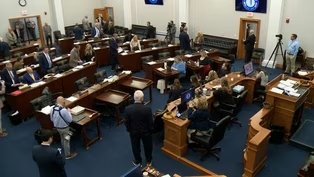
>> Bills are bouncing between one chamber to the other now, with lawmakers hoping to get the details right.
House Bill 67 is advancing with each vote and revision it retools a law passed last year that restricts private texting and social media messaging between school staff and students.
>> And it creates some boundaries that used to exist before our cell phone world came into place and students were more accessible.
>> This bill adds new financial transparency requirements for school districts as well.
>> So that the public has access to the budgeting process, the budgeting information, the auditing information, and also credit card statements on the school websites.
>> This Oldham County Republican proposed this measure earlier in the session.
Lawmakers are now adding some stalled bills to other ones with more momentum.
These changes will have to be approved by the House.
The Senate also approved its version of House Bill 490 regarding hiring and firing at public universities.
>> A faculty member at our post-secondary institutions may be removed by the board for bona fide financial reasons, including, but not limited to, financial exigency, exigency, low enrollment in a particular program, or misalignment of revenue.
>> At least three collegiate unions and associations oppose this measure.
Kentucky Democrats agree with campus workers concerns.
>> What 490 does really is weaken the tenure process.
It doesn't eliminate it, but it's designed to weaken the tenure process under the guise of financial exigency so that those tenured faculty.
Now, once this bill is passed and becomes law, will not have the same kind of freedom to teach what we refer to as academic freedom.
>> In a 30 to 7 vote, largely along party lines, the Senate approved House Bill 490.
It now heads back to the House for concurrence.
The Senate also passed House Bill 669, which eliminates the so-called orphan tax.
Kids with deceased parents or disabilities may be entitled to Social Security income, but if those kids are in foster care, most states, including Kentucky, intercept those payments to pay for the child's care.
House Bill 669 would save that money instead for the child's future.
>> This bill requires that accounts be set up for that funding to go into, for the use by that youth under certain conditions.
>> This bill now heads to the governor's desk where it could face a veto, though the measure has largely bipartisan support.
Governor Andy Beshear, his top health and social services official, has questioned this measure.
Doctor Stephen Stack wrote to lawmakers that this could cost the state $14 million.
Lawmakers continued to battle the Beshear administration over its handling of foster care reform.
Republicans have the supermajority power to override the governor's vetoes for Kentucky Edition.
I'm June Leffler.
>> Thank you.
June Kentuckians with prosthetic devices are one step closer to expanded insurance coverage, which could mean they'll have access to extra devices for everyday use and physical activity.
Our Emily Sisk has more on the measure, which received strong bipartisan support.
The House.
>> Floor advanced a measure to expand insurance coverage of prosthetic devices.
Today, Representative Michael Meredith of Edmonson County explained what exactly the legislation will do.
>> This bill would allow a patient with a prescription from the patient's licensed health care provider to receive up to three devices per affected limb, per three year period for everyday use, as well as devices designed for specific activities.
>> The Oakland Republican said.
Many people with prosthetics need multiple devices, some for everyday use and others for physical activity.
>> Most commercial insurance plans cover device for general everyday use, but do not cover the activity.
Specific devices necessary for running, swimming, biking, hiking and other activities.
>> The measure hit home for a Louisville Democrat who lost his arm at the age of 28.
Representative Al Gentry said he's been working for years to get legislation like this passed.
>> Had a game of golf with a prosthetic guy and we started talking.
He started telling me about what insurance are starting to limit these things.
This is a big deal for kids that have prosthetic devices.
What we really try to get them to do is to be active, to overcome their disability, to do great things.
>> Gentry explained why this update is so important for kids with prosthetics.
>> Unfortunately, when you're growing, you go through different sets of prosthetic devices.
These things are very expensive.
And I couldn't understand why insurance companies were wanting to try to limit these.
When you don't have a good fitting device on somebody that's growing up with a disability, it's going to create more problems later on in life because you're going to wear the other side of your body out because it doesn't fit.
>> Senate Bill 97 passed the lower chambers unanimously.
Since the House made some changes to the bill, it will return to the Senate for approval or rejection.
The House also passed a measure to oversee the state's Medicaid plans.
The cost of Medicaid has doubled in Kentucky over the last five years, and in Northern Kentucky, Republican said that's reason for oversight.
>> This is not about slowing down care.
It's about strengthening trust, improving oversight, and making sure that our Medicaid program remains effective, efficient and accountable.
>> Under Senate Bill 173, the Department for Medicaid Services would need to provide plans to the legislature for evaluation.
But a member of the minority party said the General Assembly has no business overseeing the state Medicaid Department.
>> We are not Medicaid experts here, and we are very part time, so we have a cabinet that deals with it that we pay, that know what they're doing, can respond on an instant.
>> The measure passed off the House floor in a 74 to 16 vote, mostly along party lines.
This bill will go on to the governor's desk for his consideration for Kentucky edition.
I'm Emily Sisk.
>> Thank you.
Emily.
The House passed several other measures today, including House Bill 885, which clarifies educational requirements for licensed cosmetologists and establishes strict penalties for those who operate without a license.
[MUSIC] And now.
PostScript A look back at some news from Frankfort that we haven't previously reported this week.
What started out as a simple piece of legislation has morphed into an omnibus elections bill.
On Thursday, the Senate passed House Bill 139 strictly along party lines 31 to 6.
Here's some of what's now included in the bill.
Donors could contribute $3,500 per election to candidates and political campaigns in Kentucky.
That's up from $2,200 and is on par with the federal level.
The bill also allows judicial candidates to disclose their political party affiliation.
Right now, those races are nonpartisan, and the bill allows the state Board of Elections to work with the federal government to identify and remove registered voters who are not U.S.
citizens.
House Bill 139 would also prohibit Social Security cards and public benefits cards from being used as a valid form of voter ID beginning in the year 2028.
The House must now decide whether to accept the Senate's changes before the bill can go on to the governor's desk for his review.
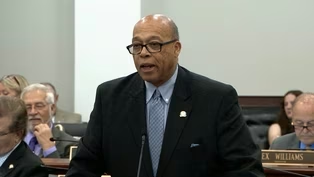
The Senate also passed House Bill ten, which is designed to limit hard to reverse executive branch actions before a new governor enters office.
Changes to the bill would largely apply to the last six months of a sitting governor's term, a committee substitute or changes by a committee also add Senate confirmation for more state board chairs.
Supporters say the bill puts checks and balances on the executive branch, but critics claim it aims to weaken a governor's authority.
>> It attempts to free the transition period from politics and possible real or perceived wrongdoing.
It requires certain document retention enforced by the attorney general.
It protects whistleblowers.
It provides certain contract oversight in the last 180 days and provides some guardrails for merit and non-merit movement employees.
Employee movement during the last 180 days.
Mr.
president, the committee sub identifies several positions, boards and commissions that will now require Senate confirmation moving forward to give these important, important appointed bodies and offices the subject matter focus that they need.
Those areas are cabinet secretaries and several areas in education.
The president of CPE, the chair of CPE, the chair of Epsb, the chair of the Kentucky Stack Board of Education, the chair and Council members of the Curriculum Assessment and Accountability Council, the Chair of Fish and Wildlife Commission, and the hiring of the agency's Commissioner, Commission and Commissioner of the Department of Aviation.
The Commissioner of Housing, Building and Construction and their Advisory Council.
Mr.
president, these confirmation requirements shall go into effect April 16th, 2026.
>> This bill is clearly, clearly a attack on executive authority.
I mean, we've never had this kind of bill in the history of our legislature, and there's no reason to do it now and then.
I would be remiss, I'd be remiss if I didn't say in this chamber and to the public that the all constitutional officers, including the governor, have submitted all travel expenses requests to the state treasurer for the last six months of his or her term.
We know what that's about.
I'm not going to be more specific than that at this point, but we know what that's about.
And there's no indication that when when the governor travels, you know, he may be doing or likely to be doing state business for the benefit of this state.
So for all those reasons that I've just articulated, Mr.
President, I think this, again, this bill is just an overreach and seeks to control the executive authority that we grant any governor, regardless of his or her party.
>> Despite that objection, the bill went on to pass by a vote of 32 to 6, largely along party lines.
It now heads back to the House, where it can be debated for final passage.
In other news, an appeals judge has recalled the arrest warrant for former Governor Matt Bevin as he asks the Kentucky Supreme Court to remove the judge from the case.
Jefferson Family Court Judge Angela Johnson found Bevin in contempt of court last week.
She says he failed to obey a court order to provide complete financial records.
His adopted son, Jonah, is asking for financial support from Bevin and his ex-wife, Glenna.
The Kentucky Lantern reported.
A hearing about that planned for today has been postponed.
Governor Bevin was supposed to be in court Tuesday, but appeared by Zoom instead.
Judge Johnson then issued the arrest warrant.
The Courier Journal reports that Judge Johnson issued the warrant after Bevin moved to have her disqualified.
According to state law, a judge is barred from proceeding in a case after the filing of an affidavit to disqualify them until the state Supreme Court rules, or until a special judge is assigned to the case.
It's being called the biggest single capital investment in Western Kentucky history.
Yesterday, Governor Andy Beshear announced global laser enrichment will invest $1.76 billion to develop the Paducah Laser Enrichment facility.
The project will mean 240 high wage jobs for McCracken County.
Global laser enrichment aims to enrich more than 200,000 metric tons of depleted uranium at the site, as part of a contract with the U.S.
Department of Energy.
The company's CEO spoke during the governor's news conference yesterday.
>> This incentive package today represents a shared vision in economic development, community revitalization, technological leadership, and establishment of a revitalized nuclear fuel supply chain.
Here in the U.S.
We look forward to reasserting Paducah's leadership in nuclear enrichment technology.
Many of you know Paducah was the original hub of the first commercial enrichment technology in the US, and we look forward to bringing the first commercialization of third generation uranium enrichment technology to that community.
Today is an important milestone in our path to make this project a reality, and we will continue to work tirelessly to bring this game changing technology to Western Kentucky.
>> Enrichment is the process of refining uranium by separating the uranium 235 isotope and increasing its concentration, which creates fuel.
[MUSIC] Time now for our reporter's notebook, and we're going to go inside Kentucky politics particularly.
We're going to go inside the Kentucky General Assembly as they wrap up their 60 day lawmaking session here very soon.
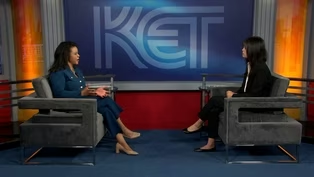
And we have with us Hannah Pinski, who is a political reporter for the Lexington Herald-Leader.
So good to have you.
>> Good to be on.
>> Yeah.
How do you feel with only four working days left?
Only two really that are veto proof.
How are things going, particularly when it comes to the state budget making process?
>> So right now in the state budget making process, we have House Bill 500 and House Bill 900 that I'm keeping an eye on.
House Bill 500 is the next two year biennial state budget, and right now the House and Senate are in conference committee, and they're working out the negotiations in the differences of their budget.
And just some key differences is that I believe the Senate budget has allocated some some funding to to new juvenile detention centers.
That's what Senator Danny Carroll has been pushing for in his legislation and also in the Senate budget.
There's a 13th check for state retirees that was not included in the House version.
They had allocated that portion of money to go into the Budget Reserve Trust Fund, also known as the Rainy Day Fund.
So it'll be interesting to see as they're working out these differences.
You know, what does get included, what doesn't get included in the next two years state budget.
And then we have House Bill 900 as well, also known as the one time spending bill.
And what's interesting about this session compared to 2024 is, you know, in 2024, we had seen the House lay out all the projects that they had wanted to invest in.
We had seen the Senate lay out all the projects they want to invest in.
What we saw this year is they just said, this is the amount of money.
I believe it's around 800 million.
>> And they agree on that part.
>> They agree on that part.
I believe the Senate allocated maybe just a touch bit more, but we do not know what projects they want to fund now.
So that is also in conference.
They're working out those negotiations.
So it's a more interesting approach.
When I talk to Speaker Osborne and President Stivers, you know, on why they are trying it this way, they said, you know this, there's a lot of negotiating that happens.
It's easier if we just come together in this conference committee to work out those differences there, rather than the House, lay out their version, and then the Senate lay out theirs.
>> But it is curious about how this House Bill 900, the one time allocations will go.
And if that's where maybe there's some more tension.
>> I definitely think that would be a fair statement to say because, you know, the consensus going into session was we're not potentially going to have as much spending as we did the last in 2024.
And also, you know, lawmakers have said, you know, people, people, organizations are requesting billions of dollars, and there's only so much money that the legislature should give out.
So you have to consider, are we going to give it to the rural counties?
Are we going to give it to urban?
What types of projects, transportation, road funding and stuff like that?
>> Well, one of the possibly line items that could be in House Bill 900 relates to K State Kentucky State University, the state's only publicly funded HBCU.
We know that Simmons College is also an HBCU, but it is privately funded.
I did not realize until they had the hearings this week that there were such serious conversations about the closure of K. State.
Tell us about were you surprised that this bill kind of came to fruition in these last hurried days of the session?
>> I definitely was.
And, you know, this kind of thing is common in the legislative session near the end when you have what you call shell bills, is that lawmakers will file it before the filing deadline and then replace it with the committee substitute.
That essentially is what they've been working on throughout this past month or so.
And, you know, with this Kentucky State University bill it sponsored sponsored by Senator Chris McDaniel, who is also chair of the Senate Appropriations and Revenue Committee.
He started off at that committee hearing saying, you know, there are serious conversations starting, I think it was in January about the closure of KSU.
But after talking with President Doctor Akapo and and they worked out negotiations to what they presented in this bill, which is it would change the university's mission to a polytechnic school.
And also it would do things like cut down the areas of study to ten.
It would also give the Council of Post-Secondary Education more financial oversight over the school.
So in the original version of the bill, the CPE would have to approve expenditures above that $5,000 for KSU.
There was a floor amendment that Senator Chris McDaniel had talked to Democratic Senator Gerald Neal about that he brought up during committee, as if we could raise that threshold to 20,000.
So that was changed.
And then another thing that changed as we went through the Senate process is in the original bill, it said put an enrollment cap of 1000 in-person students, and they changed that language in the final version in the Senate at least, to do at least 1000 in-person students for retaining faculty and staff.
>> But it also puts in some admission requirements in terms of college entrance exam scores and GPAs.
What is it, 2.5?
>> Yes, I believe.
>> It's 2.5.
And, you know, Senator, Senator Carter Heavrin had brought up that concern as well, is that it could potentially turn away students.
She brought up concerns with that.
It now heads to the House.
So we'll see what the House does if there's any changes.
But, you know, this is something that I think has been worked on for months, Doctor Copperhead said.
You know, conversations about the closure, about this bill were heated at first, but he seemed pretty satisfied with what at least the Senate's version had passed.
>> This week and there would be money for, I think it's a health sciences building.
And then.
And so there would be some, I guess I don't know if that would come out of House Bill 900 or House Bill 500.
So we'll see how that works.
Well, as we as we wrap up here.
And we also wrap up the session, what do you have your eyes on that's not budget related?
>> I definitely think changes to Kentucky's election law.
We have we have seen some bills move forward in the legislature so far during session that would do stuff like, you know, Senator Lindsay's bill, Senate Bill 154.
It passed the Senate earlier, but that provision got added into a House bill that recently passed the floor yesterday that would ban secondary form of IDs, the Social Security cards.
So I know that caused concern with Senator Cassie Chambers Armstrong because she said, you know, a lot of Kentuckians use that secondary form of ID to vote.
So could that potentially turn away voters at the poll?
That's one provision in the bill.
And the other provision that House bill that passed that got added has to do with sharing Kentucky voter data to the federal government.
That provision was in another another House bill that passed, but has not made it through the Senate yet.
You know, Democrats Brent concerns of sharing this private voter information of, you know, if voters don't believe in what the federal government believes, could that potentially harm them if they get if that gets sent to them?
So that's definitely some provisions I'm keeping an eye on, especially since we have the primaries coming up here soon.
>> That's right.
But these changes wouldn't necessarily be implemented or effective before the May 19th primary, would they?
>> Now, I believe.
>> Sorry, it would be the general.
>> Yeah.
The general election.
Right.
Because there was some some conversation that this could have some concerns.
I think the county clerk's association was concerned about the effective date.
Well, a lot to keep our eyes on.
And we thank you for writing so eloquently about it and keeping everyone informed and being here today.
Thank you.
Rest up this weekend.
[MUSIC] Well, if you want to do more than just rest, there is plenty in store for you in Kentucky on the last weekend in March.
Can you believe it?
Well, our Toby Gibbs takes us on a closer look at what's planned around the Commonwealth.
>> Get ready to glow on an egg hunting adventure in Versailles this Saturday as the city puts on glow extravaganza that turns the traditional egg hunt into a nighttime event.
Kids ages 3 to 14 can search for glowing eggs under neon lights.
The event is divided into age groups with candy and prizes scattered throughout.
The hunt, which starts at 8:15 p.m.
[MUSIC] And it's another chance to enjoy the thrill of the hunt as Lexington hosts a community egg hunt next Friday at the Dunbar Center.
The event also includes face painting, games, music and a bounce house.
Downtown liberty is shifting into cruise control with the return of Liberty Friday night cruisers.
[MUSIC] The streets in downtown liberty fill with classic cars and vendors for a casual, family friendly evening in the center of town.
The event takes place on the first Friday of every month through October.
[MUSIC] They've been riding the airwaves for decades, and the classic rock band America is celebrating that legendary run with the Happy Trails tour, making a stop in Louisville.
Next Thursday, the group will perform music from a catalog that spans more than 50 years and includes hits like A Horse With No Name, Ventura Highway, and Sister Golden Hair.
It's a chance to take a moment to remember those who serve this weekend as the Grayson Springs Daughters of the American Revolution holds a National Vietnam War Veterans Day ceremony.
The event, honoring those who served in the Vietnam War, will be held Sunday at the American Legion Veterans Memorial Park.
The Kentucky Derby isn't the only event in Louisville where four legged athletes battle it out to be the first to cross the finish line.
This weekend, it's goats going for the glory at the Nulu neighborhood.
[MUSIC] Bockfest.
The annual street festival spanning several blocks, is once again holding its popular goat racing event along with live music, local vendors and family friendly activities.
Throughout the afternoon.
[MUSIC] With this week's Around the Commonwealth, I'm Toby Gibbs.
>> Thank you Toby Gibbs.
We'll stick with k e t even after the PBS news hour at 8:00, Bill Bryant and a panel of reporters discuss the big news of the week on comment on Kentucky.
That's coming at you at 8:00 eastern, seven central.
They'll talk about the final days of the Kentucky General Assembly lawmaking session, including the continued work on the state budget.
That's all coming at you in just a bit over an hour right here on K e t, and we thank you for being with us all this week, and we hope to see you right back here again on Monday night at 630 eastern, 530 central on Kentucky edition, where we inform, connect and inspire.
We hope that you'll connect with us all the way.
As you see on your screen, you can stream our content online on demand at ket.org.
Look for us on the PBS that you can download on all your smart devices.
Send us a story idea by email to Public Affairs at ket.org.
And of course, we're on the social media channels, Facebook and Instagram to keep you in the loop.
Have a fantastic weekend.
I'm Renee Shaw and I will see you again Monday night.
Take good care.
Lawmakers Fast Tracking Bills in the Final Days of Session
Video has Closed Captions
Clip: S4 Ep352 | 3m 30s | Senate Advances Bills on School Communications, University Hiring in Final Session Days. (3m 30s)

Measure Expanding Prosthetic Coverage Moves Forward
Video has Closed Captions
Clip: S4 Ep352 | 3m 30s | Bill requiring prosthetic limbs be covered by insurance clears the House. (3m 30s)
Video has Closed Captions
Clip: S4 Ep352 | 7m 40s | Insights into some bills making their way through the Kentucky General Assembly. (7m 40s)
Senate Passes Bill Limiting Late-Term Governor Actions
Video has Closed Captions
Clip: S4 Ep352 | 3m 5s | Bill limits hard to reverse executive branch actions before a new governor enters office. (3m 5s)
Providing Support for PBS.org
Learn Moreabout PBS online sponsorship
- News and Public Affairs

Top journalists deliver compelling original analysis of the hour's headlines.

- News and Public Affairs

FRONTLINE is investigative journalism that questions, explains and changes our world.












Support for PBS provided by:
Kentucky Edition is a local public television program presented by KET