
February 16, 2026
Season 4 Episode 323 | 26m 30sVideo has Closed Captions
Why some police chiefs in Kentucky want a certain gun accessory made illegal.
Some police chiefs say they back a bill to make Glock switches illegal in the state. Legislators advance a measure that removes a requirement for lawyers. Congressman Massie says the U.S. Dept. of Justice has more work to do on the Epstein files. Why a group wants an indoor smoking ban in northern Kentucky.
Problems playing video? | Closed Captioning Feedback
Problems playing video? | Closed Captioning Feedback
Kentucky Edition is a local public television program presented by KET
February 16, 2026
Season 4 Episode 323 | 26m 30sVideo has Closed Captions
Some police chiefs say they back a bill to make Glock switches illegal in the state. Legislators advance a measure that removes a requirement for lawyers. Congressman Massie says the U.S. Dept. of Justice has more work to do on the Epstein files. Why a group wants an indoor smoking ban in northern Kentucky.
Problems playing video? | Closed Captioning Feedback
How to Watch Kentucky Edition
Kentucky Edition is available to stream on pbs.org and the free PBS App, available on iPhone, Apple TV, Android TV, Android smartphones, Amazon Fire TV, Amazon Fire Tablet, Roku, Samsung Smart TV, and Vizio.
Providing Support for PBS.org
Learn Moreabout PBS online sponsorship>> We certainly don't want this to look like it is an attack on gun rights.
It's not.
>> Why police say a device that helps guns shoot more bullets may more quickly is an automatic no.
>> It's a great thing to be able to go into an establishment and know that you don't have to worry about being exposed to secondhand smoke, or you don't have to ask for the nonsmoking section.
>> Why?
Some Kentucky advocates say a smoking ban would improve more than just their health.
>> You're living in your childhood home that you were brought home and raised in, and just watching it kind of be stripped out and under your feet.
>> Plus, find out who helped this Eastern Kentucky flood survivor get back on her feet.
>> Production of Kentucky Edition is made possible in part by the KET Millennium Fund.
>> Good evening and welcome to Kentucky Edition for this Monday, February 16th, the start of a brand new week.
I'm Renee Shaw, and we thank you for spending some of your Monday night with us.
Law enforcement is expressing support for legislation that would make a certain gun accessory illegal in Kentucky.
They're commonly called Glock switches and are already against the law at the federal level.
Our Laura Rogers talked to a couple of police departments who say getting these off the streets would lead to safer communities.
>> Kentucky is very pro-gun state.
We're very, very cognizant of that.
>> It's also a leading state in the seizure of machine gun conversion devices, commonly called Glock switches.
>> I think it speaks volumes that last year, in fiscal year 2025, the Kentucky the size of our state had 478 of these switches seized across the Commonwealth.
>> According to the Bureau of Alcohol, Tobacco and Firearms.
That's more than every state except Texas.
>> We're number two in the country right now.
>> Hopkinsville Jason newbie and Elizabethtown Jeremy Thompson are among the chiefs of police sharing public support for House Bill 299 that would ban these devices at the state level.
>> These switches serve no sporting purpose.
They serve no self-defense purpose.
They are strictly a tool for criminals to make the streets more dangerous.
>> A Glock switch can basically turn a standard pistol into a machine gun, firing up to 1200 rounds per minute.
>> It's an aftermarket piece that goes into the firearm that takes it from semi-automatic, where you pull the trigger and it goes one time to the pull the trigger, and multiple rounds are fired through that.
>> And a letter to the Kentucky General Assembly, the state's largest police department, say they've seen an increase in Glock switches in Louisville.
Seizures of them more than doubled from 2023 to 2024.
But they're not just in big cities.
>> I think you would be hard pressed to find a community in the state of Kentucky where you couldn't find 1 or 2 of these.
>> How do they tend to get in people's hands?
>> So according to the ATF report, the biggest thing is they're coming in from China.
And I think the reason Kentucky was number two is because we do have a UPS hub.
>> The size of a small coin.
They can be easily made on a 3D printer.
As the law stands now, police in Kentucky can seize a Glock switch as evidence, but have no authority to make an arrest or charge.
>> Would have to contact federal prosecutor and see if they would be willing to prosecute the case.
>> It allows us to charge on a local level versus relying exclusively on our federal partners.
>> When the majority party took over.
>> The bill's sponsor, Republican state Representative Jason Nemes of Louisville, said in a press release.
These devices lead to guns being used in ways they were never designed, posing a deadly threat to both law enforcement and bystanders.
As other states have shown.
We can recognize and address this problem while also safeguarding Second Amendment rights.
And that's exactly what this bill does.
>> We certainly don't want this to look like it is an attack on gun rights.
It's not.
It's just a mirror.
What's already illegal on a federal level.
And allow us at a state level, to have the ability to charge someone with this crime.
In state court.
>> The bill has been assigned to the House Judiciary Committee for Kentucky edition.
I'm Laura Rogers.
>> Thank you, Laura, and a correction representative.
Jason Nemes is from Middletown.
The bill's passage would make possession of a machine gun conversion device, or Glock switch, a class C felony in Kentucky.
The penalty could carry a fine and 5 to 10 years in prison.
In Kentucky, every licensed lawyer is required to join the Kentucky Bar Association, which sets ethical standards for practicing law and provides professional development.
House Bill 526, which passed the House floor Friday, would make it voluntary to join the Bar Association.
Our Mackenzie Spink tells us why supporters say the bill is important, and why opponents are worried about a lack of oversight of the state's attorneys.
More about this in tonight's legislative update.
[MUSIC] >> Nowhere else in Kentucky.
Nowhere are you required to join an association to put food on the table.
Nowhere.
Not doctors, not nurses, not architects.
Nowhere.
Only lawyers.
>> Currently, if you want to practice law in Kentucky, you must be a member of the Kentucky Bar Association, which costs 220 to $350 a year.
Under House Bill 526, the Kentucky Supreme Court would have the power and responsibility of the state bar, meaning lawyers who want to practice in Kentucky would not need to pay the bar association dues, only the fees required by the Supreme Court.
>> When you're fresh out of law school, sometimes you're not even in a steady job yet.
300 and some dollars can be a lot of money, and other folks have maybe retired, or they're in government jobs, but they want to keep their law license.
This gives folks the option to decide to join the bar association or not.
It may not be a one size fits all.
You're automatically required to join.
So although I'm going to remain in the bar association, I commend the gentleman for bringing this bill.
>> House Minority Caucus Chair Representative Lindsey Burke says the Bar Association provides oversight and resources to lawyers that should be mandatory.
>> On its best day.
It's a public protection agency making sure that attorneys don't abuse the public, that they don't take advantage of their position of trust, that they don't succumb to the mental health and substance abuse issues that plague our profession and cause people to do very regrettable things.
The Supreme Court of Kentucky doesn't want us to do this.
Every attorney I've talked to in the last 48 hours doesn't want us to do this.
I ask you, please don't do this.
This is going to hurt your constituents.
>> Representative Jason Nemes is a lawyer in both Kentucky and Indiana, a state that does not require bar association membership.
Nemes says the Supreme Court in Indiana provides the necessary services and discipline that Representative Burke is concerned about.
>> I have to pay $180 every year to the Indiana Supreme Court.
And what that covers this is very important because it goes directly to what my friend said.
What that covers is it covers seals, it recovers discipline, it recovers the ethics hotline.
And it also covers what we have in Kentucky called the Clap program, which is very important.
So if a lawyer has a substance abuse program, which is what my friend was referring to, that kind of thing is covered in Indiana by the dues that I pay in Indiana, the Supreme Court.
If I want to join the Indiana Bar Association, I'm allowed to do that.
But I don't have to.
But those things that I've just identified to make sure lawyers stay within the lines of ethics, to stay within the lines of not mistreating their clients, to stay within the lines of helping them if they have substance abuse that's covered by the Indiana Supreme Court.
Even though I don't have to join the Association.
>> House Bill 526 passed 70 to 21 and will next head to the Senate for consideration.
But if the bill does become law, it will not be effective until July 2027.
In order to give the Kentucky Supreme Court time to enact it for Kentucky edition.
I'm Mackenzie Spink.
>> Thank you.
Mackenzie.
The Kentucky Bar Association is already an independent agency of the Kentucky Supreme Court, and its authority comes from the Kentucky Constitution.
As the Kentucky General Assembly considers several important education bills.
We will continue our talk about K through 12 education in Kentucky later on Ket's Kentucky tonight.
Our guests include Education Commissioner Doctor Robbie Fletcher and other education advocates.
So we hope you'll join us tonight at eight eastern, seven central right here on KET.
Just a few minutes.
The Department of Justice says it's in full compliance with the Jeffrey Epstein Transparency Act.
U.S.
Attorney General Pam Bondi made the announcement in a letter she sent to Congress over the weekend.
In her letter, she explained all redactions made in the millions of documents released were done so in accordance with the law.
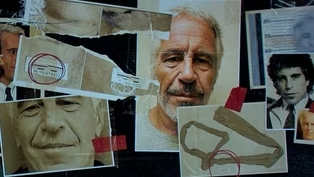
Congressman Thomas Massie of Kentucky's fourth district coauthored the act.
Speaking yesterday on ABC's This Week, he said the DOJ still has some work to do.
>> There, citing deliberative process privilege in order not to release some of the documents.
The problem with that is the bill that Ro Khanna and I wrote says that they must release internal memos and notes and emails about their decisions on whether to prosecute or not prosecute, whether to investigate or not investigate.
It's important they follow that, because then we could find out why they didn't prosecute.
Leslie Wexner.
What was the decision tree there?
And also why in 2008, they gave Jeffrey Epstein such a light sentence.
And finally, I know the DOJ wants to say they're done with this document production.
The problem is they've taken down documents before.
We were able to go over to the DOJ and look at the unredacted versions.
They took down some of the most significant documents, two of them involving Virginia phrase case and other things.
The picture of of Epstein at in a room where it's got CIA written on the boxes that's been taken down.
We want to be able to look at all these files.
They can't keep those documents down after they've already produced them.
>> Congressman Massie went on to say he's lost confidence in Attorney General Bondi.
Massie is running for reelection in this year's GOP primary.
He's being challenged by Navy Seal Ed Gallrein, who has been endorsed by President Donald Trump.
Kentucky Governor Andy Beshear is planning another trip to New Hampshire.
Beshear is scheduled to attend two fundraising events and the Granite State next month.
The term limited Democratic governor was also a guest on various cable talk shows in recent weeks.
Friday night on Ket's Comment on Kentucky, host Bill Bryant asked panelists what they thought of Beshear's high profile appearances.
>> Is this how you position yourself to run for the white House without saying you're doing that?
>> I don't think that Andy Beshear has to say he wants to run for president.
I think he's making it very clear in every other regard he's going to South Carolina.
He'll be in New Hampshire.
And when he's talked about, you know, who the next nominee for the Democrats needs to be, he said, it needs to be a governor.
Right.
And he just happens to be one.
I talked to him over the weekend and he contrasted himself very much so with Governor Gavin Newsom of California saying that, look, if Democrats are looking for someone who's going to be nasty on social media, if they're looking for a liberal Donald Trump, I'm not their guy.
And I think you see here with these sort of anti curious Democrats around the country who are getting to know him, he still is in the single digits.
When you talk about national polling as far as Democratic nominees are concerned, potential nominees are concerned.
But he is certainly making the rounds.
And I think carving out a space that he thinks is viable.
>> And he has been increasingly critical of President Trump, who carried Kentucky by 31 points in the 2024 election.
Is that what he thinks Democratic primary voters would want to hear?
>> Well, he knows that.
Look, you know, President Trump's approval numbers with Democrats is lower than it is with any other group.
So he knows that if you're going to be the Democratic nominee in the future, you're going to have to have to be able to take on Donald Trump.
The real question, I think, Bill, is where will the Democratic Party be and what mood are they in if they're in for a fighter, a more progressive, populist minded person, that may be someone like Gavin Newsom, right?
But if they're looking for someone who's more of a reconciliation candidate, you see a lot more Democrats talking about getting along with not necessarily Donald Trump, but Donald Trump's voters.
>> You can hear more from Phillip Bailey and the other Kentucky journalists on comment from last Friday, when they discussed the race for the U.S.
Senate in Kentucky and highlights from the week in Frankfort.
You can watch the entire discussion online and on demand at Keturah.
[MUSIC] One year ago, the state was dealing with the aftermath of widespread heavy rainfall that brought deadly flooding to several counties.
One region hit the hardest.
Eastern Kentucky is still trying to recover after catastrophic flooding hit the area just three years earlier, after the 2022 flooding.
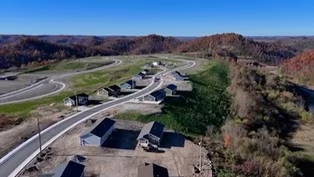
State and local governments, along with nonprofit builders like the Housing Development Alliance, began working together to build high ground communities in eastern Kentucky to provide safe housing options for flood survivors.
Among those getting a home, a Perry County woman who survived two flood disasters and is rebuilding her life on higher ground.
>> The 22 flood was the first major flood or catastrophic event that I actually lived through in Perry County.
The 2022 flood.
I was impacted minimally, just small, minor, easy fix damage that happened to my home.
And then three years later, the 25 flood the water.
Actually, it was continuing to rise, continuing to rise.
And we finally made the decision, hey, we need to leave.
And we actually set the porch camera.
We turned it facing the river so we could kind of watch it, and I watched until the water took over the porch camera.
And that was the last footage I had of my home.
>> We had floods in 21 and.
>> 22, so we were already in kind of disaster mode.
But even if you go all the way back before those floods, we've had a long standing housing crisis.
So for example, the day before the 22 flood, which was so devastating, we were already working with 250 households who wanted to buy a house, who needed a home, and about another 250 who needed their home repaired.
After we had the 21 disaster, and then the 22 and now the 25, it really, I think people are understanding that flooding is going to continue to happen, and it's critical to move people out of harm's way.
And when you're talking about relocating people, the immediate question is where I think a lot of local leaders and the governor kind of came came to the same conclusion, which was, we can't just keep doing what we've always done and putting people just rebuilding back in harm's way.
We have these narrow valleys and steep mountainsides, and it can be really challenging to find places to build houses.
And and so the governor has really pushed for rebuilding on top of reclaimed strip mines in a way that's safe and sustainable.
And that has opened up a lot of property.
When you're talking about trying to rebuild hundreds of units, you really need a lot of units in one location.
You can't do that.
Five units here, one unit here.
You got to have a big.
And that's where the high ground communities, I think, really come in.
At Skyview, we built what we call referred to as kind of the model homes, the first five homes.
And those were partially funded with team Kentucky dollars.
And so those were really targeted to flood survivors.
>> To go from thinking you're set, you know, you've you're living in your childhood home that you were brought home and raised in.
And just watching it kind of be stripped out and under your feet to living with family and friends, you know, from day to day a potential different home to finally have someone to just call my own.
It made a, you know, it made a big difference.
It's just it's comfortable.
I've adjusted, you know, now knowing that it is mine.
And, you know, I have somewhere I'm safe and I don't I don't have to worry about it anymore.
The neighborhood's growing.
I was actually the one of the first ones to move in.
And now there's, you know, upwards of 12 families moved in.
And by this time next year, probably 212 families, you know, at the rate it's going.
>> We're going to be really, really busy building houses as fast as we possibly can for the next 2 or 3 years as we try to fill up these high ground communities and get as many people housed as quickly as possible.
I think all of the housing providers I know my organization is already looking ahead to, hey, if we can build 60 houses a year during this crisis, how can we find enough resources to keep building at that level?
Because that's really what the community needs.
I mean, you know, we the our service area is short, hundreds of units.
And these disaster recovery houses are going to make a dent in that, but we're still going to be short hundreds of units.
And so we really need to figure out as a community and as a, as a region and as a state, how we can continue to build houses at, at this scale.
>> And some great news for Miss Samantha Turner.
Good news indeed.
There are currently eight designated high ground communities in eastern Kentucky.
In addition to Perry County, there are developments in Breathitt, Floyd, Knott, and Letcher Counties.
The goal is to provide more than 500 new permanent homes for families.
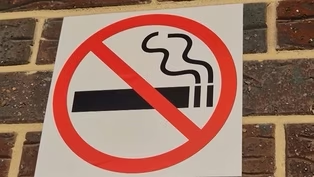
[MUSIC] You may think smoking indoors is a thing of the past, and while that is true in many Kentucky communities, only around 40 cities currently have comprehensive smoke free policies.
Northern Kentucky, one of the state's major metropolitan areas, only has a few citywide smoking bans.
But as our Emily Sisk reports, one advocacy group wants to change that for the health and prosperity of the region.
>> There are 36 unique cities across northern Kentucky's three main counties of Boone, Kenton, and Campbell.
Of those 36 cities, only four currently have a nonsmoking ordinance where people can't smoke inside public places.
Karen Finan, president and CEO of the One Nky Alliance, says four is just not enough, and it's the goal of the Breathe Easy in KY campaign to see all of the cities adopt a smoking ban.
>> Early on, it was obvious that many people did not realize that we were not smoke free.
>> But in fact, only the northern Kentucky cities of Bellevue, Dayton, Ludlow, and Highland Heights have adopted comprehensive, nonsmoking policies.
Other larger cities like Covington and Florence, and the region as a whole are not completely smoke free.
Unlike other major Kentucky cities.
>> Major metropolitan areas like Bowling Green, Louisville, Lexington have been smoke free for 15 years.
>> According to a University of Kentucky database.
Around 40 Kentucky cities and counties have smoke free laws, which cover indoor workplaces and public spaces.
Covington resident and business owner Brad Zapf says Northern Kentucky should be leading this initiative, not lagging behind.
>> Do I love that we're behind?
Do I think it could be different?
Yeah, we are behind.
I mean, 15 years.
>> Smoke free advocates like Finan and Zapp are part of the Breathe Easy in KY campaign, which has been working for nearly a decade to see the rate of smoking decrease in the region.
A recent study showed that 23% of Northern Kentucky adults were smokers, compared to 17% of adults across the state and 14% across the whole country are.
>> Smoking rate is still unacceptable to be that high against the state, against the nation.
>> And the Northern Kentucky Health Department says those statistics are cause for alarm, even for nonsmokers, because of the harmful effects of secondhand smoke like increased heart rate, coughing and breathing problems.
>> But you can also experience long term effects as well, just as if you were somebody who was smoking cigarettes.
>> Stephanie Vogel says the health department works with communities who enact smoke free policies to let businesses know how to prepare for the change.
After the ordinance is passed, the health department follows up with business owners and community members to get their perspective on the change.
>> We hear a lot from community members that say, it's a great thing to be able to go into an establishment and know that you don't have to worry about being exposed to secondhand smoke, or you don't have to ask for the nonsmoking section.
>> Finance said.
Business owners in the cities of Bellevue, Dayton, Ludlow and Highland Heights reported little change in their restaurant or bar patronage.
>> The people that have gone smoke free, whether they own a restaurant or a bar, have reported out either no activity or lack of activity.
>> In a city like Highland Heights, which is home to Northern Kentucky University and around 6000 residents.
City Manager Michael Giffen said adopting a nonsmoking ordinance back in 2023 just made sense, because all their businesses were already smoke free.
>> So it seemed like a good time for us to kind of put into writing something that would let the future of Highland Heights, whether it's the business or the residents, know, kind of where we stand and trying to make a push for a healthier lifestyles.
>> Fening believes if the region can adopt a comprehensive, smoke free ordinance, this could bring in new businesses and more tourism to the area, which already accounts for more than $2 billion of Kentucky's tourism revenue.
But finance said it will take a community wide approach to get more smoke free policies across the finish line.
>> It's going to take community will coupled with political will to get this accomplished.
It is a long term effort that many of us are staying committed to.
>> For Kentucky edition, I'm Emily Sisk.
>> Thank you.
Emily.
There is a group of business owners and residents who oppose mandated smoking bans.
The group is known as Nky choice.
Members say the decision to allow or restrict smoking should be up to individual businesses, not the government.
A poll of Northern Kentucky registered voters showed 75% of people would support a smoking ban.
[MUSIC] What could be more interesting than Kentucky basketball, horse racing and fried chicken?
Our Toby Gibbs has a little of all three in tonight's look at this weekend Kentucky history.
>> John Breathitt, Kentucky's 11th governor, died on February 21st, 1834.
[MUSIC] He was the second governor to die in office.
James Morehead, the lieutenant governor, was sworn in as governor later that day.
[MUSIC] He was the first native born Kentuckian to become governor.
The state chartered the Agricultural and Mechanical College of Kentucky on February 22nd, 1865, a school made possible by the federal Morrill Land-Grant act.
In 1916, the school would change its name to the University of Kentucky.
That school, still called A&M College of Kentucky, would win its first basketball game on February 18th, 1903, defeating the Lexington YMCA 11 to 10.
Jockey Eddie Arcaro was born February 19th, 1916, in Cincinnati.
[MUSIC] His Kentucky connection.
He won five Kentucky Derbies and is the only jockey to win two Triple Crowns in 1941 and 1948.
Colonel Harland Sanders sold the Kentucky Fried Chicken franchise to John Y. Brown, Jr and Jack Massey for $2 million on February 18th, 1964, but Sanders stayed on as a company spokesman.
The Kentucky Coffee Tree became Kentucky's official state tree on February 16th, 1976.
[MUSIC] The tulip poplar became the state tree in 1994.
And that's a look back at This Week in Kentucky history.
[MUSIC] I'm Toby Gibbs.
>> Thank you so much, Toby Gibbs.
The Louisville Orchestra is taking its show on the road.
The orchestra is leaving the Derby City to bring its popular in Harmony tour to the rest of the state.
We'll have more on those sweet harmonies and where the tour is making stops tomorrow on Kentucky Edition, which we hope we'll see you for again at 630 eastern, 530 central, where we inform, connect and inspire.
We hope that you'll connect with us several different ways you see on your screen through the social media channels Facebook and Instagram.
We invite you to send us a story idea, or just a shout out by email to Public Affairs at Keturah.
Look for us on the PBS app that you can download on your smartphone and other devices.
And of course, you can stream some great content online on demand at Keturah.
Don't forget, don't turn that dial, because we've got Kentucky Tonight coming up at 8:00, where we talk more about K through 12 education.
I do hope you'll join us.
Until then, take really good care.
I'm Renee Shaw and I'll see you a little bit.

Bill Would Make Bar Membership Optional in Kentucky
Video has Closed Captions
Clip: S4 Ep323 | 3m 57s | Currently, every licensed lawyer is required to join the Kentucky Bar Association. (3m 57s)
Congressman Massie: DOJ Still Has Work to Do in Epstein Case
Video has Closed Captions
Clip: S4 Ep323 | 1m 52s | On Saturday, the DOJ said it was in full compliance with the Jeffrey Epstein Transparaency Act. (1m 52s)
Flood Survivor Rebuilding on Higher Ground
Video has Closed Captions
Clip: S4 Ep323 | 5m 12s | A woman who survived two flood disasters in Eastern Kentucky is rebuilding once again. (5m 12s)
Group Pushing for Regional Indoor Smoking Ban
Video has Closed Captions
Clip: S4 Ep323 | 5m | Only a few city-wide smoking bans exist in Northern Kentucky. (5m)

Police Chiefs Push to Ban Certain Gun Accessory in Kentucky
Video has Closed Captions
Clip: S4 Ep323 | 3m 35s | They're commonly called Glock Switches, and are already illegal at the federal level. (3m 35s)
Providing Support for PBS.org
Learn Moreabout PBS online sponsorship
- News and Public Affairs

Top journalists deliver compelling original analysis of the hour's headlines.

- News and Public Affairs

FRONTLINE is investigative journalism that questions, explains and changes our world.












Support for PBS provided by:
Kentucky Edition is a local public television program presented by KET