
September 24, 2026
Season 5 Episode 62 | 26m 30sVideo has Closed Captions
Lawmakers debate on how to reduce the cost of the state's Medicaid program.
State lawmakers continue to wrangle with how to reduce the cost of Kentucky's Medicaid program, the Kentucky Supreme Court rejects a push by the attorney general to bring back the death penalty, senate majority floor leader Max Wise on increasing the number of school resource officers around the state and the impact its having on school safety.
Problems playing video? | Closed Captioning Feedback
Problems playing video? | Closed Captioning Feedback
Kentucky Edition is a local public television program presented by KET
September 24, 2026
Season 5 Episode 62 | 26m 30sVideo has Closed Captions
State lawmakers continue to wrangle with how to reduce the cost of Kentucky's Medicaid program, the Kentucky Supreme Court rejects a push by the attorney general to bring back the death penalty, senate majority floor leader Max Wise on increasing the number of school resource officers around the state and the impact its having on school safety.
Problems playing video? | Closed Captioning Feedback
Where to Watch Kentucky Edition
Kentucky Edition is available to stream on pbs.org and the PBS app.
Providing Support for PBS.org
Learn Moreabout PBS online sponsorshipmusic >> But I will say this.
The SROs are the ones that are truly putting themselves every day to be able to protect kids and be able to protect the students and the staff.
[MUSIC] >> A leader in the state Senate says these officers are making a big impact on Kentucky's school safety.
>> Kentucky farmers are the best in the world, and if we have a level playing field in regards to trade, we're going to win.
[MUSIC] >> What's the state of Kentucky's cattle industry.
[MUSIC] >> When you can give them something like that?
That's initially theirs and get it back to them?
It just fills your heart.
[MUSIC] >> Now the state Treasury is helping Kentuckians find property they didn't know about.
>> Production of Kentucky Edition is made possible in part by the KET Millennium Fund.
>> Good evening and welcome to Kentucky Edition for Thursday, September 24th.
I'm Laura Rogers.
Thank you for joining us.
We begin tonight in Frankfort.
State lawmakers continue to debate how to reduce the cost of Kentucky's Medicaid program.
Our June Leffler has more on what changes are coming in tonight's legislative update.
[MUSIC] >> To look at our most vulnerable Kentuckians, but also balance that approach with the fiscal responsibility and the sustainability that will be required in the future for this.
>> That balance is the recurring debate around the state's publicly funded health plan for low income Kentuckians.
Republican Stephen Meredith consistently touts the importance of the program for rural health and rural economies.
>> Whenever we have a shortfall, it's reduced reimbursement or talk about cutting services.
Even the optional services, I don't know anyone here that I'd really want to cut, because I think there's cost downstream that we're not going to realize is Senator Adams likes to quote me saying, we don't measure the cost of doing nothing.
We can't afford to do that.
But again, let's try to all get on the same page and how we want this program to work and be effective.
Nobody wants to kick people off Medicaid.
It's a needed service.
>> This is not going to go away.
So how can we do this as well as we possibly can?
>> State.
Medicaid officials presented what Kentucky's plan currently covers.
>> But when we look at what is federally required and then we look at what we have added as a state for services that we think are worthwhile for our constituents.
How much of what we are spending is state mandated that we could actually control?
>> I think Budgetarily what is a large increase in what's federally mandated and what we've done through the state is are directed payments.
They might have a great purpose.
And we're not we're not here to say whether they're important or not, but state directed payments to hospitals is what has significantly increased our budget over the past five years.
>> A key policy report released this week says state directed payments to hospitals totaled $5.3 billion in 2025.
The report, detailing the threats to rural hospitals, says changes from the One big, Beautiful bill could reduce those dollars by 90%.
Governor Beshear took 255 million state surplus dollars this summer to block Medicaid cuts to providers, he suggested even more surplus dollars could go towards the program after an economic forecast meeting this week, and come January, Medicaid Community engagement requirements will take effect, potentially kicking hundreds of thousands of recipients off the program, reducing costs that way.
For Kentucky Edition.
I'm June Leffler.
>> Thank you.
June.
The Kentucky Supreme Court has again rejected Attorney General Russell Coleman's push to reinstate the death penalty.
The death penalty is on hold as a death row inmate.
Ralph Baze challenges several parts of Kentucky's death penalty procedure.
Baze shot and killed Powell County Sheriff Steve Bennett and Deputy Arthur Briscoe in 1992.
According to the Lexington Herald leader, Justice Michelle Kellar said the issues raised by Baze haven't been resolved, so there's no point in issuing a death warrant.
The Kentucky Supreme Court will not consider reviving the impeachment case against Judge Julie Goodman of Fayette County.
The Republican led Kentucky House impeached Judge Goodman earlier this year over some of her court decisions before the Senate could act, the Supreme Court ruled the impeachment was improper because the accusations against her were not impeachable offenses.
Republican lawmakers asked the court to reconsider the Lexington Herald-Leader reports that the court decided yesterday not to reconsider the case as the new school year is well underway.
More and more school resource officers are serving and protecting Kentucky students and educators, expanding school resource officers, or SROs was one goal of the school safety and Resiliency Act, passed by the Kentucky General Assembly in 2019.
State senator and majority Floor leader Max wise sponsored that legislation and sat down with our Emily Prince to discuss the state of school safety in the Commonwealth.
Here's more from our Capitol Annex studio in Frankfort.
>> So I want to give our viewers some background just so to make sure that we're all on the same page here.
So back in 2018, students at Marshall County High School opened fire in the school building, killing two students and injuring more than a dozen others.
And that really did seem to be the catalyst for that legislation that came about in 2019.
So give us a refresher there.
What were some maybe some lessons that we learned from the Marshall County shooting that kind of played out?
And we saw these in the 2019 reforms.
>> That's a great question.
And I think we also we need to even peer back a little bit further than that.
1998 is when we established the Kentucky Center for School Safety.
And so just so viewers know, a little bit of broader history too, of how far back we have looked at this issue.
And then.
Central Mike Wilson in 2013 also passed a piece of legislation that focused on drills and the types of training and things like that that happen in schools.
But you're exactly right.
2018, the tragedy that occurred at Marshall County High School for the for the hot and cold families down there.
And then what we were able to do is not have a knee jerk reaction.
In 2018, the speaker and the president of the Senate both came together and formed a task force that would study school safety.
We traveled all corners of the state from 2018 through 2019.
When we gavel back into session of making sure we were listening, and that sometimes the role of a legislator.
Many times it's act, act, act.
But it needs to be listen, listen, listen.
We want to make sure we had a state school safety marshal of someone that was overseeing all this.
You've got the center for School Safety, but the school safety marshal is going to be overseeing the SROs, the school resource officers.
We want to make sure there was a mental health component with that.
Also, we listened to our mental health service providers.
But one of the biggest things was increasing school resource officers.
We've increased since 2013, 240 to about 947 school resource officers.
That's 290%.
That's quadrupling the number of SROs.
We're making sure now that every school system, that they've got the resources provided, every campus can have a school resource officer, and even those that do not.
We made sure the financial investment was done just last year in the 2026 biennial budget to increase that to $46 million, $20,000 per SRO.
>> For folks who might not be familiar.
Because for some of our viewers who are watching, they said, well, maybe we didn't even have those at all when they were in school.
What is the role of an SRO and how is it different from, like we said, maybe a guidance counselor or even a principal for discipline?
>> SROs are not just there to be police officers or in schools.
They're also there to provide mentorship.
Now, is the job of the SRO to be that level of protection?
Absolutely.
They're armed.
They're carrying a firearm in the school.
They're working as maybe a deputy sheriff, a former Kentucky State police officer or trooper.
They may be a city police officer or a school district may form their own police department, and they're hired from within that school district.
But the training they go through is extensive.
I mean, they're going through multiple weeks of training that's being done by the Department of Criminal Justice training in Richmond.
We're making sure that they know about student behavior, that they know about bias.
They know about situations of what can occur in schools.
They know about cyber bullying.
But I tell you what, I was in a Dare County schools just yesterday.
The SRO to Dare County middle Schools Josh Brockman, the former sheriff of Adair County, Josh, is a young guy.
Yesterday, when I walked the hallways meeting with the superintendent of Adair County, Josh comes down the hall and he's high fiving students and he is loved in that community.
>> I wanted to ask you a little bit more specifically about the funding.
So like you said, the General Assembly provided $46 million for fiscal years, 27 and 28 specifically for school resource officers.
You mentioned 20,000 for each officer.
Can you tell me more about how that money is being distributed?
So is it going to existing officers?
>> Right.
So previously, and what the governor wanted was $20,000 per qualifying campus.
Well, we thought it would be better if the school districts had some flexibility because they can pick and choose what maybe school campus building needs more protection.
We made sure that that $20,000 is per full time certified SRO.
And one of the thing that's different, we differ with this with the governor, we thought non public schools should also be able to dip into this as well for SROs.
Listen, children or children.
I don't look at a child just goes to a parochial school or a private school or whatever it may be.
We're making a commitment with the financial commitment that this is for protecting children, teachers, staff at all.
Kentucky schools.
>> So are there some non public schools right now who are.
>> I would have to get the data from the Kentucky Center for School Safety, as well as our state security Marshall to make sure.
But there are trainings now that are being conducted.
I know that there's.
Owensboro Catholic schools have conducted with the SROs and Owensboro and Daviess County because we need to have a regional approach on this.
We need to make sure that those schools are doing that.
>> Let me ask you one more thing about SROs.
Is there any particular region of the state or any school district that you think maybe they particularly had trouble in recruiting an SRO that you'd like to see?
One be be at?
>> One area that we really had to push and nudge along was Jefferson County Public Schools.
They were hesitant.
Their school board was hesitant.
They wanted to have SROs that would be in a neighborhood vicinity or in a parking lot, and not within the school building.
I've got a problem with that, and we had a problem with that.
As a legislature.
If we're going to have SROs, they're going to be within the school walls.
They're going to be on the campus and not a half a mile away or in a neighborhood patrol.
They also didn't want an SRO in their schools as well.
We had to pass legislation.
We've had to do this a lot for Jefferson County schools in terms of trying to drag them along.
But this was one in particular.
We're going to say there is no difference between a county school, an independent school, a rural school, suburban school or an urban school.
You're going to follow the intent of the law, and they've worked and they've done a much better job of where they are today than where they were years ago.
>> If I can throw one more follow up at you based on what you were just saying, how can we measure the effectiveness of the school resource officers?
>> Well, thank you.
Got to look at overall, you know, what's what's the climate of the schools.
I think if you do surveys and you could ask everybody within the school.
House, the SRO performing in your school district, I think you'd be able to get some really good responses back.
I've got a snapshot of one district, but I think you could look across the board at other things we're doing.
You know, are we going to be 100% safe from preventing any attack?
I don't think anyone can ever say we're always going to be 100% because we know if sometimes there's an intent there, we know that we may have every layer of protection lined up, but something could fall within the cracks of something.
Something could happen in the parking lot outside of the school.
But I will say this the SROs are the ones that are truly putting themselves every day to be able to protect kids and be able to protect students and staff.
And I think the relationship building that's going on is even more important also than just being a protector.
As you can tell, I'm passionate about this, but this is something that I'm so proud of what we've done as a legislative body.
>> Well thank you.
We absolutely and certainly want to see our students and our educators be safe.
So thank you so much, Senator Wise, for sitting down with us.
>> Absolutely.
Thank you for the questions today.
Thank you.
>> Senator wise said nearly all of Kentucky's public schools are in compliance with safety mandates.
That's based on the latest data from the Kentucky Center for School Safety.
[MUSIC] Earlier this month, the Kentucky Cattlemen's Association testified in front of lawmakers in Frankfort about the loss of farmland and beef cattle in the state in 2020.
Kentucky had more than a million.
And now, in 2026, there are about 860,000.
We recently caught up with the president of the Kentucky Livestock Coalition, and he talked to us about the current state of the industry and what he thinks Kentucky farmers need to be successful moving forward.
>> Kentucky livestock industry certainly is braced for future opportunities, but in a lot of ways, we're also at a crossroads.
You have many smaller age producers.
You also have younger producers who are making large investments, in particular in the poultry industry and the swine industry, and often those are very scaled and the investment is into the millions of dollars off, often required to be competitive.
Livestock producers are often operating on very tight margins and always looking for better opportunities in the market.
I think the biggest challenge that is facing livestock producers and farmers in general, and even business in general, is just production costs are higher.
Everything is related to fuel cost.
We're looking at higher labor costs.
We're looking at higher feed costs.
I would like to see our our lawmakers make sure that we have policies that do not limit opportunity for both export markets and for opportunities to get in front of local consumers.
We need to make sure that we're not putting up barriers that favor large meatpackers, or that favor large corporations.
There's a balance.
We certainly need to have rules in place.
Food safety is paramount.
We want to make sure that we're not doing anything that keeps us from having the highest standard for food safety and for delivering a quality product to consumers.
We have millions of folks in this country, millions of folks around the world that have to eat.
Not everybody can buy directly from the farmer.
We need to have ways where we deliver the product at the very cheapest price and on large scale to to the consumer.
We also need opportunities for those who want to go direct to the farm.
And that's what we truly need, is policy that helps us accomplish both and doesn't build barriers that prevent choice.
As a Kentucky farmer, I'm really excited about what the future holds, and I have three sons on my farm.
I want them to have an opportunity to be the 10th generation of my family to farm one day in LaRue County, where we live, Kentucky farmers are the best in the world, and if we have a level playing field in regards to trade, we're going to win because we produce the safest, the cheapest and the best food in the world.
>> In August, President Trump announced a plan to import up to 300,000 metric tons of beef from other countries to lower beef prices.
Since then, many groups have spoken out against it, including the Kentucky Cattlemen's Association and the Kentucky Farm Bureau.
It's Farm Safety Week, and there's a new children's book circulating through Kentucky's elementary schools on the topic.
Dale Dobson, a giant in Kentucky's farm safety field, died this summer.
But his decades of devotion to farm safety were the inspiration for the new book, Farm Adventures with Willie B.
>> All the things that he had done in 25 at that time, 25 plus years, I believe in rescue training, emergency response, and all these things that help out the emergency and the farming community and younger audiences really didn't have access to him.
But he had an idea years ago for a dog as a mascot.
And the way he said it, what kid doesn't want to come up and pet the dog?
So it was a way to draw kids in to him.
And the name of the dog would be Willie B, and to play on words that he come up with, and, you know, will he be safe?
Will he make good decisions?
Will he make bad decisions?
What about will he be?
That was the last tagline.
What about will he be?
>> I was actually working during grad school for Doctor Hoover, and during that I was, you know, we were having a discussion.
I was talking about what I needed a, I needed a project.
I needed a project to graduate.
And so we kind of came up with the idea.
We started discussing farm safety, like Willie B, Dale Dobson.
And so we kind of thought about, you know, let's make a children's book.
Children love animals.
They love dogs.
And so that was a great way to get children involved in ag safety.
And just, it's something that they can maybe relate with.
I hope that I hope that kids can begin to realize that agriculture is extremely important.
And it's a very important industry.
And everywhere.
>> The kids that come from farms, the the people that work on an actual production, agriculture farm is a lot smaller number than it used to be years ago.
So if we're looking through a book that's talking about agriculture and safety, we have scenes in the book that have crops and animals and equipment use and different things that if kids don't know or are not familiar with the scene or the equipment or the animals, there they are.
Right?
So they can learn from the book, not just how to be safe, but also about just in general, just learn about agriculture.
>> More than 700 elementary schools will receive a copy of Farm Adventures with Willie B, along with other classroom materials focused on literacy for kindergarten through fifth grade students.
Some Kentuckians are suing the Trump administration over its Medicaid work requirements.
Our Toby Gibbs tells us more, and this look at headlines around Kentucky.
[MUSIC] >> Patients in five states, including Kentucky and several medical groups, are suing the Trump administration over new Medicaid work requirements.
The Kentucky Lantern reports.
The lawsuit is over the president's tax and spending law that passed last year.
It includes work, school and community service requirements for low income adults who receive Medicaid.
There are exceptions for the medically frail, the lawsuit says.
The new administration rule limits who qualifies for those exceptions.
The lawsuit says the barriers will put people's lives at risk.
Defenders of the law say the new rules will push able bodied people back into the workforce.
It will be easier for the University of Kentucky to dismiss faculty for financial reasons.
W e KU reports.
The Board of Trustees adopted the policy last Friday.
The new provision means UK is now in compliance with House Bill 490, which requires state universities to have a faculty removal process.
The new policy means UK can dismiss faculty due to low program enrollment or financial strain.
A Graves County middle school teacher has been indicted again on charges of grooming.
A judge dismissed charges against Sadie Flores earlier this month.
The Courier-Journal reports.
A new indictment accuses Flores of deleting social media messages between herself and the alleged victim.
Flores's attorney says Flores has done nothing wrong.
The attorney calls this a disgraceful way to treat a third generation Kentucky teacher who was trying to work with a struggling student.
Link KY reports that students from Northern Kentucky University will work with the Transit Authority of Northern Kentucky, or Tank to reimagine the future of mass transit in Boone, Campbell and Kenton counties.
Students in economics, finance, artificial intelligence, public administration and business will work on ideas for an effective transit system.
Those are tonight's headlines around Kentucky.
I'm Toby Gibbs.
>> The fourth week of September.
>> Is now unclaimed Property Week in Kentucky to celebrate the inaugural year, officials with the Kentucky State Treasury welcomed legislators and other guests to learn more about the program and how it is positively impacting Kentuckians.
>> For an individual claim, you can generally find that unclaimed property in about 30s.
If you go to our website, put in your name.
Many people tell us, well, I look ten years ago, I know I don't have any unclaimed property, but we get money in twice a year.
So our recommendation is on your birthday every year.
Look at the unclaimed property database and see if there's anything in there you want to search your name forward and backwards.
You want to search your legal name and your short name.
So for example, I would search for James Florence, but also Jim Florence.
Most of the claims that come in are for monetary values.
Their stocks, their gift cards, their deposits, uncashed checks, things of that nature that were forgotten.
But we also received safe deposit box here.
But we have roughly 8000 safe deposit box contents.
And each one of those boxes has 10 to 12 items in it.
They range from gold, silver coins.
There's jewelry, all types of interesting things.
And when we see those come in, it's almost like, what are we going to experience today?
And we do have a baseball that's signed.
We see interesting things that are of value, monetarily value.
But there's also things that carry emotional value.
We know they're important to the family.
We know they are items that the loved ones want to get back, and they mean something to them personally.
So that's why we take great care in protecting them and safe care and keep and trying to get them back to the family.
We do have a lot of weird things.
We have many socks.
We have many dentures and teeth, hairbrushes, things of that that are not really like gold coins and diamonds and things of that nature, but people felt like they needed to keep them in their lock box.
And at some point they got turned over to us.
One of our individuals found a claimant who didn't realize that they were left in a will.
They had taken care of their neighbor, feeding them dinner, helping them get groceries in, mowing their yard, etc.
unfortunately, the individual passed and this gentleman, we reached out to him saying, did you realize you had unclaimed property here?
He's from Eastern Kentucky.
What makes this story special is he lost his home in the hurricane that came through in 24, lost his job, had been Reemployed baby on the way, been married ten years, going to celebrate his anniversary in about two weeks.
And when we called him, he thought, this is a scam.
It's not possible.
Had no idea he had been left $300,000.
And so now we've been able to change his life.
Getting that money back in his hands and allowing him to change his family trajectory and invest in his home and his wife and his children.
When we make changes like that and, you know, someone has a super need and they are kind of at rock bottom at that point when you can give them something like that.
That's initially theirs and get it back to them, it just fills your heart and you go home.
At the end of the day, just thinking like today was a day that made it.
And sometimes we have tough days and they're stressful, but those are the kind of things that offset those tough days and tell you it's all worth it.
>> Yeah.
Especially the $300,000 story.
Officials with the state treasury, though, say Kentuckians should be mindful of scammers.
They will usually ask you to pay a fee to receive your property.
But a state claims processor will never do that.
[MUSIC] City and country are joining forces.
>> We're really trying to highlight how our urban partners in our cities and our rural partners, our farmers and our rural communities can come together for something really special.
>> A new partnership seeks to bring fresh, local food to more Kentuckians.
We'll tell you how it works tomorrow night on Kentucky Edition.
Join us again tomorrow night at 630 eastern, 530 central for Kentucky Edition, where we inform, connect and inspire.
Subscribe to our Kentucky Edition Email newsletters.
You can watch full episodes and clips on our website at KET dot org.
You can also find Kentucky Edition on the PBS video app on your mobile device, and smart TV and email.
Those story ideas to public affairs at ket.org and give us a follow on Facebook.
X and Instagram.
Thank you so much for joining us.
Have a good evening.
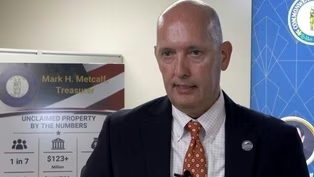
Kentucky Kicks Off Inaugural Unclaimed Property Week
Video has Closed Captions
Clip: S5 Ep62 | 3m 34s | State treasury helping Kentuckians find their unclaimed property. (3m 34s)
Lawmakers Debate Ways to Reduce Medicaid Costs
Video has Closed Captions
Clip: S5 Ep62 | 2m 54s | State lawmakers discuss potential changes to Medicaid to reduce costs. (2m 54s)
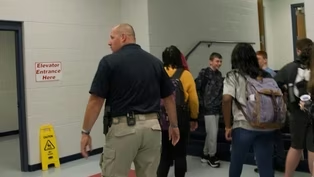
Senator Says SROs are Making Kentucky Schools Safer
Video has Closed Captions
Clip: S5 Ep62 | 8m 5s | Sen. Max Wise on school safety efforts and SRO expansion in Kentucky. (8m 5s)
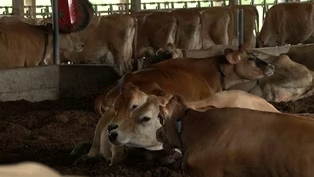
State of Kentucky's Cattle Industry
Video has Closed Captions
Clip: S5 Ep62 | 3m 22s | Livestock Coalition president weighs in on cattle decline and farm future in Kentucky. (3m 22s)
Providing Support for PBS.org
Learn Moreabout PBS online sponsorship New Episode
- News and Public Affairs

Top journalists deliver compelling original analysis of the hour's headlines.
 New Episode
- News and Public Affairs

Today's top journalists discuss Washington's current political events and public affairs.
 New Episode
 New Episode
 New Episode
 New Episode
 New Episode



 New Episode

Support for PBS provided by:
Kentucky Edition is a local public television program presented by KET