
February 26, 2026
Season 4 Episode 331 | 26m 30sVideo has Closed Captions
Kentucky's two-year budget heads to the upper chamber after passing in the House.
The House passes an amended version of the state's two-year budget bill, a bill allowing scholarship donations for public or private schools clears another hurdle, state lawmakers address data centers and child marriages, and why the FBI director is planning a trip to Kentucky.
Problems playing video? | Closed Captioning Feedback
Problems playing video? | Closed Captioning Feedback
Kentucky Edition is a local public television program presented by KET
February 26, 2026
Season 4 Episode 331 | 26m 30sVideo has Closed Captions
The House passes an amended version of the state's two-year budget bill, a bill allowing scholarship donations for public or private schools clears another hurdle, state lawmakers address data centers and child marriages, and why the FBI director is planning a trip to Kentucky.
Problems playing video? | Closed Captioning Feedback
How to Watch Kentucky Edition
Kentucky Edition is available to stream on pbs.org and the free PBS App, available on iPhone, Apple TV, Android TV, Android smartphones, Amazon Fire TV, Amazon Fire Tablet, Roku, Samsung Smart TV, LG TV, and Vizio.
Providing Support for PBS.org
Learn Moreabout PBS online sponsorshipmusic >> This budget is going to cause a lot of harm if not changed.
>> The governor says a Republican crafted budget plan is bad news for Kentuckians.
[MUSIC] Health.
>> If this bill passes, there's no way that any constituents electric bills, utility bills would go up because of that.
>> The push to make sure new data centers don't drain your wallet.
[MUSIC] >> I'm going to ask you what you want, and I hope the answer is fairness.
What do you want?
[MUSIC] When do you want it?
What do you want?
>> And fairness campaign supporters protest bills.
They say are anti LGBTQ.
[MUSIC] .
>> Production of Kentucky Edition is made possible in part by the KET Millennium Fund.
>> Good evening and welcome to Kentucky Edition for this Thursday, February the 26th, I'm Renee Shaw.
We thank you for spending some of your Thursday night with us.
[MUSIC] It's day 35 of the 2026 Kentucky General Assembly in regular session, and a plan on how to pay for government programs and services is in full motion today.
The full House gave final passage of the state's two year, $31 billion budget.
House Bill 500 was debated on the House floor at length this afternoon.
Several Democrats filed a number of floor amendments seeking to add funding for housing, teacher pay, expanding pre-K and more.
All of those amendments failed.
Speaking on the House floor, House Minority Caucus Chair Lindsey Burke said when it comes to crafting the budget, she and her fellow Democrats want to have a seat at the table.
>> We represent constituents that you don't, and our constituents are no less important than yours.
So we're doing a really hard job up here because you might get a seat at the table when we don't.
And that's just wrong.
And as a result, this budget is just wrong.
It fails to consider many of the things that Kentuckians across the state need and deserve.
And I hope that the Senate will do better.
>> Do you know how many times in the hallway or how many conversations I've had with members of the minority about any of these floor amendments that have been filed?
Zero.
These cameras turn on you, act like you're doing something, but when it comes time to work, nobody ever asks.
So you can have your press conferences, you can file your amendments, but do the work.
We all want to see more taxpayer dollars spent in appropriate manners.
We want to see more education funding.
We want to see more money for our universities.
We want to see you name it.
We we want to see more Medicaid funds.
But the fact of the matter is we have to live within our means.
>> House Bill 500 was forwarded to the Senate today after being amended during a committee meeting late yesterday.
One big change to the bill is that that it no longer includes a proposed 5% cap on state contributions to the Employee Kentucky Employees Health Plan, many current and retired state employees said the cap could have increased their health insurance premiums by almost 80%.
The amended bill also increases funding for SEEK, which is the state's education funding formula.
The Prichard Committee on Academic Excellence and Education advocacy group applauded that decision, saying, quote, we are encouraged to see improvements in SEEK and transportation funding in this version of House Bill 500, while continuing to advocate for transportation funding at the full level called for in the statute today.
Democratic State Representative Tina Bojanowski, a teacher from Louisville, also threw her support behind the bill.
>> There are celebrations for public education in this budget bill.
The cap on employer contributions to state employee health insurance has been removed.
That is a great sigh of relief for many educators.
Our pensions are fully funded.
The total Department of Education General fund appropriation for all of Department of Education increased by 172 million for fiscal year 27 and 233 more in fiscal year 28.
All in all, I think this is a pretty solid public education budget.
>> But some fiscal conservatives say the newly crafted budget bill still needs to be put under a microscope.
Andrew McNeill is with the Kentucky Forum for rights, Economics and Education, or what's commonly called Kentucky Free.
He said the budget still contains an excessive number of earmarks directed towards numerous nonprofit organizations and government programs that have gone without meaningful review for years, in some cases for decades.
He did, however, applaud House Republicans for showing some fiscal responsibility.
In its current form, the budget is expected to add more than $600 million to the state's Budget Reserve Trust Fund, commonly referred to as the Rainy Day Fund.
House Bill 500 cleared the full House today by a vote of 81 to 18, largely along party lines.
Having now cleared the full House, it now awaits action by the Senate.
Despite changes to the budget bill, Governor Andy Beshear is still not satisfied with what he's saying today.
During his weekly news conference, the governor talked about what he sees as the budget's shortcomings.
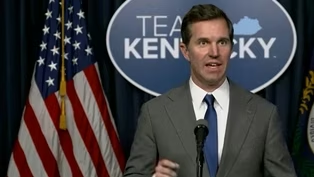
>> This budget is going to cause a lot of harm if not changed.
So on the Medicaid side, we make projections of what Medicaid is going to cost.
It's it's the cost of care times the number of people.
And you need that amount of money.
Otherwise, you've got to start looking at changing coverage or other drastic measures.
The House budget has $1.4 billion less than it for Medicaid, than the projection.
What will that do?
It's going to hammer rural and urban health care.
The big ugly bill already did enough.
I mean, $1 trillion of Medicaid cuts it's projected to impact, if not close, 35 rural hospitals.
On top of that, you got people that are falling off the the ACA exchanges that reimburse these same hospitals more than Medicaid, but because Congress extended tax cut for the wealthy but refused to extend a tax credit for hard working Americans to afford health care, those hospitals get hit again.
And now these are all Kentucky hospitals and clinics, $1.4 billion less than what they will need to operate.
Basically, they're just taking what the federal government did and hurting our health care organizations that much more.
>> The governor also said the budget doesn't give Kentucky State Police the money they need to do their jobs, and he was critical of the lack of money for pre-K, something he's repeatedly advocated for.
The Kentucky General Assembly is one step closer to giving the state the chance to opt in to a federal tax credit program, which would allow for scholarship donations for K through 12 students in public or private schools.
Our Emily Sisk has more from today's Senate Education Committee.
>> Simply put, Kentucky students can't afford to miss out on this opportunity.
>> Northern Kentucky Republican Representative T-j Roberts says House Bill one will benefit both public and private school students in Kentucky.
The bill would authorize the Secretary of State to opt Kentucky in to the federal tax credit program.
Donors can give up to $1,700 a year, which will go to scholarship granting organizations that can then award the money to K through 12 students.
>> Anybody who owes a dollar in federal taxes or above can give.
If you owed a dollar, you could give that dollar right to one of these organizations, right?
>> Roberts clarified.
Only families with an income at or below 300% of the area's gross median income would be eligible to receive the scholarship money.
The dollars can be used for a variety of things, from private school tuition to transportation, internet access, tutoring, and more.
The Republican sponsors emphasized these scholarships would not use any state funding.
>> Is anything in this bill cost any citizen in the state of Kentucky any money?
>> Not a penny, Senator.
>> It doesn't cost the people of Kentucky a penny to pass House Bill one.
>> There has been some concern over HB one and its similarity to amendment two, the school choice ballot measure from back in 2024, Kentucky voters overwhelmingly voted against amendment two, which would have allowed for public school dollars to be used at nonpublic schools.
An Oldham County Republican asked how House Bill one was different.
>> There's a lot of talk about this being the next new voucher program and some some people who are opposed to this idea are using that to say we voted against the state of Kentucky, voted against this already.
This is very different, am I correct?
>> So amendment two was specifically worded about the use of state general funds.
This bill designates it to the Secretary of State's office, which is a fee driven agency.
It's not a general fund driven agency.
In other words, at no point does the Kentucky General Fund get touched by this bill.
>> The Senate Minority Caucus chair still opposed the bill, saying he couldn't support any dollars going to private schools.
>> These kind of programs negatively impact and are harmful to our public schools.
Every dollar that's taken away from the federal Treasury here, we talk about the federal Treasury, is dollars left that we have to spend on very critical areas like defense, like transportation, like education, like health care.
>> Senate Education Committee Chair Stephen West was critical of the Democrats reasoning, saying not passing the bill would leave money on the table for Kentucky.
>> This should not be a public school versus private school debate.
This particular federal law is basically the federal government coming to Kentucky and with a silver platter and saying, here's some of your money, that you take it, take it.
>> Senate Majority Floor Leader Max Wise was also critical of arguments made by the two minority members who voted no.
And he made this promise.
>> We're going to pass this bill.
We'll pass it off the Senate floor.
Governor may veto it.
We'll be right there to override it.
But I will tell you, those that are voting no and those that are sharing misinformation about this bill, this could be something that can be a game changer for your school district.
I don't care if your school district is in Covington or if it's in Louisville or Campbellsville or wherever it may be.
This is a piece of legislation that's for kids.
>> HB one passed the Senate Education Committee with a vote of 11 to 2.
It moves on to the full Senate for consideration for Kentucky edition.
I'm Emily Sisk.
>> Thank you Emily.
State representative TJ Roberts, a Republican, said right now, 27 other states participate in the federal tax credit program.
It was made possible through President Donald Trump's one big, beautiful bill, which Congress passed last year, ending child marriage in Kentucky once and for all.
That's the intent behind Senate Bill 156.
As proponents see it, it would close a loophole in the current law that the bill sponsor says is being exploited by the judicial system.
A survival of generational child marriages told her story in committee this morning.
>> I approached Senator Adams about filing this bill because this is not theoretical to me.
This is my life.
>> Donna Simone's mother was married when she was 13, ending her education after the eighth grade.
Simmons says that trauma and instability shaped her childhood.
>> I was admitted to a behavioral health facility where I was groomed by a 29 year old staff member.
I was 14 years old when I was released.
That relationship continued, and at 16, my mother consented to me marrying him.
He was 31.
I was forced to drop out of high school before completing the 10th grade.
When I tried to escape his abuse, I was denied housing because I was a minor and I could not enter into a contract.
At 16, I miscarried and nearly died from complications.
As a married minor, I could not consent to my own medical care.
>> Now an advocate against child marriage, Simmons worked with Senator Julie Adams to pass Senate Bill 48 in 2018, which established the legal age for marriage as 18.
With some exceptions.
>> We have one one caveat that did allow for 17 year olds to get married if they had approval from the judicial system.
What we found is that caveat that we put in back in 2018 has really been exploited.
It hasn't been adhered to.
The law hasn't been followed.
>> Simmons says she found public records of judges authorizing marriages for 16 year olds, and spousal age gaps of up to 12 years between a minor and an adult.
>> So all this bill does is just close that loophole and it just makes marriage.
At 18 years old.
>> The bill passed unanimously, but one lawmaker wants to see exceptions for 17 and 18 or 19 year olds who want to be married.
>> My best friend and his wife, they were married when she was 17.
He's 19.
They've been married 60 some odd years.
And so I understand the issue when it comes to predators.
But I do have a few questions maybe we can talk about.
Thank you.
Possibly, maybe tighten this thing up a little bit.
>> The bill will next head to the full Senate for consideration there for Kentucky edition.
I'm Mackenzie Spink.
>> Thank you Mackenzie.
Now another news.
Last year, the General Assembly approved tax incentives for companies looking to build data centers in the state.
But this year, state lawmakers might set some guardrails to protect the people living near those facilities.
Our June Leffler has more.
>> AI supporting data centers guzzle energy that can require expensive energy infrastructure upgrades.
House Bill 593 would make sure companies, not residential energy customers, would fit that bill.
>> Eastern Kentucky is kind of the perfect example, right?
We used to have a lot of industry there that's had to be forced out.
And so now we've got all of this transmission, all of this infrastructure that's got to be paid for.
And the only people left to pay for it are the residents.
And so this bill aims to make sure that we don't have situations like that going forward.
>> Do I understand you right?
If this bill passes, there's no way that any constituents electric bills, utility bills would go up because of that.
>> That is my intention.
Yes, sir.
>> And I appreciate that very much.
>> Companies could build their own energy sources, but if they pull from the public grid.
>> If we have to increase generation, if we have to increase transmission, then the data center should pay for all of those expenses upfront.
>> The bill received unanimous bipartisan support in a committee.
>> So I appreciate you.
And I want to say that this bill is a due diligence bill.
I feel like we are always on the backside of fixing problems here in Frankfort.
And this is a bill that gets ahead of the game.
>> In a state like Virginia, for instance, in the last five years, their electricity costs have gone up 267% because of data centers.
So I agree with my colleagues.
I appreciate what you're doing here.
You're getting ahead of the problem.
>> I thank you for making sure that our ratepayers are not going to be impacted.
I want to also make sure we address environmental impacts of these data centers.
So there's going to be a lot of areas where we need to regulate them.
But I appreciate you taking this first step.
So I mean yes.
>> The bill now heads to the House floor for Kentucky Edition.
I'm June Leffler.
>> Thank you.
June.
The federal government is working on this to the white House says next week, Google, meta, Microsoft and other major tech companies will sign a pledge to supply their own energy for AI projects.
Those wrongfully convicted of a crime would be compensated under a new bill that passed the Senate Judiciary panel today, Republican State Senator Robin Webb sponsored Senate Bill 131.
She told lawmakers since 1989, there have been 23 known exonerations, with wrongfully convicted Kentuckians serving a combined 220 years.
One of those exonerees whose conviction was overturned with the help of the Kentucky Innocence Project, spoke at today's hearing.
>> When you take 27 years as a convicted felon and the end result is, oops, we're sorry, it doesn't sit right with anyone.
If anyone if anyone in this room was to experience the same thing, you would be saying, there's a lot of zeros missing off of these numbers.
An incredible experience, certainly deserving of some compensation.
>> You can't quantify what Mike and other individuals have lost, but certainly I think the state can allow a threshold.
You know, he's he was released with no assistance whatsoever.
Just turn back into society with no reentry services.
You know, that would maybe so this bill would also address that to some degree.
But we have with the technology that we have now.
And since I've been in the General Assembly, we've made great strides with DNA.
We're trying to upgrade our labs.
We're trying to do all those things.
So the pool of wrongful convictions in a perfect world is going to dwindle.
>> Committee members were told of the 23 recognized exonerations in Kentucky.
Eight reached Civil settlements for their wrongful conviction, leaving 15 who could apply for compensation under the bill.
It's expected that $7.5 million would go to that group based on the time served.
Average compensation for any future exonerations would be between 100,000 and $650,000.
Senator Webb said the state could save money since most of the civil settlements in wrongful conviction cases have exceeded the compensation amount awarded under the bill.
LGBTQ plus Kentuckians are sending this message to state lawmakers.
They say, stop politicizing our lives.
And they brought that message to the Kentucky State Capitol.
Yesterday, supporters gathered for a fairness rally to oppose what they see as anti-lgbtq+ legislation, including what they call a health care discrimination bill.
>> I'm going to ask you what you want, and I hope the answer is fairness.
What do you want?
When do you want it?
What do you want?
>> Today we make our voices heard.
No matter where we are in the state, we shouldn't live in fear of harassment or being fired from our job, from being kicked out of our homes, or especially from being denied basic medical care because of who we love or who we are.
>> Everybody here is fighting hard against Senate Bill 72, which is an overly broad health care discrimination bill that would allow any health care worker in the Commonwealth of Kentucky to deny service and to discriminate against patients based on virtually any reason, including prejudice.
Also got concerns about House Bill 468, which seeks to overhaul a lot of the human rights commissions and really change quite a bit of the Kentucky Civil Rights Act.
We know that there's consideration of a bill out there right now.
We deeply believe that drag is not a crime, and that's clearly what everybody here agrees with as well.
>> And everybody's got a right to live.
>> I wanted to be.
>> Here because we're living in a time where people feel attacked by their own federal government, along with parts of our state legislature.
You are citizens of the Commonwealth, just as worthy as anyone else.
I see you, I appreciate you, and I will continue to serve each and every one of you.
>> We exist in all of Kentucky and where we live, we belong.
Sometimes that's hard to remember in uncertain times like this.
In a time when it feels like too many of our allies have abandoned us, and we watch as so many of our elected leaders try to chip away our rights one by one.
They act like they can legislate us away.
And yet here we are.
>> Now turning to federal government news.
The FBI director will be in Kentucky tomorrow.
Kash Patel will be at the EKU Manchester campus for a law enforcement appreciation luncheon and panel discussion, along with Congressman Hal Rogers of the fifth district.
Rogers and Patel will discuss national security and crime during a news conference after that luncheon.
[MUSIC] Lynn Family Stadium is attracting more pro sports teams to Kentucky.
Five years after LOU City and Racing Louisville found a home there.
The United Football League is bringing pro football to Louisville with the Louisville Kings.
Our Kelsey Starks explores the history of this bustling area of Butchertown, and how it became home to Kentucky's only pro sports teams.
Its roots can be traced back to the late 1700s, long before it was called Butchertown.
Settlements began along Beargrass Creek, and industry followed the Adams Street area.
Named after President John Quincy, Adams became known as Butchertown because of the many German butchers and the shotgun homes housing workers for nearby Bourbon Stockyards.
In the 1920s and 30s, the area was thriving as Louisville's first designated neighborhood to the east, but the flood of 1937 wiped out nearly everything.
Few homes and businesses survived.
One that did was Saint Joseph Catholic Church, one of the area's most notable landmarks that still stands tall today.
[MUSIC] The neighborhood became industrial.
Many of the original homes were torn down.
More people moved to the suburbs in the 1950s, and an interstate was built through the neighborhood in the 1960s.
That's when a few of the neighborhood's remaining residents banded together to preserve the working class neighborhood and protect the homes that remained.
The neighborhood was listed on the National Register of Historic Places in 1976, and the area was designated as a local preservation district in 2003, which helped preserve the area's architectural style that remains today.
But back then, much of the area remained as dilapidated buildings and industrial junkyards.
Enter LOU city.
>> It's really turned into what can we do for Louisville?
>> After five years of playing pro soccer at Louisville Slugger Field, Louisville City FC was looking for a permanent home.
In 2017, they announced the plan to turn 40 acres into a state of the art stadium, giving the Butchertown area a crown jewel visible from Spaghetti Junction.
[MUSIC] The stadium was named Lynn Family Stadium in 2019, and in 2020, after being delayed a few months because of Covid, LOU city FC kicked off their first home game inside their new stadium.
>> Pretty cool and you can hear the full story from the president of LOU City and Racing Louisville and the man behind the name doctor Mark Lynn.
Plus, what's the best plan for the rest of the area around the stadium?
You'll learn all about that on inside Louisville this Sunday at 12 noon eastern, 11 a.m.
central, right here on KET.
It's the biggest school system in Kentucky, and it's been at the center of debate and criticism in Frankfort.
Hear from Jefferson County Public Schools Superintendent Brian Yearwood tomorrow as he delivers the JCPS state of the district.
Address those highlights tomorrow night on Kentucky Edition.
And late tonight, the U.S.
Justice Department is suing Kentucky over the state's failure to hand over voter rolls.
[MUSIC] More on this tomorrow night at 630 eastern, 530 Central on Kentucky Edition, where we inform, connect and inspire.
Connect with us all the ways you see on your screen.
The social media channels, Facebook and Instagram.
To stay in the loop.
Send us a story idea by email to Public Affairs at Keturah and look for us on the PBS app that you can download on your smart devices.
And of course, we're always streaming content online on demand at Keturah.
Have a great night and we'll celebrate Friday tomorrow.
[MUSIC] Until then, take really good care.
[MUSIC] So long.
Bill Allows State to Opt in to Federal Tax Credit Program
Video has Closed Captions
Clip: S4 Ep331 | 4m 29s | Bill allowing scholarship donations for public or private schools clears another hurdle. (4m 29s)
Exonerees Compensated Under New Measure
Video has Closed Captions
Clip: S4 Ep331 | 2m 17s | Senate bill would compensate those who were wrongfully convicted of a crime. (2m 17s)
Governor Responds to Proposed State Budget Plan
Video has Closed Captions
Clip: S4 Ep331 | 1m 41s | Governor Beshear says Republican-crafted budget plan is bad news for Kentuckians' health. (1m 41s)
House Passes New $31 Billion State Budget
Video has Closed Captions
Clip: S4 Ep331 | 4m 28s | Kentucky's two-year budget heads to the upper chamber after passing in the House. (4m 28s)
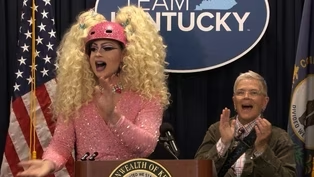
LGBTQ+ Advocates Rally for Fairness
Video has Closed Captions
Clip: S4 Ep331 | 2m 17s | Advocates gather in Frankfort to rally against what they call anti-LGBTQ+ policies. (2m 17s)
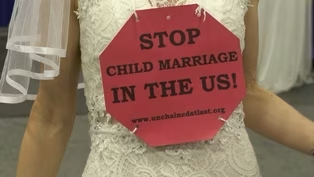
Measure Aims to End Child Marriage in Kentucky
Video has Closed Captions
Clip: S4 Ep331 | 2m 46s | Bill would close loophole that allows for child marriage. (2m 46s)

State Lawmakers Address Concerns Over Data Centers
Video has Closed Captions
Clip: S4 Ep331 | 2m 22s | Push to make sure new data centers don't drain taxpayer wallets. (2m 22s)
Providing Support for PBS.org
Learn Moreabout PBS online sponsorship
- News and Public Affairs

Top journalists deliver compelling original analysis of the hour's headlines.

- News and Public Affairs

Today's top journalists discuss Washington's current political events and public affairs.












Support for PBS provided by:
Kentucky Edition is a local public television program presented by KET