
May 11, 2026
Season 4 Episode 383 | 26m 30sVideo has Closed Captions
A federal lawsuit is challenging a new state law designed to restructure KSU.
A federal lawsuit challenges a new state law designed to restructure KSU, Kentucky's Secretary of State signs House Bill 1 into law, how a significant drought is impacting an Eastern Kentucky city, a program providing cancer screenings to firefighters, and a graduating Kentucky senior because a school's first student to win a major award.
Problems playing video? | Closed Captioning Feedback
Problems playing video? | Closed Captioning Feedback
Kentucky Edition is a local public television program presented by KET
May 11, 2026
Season 4 Episode 383 | 26m 30sVideo has Closed Captions
A federal lawsuit challenges a new state law designed to restructure KSU, Kentucky's Secretary of State signs House Bill 1 into law, how a significant drought is impacting an Eastern Kentucky city, a program providing cancer screenings to firefighters, and a graduating Kentucky senior because a school's first student to win a major award.
Problems playing video? | Closed Captioning Feedback
How to Watch Kentucky Edition
Kentucky Edition is available to stream on pbs.org and the free PBS App, available on iPhone, Apple TV, Android TV, Android smartphones, Amazon Fire TV, Amazon Fire Tablet, Roku, Samsung Smart TV, LG TV, and Vizio.
Providing Support for PBS.org
Learn Moreabout PBS online sponsorship[MUSIC] With just over a week to go to Republican candidates try to make the case for why they should be the next U.S.
senator from Kentucky.
[MUSIC] Plus, a new lawsuit challenges a state law billed as a way to save Kentucky's only publicly funded HBCU.
[MUSIC] >> Unfortunately, this spring, we did not get the rainfall, so we are still greatly struggling and it.
It's a scary situation.
>> A statewide drought is draining the lakes and reservoirs communities rely on for their drinking water.
[MUSIC] >> I've been to more funerals than I can count for friends, coworkers, people that I have known in the fire service.
>> And how.
A new cancer screening program for firefighters seeks to provide peace of mind and early detection.
[MUSIC] >> Production of Kentucky edition is made possible in part by the KET Millennium Fund.
>> Good evening and welcome to Kentucky Edition for this Monday, May 11th, the start of a brand new week.
I'm Renee Shaw, and we thank you for spending some of your Monday night with us.
Well, we are now just over one week away from Election Day right here in Kentucky.
Next Tuesday, voters will decide which candidates will move on to the general election in November.
The only statewide race on the ballot this primary is for U.S.
Senate on Friday, two Republican candidates hoping to replace retiring U.S.
Senator Mitch McConnell participated in a forum hosted by the Paducah Area Chamber of Commerce and WPSD TV Congressman Andy Barr and former Kentucky Attorney General Daniel Cameron did not appear on the stage together.
Instead, they each took turns answering the moderator's questions, with Congressman Barr going first.
>> In Kentucky, the average price is 4.23 a gallon.
How would you work with the Senate, the House and the white House to address the budget concerns Kentuckians have over gas prices?
>> Well, they should have concerns over gas prices, I do too.
We all we all want gas prices to come home.
Come, come, come down, come down and go back to where they were pre-war.
Remember this administration, this Congress is making great progress on bringing down the cost of living and bringing down the cost of energy before the disruption in the Strait of Hormuz.
But this effort to make sure that the world's leading state sponsor of terrorism no longer has the ability or the capability of acquiring a nuclear weapon.
This is a war worth winning.
And this is a process of not starting a war, but ending a 47 year war.
>> Well, as I've talked about earlier, let me first say, I appreciate what President Trump has done to take decisive action to limit a regime in Iran that has been terrorizing our people since the late 1970s.
They've been harming, they've been maiming, they've been killing American service men and women.
And this president had the fortitude to say that enough is enough.
And we should be grateful, whether it is in Iran or whether it is what we saw in Venezuela in removing a narco terrorist, someone who was preying on addiction and poisoning our communities.
These are good steps.
>> The candidates also discussed the role of coal and nuclear energy in the region.
Barr and Cameron are the two frontrunners in the GOP primary.
Businessman Nate Morris dropped out of the U.S.
Senate race once Barr was endorsed by President Donald Trump.
Today, the group medium buying, which tracks spending on political ad campaigns, is reporting Cameron has canceled TV ads that were scheduled to air in the final week leading up to Election Day.
Turning now to the race in Kentucky's fourth congressional district that is getting national attention.
Incumbent Congressman Thomas Massie is up with a new commercial of his own.
He calls it a positive ad for the final week of this election cycle.
>> Our nation in Kentucky have enormous challenges and problems, but after every visit back home to Kentucky and talking with you and holding my grandchildren, I'm more renewed than ever to keep fighting.
I'm Thomas Massie, and I approve this message.
>> Massie is seeking an eighth term in Washington.
He's opposed in the Republican primary by editor Paul Ryan, who's been endorsed by President Donald Trump.
Election day is in Kentucky, is next Tuesday, May 19th.
In person.
No excuse.
Voting begins this Thursday.
You can find your voting locations in your county and view a sample ballot.
If you go online to go vote.ky.gov.
Our candidate conversations continue tonight on Kentucky.
Tonight, as we welcome two candidates for the U.S.
House in the second and fifth congressional districts.
And we hope you'll send us your questions tonight.
That all begins at eight eastern, seven central right here on KET and other news new tonight.
A federal lawsuit is challenging a new state law designed to restructure Kentucky State University.
The lawsuit was filed by KSU alumni and students.
They allege Senate Bill 185, passed by the Kentucky General Assembly just last month, threatens the future of Kentucky's only publicly funded historically black college and university.
SB 185 was billed as a way to save KSU, with lawmakers saying there were some serious discussions about shutting down the university because of its recent history of financial mismanagement.
The bill outlines fiscal procedures, sets expenditure limits and academic admission standards and transitions K-State to what's called a polytechnic institution.
The lawsuit alleges SB 185 violates federal civil rights laws, according to the lawsuit obtained by KY t TV, the federal government alerted Governor Andy Beshear that KSU received millions of dollars less in land grant funding than the University of Kentucky, an attorney representing the plaintiffs said, quote, Kentucky cannot underfund its public HBCU for decades receive repeated federal notice of that inequality and then use the resulting financial condition as justification to dismantle the institution's historic mission and academic structure, unquote.
The lawsuit also seeks to prevent SB 185 from taking effect until the court case can be heard in court.
Late this afternoon, Kentucky State University responded to the pending lawsuit, saying, quote, the university was not involved in filing this action, did not coordinate with the individuals who filed it and was not aware of the action before receiving the filing.
Because this matter is before the court, the university cannot comment further on the filing at this time.
As a public institution, Kentucky State will continue to follow applicable law and work collaboratively with state and federal partners in fulfillment of its mission, end quote.
In other news, this afternoon, Kentucky Secretary of State Michael Adams ceremonially signed House Bill one, opting Kentucky into a federal program that offers tax credits to individuals who donate to what's called scholarship granting organizations.
The bill does not use state dollars and can be accessed by public, private and home school students.
Republican state Representative TJ Roberts of Northern Kentucky responded to questions about how the bill could affect pre-K in the state, which is a priority of Governor Beshear, who vetoed House Bill one.
He also shared his thoughts on potential threats of litigation against the bill.
>> This is estimated to bring millions of dollars into education funding that Kentucky otherwise would not have had.
School systems themselves can set up their own sgaus, they can use them for any qualifying educational expense.
And under federal law, that includes pre-K expenses.
So the governor isn't even willing to work with us on something that could very well be used toward one of his primary goals.
And it's ultimately because of the special interests being diametrically opposed to this policy, him being diametrically opposed to the president who signed the law that made this happen.
I've heard threats.
I think that they're hollow threats.
And this is a federal tax credit.
You can't use state constitutional provisions to override federal policy.
That is clearly taken pursuant to Congress's tax power.
>> Adams must notify the U.S.
Treasury that Kentucky is opting into the federal program by January 1st.
Now, some weather news.
Kentucky's drought is getting worse.
The National Drought Mitigation Center shows Western Kentucky is experiencing extreme drought.
The situation is getting worse in other parts of the state as well.
That's alarming towns that rely on a single lake or reservoir for their drinking water.
Our John Loeffler visited Wolf Lake in eastern Kentucky, where the water level there is receding, and a mayor is praying for rain.
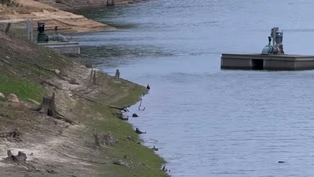
>> This is Wolf Lake, the single public water source for 2600 households across Wolf County.
Camden is the county seat and Kathy May is the mayor.
>> So yeah, the lake's really not been to full capacity for us for several years.
>> A full lake could reach the height of these rocks, nowhere near where it is today.
May and engineers monitor the lake by sight.
This stump was covered in water after snowfall in February.
Now it's exposed.
A marker placed at the lake's edge days ago is now surrounded by mud, showing how the water level has receded.
Public officials are taking the reins.
Last November, the county placed a moratorium on new water customers.
>> My Clark has answered two calls that I know of today of someone calling to get new water service.
And, you know, it's heartbreaking for us to tell them that we cannot give them water service.
We have people that are starting to build their their homes in the hopes that by the time they get their homes built, that that they will be able to obtain a water meter.
>> And the statewide drought has only made conditions worse.
>> And lack of rainfall has definitely aided in this as well.
We've struggled, you know, a couple of winters in the past, but by spring we get the spring rain and the lake is back to full pool.
Unfortunately, this spring we did not get the rainfall, so we are still greatly struggling.
And it it's a scary situation.
>> The Division of Water, a state agency, says the drought is impacting the water supply of multiple counties.
May says any emergency conservation efforts will be decided alongside state officials.
>> From the I. I would think that we're already in a critical state.
>> You know.
>> He doesn't deem it there yet because he has monitored this lake for many years and he he knows how many gallons, how many thousands of gallons that I have left.
But we do have a time frame of when we're going to have to call the state of emergency.
If the rainfall doesn't come.
>> May is looking for more water outside of Wolf Lake, with plans to tap into nearby communities.
Water systems, drill more wells and hopefully acquire another lake from a private donor.
>> You know, getting tied into one of our interlocal connects is obviously the fastest solution and one that we desperately need now.
But long term, I really want to see Wolf County being able to supply their own water.
So we are beginning that process so that, you know, I probably will not be here to see it, you know, come to fruition.
But, you know, hopefully for the future mayor or whomever, you know, it, it will happen.
>> If spring showers don't come soon.
May says she'll have to make some tough decisions by the end of the month for Kentucky Edition.
I'm June Leffler.
[MUSIC] >> Thank you.
June.
According to last week's Kentucky Drought Update, statewide rainfall for this year is at 10.5in.
That's seven inches fewer than normal.
[MUSIC] Firefighters face many risks in their line of work, one being an increased risk of cancer.
After the death of a Northern Kentucky firefighter in his 40s.
Saint Elizabeth Health Care launched a program to provide cancer screenings to fire service workers.
Our Emily Sisk has more in tonight's medical news.
[MUSIC] >> Jim Schaefer is an assistant fire chief with the Edgewood Fire Department in Northern Kentucky.
Schaefer has been working in the fire service for more than 30 years.
>> When I started, I was 18 years old.
You know, they didn't talk about cancer.
They didn't talk about any of the the high risks.
>> In fact, Schaefer said embracing dangerous situations was considered a symbol of hard work.
>> You know, back in the day, the dirtier your helmet, the dirtier your gear meant, the harder you were working.
And it was a badge of courage back then.
>> But as the years have gone by, the assistant fire chief says he's seen firsthand the deadly effects of the job.
>> I've been to more funerals than I can count for friends, coworkers, people that I've known in the fire service that have passed away in their 50s to 60 from cancer.
>> Doctor Mike KEC with Saint Elizabeth, says firefighters are 9% more likely to get cancer than the general population, and 14% more likely to die from their cancer than others who are diagnosed with all these things in mind.
Saint Elizabeth launched a firefighter cancer screening program to provide early detection for the emergency workers in Northern Kentucky.
Doctor said the program was put into action after the death of Captain Travis Ransom with the Union Fire Department.
>> At 47 years of age, he was diagnosed with stage four adenocarcinoma.
He at that time already had widely metastatic lung cancer.
He died 26 months later, despite the best treatment.
And that's what we don't want to see.
We want to try to catch it in stage one when it's you have a greater than 90% chance of curing that cancer.
>> Saint Elizabeth launched the cancer screening program last fall, piloting the program with the Union and Fort Mitchell fire departments.
Now, seven months later, a dozen fire departments have gotten on board, including in southeast Indiana and Cincinnati.
>> We've done about 65 to 70 low dose CT lung cancer screenings.
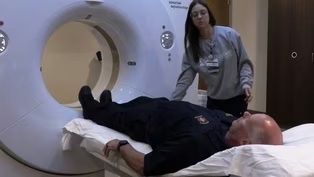
>> Assistant Fire Chief Jim Schaefer was one of the participants who completed his chest Cat scan.
Doctor said the test is the easiest cancer screening they do.
>> You can usually leave the clothes on that you had on when you walked into the department.
Nothing gets put in you up you down you are.
Through you.
Nothing gets squeezed.
It takes three minutes.
It's one breath.
Hold for a few seconds, and then you're in and out of the scanner within three minutes.
>> If there is something abnormal, you're going to know about it pretty quickly.
And then we've got a whole team, you know, that's there to help you.
>> Emily Fogle, a nurse practitioner with Saint Elizabeth, helps advocate for fire departments to join the program.
She has a special connection as her husband has spent 18 years in the fire service.
>> Over the years.
It's been really difficult trying to find a provider for my husband to see that actually knew knew what to screen for.
>> For Jim Schaefer, the screening brings peace of mind that he can continue his job and have many years left to spend with his friends and family.
>> Having something for early detection, I think is vital if you want to be in this field.
>> For Kentucky edition, I'm Emily Sisk.
>> Thank you, Emily, for that.
Many women going through menopause or perimenopause are prescribed an estrogen patch to help manage symptoms like hot flashes and poor sleep.
But recently, the patch has been in short supply.
Our Kristy Dutton spoke to a nurse practitioner specializing in women's health about the shortage.
As we continue our medical news.
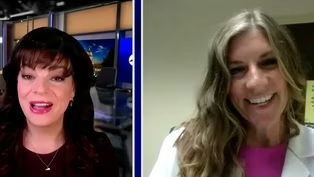
[MUSIC] >> Erika Martinotti joins us now from UK Health Care.
We're talking about the shortage of the estrogen patch.
Tell us, why is the shortage happening and do we see any relief in sight?
>> So the shortage is happening for a few reasons.
One reason is that the FDA removed the black box, warning that that's one factor contributing to the patch shortage.
But it's not the only reason estrogen patch prescribing has increased dramatically over the last several years.
And so many experts believe the FDA decision further increased the awareness and confidence around menopausal hormone therapy.
And at the same time, women are seeking treatment for menopause symptoms and more.
Clinicians are becoming comfortable with prescribing hormone therapy, so the manufacturers have struggled to keep up with the demand due to production and supply chain limitations.
>> And this shortage has been going on for months now, you know, since the beginning of the year.
So what do you say to your patients that are having a hard time finding this, the estrogen patch?
Are there any alternatives?
>> Yeah.
So luckily a lot of my patients are still able to get their current dose.
So some women can switch from the patch to a gel or a mist or there's a, there's something called a femring and then there's oral estradiol.
So really women that are struggling to find theirs can call around to pharmacies in town and see if anybody else has it in stock, because one pharmacy might have it and another one might not.
So they can call around and then they should talk to their clinician about what to do.
And so there might be just alternate options that they can prescribe if they can't get their current patch dose.
>> Yeah.
And I've heard of some women sort of rationing their estrogen patches or, you know, or trying to use one for two doses.
And some women have had to stop using the estrogen patch.
What happens when that treatment is stopped?
>> So if the treatment stopped, women will have recurrence of their symptoms.
So whatever they went on the patch for, whether it be like hot flashes, night sweats, mood swings, vaginal dryness, those things can start to recur.
It's not dangerous to stop it temporarily.
And but, you know, long term over if women are started on hormone therapy for their bone health, then their bone health can decline over the next 1 to 2 years after they stop estrogen.
So I definitely recommend that women talk to their clinician about an alternate option, but the short term would really be the quality of life issues that women experience in menopause, which would be the hot flashes in the night sweats.
>> Okay.
And so what is your best advice for women out there who are having difficulty finding an estrogen patch?
>> So if they are having difficulty, then I recommend that they they call around to different pharmacies in town and see if they have their exact dose available.
And, and then they could also just stay in close communication with their health care provider and see if they're eligible for an alternate form of transdermal estrogen, whether it be the gel or the mist or the ring or oral estradiol.
So those would be my recommendations for that.
But the important message is that women still have treatment options and should not feel like they're going to have to suffer through symptoms while they supply issues are being worked out, because the supply issues might last for several months, or even some some are saying up to a few years as demand continues to increase.
>> Oh, wow.
So we're in this for the long haul then perhaps.
Okay.
Well, Erica, Manon, thank you so much for talking with us today.
>> You're so welcome.
Thank you for having me.
>> The 2026 Pulitzer Prizes were announced last week.
The honorees include a graduating senior at Western Kentucky University.
Go tops majoring in photojournalism.
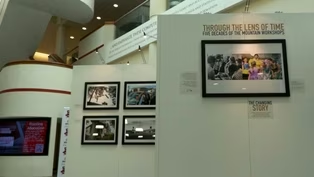
Our Laura Rogers spent time with the young winner, the first Ku student to win a Pulitzer Prize while still enrolled on the Hill.
>> Ever since I was a kid, I was always studying history.
The photos always stuck out to me, and that's what always resonated.
>> That sparked an interest in photojournalism for Dominic di Palermo, who grew up in the suburbs of Chicago.
>> I fell in love with photography my freshman year of high school, and I wanted to continue my photojournalism education in a place with very distinguished alumni and a. In a well-known program.
>> That would be Western Kentucky University, whose award winning photojournalism program is often hailed as one of the best in the country.
>> Our program has turned out very strong storytellers over the years.
They're not out to win awards.
They're just out to tell stories that need to be told.
And that kind of work eventually garners recognition.
>> That's already the case for Di Palermo, who learned last week just minutes before presenting his senior capstone presentation.
He had won a Pulitzer Prize.
>> I turned to my left and he's not sitting there anymore.
And I said, Where's Dom?
And one of his friends?
Students said he left the room and I said, left the room.
He's next.
>> Tim Broekema was understanding when he learned why.
Dom had taken a quick moment to take in such big news.
>> Then he held up his phone and it said, Chicago Tribune wins Pulitzer.
And I went, oh.
>> Staff of the Chicago Tribune.
>> It was a really surreal experience to have that, just experience all those emotions with my classmates, with alum that were back judging our capstones and just the professors here, it was awesome.
>> Dominic Di Palermo interned at the Chicago Tribune this past fall as federal immigration enforcement conducted Operation Midway Blitz targeting undocumented immigrants, leading to arrests and protests.
>> They gave me assignments that were real and that they would give any other staff member.
>> Those assignments included covering everything from sports and parades to, yes, those Ice raids and protests at the Broadview Ice facility.
>> I was definitely nervous a couple times being in those tense situations.
The nerves were there and the adrenaline was there, but I knew how to keep myself safe.
>> Di Palermo says he's one of more than 75 Chicago Tribune staffers who collectively won the Pulitzer Prize for local reporting.
>> It was bittersweet because, yes, we brought a lot of issues to light as a team, and I was very proud of that.
And people got to see that in the suburbs, nationally, in the city.
But the subject matter wasn't necessarily the most awesome thing.
And so it's kind of juggling this, the joy of bringing that to people and having that coverage be widespread, but also remembering what we're covering and the gravity of that.
>> What the Tribune did is a really thorough, long form investigative documentary approach to storytelling.
I really remember.
>> Broekema has also previously won a Pulitzer, and his pride in Dominic's talent is evident.
>> Dom is one of those people that has been very diligent in his work.
>> I think local journalism is one of the most important things in this country.
>> He now officially becomes one of those local journalists telling visual stories that may inspire change, or even just help us all understand each other a little better.
For Kentucky edition, I'm Laura Rogers.
>> Yay, Dominic!
Well, the Kentucky Derby is long over, but it wasn't always in early May.
Our Toby Gibbs tells us more.
And this look at this week in Kentucky history.
>> Electors from different parts of Kentucky gathered and elected Isaac Shelby as Kentucky's first governor on May 15th, 1792, a few weeks before Kentucky became a state on June 1st.
Shelby then took the oath of office on June 4th.
On May 16th, 1861, the Kentucky General Assembly voted to declare Kentucky neutral during the Civil War, though thousands of individual Kentuckians would pick sides and fight during the four year conflict.
Willis Augustus Lee Jr was born in Owen County on May 11th, 1888.
He won seven medals in competitive shooting, including five gold medals at the 1920 Summer Olympics in Antwerp, Belgium, and he went on to be a rear admiral in the United States Navy.
Speaking of birthdays, Earle Combs was born in Owsley County on May 14th, 1890.
He went on to play 11 years as center fielder for the New York Yankees, where he was a teammate of both Babe Ruth and Lou Gehrig.
He earned the nickname the Kentucky Colonel.
The run for the roses wasn't always on the first Saturday in May, the first Kentucky Derby was May 17th, 1875, a Monday with Aristides as the first winner.
A horse named Kingman won the Derby on May 13th, 1891, a Wednesday with Kentucky and Isaac Murphy as jockey.
Kingman was the slowest Derby winner, winning in two minutes and 52 seconds.
And flying Ebony won the Derby on May 16th, 1925, the first race broadcast on radio.
It aired on both WHAS and Louisville and WGN in Chicago.
And that's a look back at this week in Kentucky history.
I'm Toby Gibbs.
>> Thanks as always, Toby Gibbs.
That'll do it for us tonight.
Hope you'll tune in to Kentucky tonight at 8:00 eastern seven central for our last of our candidate conversations.
Stay tuned for that.
Thank you so much for joining us.
And we'll see you back here tomorrow night for Kentucky Edition.
Estrogen Patches in Short Supply
Video has Closed Captions
Clip: S4 Ep383 | 3m 57s | Demand for estrogen patches increases, leading to supply shortage. (3m 57s)
Video has Closed Captions
Clip: S4 Ep383 | 3m 56s | Statewide drought draining lakes and reservoirs communities rely on for drinking water. (3m 56s)
Program Provides Cancer Screenings for Firefighters
Video has Closed Captions
Clip: S4 Ep383 | 3m 32s | New cancer screening program for firefighters providing peace of mind and early detection. (3m 32s)
WKU Student Wins Pulitzer Prize
Video has Closed Captions
Clip: S4 Ep383 | 3m 27s | Western Kentucky University photojournalism major wins Pulitzer Prize. (3m 27s)
Providing Support for PBS.org
Learn Moreabout PBS online sponsorship New Episode
- News and Public Affairs

Top journalists deliver compelling original analysis of the hour's headlines.
 New Episode
- News and Public Affairs

Today's top journalists discuss Washington's current political events and public affairs.


 New Episode
 New Episode
 New Episode
 New Episode
 New Episode
 New Episode
 New Episode
 New Episode
Support for PBS provided by:
Kentucky Edition is a local public television program presented by KET