
March 17, 2026
Season 4 Episode 344 | 26m 28sVideo has Closed Captions
Funeral plans are set for a Kentuckiy soldier killed in the war with Iran.
Funeral plans are set for a Kentuckian killed as part of the U.S. fighting Iran, state lawmakers considering changes that could kick 47,000 Kentuckians off SNAP, a Paducah Republican is urging Kentucky to develop a nuclear energy pilot program, and the Senate votes to override the governor's veto of House Bill 1.
Problems playing video? | Closed Captioning Feedback
Problems playing video? | Closed Captioning Feedback
Kentucky Edition is a local public television program presented by KET
March 17, 2026
Season 4 Episode 344 | 26m 28sVideo has Closed Captions
Funeral plans are set for a Kentuckian killed as part of the U.S. fighting Iran, state lawmakers considering changes that could kick 47,000 Kentuckians off SNAP, a Paducah Republican is urging Kentucky to develop a nuclear energy pilot program, and the Senate votes to override the governor's veto of House Bill 1.
Problems playing video? | Closed Captioning Feedback
How to Watch Kentucky Edition
Kentucky Edition is available to stream on pbs.org and the free PBS App, available on iPhone, Apple TV, Android TV, Android smartphones, Amazon Fire TV, Amazon Fire Tablet, Roku, Samsung Smart TV, LG TV, and Vizio.
Providing Support for PBS.org
Learn Moreabout PBS online sponsorship[MUSIC] Ahead.
Funeral plans for the Ahead.
Funeral plans for the first Kentuckian killed in the war with Iran.
[MUSIC] >> We're going to take advantage of the billions of dollars being invested in nuclear.
We need to move now.
>> But if Kentucky goes nuclear, who foots the bill.
[MUSIC] >> For a trash company CEO to force his employees to go to white privilege retraining classes?
[MUSIC] That is evil.
This guy's a complete hypocrite.
Every breath he's taken, he's lying.
>> Republican candidates for the U.S.
Senate, trade accusations and some hefty barbs over DEI.
>> Production of Kentucky edition is made possible in part by the KET Millennium Fund.
[MUSIC] >> Good evening and welcome to Kentucky edition on this Tuesday, March the 17th.
Happy Saint Patty's Day.
I'm Renee Shaw, and we thank you for winding down some of your Tuesday night with us.
Funeral plans are now set for the Kentucky service.
Men who was killed as part of Operation Epic Fury in Iran.
Staff Sergeant Benjamin Pennington died a week after being wounded in an Iranian attack on a base in Saudi Arabia.
He was from Glendale in Hardin County.
The governor's office says Sergeant Pennington's funeral will be Saturday at Central Hardin High School, with burial at the Kentucky Veterans Cemetery in Radcliff.
Pennington was just 26 years old.
Rules around the federal food stamp program, called SNAP are changing and states are under pressure to adapt.
As our June Leffler reports, state lawmakers are considering changes that could kick almost 47,000 Kentuckians off the food Assistance program.
[MUSIC] That begins tonight's legislative update.
[MUSIC] >> Last year, Congress voted to reduce SNAP spending by hundreds of billions of dollars.
Over the next decade.
Cuts will come in part from moving more administrative costs to the states.
States will soon be on the hook for handing out the wrong amount of SNAP dollars to participants, which is referred to as error rates.
>> So we've got to get that error rate below 6% without having it below 6%.
We're going to experience an additional cost over 100 million.
>> This Northern Kentucky Republican proposes Senate Bill 257 to reduce costs of running the program.
>> These are federal dollars that all of us taxpayers pay to the federal government.
But Kentucky is responsible for holding a very compliant process, an efficient process to keep eligibility on track.
>> The bill limits who can get food stamps.
According to a report from the left leaning Kentucky Center for Economic Policy, the bill lowers the income limit to receive SNAP, meaning someone making $20,000 a year would still qualify, but not someone making $25,000.
KY policy calculates that could kick 40,000 people off the program.
Recipients could only have so many assets like savings or car.
This could kick 7400 people off.
SNAP advocates are alarmed.
>> At a time when gas prices and diesel fuel is increasing, grocery prices continue to increase, and we're lowering the threshold here.
That's kind of what we call an exponential threat to food security for children and seniors in our community.
>> This will have a substantial impact.
Benefits cliffs demonstrably empirically impact school meal participation.
If enough students are kicked off the program because their parents lose Snap benefits, that will impact not just themselves, but their classmates.
>> The bill also calls for more frequent income and identity checks for participants.
>> So we'll work on more regular checks of state and federal databases that catch eligibility changes quickly.
So as many know, if if you've got even people that have died aren't necessarily being removed quick enough, that'll hit our error rate.
>> Opponents say more checks won't reduce costs.
>> In some cases, and it's extremely error ridden.
It ties Snap benefits to new databases that can be based on old or inaccurate information and conflicting information as well, which we know would lead to errors.
>> The Senate Families and Children Committee heard testimony and discussed the bill today, but did not vote on the measure.
>> And my demographic with the high utility prices, high fuel prices, where transportation is our number one barrier is is going to be impacted.
Disproportionately.
So I have these concerns from a fiscal side and a humanitarian side, how it impacts my district.
>> Tomorrow marks day 49 of the 60 day legislative session for Kentucky edition.
I'm June Leffler.
>> Thank you.
June and other legislative news.
Government agencies are often required to post public notices in local newspapers as a form of transparency, so that the public knows what local governments are doing.
But the cost of these required notices has been a point of conflict for more than a decade, according to some state lawmakers.
Is our Mackenzie Spink tells us about House Bill 141, which is Senate Bill 141.
Supporters say.
Finally, the right balance has been achieved.
>> Every government agency has a website where public notices, also known as legal ads, can be posted for free.
So why require local newspapers to print these communications?
Lawmakers say communities without internet access have a right to see these notices as well.
On the other hand, there is concern about the cost burden on smaller local newspapers in these areas.
>> This issue we have before us today is about public advertising and typically going to be local papers, because this is local government challenged with that charge that we give them of transparency and notice providing.
But at the same time, we want to be responsible for taxpayers expenses.
So the conflict comes in that space of being a transparent government that provides notice, but minimize the taxpayers spend.
>> Senate Bill 141 is a result of a partnership between the Kentucky League of Cities, Kentucky Association of Counties and the Kentucky Press Association.
It says that when a newspaper receives a legal ad from a government agency, it must be published in the next print edition of the paper or within seven days, whichever is first.
Additionally, the newspaper has 24 hours to send the public notice to KY public notice.com.
A third party website run by the Kentucky Press Association.
>> It also requires faster online posting and inclusion in a centralized statewide public notice website hosted by the Kentucky Press Association.
I do want to emphasize this.
The Kentucky Kentucky Press Association has volunteered themselves, under this bill to put a mandate on all papers to publish these legal notices on their website.
It also establishes clear timelines and responsibilities for newspapers publishing required ads.
>> We've modernized, we've reduced the cost, and we've provided a 24/7, 365 access to the public via the KY public notice.com website, with no cost to the state.
>> The bill's proponents say making public notices the purview of the Kentucky Press Association lessens the burden on local newspapers, especially in areas without internet access.
>> Typically, with bills like these, there's always concerns with rural newspapers, specifically in areas without internet access.
Could you address how the bill addresses that concern?
Specifically.
>> The local papers do have to send their notices to the Kentucky Press Association's website.
There is not a requirement like Bill's.
We have seen in the past where all newspaper notices and things like that have to go on the newspaper's website.
So, you know, they they can call the Kentucky Press Association and say, this is what I need you to post and things like that.
So the notices will also be circulated in those written hard copy papers.
And the internet posting would just be in addition to that hard copy.
>> Senate Bill 141 passed the House Local Government Committee this morning.
It will next head to the House floor.
The bill passed the full Senate 36 to 1 last month for Kentucky edition.
I'm Mackenzie Spink.
>> Thank you so much.
Mackenzie, a Paducah Republican and state senator.
Senator is urging Kentucky to develop a nuclear energy pilot program with at least three test sites that are across the state.
But some Democrats and some citizens are wondering who's going to foot the bill.
Well, our Emily Sisk has more on the latest nuclear energy legislation.
>> If Kentucky is good to sustain our growth and we're going to attract new industries, we're going to take advantage of the billions of dollars being invested in nuclear.
We need to move now.
>> Paducah Republican Senator Danny Carroll urged the House Appropriations and Revenue Committee today to advance Senate Bill 57, which would establish a nuclear reactor site pilot program.
The state senator said nuclear energy is the future for the Commonwealth and beyond.
>> Frankly, we don't have another option to produce this kind of energy to meet the demand that we will have.
>> Under Senate Bill 57, the Kentucky Nuclear Energy Development Authority will oversee the pilot program, which would approve three nuclear energy sites across the state.
Senator Carroll explained how the group will decide on which sites to approve.
>> Looking at the location and suitability of the site and previous site usage, the economic condition of the region, the economic impact on the region.
Is the site geographically diverse away from other projects?
It is important that as we move forward in the development of nuclear reactors and a nuclear ecosystem, that we are inclusive of the entire state.
You all are aware of all that we have going on down in our part of the state, in Paducah and West Kentucky, we want to make sure that every region of our state gets benefit from this.
>> There was some concern, however, about who will foot the bill of the new sites, and could the responsibility fall to Kentucky ratepayers?
Both a lobbyist and Lexington Democrat raised this question.
>> Kentucky families are already feeling the burden and the pressure from rising utility bills, and many households are living paycheck to paycheck.
If a project is delayed, if it's over budget, or if it's never complete, which is not uncommon in the nuclear industry, ratepayers will have borne the cost without ever receiving the benefit.
>> What happens if the timelines get extended or projects that are approved fail to deliver?
What protections are there for ratepayers?
>> Whatever power is used by that entity, the Hyperscaler, or if it's an industry, they would be responsible for paying those those costs involved because they would be the primary user and the ratepayer would only be responsible if approved by the Public Service Commission for any amount of electricity generated.
That's above what that data center, AI center, whatever they might need.
>> The legislation sets up a framework for the General Assembly to award the pilot projects up to $25 million to get the site up and running in the future.
However, House Appropriations and Revenue Chair Jason Petrie clarified this bill does not have an appropriations request at this time.
The bill passed out of committee with 17 yes votes and two Democratic pass votes for Kentucky edition.
I'm Emily Sisk.
>> Many thanks, Emily.
Companies that are interested in taking part in the pilot program would have to submit a request to the Kentucky Nuclear Energy Development Authority.
Senator Carroll says the Kentucky General Assembly could then approve three projects in the 2027 legislative session, and Carroll says he hopes to have nuclear energy produced in the state in the next 10 to 15 years.
Now another Frankfort news, the Kentucky Senate, made good on its promise to override the governor's veto of House Bill one.
Now that bill allows Kentucky to take advantage of federal tax credit program that can be used to support various educational expenses for students that are in both public and private schools.
And his veto message, the governor said.
Kentuckians in 2024 soundly rejected Constitutional Amendment number two, that it would have given state lawmakers the authority to spend public money on nonpublic education.
Well, today, Senate GOP leadership responded to the governor's message.
>> This conversation about a back door amendment to is totally and patently false.
These are federal dollars.
These are not state dollars.
And I shared in my conversation last week the only impact to the state budget from House Bill one can be a positive impact.
Anytime we can infuse 400 to $600 million annually back into the economy of Kentucky, it can only be a positive tax revenue.
If we can impact a kid's life.
It shouldn't matter.
It should not matter the path the child travels.
If we can impact that life in a positive way, which we can do at no cost to our citizens and at no detriment to our state budget.
>> To the contrary, Senate Minority Floor Leader Gerald Neal urged the colleagues to allow the veto to stand.
>> This decision is not about rejecting new approaches or limiting opportunity.
It's about ensuring that any policy we adopt is carefully structured, accountable and works well for all students and communities across the Commonwealth.
The concerns raised give us a chance to slow down, take a closer look and continue working together toward a solution that reflects our shared commitment to both innovation and strong public schools.
>> Yesterday, the House was the first to override the governor's veto.
That included at least one Republican lawmaker who said he was initially skeptical of the new tax credit.
>> When we originally voted on this bill several weeks ago, I had many questions.
I felt somewhat unsettled, as well as many public school administrators that I had the conversation to speak with about this bill.
Since that time, and having more opportunity to research this, continue conversations with public school administrators, public school supporters.
I realized what every teacher, every public school administrator, realized when we originally voted on this bill, and that this bill is good for public school students.
>> There is not one single dollar of state money that is being put at risk, and there's a lot of people out there in the public space right now that don't understand what this bill does, and I understand that they are subject to the propaganda that continues to flow from the mouths of those that want to maintain the status quo.
But it's up to us to educate them.
It's up to us to tell them the truth, and it's up to you to live with yourself if you don't.
>> This is the second time state lawmakers have overturned a bill vetoed by the governor this session.
The first was House Bill 314 that aims on streamlining the fiber broadband cable program.
Kentucky wired about 1.3 million 1.4 million people actually, in Kentucky, that's one out of every three Kentuckians are on Medicaid.
The Kentucky General Assembly is considering House Bill two, a Medicaid reform bill that would require community and work requirements for some recipients.
Supporters say it will prevent fraud and keep the program accountable.
The bill also calls for co-pays and cost sharing for Medicaid recipients, including co-pays for non-emergency E.R.
and inpatient hospital stays, and allows a $20 co-pay for specialized care.
Some of our Kentucky Tonight guests who were on just last night said that that's more than some people can afford.
>> When you talk about a $20 co-pay for somebody talking about a family of three with $27,000 annual income and a $20 co-pay every time, every time you need to see a specialist.
So for people in cancer treatment, for people in dialysis, you're you're talking about a large percentage of an income that is not adequate already to feed and house.
>> Someone who needs specialty care for really serious health conditions like cancer.
For something like dialysis, they'll be paying copays for every service that they need.
And that adds up very quickly.
Now it is capped at 5% of your annual income.
But for a family of four making $33,000 a year, that adds up to $1,650.
And if people don't have that money at the point of service, they can be turned away.
There are a lot of good providers out there who don't want to turn their patients away, but for $20 over and over and over again, they're going to be faced with a tough decision because a lot of our providers, hospitals especially, are going to see reduced reimbursements because of the big, beautiful bill.
And I think that they're going to be in a hard position to take on more of that uncompensated care.
>> When it was mentioned by Senator Berg about the $20 and you just mentioned that doesn't take effect until October 1st of 2028.
We've got several a lot of time to go through and digest this, get more information, get a get an understanding of the data in terms of what's the impact and towards what that is.
So right now, you know, it's a proposed at $20, but that's not going to happen until October 1st of 2028.
>> You can see more of last night's discussion about Medicaid reform online on demand at KET dot Johnny Nash KY tonight, the war in Iran, immigration, the Jeffrey Epstein files, and Senator Mitch McConnell's legacy were those were just some of the topics that three Republican candidates in the U.S.
Senate primary in Kentucky discussed and debated it heatedly last night.
Those issues and more during a televised debate broadcast on W d r b in Louisville and co-sponsored by several other TV stations throughout Kentucky and the Jefferson County Republican Party.
The moderators asked Congressman Andy Barr, former Attorney General Daniel Cameron and businessman Nate Morris about diversity, equity and inclusion programs otherwise known as DEI.
Congressman Barr stood by his statement in a campaign commercial that DEI is, quote, evil, and he took aim at one of his opponents.
>> It is also evil indoctrination for a trash company CEO to force his employees to go to white privilege retraining classes.
That is evil.
That's what I mean.
And what I mean is we ought to, in this country, embrace the great traditions of Martin Luther King, who said, it's about the content of your character, not the color of your skin.
And I have been a leader in the Congress fighting back against these environmental, social governance programs, programs that Mr.
Morris lectured me that I shouldn't be fighting when just when I was leading the fight.
And also I have voted over and over and over again, whether it's in the military, government, institutions, fighting DEI programs that discriminate against Americans based on immutable characteristics.
>> Well, look, me and Mackenzie are raising our three boys, and we want to see a society that is based on merit and opportunity and not diversity, equity and inclusion.
We want that colorblind society because of those three boys.
It's important to us that we ensure that they know without a shadow of a doubt, that they are image bearers of Jesus Christ.
And that is our focus.
And that is why I think I have a unique perspective on this.
We shouldn't be focused, as Congressman Barr mentioned, on folks color, but the content of their character.
>> Thank you, Mr.
Morris.
>> 30s yeah, I mean, one of the things that Andy Barr is not telling you that he took your tax dollars and he created a chief diversity officer position in the Pentagon.
This is what he voted to do.
It's on the record.
You can go look it up.
Everybody at home.
>> I didn't.
>> This guy's a complete hypocrite.
Every breath he's taken, he's lying.
Just like the career politicians do, folks.
That's why we got to have outsiders.
We got to have business people to be able to fight this nonsense once and for all.
Not career politicians who are speaking out of both sides of their mouth.
>> He was a corporate CEO.
>> There weren't a lot of policy differences between the three candidates.
They all support the current U.S.
War in Iran, and they praised President Donald Trump for his leadership work.
[MUSIC] Work begins in the spring on the Brent Sprints bridge corridor, where the new bridge connecting northern Kentucky to Cincinnati.
It will be beside the current Brant Spence Bridge and is expected to be complete by 2031.
The cost of the project is now estimated at $4.4 billion.
The construction work will mean about 1000 jobs, with wages starting at about $30 an hour.
Kentucky and Ohio have been working together to develop a traffic plan to help people driving between the two states, the governor said.
The bridge corridor, quote, will deliver safer travel for our families, create good paying construction jobs, boost national commerce and ease congestion for those commuting between Ohio and Kentucky.
End quote.
It's been more than a year of protests and criticism since the deadly police involved shooting of a Laurel County man.
Our Toby Gibbs has the latest developments in that case, and this look at headlines around Kentucky.
>> On February 20th, the Laurel County Grand jury decided not to indict anyone after the December 23rd, 2024, fatal shooting of Douglas Harless.
Harless family says police went to the wrong home to serve a warrant concerning a stolen weed eater.
Officers say Harless pointed a gun at them and they shot him, the Sentinel Echo reports.
Two former prosecutors have now written a letter asking for additional transparency and the disclosure of more records in the case.
The two argue that after an officer involved shooting, detailed information is usually released.
They argue it hasn't happened in this case.
[MUSIC] Several Western Kentucky sheriffs are warning the public about an increase in scams, according to the Paducah Sun Sheriff's in Caldwell, McCracken and Graves County say con artists are calling people claiming they missed jury duty or a court date.
Others claim to offer new pharmacy services, and another con involves the false claim that a person's debit card has been compromised.
In all of these cases, the con artists want money or personal information.
[MUSIC] The sheriffs say if you get a call like this, hang up.
The Courier-Journal says the University of Louisville is closing the Gaines Science Hall and Rauch Planetarium.
[MUSIC] They closed in 2020 due to Covid, but the closure was considered temporary.
Now it's permanent.
UofL president Jerry Bradley says the planetarium has always lost money and now the university can't afford to keep it going.
He says UofL can no longer justify the expense.
[MUSIC] In a related story, Eastern Kentucky University is tearing down the Hummel Planetarium.
It hasn't been open to the public since 2019.
[MUSIC] Retired professor Jack Fletcher, the Planetarium's first director, told the Richmond Register the planetarium had been neglected since it opened.
[MUSIC] He says several administrations decided not to maintain it because of the costs.
[MUSIC] With headlines around Kentucky.
I'm Toby Gibbs.
[MUSIC] >> College basketball in Kentucky is about more than just UK and UofL.
There is another Kentucky team that is headed to the Big Dance.
More about that in tonight's look at sports news.
The Murray State Racers are headed to the women's NCAA tournament.
The racers won the Missouri Valley Conference title this year, losing only one game along the way.
The racers take on Maryland in Round one of the tournament Friday.
It's Murray State's second consecutive NCAA tournament appearance.
Go, racers!
Yay!
Well, that will do it for us tonight.
We thank you for being with us and we hope to see you right back here again tomorrow night at 630 eastern, 530 central on Kentucky edition, where we inform, connect and inspire.
We hope that you'll connect with us all the ways you see on your screen.
Stream content online on demand at KET dot o r g. Download us on your PBS app on your smart devices, and you can send us an email at Public Affairs at KET dot o r g. And of course, we're present on the social media channels, Facebook and Instagram.
I'm Renee Shaw, and I will see you tomorrow
Bill Sets Rules for Legal Ads in Print and Online
Video has Closed Captions
Clip: S4 Ep344 | 3m 37s | Lawmakers weigh legal ad rules balancing online access and costs for local papers. (3m 37s)

Measure Creates Nuclear Energy Pilot Program in Kentucky
Video has Closed Captions
Clip: S4 Ep344 | 3m 41s | Lawmaker urging Kentucky to develop a nuclear energy pilot program. (3m 41s)
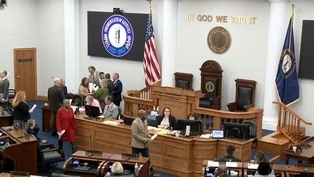
Senate Overrides Veto, Moves Ahead with School Tax Credit
Video has Closed Captions
Clip: S4 Ep344 | 3m 39s | State lawmakers override governor's veto on federal scholarship tax credit program. (3m 39s)

SNAP Rule Changes Push Kentucky to Rethink Food Aid
Video has Closed Captions
Clip: S4 Ep344 | 3m 31s | Lawmakers consider SNAP changes that could affect more than 47,000 Kentuckians. (3m 31s)
Providing Support for PBS.org
Learn Moreabout PBS online sponsorship New Episode
- News and Public Affairs

Top journalists deliver compelling original analysis of the hour's headlines.

- News and Public Affairs

FRONTLINE is investigative journalism that questions, explains and changes our world.

 New Episode
 New Episode
 New Episode

 New Episode
 New Episode
 New Episode
 New Episode
Support for PBS provided by:
Kentucky Edition is a local public television program presented by KET