
February 27, 2026
Season 4 Episode 332 | 26m 30sVideo has Closed Captions
A bill advances to allow tax credit scholarships for public and private school students.
A bill that allows tax credit scholarships to public and private school students is headed to the governor's desk. The U.S. Dept. of Justice sues the state for refusing to turn over voter registration data. The FBI director visits Eastern Kentucky. What the end of reformulated gas means for Louisville.
Problems playing video? | Closed Captioning Feedback
Problems playing video? | Closed Captioning Feedback
Kentucky Edition is a local public television program presented by KET
February 27, 2026
Season 4 Episode 332 | 26m 30sVideo has Closed Captions
A bill that allows tax credit scholarships to public and private school students is headed to the governor's desk. The U.S. Dept. of Justice sues the state for refusing to turn over voter registration data. The FBI director visits Eastern Kentucky. What the end of reformulated gas means for Louisville.
Problems playing video? | Closed Captioning Feedback
How to Watch Kentucky Edition
Kentucky Edition is available to stream on pbs.org and the free PBS App, available on iPhone, Apple TV, Android TV, Android smartphones, Amazon Fire TV, Amazon Fire Tablet, Roku, Samsung Smart TV, and Vizio.
Providing Support for PBS.org
Learn Moreabout PBS online sponsorshipmusic >> Shouldn't we have a choice of where our taxpayers dollars go?
>> State lawmakers advance a plan to let Kentucky opt into a federal tax credit scholarship program.
Is that helping students or hurting public schools?
Louisville drivers A change at the gas pump could mean more change in your pocket.
[MUSIC] >> Morgan's family never gave up on her, nor did this community give up on Morgan.
[MUSIC] >> And there are answers tonight in a child's kidnaping and death that's haunted a community for 30 years.
[MUSIC] >> Production of Kentucky edition is made possible in part by the KET Millennium Fund.
[MUSIC] .
>> Good evening and welcome to Kentucky Edition for this Friday, February the 27th.
We've made it to the weekend and almost the end of the month.
We thank you for joining us tonight.
I'm Renee Shaw, a bill that would allow for tax credit scholarships to public and private school students is now on its way to Governor Andy Beshear desk.
Our Emily Sisk has more on House Bill one, which Republicans say is a win for all K through 12 students.
Details.
As we kick off tonight's legislative update.
[MUSIC] >> Do you want to send $1,700 to Washington, D.C.
or do you want to invest in the education of a student here in Kentucky?
A dollar for dollar tax credit.
It cost you zero.
If you are a federal taxpayer.
>> Senate President Pro Tem David Givens making the argument on the Senate floor today in support of HB one, which would allow Kentucky to opt in to the federal tax credit program, which was made possible by President Donald Trump's one big, beautiful bill.
The measure allows taxpayers to reap a dollar for dollar tax credit for up to $1,700 when they donate to scholarship granting organizations, or sgaus.
>> As we all pay tax dollars, shouldn't we have a choice of where our taxpayers dollars go?
>> So what would happen with the money that's intended for this tax credit program?
Well, it would go to a scholarship granting organization of the taxpayer's choice.
These organizations are not for profit, and they could be set up by a school district or another entity.
One important part of the program is that the money could go toward public or private school students, which is where one Louisville Democrat's drew the line.
>> We have a way, because of what Trump did to bypass the Constitution of Kentucky and to bypass the will of the voters in Kentucky to give your tax dollars to private schools.
>> The other piece of HB one is who can receive the money that's been given to scholarship granting organizations.
Any family with a K through 12 student who makes at or below 300% of the area's gross median income, could stand to benefit.
>> 300% of the median income.
Average is $150,000.
If you have two parents working, that's $75,000 apiece that you're earning, and you would qualify for your kids with that, not those above.
That's the rich, those underneath that are the ones that qualify for this.
>> Once awarded, the scholarship money could be used on things like extracurriculars, private school tuition, internet access, books and more.
Despite some objections from minority lawmakers, HB one passed the Senate floor with a vote of 33 to 5, with one Democrat voting yes with passage in both chambers, it now heads to the governor's desk for his consideration.
For Kentucky edition, I'm Emily Sisk.
>> Thank you.
Emily.
If Kentucky opts in the tax credit, scholarships could begin as soon as next year.
A medicaid reform measure is headed to the Senate chamber after the House advanced a plan at week's end.
The Republican plan makes changes to Medicaid that will align with new federal requirements.
Supporters say the reforms will reduce wasteful spending in the program.
But as our June Leffler reports, Democrats believe House Bill five will create more barriers for Kentuckians to access and keep public health care benefits.
>> Last year, the Kentucky General Assembly created a new Medicaid Oversight and Advisory Board and made more rules for the state Department of Medicaid Services, in part citing how costly the program is.
>> Over the past five years, our Medicaid budget has grown from about 10 billion to 24 billion.
Despite seeing significant growth in program funding, our state continues to consistently rank at the bottom of the national health ratings.
>> This year.
Jefferson County Republican proposes House Bill two to reduce costs and add accountability.
>> I'll give you an example.
I had somebody literally in my office show me that they got a qualify for Medicaid at $44,000 a month, not a year, a month.
That's fraud.
>> Some of those changes include federal requirements in the big bill, like co-pays and work or community engagement requirements for nearly half a million Kentucky adults on Medicaid expansion.
The bill's sponsor says Kentucky's most vulnerable aren't subject to these changes.
>> These populations include pregnant women, caregivers for a dependent child under 13, and individuals with serious or chronic health conditions.
Individuals currently receiving services through the home community based waivers.
>> But Democrats say House Bill two adds more hurdles on top of federal statutes.
>> You can't be a human being in a body and not need health care, that we take our most vulnerable people and tell them, you've got to jump through these hoops, you've got to do this.
If we know there's fraud, why not go after the clinics that are defrauding the government?
Why not go after the people that are defrauding the government instead of making all the people pay.
>> A co-pay?
Might sound like a small amount, but for a Kentuckian who is battling cancer, a grandmother needing regular dialysis, or a neighbor managing heart disease, these are recurring and compounding barriers to life saving or sustaining care.
>> My prediction is in the next three years or so, our state will be in a huge mess of folks needing health care, not getting health care, dying of things that could have been prevented.
And I cannot vote for this bill in good conscience.
>> House Bill two passed 77 to 21, largely along party lines.
Before the vote, Democrats offered a host of failed amendments to address their concerns for Kentucky edition.
I'm June Leffler.
>> Thank you.
June.
Health care providers and insurance companies will also face tighter scrutiny under this bill.
The Department of Justice is now suing Kentucky for the state's refusal to turn over voter registration data that has Kentucky's Republican secretary of state worried about a data breach.
The DOJ wants voter registration data, which includes driver's license information and Social security numbers.
The department says it's to ensure clean voting rolls.
Secretary of State Michael Adams responded in a statement, saying, quote, Kentucky's elections are a national success story, and the Department of Justice has repeatedly acknowledged in our court, in court, our successful work to clean up the voter rolls I inherited.
Kentucky law protects voters personal information, and I will not voluntarily commit a data breach by providing Kentuckians personal data to the federal bureaucracy unless a court order tells me to end quote.
The DOJ is now suing 29 states and the District of Columbia.
Last week, the U.S.
Supreme Court ruled President Donald Trump went beyond his authority imposing emergency tariffs on products from other countries.
That was a topic during a debate last night on Spectrum News, one between former state senator Ralph Alvarado and current state Representative Ryan Dodson, two Republican candidates for Congress from Kentucky's sixth district.
The two talked about the ruling and who should have the power to impose tariffs.
>> So at the bottom line, I'm a I'm a free market Republican.
I do believe in free market principles.
However, the president does have some authorities which he's using right now when it comes to tariffs.
There are specific angles that that the Supreme Court ruled on that said that he could not do.
And so I think there's obviously a always a balance of powers between the Supreme Court and the executive branch and the legislative branch on things.
If those tariffs remain for a long period of time and it trickles down to the American consumer can cause a problem.
But we're seeing success.
I think in a lot of those people predicted the market would collapse under his policies.
And the markets have continued to do very, very well.
So I think it's a different approach.
I think it's an opportunity to get people to trade fairly with the United States.
Again, this is a president of action who's wanting to get those things done.
>> And I particularly did not agree with what the Supreme Court ruled, because I do believe that he needs that latitude to be able to negotiate, to be able to represent us in the global markets.
So with that being said, I do believe that long term tax implications should go through Congress.
But I believe that we need to give that up to the president to be able to negotiate on our behalf, because what we've seen done over the last year, we're seeing major investments coming back to America.
We've seen it coming back to Kentucky, all because of Donald Trump's trade policies.
So I just do believe that the trajectory that we're on is going to be very good a year from now.
Now, we're not as far as I thought we would be, but we are going even further.
I think over the next six months to a year.
>> The two also discussed the larger economy health care, vaccines, foreign policy, guns and more.
Alvarado and Dodson are not the only two candidates in the May Republican primary Adam Marquette, Greg Plucinski and Steve Shannon are also on the ballot.
Someone broke into and vandalized Andy Barr's campaign headquarters in Lexington yesterday.
Barr is a Republican candidate for the U.S.
Senate and the current congressman for the sixth district, which includes Lexington.
Barr calls the vandalism, quote, and the vandal a unhinged radical who has been a past critic of bars politics.
Barr thanked police for their quick response.
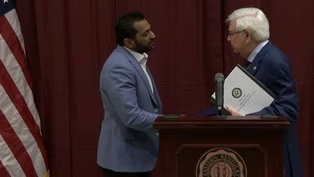
FBI Director Kash Patel was in Kentucky today.
He was joined by Congressman Hal Rogers of Kentucky's fifth district.
Together, they attended a law enforcement appreciation luncheon in Manchester.
Director Patel and Congressman Rogers celebrated the progress the FBI and local law enforcement have made reducing fentanyl and child trafficking in the state.
>> What we do at the FBI is simply resource the mission where it's needed.
And thanks to the chairman highlighting the specific needs of Eastern Kentucky, the FBI is here with our great leadership team in Louisville and our SAC there, and our headquarters components have surge resources here.
And specifically speaking, we've seized enough fentanyl with our state and local partners here in Kentucky that would have killed nearly 1 million Kentuckians.
And that's a large, large number.
We've also done an immense amount of work to reduce the number of child traffickers coming in and through the state of Kentucky.
So while they may be happening locally here and in rural areas, it's all interconnected to a bigger operation criminally from without Kentucky and also across our border.
So the FBI is committed to working with state and local law enforcement.
And when I asked them is what they're already doing, they've got the best Intel on the ground, especially in the rural communities.
They're sharing it with us and it's getting to our offices.
And then we're putting out the task forces like the Homeland Security Task Force and other task forces necessary to combat that, which is why you're seeing the historic results that we've been talking about.
>> Congressman Rogers also announced a $20 million investment in communication equipment for law enforcement in eastern and southern Kentucky.
He said the equipment will help ensure the department can communicate in the mountains during natural disasters.
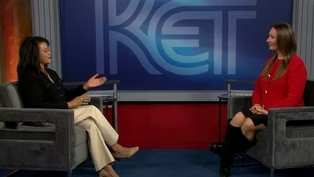
[MUSIC] Time now for our reporter's notebook, where we're going to digest some of the major developments of week eight of the Kentucky General Assembly and regular session.
And we're so glad to have with us Karolina Buczek, who is the politics in Frankfort, reporter for w l X channel 18 here in Lexington.
Wow, what a week.
>> What a week.
>> Yeah.
I mean, when last you were on, we were talking about how tempered the measures, the tempered the pace seemed to be for the session.
But things have really ramped up to high gear this week, has it not?
>> Yes.
I think I told you I would be regretting my words.
I'm sure I will be eating my words and wishing for a slow week very soon.
And I definitely am.
I mean, things just picked up.
It seems like out of nowhere and they are racing towards that finish line.
>> Yeah, the big item of this week the budget.
So that finally House Bill 500 and a couple of other bills related have moved through.
But the executive branch budget is what gets the most attention.
Tell us how you've been covering this, the main tenants of it and where where the conversation now goes.
>> Absolutely.
For the longest time, the conversation was like, where is the budget?
Right?
Where is it?
Well, now we have it.
The House passed its version yesterday.
So that's House Bill 500.
And the budget chairman describes it as a restrained budget.
He says this is about fulfilling needs, not wants.
But critics are looking at it and saying, is it really fulfilling Kentucky's needs because they're skeptical that it is so?
I think that's kind of the battle right now.
House Republicans are saying this is enough.
This sets up Kentucky on a good path.
And, of course, Democrats and other critics are looking at this and saying this isn't really going to do much to help regular Kentuckians.
>> And wonder, you know, that's that's exactly what we heard a lot of.
And Democrats also bemoaning the fact that there's no universal pre-K funding, things that weren't probably going to go anywhere anyway, but there's still some not completely satisfied with some of the K through 12 funding when it comes to transportation and other things.
So and Chairman Petrie, who is the budget panel chairman, has said, you know, it's got miles to go before it sleeps.
This is this is the first step and then it still goes to the Senate and then it goes to a conference situation.
So there's a lot of negotiating yet to be done.
What are you hearing particularly from the education community or others who feel like they got this time around?
>> Absolutely.
You're absolutely right.
This budget is going to change quite a few times before we get the final product.
But when it comes to education, I mean, education is always a hot button issue when it comes to the budget.
And this time around, what we saw come out of the house, they definitely increased that base SEEK formula.
So that per pupil funding that Kentucky schools receive, however, critics are looking at it and saying, listen, Kentucky funding has not even kept up with inflation over the years.
And one thing that they did not do is that they did not increase any funding for transportation, which was already not fully funded to begin with in Kentucky.
So education supporters and critics of this budget are looking at it saying, is this enough?
It doesn't seem like an increase at all.
That's the way they're looking at it.
But of course, people like the budget chairman are saying, you know, this, this is a good step.
We increased education funding, and House Republicans have said that this is a major priority for them, that they're focused on increasing education funding.
I mean, did they do it?
Yes.
Has it kept up with inflation?
It depends on who you speak with.
>> Who you ask.
Right.
Well, in education, as you just alluded to, has been the hallmark of this session so far.
Right?
A lot of education measures have gotten traction.
You know, we've had the House bill, one that was approved today.
You know, that's going now to the governor's desk.
DJ Roberts, Kim Mosier and the speaker are all sponsors of that measure that takes the federal tax credit up to $1,700 a year for those who contribute to scholarship granting organizations.
And many people have tried to conflate this with Kentuckians overwhelming rejection of constitutional amendment number two a couple of years ago, because it also would have allowed for public dollars to go to nonpublic schools.
So these are two different things, right?
>> They are two different things.
But the Republicans in the General Assembly, they know right now they have an image issue when it comes to tax credits, scholarship, tax credits, however you want to word it, people here in Kentucky, especially public education supporters, like their their their radar just starts firing whenever they hear stuff like this because they're worried.
They have seen the attempts that the General Assembly has made at state programs, and those programs have failed one way or another through court system, or they have been voted down by voters.
However, like you said, this is a federal program.
So this is different.
This program already exists.
It was created.
It was established by President Donald Trump's one big, beautiful bill.
So Kentucky Republicans are looking at it like we're leaving money on the table if we don't opt into this program.
So that's kind of where the fight is.
And there were a lot of lawmakers, too, that expressed confusion because they said, well, of course I want to do more for Kentucky students.
I don't want to leave this funding on the table, but they're a little skeptical.
They're like, are you sure that this isn't going to hurt public schools?
So that's kind of where we are.
>> Well, and House Democrat Tina Bojanowski, who was a public educator in Jefferson County who supported the bill, unlike some of her other Democratic colleagues, said that she looks at it as an opportunity for public schools to start their own scholarship granting organizations or those who are public education advocates that would go to things like fees and other types of activities that that people have to pay for.
So there could be a different way to reframe it for Democrats to become more on board.
>> Absolutely.
And this is something that the representative behind the bill, Kim Moser, she has really been highlighting this week.
She's been saying, listen, this is an opportunity not just for private schools, but also for public schools.
Everyone has an opportunity to create these scholarship granting organizations, and then you can use that money pretty creatively.
It does have to be used for educational reasons.
So tuition, transportation.
But she's like, we can get creative with how we use this money.
And if people are saying public schools are lacking in funds, this could be a great way to influx those schools with some money.
>> Yeah.
So what are you looking for in the next 20 something odd days before they wrap up April 15th, other than the budget?
>> Oh, boy.
I mean, there's a lot, there's a lot, but this is really an education legislation session.
That's what it has turned into.
So that's what we're looking into.
There are a lot of bills floating out there also about student aggression in classrooms and stuff.
So I'm looking to see where those go because there's some there's some debate on this.
Some people are looking at it like, do we do we refer our students to the court system or expel them from schools?
Is that really going to solve the problem?
But then others are looking at it like our teachers cannot be scared to go to work every single day.
And the Kentucky Department of Education has released some data that there have been 25,000 incidents of assaults on teachers since 2021.
So there is a problem in Kentucky.
The issue is how is the legislature going to deal with it?
That's a big issue that I'm looking at.
>> Yeah, I know you're looking a lot of things and a lot of miles to go before you sleep too.
So thank you, Karolina Buczek, for being on the case and reporting from Frankfort.
We appreciate your time today.
>> Thank you.
>> Now to answers in a 30 year old Kentucky cold case, seven year old Morgan Violi was abducted in Bowling Green in the summer of 1996.
Her body was later recovered in white House, Tennessee.
Her murder has remained a mystery for decades, until authorities say advanced DNA testing led them to question Robert Scott Froberg, who's been in custody in Alabama since 1996.
The August of that year.
He was an escaped inmate at the time of Viola's murder.
>> I hope this significant development brings some degree of closure for Morgan's mom, her dad and her two older sisters.
They've waited far too long for answers.
Yesterday evening, we were able to give them those answers and to begin their process of closure.
>> Authorities say Froberg confessed to killing Violi.
His DNA matched a strand of hair recovered from the stolen van used in her kidnaping.
Good news, Louisville drivers.
You'll be getting some relief at the gas pump thanks to the end of RFG or reformulated gas, mayor Craig Greenburg explained the change in a video.
>> Hey Louisville, RFG is gone and that's great news for our environment and your wallet.
30 years ago, reformulated gasoline was required to be sold here in Jefferson County because our air quality was not good.
Fast forward 30 years and we've made tremendous improvements in our air quality, and there's no longer a significant difference between RFG gas and regular gas.
>> RFG the change will come in late May and could mean a reduced cost of 10 to $0.15 per gallon of gas.
Good news.
[MUSIC] .
If you're interested in mystery meat falling from the sky and who's not?
Head to Bath KET tomorrow.
Our Toby Gibbs explains the strange phenomenon as he previews what's happening around the Commonwealth.
>> Check out a celebration that really takes the steak as Bath County brings back the Kentucky Meat Shower Festival this Saturday.
[MUSIC] [MUSIC] This year marks the 150th anniversary of the mysterious Kentucky Meat Rain.
The bizarre 19th century event that reportedly left chunks of meat falling from the sky.
The Kentucky Meat Shower Festival revisits that strange slice of history with vendors, games and a look at the only remaining piece of the so-called meat shower preserved at the Bath County History Museum.
Organizers even suggest bringing an umbrella just in case history decides to repeat itself.
They're blending bourbon, history and music in Covington with the Bonded Spirit Bluegrass Festival.
The event highlights Northern Kentucky's role in bourbon history and features live music, a cocktail competition, and connections to the region's self-guided Beeline Bourbon tours.
[MUSIC] The multi-day festival kicks off next Tuesday.
Three of music's most influential voices will be in the spotlight in Louisville this weekend, as the Louisville Orchestra celebrates the artistry of Joni Mitchell, Carole King and Carly Simon hear hits like Both Sides, Now You've Got a Friend, You're So Vain, and others that defined a generation all reimagined for full symphony orchestra.
The concert takes place Saturday.
[MUSIC] Immerse yourself in the dark and mysterious at the Virginia Theater in Somerset as it presents the Edgar Allan Poe Speakeasy.
Chapter two.
The Immersive Experience features four new tales inspired by Edgar Allan Poe's darkest works, atmospheric performances and themed cocktails in an intimate setting.
Performances are March 5th and sixth.
It's a festival that's all about the kiln and the community.
The Southern Crossings Pottery Festival highlights contemporary ceramics while exploring the long cultural history of pottery through demonstrations, exhibitions and educational outreach.
An Empty Bowls benefit will take place during the festival, with proceeds going toward efforts to end childhood hunger locally.
[MUSIC] They're going for the high notes and high honors at the 21st annual Altec Vocal Scholarship Competition, taking place this Sunday at the UK Singletary Center for the Arts.
Come here.
Vocalists from across the country compete before a live audience for more than $700,000 in scholarships and prizes.
And the opportunity to be part of the University of Kentucky's Opera Theater program.
[MUSIC] The event is free.
And that's what's happening this week around the Commonwealth.
[MUSIC] I'm Toby Gibbs.
>> Thank you.
Toby Gibbs.
More on what happened this week in Frankfort on comment on Kentucky.
Bill Bryant and a panel of Kentucky journalists will talk about the state budget, the future of data centers, and other issues before state lawmakers.
That's on your way in about eight eastern, seven central right here on KET.
So stay tuned.
And we sure hope to see you again Monday night at 630 eastern, 530 Central on Kentucky Edition, where we inform, connect, and inspire.
We hope that you'll connect with us all the ways you see on your screen.
You can stream us online on demand at Keturah.
Look for us on the PBS app that you can download on your smart device devices, and send us an email to the address on your screen.
A shout out with a story idea, perhaps at Public Affairs at Keturah.
And of course, we're on the social media channels for you to connect as well.
I'm Renee Shaw.
Have a great weekend.
We'll see
 New
NewCo-pays and Work Requirements Part of Proposed Medicaid Bill
Video has Closed Captions
Clip: S4 Ep332 | 3m 9s | Lawmaker says House Bill 2 aligns with federal Medicaid requirements. (3m 9s)
 New
NewVideo has Closed Captions
Clip: S4 Ep332 | 1m 40s | FBI Director Kash Patel attends law enforcement event in Manchester. (1m 40s)
 New
NewVideo has Closed Captions
Clip: S4 Ep332 | 7m 41s | Karolina Buczek of WLEX discusses education bills before the state legislature. (7m 41s)
 New
NewTax Credit Scholarship Bill Advances
Video has Closed Captions
Clip: S4 Ep332 | 3m 16s | Lawmakers advance a bill to create a tax credit scholarship program. (3m 16s)
Providing Support for PBS.org
Learn Moreabout PBS online sponsorship
- News and Public Affairs

Top journalists deliver compelling original analysis of the hour's headlines.

- News and Public Affairs

FRONTLINE is investigative journalism that questions, explains and changes our world.












Support for PBS provided by:
Kentucky Edition is a local public television program presented by KET