
February 23, 2026
Season 4 Episode 328 | 26m 30sVideo has Closed Captions
State workers say the current budget proposal would cause their health care costs to spike.
State employees and retirees bemoan possible spikes in their state-supported health plans. A judge rules Kentucky's lawsuit against TikTok can proceed. A psychologist discusses how social media addiction can impact a child's development. Learn about the novel way avid readers are enjoying community.
Problems playing video? | Closed Captioning Feedback
Problems playing video? | Closed Captioning Feedback
Kentucky Edition is a local public television program presented by KET
February 23, 2026
Season 4 Episode 328 | 26m 30sVideo has Closed Captions
State employees and retirees bemoan possible spikes in their state-supported health plans. A judge rules Kentucky's lawsuit against TikTok can proceed. A psychologist discusses how social media addiction can impact a child's development. Learn about the novel way avid readers are enjoying community.
Problems playing video? | Closed Captioning Feedback
How to Watch Kentucky Edition
Kentucky Edition is available to stream on pbs.org and the free PBS App, available on iPhone, Apple TV, Android TV, Android smartphones, Amazon Fire TV, Amazon Fire Tablet, Roku, Samsung Smart TV, and Vizio.
Providing Support for PBS.org
Learn Moreabout PBS online sponsorshipmusic >> It would not only increase their premiums, which is money straight out of your pocket, but they might be forced to choose a plan with less benefits.
>> Health insurance rates are on the rise for many.
Kentucky's public employees are fighting to keep their premiums steady.
>> We owe it to these children.
Who else is going to speak for them but us?
>> A new report shows how Kentucky is faring in child maltreatment cases.
[MUSIC] >> Silent Book Club globally calls it introvert happy hour.
>> And this club is BYOB.
Bring your own book.
[MUSIC] .
>> Production of Kentucky Edition is made possible in part by the KET Millennium Fund.
[MUSIC] .
>> Good evening and welcome to Kentucky Edition for this brand new week.
It is Monday, February the 23rd.
I'm Renee Shaw.
We thank you for spending some of your Monday night with us.
Health care costs are on the rise for many and now public employees and retirees in Kentucky are bemoaning possible spikes in their state supported health plans.
As lawmakers craft the state's two year budget, they'll have to decide whether taxpayers or those public workers should pay for the increases.
Our June Leffler has more from those who could see their premiums rise.
>> House Republicans draft budget bill House Bill 500 places a cap on state dollars towards public employee health plans.
The proposal any market increase greater than 5% a year should be passed on to the employee or retiree.
>> It would not only increase their premiums, which is money straight out of your pocket, but they might be forced to choose a plan with less benefits.
There'll be some drugs that are excluded under those things.
It can make managing your health very difficult.
If you don't get a health plan that is most tailored to your needs.
>> A state budget official wrote that employees could see their monthly premiums increase hundreds of dollars.
>> For a teacher, a rank three teacher.
In Kentucky, this means losing $486 a month.
That's nearly $5,800 a year gone from a paycheck that is already weakened in buying power.
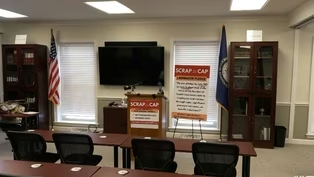
>> Kentucky's teachers union and others are asking lawmakers to scrap the cap as the budget process continues.
>> It's simple, it's specific, and it demands a straight answer, the pledge reads.
I pledge to vote no on any budget that shifts more of the burden of health insurance costs to employees and retirees through caps, significant premium increases or benefit reductions, yes or no.
>> Public employee representatives say keeping the cap would be a slap in the face for current perspective and retired workers.
>> When you retired and living on a fixed income, you don't have the option to go ask for a raise.
You don't have the option to switch jobs you're living with the decisions you made 20 or 30 years ago.
Decisions were based on promises the state made to you.
>> Kentucky House representatives will be the first to vote on the budget.
So far, the executive branch spending plan hasn't had a standing committee vetting or vote.
Kentucky speaker of the House blames the Beshear administration for any delays in revising the budget, saying, quote, the administration failed to provide the necessary information and data.
Without the requested information, it is impossible to make evidence based decisions.
But we will continue our efforts in subcommittees and with stakeholders and advocates.
>> When they say that this isn't the final form, I absolutely believe them.
I just don't know what the final form will look like in.
>> Lawmakers are.
More than halfway through the 60 day legislative session.
Today is day 32 for Kentucky Edition.
I'm June Leffler.
>> Thank you June for Legislative leaders will join us on Kentucky Tonight this evening to talk about the first draft of the House Republican budget plan that currently includes those health insurance provisions, plus several important education bills and a scheduled hearing tomorrow on machine gun conversion devices or what's called Glock switches.
A recap of the session and what to expect the rest of the way.
That's tonight on Kentucky, tonight at 8:00 eastern, seven central, right here on KET.
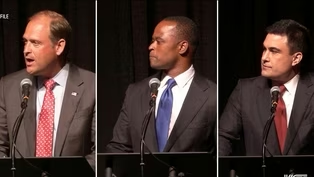
Now, while the state lawmaking session is hitting a new stride, so is the campaign trail for candidates in the closely watched U.S.
Senate race here in Kentucky.
Some of the high profile Republican contenders are dominating the TV airwaves with pro-Trump messages.
Last Friday, I talked with our political commentators, Trey Grayson and Bob Babich, about the candidates messaging and the quest to land a presidential endorsement.
This is part of our election 2026 coverage.
Bob Babich, Trey Grayson, thanks for being back for part two from our continuation discussion on Friday.
Bob, I'll start with you.
The U.S.
Senate race.
There's some interesting ads in the Republican primary, particularly coming from Andy Barr and Nate Morris.
What strikes you about the messages that these candidates in particular are sending at this juncture?
>> Well, we get mad about ads and often critique ads, but they are definitely designed from knowing the audience and knowing who you have to appeal to with, say, a 40% turnout in a primary.
You know who that's going to be in large measure.
You can see the voting history.
That's who you're talking to.
And if you pulled them and know how they feel, then you can gear and add to what matters most to them.
The Morris ad is very effective and will appeal to a lot of voters who will be primary voters on May 19th.
And Trey can definitely add more to that.
The the Barr ad is more inflammatory and more hard hitting.
>> It's not a sin to be white.
It's not against the law to be male.
>> He has caught up a bit in the polls and maybe gone ahead in the polls, from what we've seen lately.
Still a hunk of undecided voters.
Morris is the guy who has to gain.
Cameron is the candidate who has to hang on.
>> And ladies and gentlemen, let us speak truth.
>> That's that's where we are.
I would think we're going to turn the corner here shortly and see these ads and others like them all the time from now on, all of March, all of April, right to the end.
>> And we know that Daniel Cameron just does not have the money to be on television.
So is that pushing him even further behind because you were getting so much from Barr and from Morris right now?
>> Well, what he what he can hope to benefit from that he has this level of support and that as he loses support, that support splits between the two and he's able to hang on.
I think we've talked about this in the past, like a scenario where he wins is he gets 40 to 30 5 to 40% of the vote, and those other two kind of split the rest.
And and while he doesn't have a majority, he wins.
That's probably his winning scenario.
The Morris ad is striking to me.
As Bob mentioned, I think it's an effective ad.
We talk a lot about desire for all these candidates to get Trump's endorsement and that they're playing, in some respects, two different races.
There's the primary one, the president, and then there's everybody else.
Morris ad reminds us there's another really popular figure, maybe more popular in the Republican Party, which is Charlie Kirk.
>> Morris, we're behind you.
>> And I remember when Morris announced his candidacy, Kirk came to Kentucky.
They had an event, I think it was in Hardin County.
And but Kirk was tragically assassinated.
And I remember thinking, you know, in the wake of that, I was like, oh, that's kind of bad luck for Nate Morris, because Kirk can't come back and do get out the vote rallies and things like that.
Well, this ad has is Kirk's video talking about Nate Morris and his voice.
And Kirk is probably, as I said, maybe more popular than Trump.
It's not clear that he has the same electoral chops that Kirk endorsement delivers the way a Trump endorsement.
But I've seen this in heavy rotation even in Northern Kentucky.
I've got my we're taping this in the Olympics are just wrapping up.
So I've got my red, white and blue and even in Northern Kentucky.
So I'm broadcast television in Cincinnati.
Morris is running that ad.
And so people are being introduced to Morris as Charlie Kirk's candidate, who's this outsider business guy?
That's how I thought an effective or potentially effective message for him all along.
And we're just seeing this in heavy, heavy rotation.
So it'll be interesting to see the next time we get some polling.
Did that at work to get him back up into closer to Barr into Cameron.
I think it will make a big difference.
>> And Donald Trump Junior is in the ad as well.
>> Trump junior is in the ad.
>> Is he?
Yeah.
A second to the late Charlie Kirk in in many.
>> Ways yeah.
And it's a subtle you know it's subtle.
Right.
You got the president's son who namesake saying you know that's a really good point Nate.
And so we'll see.
But I just thought it was a great ad.
And I think a better strategy than maybe what he was doing at the beginning, which was focusing more on McConnell and less on himself and some of the other support that he has.
>> The week that we were talking, the debate schedule that they I think they're kind of agreeing on or seems to be gelling or at least forming by one candidate, Daniel Cameron, seemed to come out front and says this is what he's agreeing to do, and then we'll see how the others to kind of match up.
How does this usually work?
Do the campaigns talk to each other about what they will agree and how many they'll agree to do, and which ones?
>> Often what I did is we decided here's what we wanted to do, went first, and that shaped then the other candidates response.
I mean, I think there's a desire to do a few debates around the state.
Hopefully they're going to come here and you'll have a conversation.
I don't think we call that a debate.
I think.
>> We call it an.
>> Appearance, an appearance on KET.
But yeah, no, they don't really talk much.
Usually there's some strategy and that doesn't require cooperation.
>> So what's the liability for an Andy Barr or even a Nate Morris to come on, let's say a statewide television network.
What do they risk or what could they gain?
>> Same as with most debates, you can't make mistakes and you've got to get across a measure of superiority that appeals to primary voters, not to everybody who watches, but to that very important group of that vote's May 19th.
And knowing what moves them and how to appeal to them.
That's why people repeat themselves in debates and often mention themes and key goals over and over again.
>> Regardless of the question that's asked.
>> We get bored with that.
We get mad about that.
But there's a meaning to that.
They're talking.
Maybe not to us, maybe not to most people, but to the people they need to have on Election Day.
>> Yeah, it also creates some some buzz, you know, some of it is the audience who's watching.
You've got prospective voters and maybe open minded voters, but you also have people who comment on politics and who also then like us, but then also people who are just political.
The local elected official might watch it, and maybe that person already has an endorsement in mind, but that but she could say, you know, I watched that debate and, you know, Barr was great, Cameron was great, Morris was great or whatever.
And so you have that aspect.
It's because it's less there's the people who watch it, but then there's how the the coverage of the debate gets out there.
>> Good things to know.
Thank you guys.
Thank you.
In other news, the Kentucky judge says the state's lawsuit against TikTok can proceed.
Kentucky Attorney General Russell Coleman sued the social media platform in 2024.
The suit alleges TikTok is exploiting Kentucky's youth by getting them addicted to the platform and then targeting them with ads.
In a statement, General Coleman said, quote, this ruling is a critical victory in our fight to hold TikTok accountable and protect Kentucky's young people.
End quote.
Meanwhile, state lawmakers are considering a bill that would require large social media companies like TikTok to delete accounts for children under the age of 16.
The accounts could only be reinstated with parental consent.
House Bill 227 has cleared a legislative committee hearing and is waiting for a vote from the full House.
Because social media is such a presence in our daily lives, many are worried about the social, emotional and developmental impacts it can have on children.
Our Kristi Dutton recently spoke with a leading child psychologist at Norton Children's Behavioral Health to find out how social media addiction can affect a child's development.
>> Doctor Katie Hopkins is here.
Child psychologist with Norton Children's.
Okay, Doctor Hopkins, parenting in the age of social media is so hard because it's a world we didn't grow up in, and we've heard in the news a lot about social media addiction.
What is that and how big of a problem is it?
>> So, you know, I think that we need to be mindful that a lot when we talk about addiction, that we're actually talking about what what that means, what it means when anyone has kind of a problematic use of social media.
And when we talk about problematic use, we're talking about something that we see having a clear and detrimental impact on, not just their moods.
So decreased, you know, levels of happiness, increased depression, increased anxiety, increased negative self-image, but also impacting their functioning.
Sleep is a big one.
That's where we're really seeing just, you know, screen use in general.
But social media particularly can have a negative impact on on how much sleep they're getting.
Certainly if self image is wrapped up in that, it could be impacting their nutrition.
It could be impacting their behaviors.
So when we're thinking about determining or looking at social media addiction, we really have to think about how does that use cause a problem in a teenager or child's life.
>> Okay.
You touched on sleep a little bit as a big warning sign.
So how does social media affect a child's sleep patterns?
>> Well, I mean, basically the more they're on it, the more likely it is that they're going to be on it late at night, having a hard time getting off of it.
And it's impacting not only the quantity of sleep, but also the quality of the sleep, because their brain is still really active when you're on a screen, not just because of the content and the algorithms that keep scrolling.
You know, it's like an automatic video play after the, you know, you play one and then one is automatically loaded.
And I think all of us have experienced that where we're like, oh, I'm tired.
And then we say, I'll just check.
I'll just hop on Facebook or Instagram really quickly.
And then 45 minutes have gone by and we thought that we were only going to be on for ten minutes.
But also the light from the screens itself impact the production of melatonin in our brains and trick our brains into thinking that it's the sun is still out, which actually makes it more difficult for us to get that restful, deep sleep even after we've turned it off.
>> Okay, well, how does overuse of social media impact a child's brain?
We've you've told us some things to watch out for, but how does it impact brain development or attention span and those sorts of things?
>> Well, you know, it's a very.
Adolescence is a very tender period when it comes to brain development.
You're really developing things like identity.
You're developing the ability to sustain attention and plan for the future.
These are all things that we want to see happening in adolescents.
And again, we think about that onset of adolescence like onset of puberty.
So it's different for every child.
But somewhere in that 10 to 14 age.
So we're thinking about okay, our brains are built based on what we think the most, do the most and feel the most.
So if the content that we're engaging in.
Requires limited attention and a lot of reward, and a lot of these social media apps are designed in a way to give us immediate feedback, immediate reward, immediate clicks.
I mean, even the likes the like button is is can be really powerful where it's like this dopamine hit in our brain.
And so we start seeking.
We see kids really start to seek out activities that give them that immediate dopamine.
So that's that that happy hormone in our brain, our get up and go hormone.
I want to keep doing it hormone.
And so if we're if we're getting a lot of immediate hits, we're going to continue to seek out that short term reward system versus looking for things that give us more, longer term rewards and sustained happiness.
>> It's a sobering ranking.
Kentucky's child abuse and neglect rate far outpace the national numbers.
That's according to the Child Maltreatment Report for 2024, which was released last month by the Children's Bureau of the U.S.
Department of Health and Human Services.
We talked with officials to learn more about how children are faring across the state.
>> So in Kentucky in 2024, there were 14,505 victims of child maltreatment.
During that reporting period.
It was a very slight increase from the last report.
We saw just 21 more victims.
Kentucky continues to see just about double the national rate of child maltreatment, which is 14.1 per 1000 children, and the national rate is about 7.2 per 1000 children.
>> It's a complex web of factors that come together to put children like this at risk, and a lot of it is the environmental piece of it, where it's housing, money, transportation, substance abuse that sort of creates a toxic environment around the child that is going to put them at much higher risk of getting abused than a child who's not exposed to an environment like that.
Most of what people would think probably is physical abuse, where some injury occurs to a child as a result of the environment they're in, there can be psychological abuse, there can be sexual abuse.
And probably the biggest category, though, is neglect.
>> What we know is that a large majority of our victims of child maltreatment are little kids, young kids four and under and also one years old and under.
So that says to me that we have a lot of opportunity for prevention in supportive services for new parents.
So making sure that our new parents know about access to programs like the Hands program, which is a home visiting program for families to help support them through the first three years of a child's life that our parents and caregivers have access to child care.
Those are.
That's critical.
It helps to reduce stress.
Some other things to consider around prevention are just parents understanding developmental milestones for kids four and under.
That's a stressful time, especially for children who are not able to verbalize their needs.
Or if we have children in the home who have intellectual or developmental disabilities.
>> We all have a role in this, whether it's donating money to organizations that help with this kind of work, whether it is advocating for more social workers in the state, whether it is meeting your neighbor where they need something, all those things help, and it's going to take a monumental effort to make a dent in this.
But we owe it to these children.
Who else is going to speak for them but us?
>> Shannon Moody says state lawmakers have filed bills this session that, if passed, could make a difference in preventing child maltreatment.
One is House Bill 102, which would require continuous background checks and prohibit nondisclosure agreements related to misconduct involving school staff and students.
Another is House Bill four, which criminalizes grooming of minors.
[MUSIC] Now to turning the page on the classic book club.
It's a novel way for avid readers to enjoy community and their own reading material.
Our Laura Rogers explains the allure of silent book clubs for readers all around the world.
>> Like many people who love reading, I always wanted to open my own bookstore.
>> Schimmel's bakery opened in Bowling Green in April of last year.
>> Bowling Green didn't have an independently owned bookstore, and I just decided that it was the right time to take the risk.
>> It offers a curated collection across all genres, from the classics to historical fiction, romance and graphic novels.
>> Being able to imagine a person's life who doesn't exist, or who was alive but isn't now, and how their life was compared to how it is today.
It creates this multifaceted connection across different ages generations.
>> Connections have also been formed through the concept of the Silent Book Club, which meets monthly at Schimmel's Bakery to U.S.
Reed and Silence Together.
>> I thought I would only get five people at our first meeting.
You know, I thought I would have to beg my friends to come, and we got 35 people at our first meeting.
It was huge.
>> Danielle Edwards learned about silent book clubs on social media.
There are 2200 of them and more than 60 countries.
>> Reading can be such an isolating hobby.
It's not something that's usually so easy to share.
>> This flips that script, allowing readers to enjoy others company with no assigned reading or discussion.
>> You get to choose what you want to read, what genre you want to read.
You also don't have to answer those awkward questions.
Silent Book Club globally calls it introvert happy hour.
>> It's a little bit different from a lot of traditional book clubs, and there's not a set.
We are reading this book this month and that's what we're doing.
>> Elizabeth Durr created a silent book club in Warren County, Smith's Grove Community, meeting regularly at a local cafe.
>> It's just a way for readers to get together, to have some time to socialize with other readers, maybe get book recommendations, maybe swap books.
>> Silent Book Club members also share outdoor activities that incorporate books.
>> We will do some picnic at the park while doing silent reading, and we've also done actually an audiobook hike where people listen to audiobooks, that we go to the park and they go on a hiking trail.
>> In an increasingly digital world, many are once again turning to analog activities like reading and crafts.
>> It increases your ability to connect with others and their humanity.
Because if you can feel things for a character that doesn't exist, imagine how you can feel for your neighbor or the next person you see.
It gives us a chance to connect more with ourselves, with the humans around us and our community.
>> Schimmel also enjoys helping patrons choose what book to read next.
>> Bury them in recommendations, basically, and then they pick one that they're excited about.
That's a really good feeling.
>> You're able to go on an adventure with these characters, and I also just love storytelling.
It's a really great way to like, examine the human condition.
>> We also asked that age old question, can you really judge a book by its cover?
>> This has to do with the story, and all of this plays into it, which makes it an even more enjoyable read, because you get through the story and it all comes together as you're reading it.
>> Which makes for a satisfying, perhaps even happy ending for Kentucky edition.
I'm Laura Rogers.
>> Thank you Laura.
I like that concept.
Introverted Happy Hour The Silent Book Club began in 2012, in San Francisco.
They typically gather a few times a month at bookstores, libraries, and coffee shops.
There are at least a dozen a couple dozen chapters across Kentucky.
The Bowling Green club sets aside an hour for silent reading, along with time before and after for conversation.
[MUSIC] Tonight we look back to the day a Kentuckian won the World Heavyweight title, and it's the anniversary of an iconic World War two moment with a Kentucky connection.
Our Toby Gibbs has more in tonight's look at This Week in Kentucky history.
>> Henry Clay junior, son of the famous Kentucky statesman, was killed during the Mexican Wars.
Battle of Buena Vista on February 23rd, 1847.
He was 35 years old.
A little known Kentuckian on the U.S.
Supreme Court, Horace Harmon Lurton was born in Newport on February 26th, 1844.
President William Howard Taft appointed Lurton to the bench in 1910.
He died just four years later, in 1914.
President Franklin D Roosevelt established the Cumberland National Forest in Kentucky on February 23rd, 1937.
It was initially 350,000 acres.
Within days, Senator Alben Barkley urged it to be renamed the Daniel Boone National Forest, which happened in 1966.
Marines planted the American flag on Iwo Jima on February 23rd, 1945, and a Kentuckian is among those in the famous photo.
Private First Class Franklin Owsley of Fleming County would die in battle about a month later.
The famous Muhammad Ali Sonny Liston fight was February 25th, 1964, in Miami Beach.
Ali, then known as Cassius Clay, won the fight on a technical knockout when Liston wouldn't come out of his corner at the beginning of the seventh round.
Clay then became heavyweight champion for the first time.
Liston had been an 8 to 1 favorite, and that's a look back at This Week in Kentucky history.
I'm Toby Gibbs.
>> Thank you Toby.
Whose birthday is this week as well?
Happy birthday Toby Gibbs.
We hope to see you tomorrow night again at 630 eastern, 530 central for Kentucky Edition, where we inform, connect and inspire.
We hope that you'll connect with us all the ways you see on the screen, the social media channels.
Send us an email at the address on your screen and look for us on the PBS app.
Hope to see you right back here for Kentucky tonight in about an hour.
Until then, take really good care.
So long.
Video has Closed Captions
Clip: S4 Ep328 | 6m 28s | A look at candidate messaging in the U.S. Senate race. (6m 28s)
Kentucky Double National Rate for Child Maltreatment
Video has Closed Captions
Clip: S4 Ep328 | 3m 31s | New report shows Kentucky has double the national rate of child maltreatment cases. (3m 31s)

Signs of Social Media Addiction in Children
Video has Closed Captions
Clip: S4 Ep328 | 4m 48s | Child psychologist discusses how social media addiction can impact a child's development. (4m 48s)

Silent Book Clubs Become the New Social Chapter
Video has Closed Captions
Clip: S4 Ep328 | 3m 58s | The novel way avid readers are enjoying community. (3m 58s)
State Workers Asking Lawmakers to "Scrap the Cap"
Video has Closed Captions
Clip: S4 Ep328 | 2m 55s | State workers say the current budget proposal would cause their healthcare costs to spike. (2m 55s)
Providing Support for PBS.org
Learn Moreabout PBS online sponsorship
- News and Public Affairs

Top journalists deliver compelling original analysis of the hour's headlines.

- News and Public Affairs

FRONTLINE is investigative journalism that questions, explains and changes our world.












Support for PBS provided by:
Kentucky Edition is a local public television program presented by KET