
July 6, 2026
Season 5 Episode 4 | 26m 30sVideo has Closed Captions
Some Kentucky educators say students want to trade their laptops for textbooks.
Lawmakers hear from educators who say their students want more instruction from teachers and less from technology. A major AI company now has a stake in a Kentucky data center. Why the FBI arrested a former UK basketball player. A campaign focuses on reducing the use of plastic.
Problems playing video? | Closed Captioning Feedback
Problems playing video? | Closed Captioning Feedback
Kentucky Edition is a local public television program presented by KET
July 6, 2026
Season 5 Episode 4 | 26m 30sVideo has Closed Captions
Lawmakers hear from educators who say their students want more instruction from teachers and less from technology. A major AI company now has a stake in a Kentucky data center. Why the FBI arrested a former UK basketball player. A campaign focuses on reducing the use of plastic.
Problems playing video? | Closed Captioning Feedback
Where to Watch Kentucky Edition
Kentucky Edition is available to stream on pbs.org and the PBS app.
Providing Support for PBS.org
Learn Moreabout PBS online sponsorshipmusic >> Students are completely unengaged when using technology.
[MUSIC] >> Should schools ditch the screens and go back to old school learning?
On the heels of deadly flooding across the state, two Kentucky projects focused on mitigation and monitoring gain access to federal funds.
[MUSIC] >> You don't have to do everything, but just do something.
[MUSIC] >> And how a campaign is encouraging people to reduce single use plastics.
[MUSIC] >> Production of Kentucky edition is made possible in part by the KET Millennium Fund.
>> Good evening and welcome to Kentucky Edition for this brand new week.
It is Monday, July 6th.
Hope you had a great fourth holiday.
I'm Renee Shaw.
We thank you for spending some of your Monday night with us.
In 2025, the Kentucky General Assembly passed a bill aimed at limiting the use of cell phones in K through 12 public schools.
But some education advocates want to take things a step further, turning away from using laptops and tablets for instruction and going back to pen and paper.
As our Emily Prince reports, advocates say it could benefit students and teachers.
>> Students are telling us that they want to change and what they're experiencing in the classroom.
>> A big part of that change includes screen usage in schools.
Fleming County Schools superintendent spoke to the Interim Joint Committee on Education about proposed changes in his schools, including limiting screen time.
The school district's proposal would limit usage to 45 minutes a day for kindergarten through fifth graders, 60 minutes for sixth through eighth grade students, and 90 minutes for high schoolers.
>> One of the things that students are asking us to do is asking for more authentic learning, more meaningful discussion, collaboration, hands on experiences, fewer technology driven assessments, and learning connected to the real world.
>> Right now, many schools across the state incorporate technology like Chromebooks and iPads into learning curriculum.
A middle school principal in the Fleming County School District said her teachers are ready for a change.
>> Students are completely unengaged when using technology, and that doesn't.
It doesn't matter how closely you are monitoring them because they have figured everything out.
They know how to do more things on technology than the adults do, and so they are doing almost everything but what we are asking them to do.
So meeting with teachers at the end of the school year this year, the discussion was very much about what can we just go away from using our Chromebooks?
And I was like, absolutely, why not?
>> The principal said, right now, school leaders are in the process of ordering physical textbooks for the upcoming school year.
Today's committee also heard from national advocates against using screens for education.
Lawmakers were full of questions about the impacts of devices on learning.
>> Everything we do, I think now in Kentucky, is online testing from third grade to 11th or 12th grade.
What's your thought on that?
>> Online tests always bring back lower results than than hand tests.
>> But the presenter said since Kentucky went digital with its standardized testing about a decade ago, scores have steadily declined.
>> Gen Z is the first generation in recorded history to underperform their parents on nearly every cognitive skill we measure.
>> Is there a specific age for children at which it's okay for them to start using screen time for learning, and how much screen time is acceptable?
>> I would say anything primary you could get away with never touching tech.
I've never heard an argument why a kindergartner would ever need a screen, but once you get up into middle school and kids start to take a little bit more control of their homework and learning, that might be where it starts to make a little bit more sense up into high school.
But again, that should be very, very regulated by the teacher as opposed to kids just having a laptop.
>> Education Committee chair Senator Stephen West said based on today's testimony, there may be legislation forthcoming for Kentucky Edition.
I'm Emily Prince.
>> Thank you.
Emily.
Today's Committee on Education also heard from advocates wanting more training for students with dyslexia and a push for more coursework options for advanced students.
A data center project in Kentucky just announced a deal with one of the world's most valuable AI companies, Tara Wolfe plans to build a data center in Hancock County along the Ohio River that's in western Kentucky, according to the Courier-Journal.
The company says anthropic has signed a 20 year lease for the center.
Anthropic is known for its AI platform called cloud, which is similar to ChatGPT and Google's Gemini.
Tara Wolfe says it's a $19 billion deal.
They expect the data center to be up and running late next year.
Tara Wolfe also wants to build what would thus far be the largest data center in the state in northeastern Kentucky, near Ashland, it's costing more to cool our homes this summer.
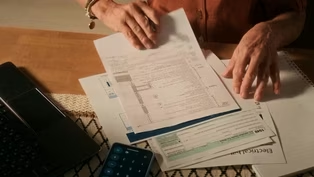
This year, state energy regulators approved rate hikes for urban and rural Kentuckians, though a federal program has for decades help low income households pay those utility bills.
And Eastern Kentucky lawmaker says it's just a band aid approach.
Our Jeanne Leffler explains.
>> Congress created the Low Income Home Energy Assistance Program, or Lightup, in the 1980s.
This fiscal year alone, it's offered nearly $50 million to keep the electricity on for hundreds of thousands of Kentuckians.
>> Because LIHEAP funds are appropriated by Congress every October, and we're always subject to whether they want to increase or decrease or not fund at all.
There has been some folks that would like to defund the program, but we're going to go ahead, go ahead and file as though we will be receiving those funds.
>> President Donald Trump wants to eliminate that funding.
As he proposed last year.
Congress did uphold the program in 2025, increasing overall funding.
>> But it looked like on slide three, the current proposed presidential budget would be eliminating this program.
So this is more of a statement of making sure that we are doing everything we can as, as legislators, to reach out to those who are part of our congressional delegation, to look out for these tens of thousands of Kentucky households who are benefiting from keeping their power on, on the coldest days, on the hottest days.
>> This Eastern Kentucky Republican values the program, but says one time seasonal assistance is not a solution for his region.
>> You go a maximum of $400 the next month.
You don't come back and give another $400.
They're cut off.
So we need to understand that this is just a Band-Aid for a certain period of time, not for a season.
I know our goal as a committee is to try to bring costs down and look at, and we know we're looking at coal regeneration, bringing it back, whatever we can do to reduce the cost, because we're just talking about helping a few that and there's a mass that needs help.
>> Lawmakers offered these comments last week at a natural resources meeting in Frankfort.
The Public Service Commission, the state utilities regulator, testified Thursday, saying it considers the cost to residential customers when approving utilities requests to power data centers.
>> When we had a couple of a number of cryptocurrency and crypto mining users come in, they weren't using anywhere close to this, but particularly the commission actually denied a couple of those applications because they looked at them and said, no, this is this has the potential of some costs being borne by the existing customers rather than the causer.
So.
>> Yes, we do have the power currently to disapprove a special contract that's brought before us, and we have done it at least a couple times since I've been here for projects that were brought to us that we did not think were good for ratepayers.
>> State lawmakers did not pass data center ratepayer protections this year.
Reporting from the Kentucky Lantern shows utilities favored oversight from the PSC rather than statewide legislation for Kentucky Edition.
I'm June Leffler.
>> Thank you so much for that.
June.
Flooding is the most common and costly natural disaster in Kentucky.
That's according to a 2024 report from NASA.
That same research cites flood damage totaling more than $40 million annually.
Recent flooding in Madison and Jackson counties killed four people and destroyed buildings and roads.
Bullitt and Cumberland counties were hit hard as well, with those deadly floods fresh on the minds of many Kentuckians.
Governor Andy Beshear announced federal funding is now available for two disaster related projects in the state.
>> FEMA recently announced it's releasing $189 million through congressionally directed spending for 125 projects across 40 states.
This is through the Pre-disaster Mitigation Program, and I'm happy to share that Kentucky had two projects included.
First, the City of Frankfort set to receive $5.8 million for the Frankfort riverbank stabilization after the floods hit here in Frankfort in April of 2025, we saw just how essential this project is for this community.
This funding will help us make progress as we continue to build back stronger for future weather events.
Second, Kentucky Emergency Management is receiving $869,000 for a flood monitoring system.
Flooding continues to be almost a monthly, but certainly a yearly challenge for the state.
And the more we can be prepared, the more lives that we can save.
>> The Frankfort Riverbank Stabilization Project is working to stop the Kentucky Kentucky riverbank from further eroding, while Kentucky Emergency Management will use its federal dollars to modernize its flood monitoring system.
In his funding request, Kentucky's fifth district, U.S.
Congressman Hal Rogers, said the money would, quote, address key shortcomings from persistent flash flooding in eastern Kentucky to secure the funds for both projects, must send FEMA an application by July 22nd.
It's now been more than three weeks since U.S.
Senator Mitch McConnell of Kentucky was admitted to the hospital.
McConnell's office confirmed on Thursday that the 84 year old remains hospitalized.
The reason for his stay is unclear, although there is reporting to suggest he was unconscious when paramedics were dispatched to his Washington, D.C.
home on June 14th.
On the latest episode of Comment on Kentucky last Friday, host Bill Bryant and his panelists discuss how a vacant U.S.
Senate seat is filled in Kentucky.
>> We've seen questions from not only Kentuckians, but people across the nation about the succession of Mitch McConnell.
If he were to die in office or vacate that seat in 2024, the General Assembly, they changed the law from a previous law change they had in 2021.
But the new law says that the governor must hold a special election after a seat were to become vacant in the U.S.
Senate for Kentucky.
But that law has not been challenged in court at this point, and it's unclear if the Beshear administration will challenge that, because there probably is immense pressure on him to go under what the state constitution says and appoint a Democrat to that seat.
>> And make it very clear we're not at that point yet, certainly, but.
>> There's been a lot of speculation online and a lot of incorrect information that's floating out.
>> There would likely be some pressure on the governor regarding the appointment from his party.
And then, of course, what the law says.
>> With a Senate this close, you can't discount it.
I think there's immense pressure, you know, to flip the Senate, to flip the House for Democrats.
I don't know if this is going to be an avenue for Beshear, but it's certainly going to be a question.
And like McKenna said, I have seen a lot of misinformation online there, like conspiracy theories that McConnell is hanging on just so that because Beshear has some window in which he can do appointments, that's not the case.
The state law says must call a special election.
But again, we could very well see some some challenges.
>> Phillip obviously everybody, you know, pulling for McConnell to come through this, but his legacy is cast at this point, right?
No doubt a very, very impactful figure on the Kentucky political scene.
>> I think Senator McConnell is going to be known as the most consequential senator in Kentucky history.
I think he's long since passed Henry Clay in that regard.
When you look at campaign finance, right, he was certainly the person who helped undo McCain-Feingold.
When you look at the Supreme Court, I think you have to call them McConnell court, right?
It was in 2016 when he held up that Supreme Court vacancy that Barack Obama could have filled.
That really gave the signal to a lot of social conservatives to support Donald Trump in 2016.
And then, of course, you know, when you ask average Kentuckians, Kentucky was able to punch above its weight for years as a small, poor state because McConnell was known to bring home that bacon and those resources.
So I think clearly his legacy, although he will be remembered as Darth Vader on the liberal side of things, and he certainly isn't beloved on that side of the political spectrum, his consequential and history Mark is, I think, very clear.
Now.
>> You can see the full program coming on Kentucky, including discussions about some key political races in Kentucky.
Just log on to ket.org to watch.
Comment on Kentucky right now.
After celebrating America's 250th birthday, we'll take a look at the principles that inspired America's independence, including and particularly service and civic engagement and how people feel about those principles today.
Join us for that discussion live on Kentucky tonight, this evening at 8:00 eastern, seven central, right here on KET.
A former University of Kentucky basketball player is accused of defrauding victims out of more than $2 million.
Kerr Chris was arrested by the FBI Friday in Lexington.
According to the federal indictment, Carissa lied about he and his family being in danger if a debt wasn't paid.
He also is accused of posing as his mother to ask for money to pay for her alleged cancer treatments.
The alleged crime began in 2022 and continued through June of this year.
Carissa is from Estonia.
He played for four college teams, including UK, during the 2020 425 season.
[MUSIC] Making a coffee run or going to pick up some groceries instead of using the single use coffee cups or plastic bags.
Consider switching over to a reusable cup or bag.
That's the message at the center of Plastic Free July, an international campaign Lexington has joined to encourage people to reduce their plastic use.
>> Plastic Free July is an international movement.
It started in Australia, and this is the second year that Lexington has officially participated.
And I know the name sounds intimidating, like it sounds like you have to give up plastic for a whole entire month, but we're really asking people to do is just choose one little thing to focus on and try and reduce their plastic use in that way, a few swaps that you can do are carry a reusable bag with you instead of getting single use plastic bags, and you'll be surprised at how often that comes in handy.
Decline straws or carry a reusable metal straw with you.
And the same is true if you're a person that does creamer in your coffee and you have a coffee stirrer.
Take your reusable water bottle, which you're probably already doing in this hot weather, or come up with your own challenge so you can tag us live Greenup Gex on Facebook and Instagram.
And we're asking people to show us all the creative ways that they are cutting down their plastic use this month.
Think of this as kind of like a mid year New Year's resolution.
So maybe it's you'll do it, you'll try it.
And then it might be a habit that will stick.
So for me, I try not to put my food in plastic.
And especially I don't heat it up in plastic.
So I have glass containers that I bring my lunch in or stainless steel if it's cold.
There's all kinds of reasons why people might want to do this.
In some cases, it can save you money if you do the coffee shop thing.
A lot of our local coffee shops will give you a discount, like 15 or 10% off for bringing your own cup, because that's one less cup they have to buy.
It's also good for your health.
If you've heard about microplastics, those are plastics that break down into very, very tiny pieces and they can end up in your body and your bloodstream.
Think about your day and how many times you use something that's plastic.
Some of it can't be avoided.
Our cars do have a lot of parts that are plastic, and that helps them be safer.
And for example, I wear contact lenses.
I'm not going to change back to glasses, but there are a lot of times where people use plastic just for convenience, and then it ends up in the trash and the landfill.
So we're just encouraging people saying, you know, you don't have to do everything, but just do something to help increase awareness and reduce the problem.
>> Louisville is also participating and has started its own campaign to reduce the use of everyday plastic items.
[MUSIC] In 1903, as the United States was growing into the 20th century, with city expansion and technological advances, one man decided he and his family were not ready for the change.
As our Chip Polston explains in this Kentucky Life extra, he moved more than 100 members of his family to the top of Brush Mountain, what is now part of Cumberland Gap National Historical Park.
Chip, tell us more.
>> Thanks so much and it's good to be with you again.
More than a century ago, Burton Hensley set out to preserve his love of the life his family had enjoyed for years, relying solely on themselves, raising cattle and farming the land.
Today, hikers from all over can visit what has been preserved of Burton's dream.
[MUSIC] 25 of the original buildings still stand in a beautiful pastoral farmland in what was once the Hensley settlement.
In the early 1900s.
[MUSIC] As cities grew and technology changed lives, one man, Burton Hensley, had a vision for his family to return to the days of old.
He fulfilled that vision by buying 200 acres on top of Cumberland Mountain in the Cumberland Gap area and creating the Hensley Settlement.
For Brittany Pike, a park guide for the Cumberland Gap National Park Service.
The Hensley settlement is one of the best preserved living museums of this time period.
[MUSIC] >> No matter where we're at, somebody has a connection to that culture that was our families.
And we we learn from what they have made.
We have learned from those stories.
And if we are not able to go back and see those things or hear those things, we are definitely losing that connection with our past.
And our past is very important to who we are today.
No matter where you are in the world.
>> Burton Hensley divided the land among his family members, and a small community of 100 people grew and prospered log homes, spring houses and barns for food storage sprang up across the landscape, along with the blacksmith shop and a church.
>> When visitors attend a tour today at Hensley Settlement, there are several different buildings that they get the opportunity to see how they were built, how they were and how these people lived, how how it was all set up.
And one of them, more specifically, is the schoolhouse behind me here.
And everybody expects when they moved on the mountain, that they didn't have a school or they had to go off the mountain for school, but the school was right here in the community.
[MUSIC] >> For over 40 years, these families farmed and raised animals and created crafts to trade with others in the area.
[MUSIC] >> This was a village.
Everybody worked together.
It was a community.
[MUSIC] Everybody was one big family.
[MUSIC] >> But just as Burton Hensley intended, the Hensley settlement remained isolated, reachable only by horse on dirt roads.
Electricity never reached the community.
The Hensley Cemetery bears witness to the tough times, with a number of graves for lost children.
>> You were taken a sleigh or a sled, something of that nature off the mountain or mule going off the mountain, you had to go find a doctor if someone was ill.
Sometimes it could be several weeks before someone was able to get back on the mountain to doctor whoever may have been ill, and especially young children, they didn't know what was wrong with them.
We knew they were ill.
We knew they didn't feel good.
Whatever the case may have been, you have a lot of young children in that cemetery because of that reason.
>> By the late 1940s, many members of the community began leaving for a number of reasons.
>> Reason.
The settlement itself started to punishing jobs that people were currently working, young men were working, and places has closed.
More specifically, the Chad Aull Gap Coal Company, just on the Virginia side of the mountain.
And they were having to go off the mountain to find work.
They were finding young women to marry, finding different modern things that they enjoyed, and they were starting to slowly move off the mountain.
[MUSIC] >> Sherman Hensley, who arrived in 1903, was the last to leave in 1951.
[MUSIC] Upon his death, Sherman Hemsley would return to the home he loved.
Today, the Hensley settlement is open for the public to explore many of the original buildings.
There are miles of trails available for hikers to experience the serenity and peacefulness Barton Hensley searched for over a century ago.
>> There's about 85 miles worth of trails.
Several trails actually access Hensley settlement.
You can access it from the Pinnacle Overlook if you choose to do so.
We are about 12 miles from the Pinnacle Overlook via the Ridge Trail.
At this time.
You can actually hike the Chad Aull Gap Trail as well on the Virginia side of the mountain.
Hensley settlement is very serene, very peaceful.
[MUSIC] When you stand and stand quietly and just listen, you hear the wind, you hear the rain, you hear the trees moving in the wind.
You you know your surroundings.
[MUSIC] And it kind of lets you touch base with nature.
[MUSIC] >> Great stories like this one come your way on our show every Saturday night at eight seven central, right here on KET.
As we continue to cherish this great Kentucky Life, back to you.
>> Thank you so much, Chip.
Tonight we look back at two presidents with Kentucky connections.
And what's the story behind one Kentucky County's unusual southern border?
Our Toby Gibbs explains.
And this look at this week in Kentucky history.
>> President Zachary Taylor died in the white House on July 9th, 1850.
Although he was born in Virginia, his family moved to Kentucky when he was a baby.
Kentucky was his home until he joined the Army, and he's the only president buried in Kentucky at the Zachary Taylor National Cemetery in Louisville, Simpson County in southern Kentucky has an odd shaped border with Tennessee.
[MUSIC] Weather conditions caused a surveying mistake in 1780, resulting in a divot that left part of Kentucky extending into Tennessee.
[MUSIC] But there's more.
A Tennessee landowner named Middleton said 100 acres of his land extended into Kentucky, but he wanted it to be in Tennessee.
So after a survey on July 6th, 1859, it was agreed to redraw the boundary, allowing the man to keep his property in Tennessee.
The divot within a divot is often called the Middleton offset.
[MUSIC] Happy birthday to Charles Morehead, Kentucky's 20th governor, serving from 1855 to 1859, he started off his political career in the Whig Party, then became a member of the Know Nothing party.
He is the only Kentucky governor elected from that party.
[MUSIC] President Franklin Roosevelt visited Covington's Latonia >> Racetrack.
On July 8th, 1938, while campaigning for Senator Alben Barkley in his reelection campaign against Governor Happy Chandler, Barkley won.
 New
NewLIHEAP's Effectiveness Questioned as Rates Rise in Kentucky
Video has Closed Captions
Clip: S5 Ep4 | 3m 14s | As utility bills climb, Kentucky lawmaker calls federal aid a temporary fix. (3m 14s)
 New
NewMonth Focused on Limiting Single-Use Plastics
Video has Closed Captions
Clip: S5 Ep4 | 3m 1s | A look at some of the ways to limit single-use plastics. (3m 1s)
 New
NewPush for Less Screen Time Brings Pen, Paper Debate
Video has Closed Captions
Clip: S5 Ep4 | 3m 38s | Some educators push to bring pen and paper back to the Kentucky classrooms. (3m 38s)
Providing Support for PBS.org
Learn Moreabout PBS online sponsorship New Episode
- News and Public Affairs

Top journalists deliver compelling original analysis of the hour's headlines.

- News and Public Affairs

Today's top journalists discuss Washington's current political events and public affairs.


 New Episode
 New Episode
 New Episode
 New Episode
 New Episode

 New Episode
 New Episode
Support for PBS provided by:
Kentucky Edition is a local public television program presented by KET