
April 15, 2026
Season 4 Episode 365 | 26m 30sVideo has Closed Captions
A Senate panel halts the impeachment trial of a Fayette circuit judge.
A Senate committee postpones the impeachment trial for Fayette Circuit Court Judge Julie Goodman. Lawmakers finalize the Judicial Branch Budget but say higher filing fees are needed to offset a projected shortfall. Gov. Beshear weighs in on the 2026 legislative session. State Auditor Allison Ball testifies before a Congressional panel on Medicaid fraud.
Problems playing video? | Closed Captioning Feedback
Problems playing video? | Closed Captioning Feedback
Kentucky Edition is a local public television program presented by KET
April 15, 2026
Season 4 Episode 365 | 26m 30sVideo has Closed Captions
A Senate committee postpones the impeachment trial for Fayette Circuit Court Judge Julie Goodman. Lawmakers finalize the Judicial Branch Budget but say higher filing fees are needed to offset a projected shortfall. Gov. Beshear weighs in on the 2026 legislative session. State Auditor Allison Ball testifies before a Congressional panel on Medicaid fraud.
Problems playing video? | Closed Captioning Feedback
How to Watch Kentucky Edition
Kentucky Edition is available to stream on pbs.org and the free PBS App, available on iPhone, Apple TV, Android TV, Android smartphones, Amazon Fire TV, Amazon Fire Tablet, Roku, Samsung Smart TV, LG TV, and Vizio.
Providing Support for PBS.org
Learn Moreabout PBS online sponsorship[MUSIC] Why is this judge's impeachment trial now?
On hold?
[MUSIC] We'll tell you.
>> Production of Kentucky edition is made possible in part by the KET Millennium Fund.
>> Good evening and welcome to Kentucky edition for this Wednesday, April the 15th.
It's tax day.
I'm Renee Shaw, and it's also the last day of the General Assembly in regular session.
And I'm coming to you from KET Studios in the Capitol Annex in Frankfort.
And we thank you for winding down your Wednesday with us.
Well, things are getting pretty interesting here in Frankfurt.
Earlier today, it was determined that there will be no trial this week for Judge Julie Goodman of the Fayette Circuit Court.
The Kentucky Senate was supposed to begin hearing the impeachment case against her, but a Senate impeachment committee voted to postpone that trial indefinitely.
Our June Leffler tells us why as we kick off tonight's legislative update.
>> For the first time in two centuries, Kentucky's House impeached a sitting judge last month.
Fayette Circuit Court Judge Julie Goodman allegedly abused her power and disregarded the law.
In a number of cases, House members voted to send Goodman to a trial in the Senate, but that is now on hold.
>> I cannot stress enough that the actions this committee takes today are driven by two factors only the Senate's duties under the Constitution and fairness to the defendant.
It is the sense of this committee that those two concerns can be best served by tabling further proceedings in this matter.
This will allow the JCC to complete its role.
If necessary.
This matter can proceed to another legislative session.
>> The JCC is the Judicial Conduct Commission, which handles complaints against sitting judges.
The JCC cannot confirm or deny if it is conducting an investigation against Goodman, but senators say one is underway.
>> Significantly.
The Supreme Court did reveal for the first time that Judge Goodman is undergoing a parallel proceeding in the Judicial Conduct Commission that addresses the issues contained within the Articles of Impeachment.
It is unfortunate that the existence of that was not known to the House when the inquiry early in the process was requested.
>> Goodman has fought her case in court, and last week the Kentucky Supreme Court ruled the House's impeachment violates the powers of the judicial branch.
Senators say that ruling isn't what's stopping them.
>> This should not be viewed in any way as seating or abrogating the Senate's rights and duties.
Under the Constitution of the Commonwealth of Kentucky.
>> The JCC has the authority to privately or publicly reprimand a judge, or suspend or remove them from office.
If the JCC holds hearings regarding a complaint, those would be held in public.
Kentucky Senate president, issued a statement today saying, quote, the Senate implores the JCC to conclude a comprehensive and prompt investigation and provide a report of its findings to the Kentucky General Assembly.
At such time, it may be proper for the General Assembly to proceed further.
For Kentucky edition.
I'm June Leffler.
>> Thank you.
June.
And this story does not end there.
Just about 75 minutes ago, Kentucky Senate President Robert Stivers recommended a Kentucky Supreme Court justice be censured.
He says justice Kelly Thompson's statements in his concurring opinion in the Goodman case threatens the independence of the legislature that Stivers and others believe threatens the license to practice law and could face possible criminal penalties for participating in the proceedings.
The Senate resolution was adopted in the Senate by a voice vote.
It was a heated debate on this development that we will break down even further tomorrow night on Kentucky edition.
Well, the budget for Kentucky's judicial branch has been finalized.
The two year spending plan passed both chambers yesterday evening, and Kentuckians will see an increase in filing fees to help offset a projected shortfall.
Our Mackenzie Spink has the details on House Bill 504.
>> The judicial branch is seeing an increase in funding over the next two years.
The current budget includes $466 million from the general fund, but that will increase to 498 million by fiscal year 20 2728.
However, before the veto period, Chief Justice Deborah Lambert posted on social media that she was, quote, deeply disappointed with the funding levels.
The progressive leaning Kentucky Center for Economic Policy says the reason the judicial branch will feel a pinch despite the higher funding is because of the rising cost of health insurance and 2% worker raises.
The governor agrees that the budget is not sufficient.
>> Among his concerns, and also outlined in the veto message, the judicial branch has publicly stated that it projects a general fund deficit of $12,600,000 next fiscal year and 17 million the following fiscal year, and that this poses significant problems for the judicial branch.
>> Representative Jason Nemes says that projected deficit is no longer accurate because the legislature and the judicial branch found solutions included in House Bill 504 that will narrow that gap.
>> While the courts initially projected a shortfall of approximately $13.5 million per year, discussions with the Chief justice and information exchanged with the Administrative office of the court's Budget Office have helped narrow that gap considerably.
Actions, including included in HB 504 address a significant portion of the shortfall.
Taken together, these actions reduce the potential shortfall to less than $500,000 annually.
>> Those actions include an increase in filing fees, which Nemes says is projected to generate $5 million annually for the courts.
Democratic representative Lindsey Burke says it's not fair to shift that financial burden onto the people.
>> The judiciary needed $5 million per year that we're asking your constituents to pay through increased filing fees.
It's already expensive for people to go to court.
They struggle to hire attorneys.
They struggle with filing fees, making access to justice even more out of reach for low to moderate income families is not in the interest of justice and Kentucky.
>> The House voted to override the governor's veto in a 76 to 16 vote, and the Senate did the same, voting 27 to 6.
The bill has been delivered to the Secretary of State for his signature for Kentucky edition.
I'm Mackenzie Spink.
>> Thank you so much, Mackenzie.
Late last night, state lawmakers also overturned Governor Beshear's veto of House Bill 904.
The omnibus sports wagering bill underwent a number of changes during the legislative process.
In its final form, the bill bans some prop bets on college athletes in Kentucky and introduces fixed odds horse racing.
It also raises the legal sports betting age from 18 to 21, attempts to put guardrails on prediction markets, and calls for a regulatory framework for fantasy sports.
In his veto message, the governor said the bill prevents him from carrying out his constitutional duties by allowing boards and agencies to impose rules on Kentuckians without executive oversight.
Some Democrats in both the House and the Senate joined Republicans in overriding the governor's veto of House Bill 904.
Changes to last year's film tax credit bill are working their final way through the session as the clock keeps ticking.
Senate Bill 324 would make music industry productions eligible for the tax credit.
Democrat Mary Lou Marzian of Louisville was concerned that productions don't have to hire a certain amount of locals to qualify for the credit.
>> I like this bill and I like promoting Kentucky and seeing movies that have Kentucky, bridges and rivers and folks in them.
But the.
But the concern I have, and I guess I don't see it in this bill is is there a certain cap or certain amount of people that must be hired before they can get these tax credits?
And the concern I would have is they might say, well, we have two people out of 100.
So we're going to take you to the cleaners.
I just want to make sure that there are certain guidelines and guardrails that Kentucky folks will be hired, will be used for the catering.
I mean, there's lots of side businesses that businesses that go along with the film industry, the equipment that's needed, the people that carry around the equipment.
And I certainly would hope that we are vigilant on watching over to make sure that that they don't take the tax credits, but then bring in their own folks.
Thank you.
>> In response, Representative Suzanne Miles, a Republican, says there are different tiers of incentive for productions to hire local talent.
The House okayed the bill, and later the Senate gave unanimous passage to the measure, and it now heads to the governor's desk, where he can sign it, veto it, or allow it to become law without his signature.
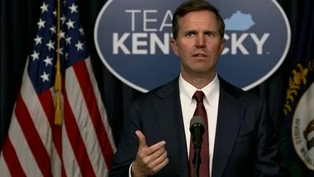
Governor Andy Beshear claims.
One word sums up this legislative session denial.
He says the Kentucky General Assembly denied the state's spending needs and Medicaid, housing and other programs.
>> It was also denial of of people struggling to put food on the table.
With the SNAP cuts that have happened and are coming.
My budget had $50 million going to our food banks to help people in need.
Not only did they not do that, they didn't fully fund senior meals after what we saw previously, which suggested that that they thought that was important.
We didn't see any extra dollars to make health care more affordable.
After Congress didn't extend the ACA credits that so many people needed, we didn't see a rural hospital fund, which I tried to create, to make sure that this largest payroll in so many of these communities doesn't close, because if it does, so does the the local coffee shop and restaurant, bank, insurance company.
I mean, those are just such important parts of, of rural Kentucky and rural America.
But my job is to take whatever good I can from this budget and to continue the momentum that we've got.
I don't believe in excuses.
And so we will do our best in each of these situations to to find a way.
>> So as state legislators in Frankfort continue their work on the last day of the session at the state Capitol, Kentucky State Auditor was in the U.S.
Capitol testifying before a congressional panel.
Allison Ball was one of the witnesses at a hearing called by the House Committee on Oversight and Government Reform, chaired by Republican Congressman James Comer of Kentucky, the focus of today's hearing fraud in state run federal programs like Medicaid, SNAP and unemployment insurance.
Ball told committee members that a state government audit by her office for the 2020 fiscal year revealed more than $1 billion in waste, fraud and abuse and that a majority of it involve Kentucky's Medicaid program.
>> This exam revealed that Kentucky paid $836 million to managed care organizations for the same Medicaid beneficiaries, whose coverage was also being paid for by another state.
To be clear, this is definitively waste because one state's payment to an MCO covers all health care of all Medicaid recipients.
So when two or more states are paying Mcos for the same person, only the MCO, not the Medicaid recipient benefits.
But that's not all we found in conducting the last three audits required by the Single Audit Act, we have revealed a plethora of problems that show Kentucky is a target rich environment for waste, fraud, and abuse in the executive branch.
These problems include dead people remaining on Kentucky Medicaid, multiple people using the same Social Security number to obtain Medicaid and eligible non-citizens receiving Medicaid benefits.
We found that on this, $836 million of waste that we discovered because when we started doing interviews with boots on the ground and then with leadership, we found out that people that were actually doing the work were told, hey, this is not that big of a deal.
It's low priority.
If you get to checking somebody's residency, you know, that's good, but it's really not that big of a deal.
So it really did expose that the attitude at the top really does make a difference.
I think that's why it's really important today that we're here, because you are indicating to all the American people, hey, this really matters.
And that has a cultural response and a cultural change.
So I would say the culture is important.
I also think that we need to be reviewing things at all levels.
So as we've started to get more aggressive on reviewing the error rates, those error rates have begun to go down.
We saw that with SNAP, we went from 9.1% to 3.5% error rates, just because we were actually involved in the process.
And we were identifying particular errors.
>> Auditor ball was asked if she thought using biometric information like a fingerprint as proof of identity would help cut down on fraud, ball said a secure, reliable identification process would be helpful, but believes it's better to focus on record keeping and responding immediately to red flags.
>> I will say for us, in our experience, it's not always proven that somebody is who they say they are.
That's the problem.
It's other kinds of breakdowns.
So my focus has been on problems of, well, we know this person is dead, but they're still listed as eligible and issues like that.
So so I would say you are correct.
That is part of the problem.
But but my focus has been on a lot of other problems.
Duplicative payments for one person, issues like that.
And I would say those may be the greater issues of concern right now, rather than someone pretending to be somebody that they aren't.
>> According to the U.S.
Government Accountability Office, in 2024, the U.S.
government lost between 233 billion and 521 billion to fraud.
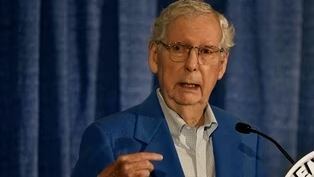
Now, turning back to the state Capitol here in Frankfurt yesterday, the House and Senate overrode the governor's line item vetoes in House Bill 757, the state revenue bill that includes several business and individual tax changes.
A portion of that bill authorizes a privately funded statue of U.S.
Senator Mitch McConnell for the state Capitol Rotunda.
During his news conference in April, the governor talked about why he didn't think Senator McConnell deserved a statue in the rotunda.
>> I will also tell you that with everything going on in our country right now, Mitch McConnell could have prevented it.
Mitch McConnell was that person who could have stepped forward after impeachment and prevented this new term where we have tariffs that are making things cost too much for our families, where we're in a war with Iran that hasn't been explained to our people or to Congress, where gas is spiking at such a significant level.
So I'm not in favor of it.
>> On these issues.
>> On KET Kentucky tonight, on Monday night, Senate President Robert Stivers and House Speaker David Osborne talked about why they think McConnell deserves the honor.
>> This individual has been in office for 40 years, has impacted this state, has impacted this nation, and has impacted this world as no other Kentuckian has done.
Maybe ever, except for possibly two people, one being Lincoln and Henry Clay.
I don't know if that is the criteria, how you argue that any other person has been around for a little less than 41 years, 40 years that has been on every national news story has been considered the most prominent Republican when in the in the nation, which makes him the most prominent Republican in the world.
When there was an individual, be it Clinton, Obama, or, or or any other Democrat elected official to the presidency, this was the opposition to that individual.
And so I find it hard to argue with that rationale.
>> Mr.
speaker.
>> I would agree.
I think that clearly leader McConnell is the most certainly the most consequential Kentucky political figure of my lifetime.
And I would submit to you in the history of the Commonwealth.
And also, I think in the history of this country, he will he will be recorded in the history books as being one of the most significant figures in American political history.
That doesn't mean that you have to like him.
You know, when when if you read the history books, you know, Henry Clay was less than admired person at many times in his political career, was a very controversial figure, as was Alben Barkley.
Alben Barkley was was an absolute partizan.
That that was was controversial at times.
I don't think that we have to say that we are broadly accepting these as, as as well-liked people.
But their their political significance that have have molded the shape of this Commonwealth in this country.
>> Those comments were part of a broader conversation about the 2026 Kentucky General Assembly's regular session and its accomplishments.
You can see more of that online on demand at ket.org.
Johnny Nash.
KY.
Tonight, one of the best known figures in the Beshear administration is leaving his job.
Jim Gray, the state transportation cabinet secretary, will take on a different role as a part time special advisor to the governor on transportation policy.
Gray has been transportation secretary since Governor Beshear took office back in 2019.
Before that, he served two terms as mayor of Lexington.
In a statement, the governor praised gray for delivering safer roads and bridges to Kentucky and for his response to natural disasters.
The governor announced the current secretary of the Energy and Environment Cabinet, Rebecca Goodman, will become secretary of the Transportation cabinet.
Now we're counting down to Kentucky's 2026 primary election.
Dale Romans, a Democrat running for the U.S.
Senate, is out with his first TV ad.
Here's part of it.
>> And I know what Kentucky needs in Washington.
An independent Democrat that can go to Washington, DC and vote for what's right for the people of Kentucky that wouldn't be beholden to the party, but also wouldn't be a puppet to the president.
>> Romans is a horse trainer whose horse Shackleford won the 2011 Preakness.
This is his first run for public office.
Now.
More campaign news.
Kentucky's two largest cities are picking mayors this year.
Candidates debated in both races last night.
In Louisville, 11 candidates are seeking the city's top job.
Incumbent Mayor Craig Greenburg is seeking reelection, but he was not one of the eight candidates taking part in last night's debate.
He said he had a prior commitment in Frankfort.
The mayor's race in Louisville is now nonpartisan, meaning all 11 candidates will appear on the May 19th ballot.
The two top finishers will move on to November 7th.
Candidates are running for mayor of Lexington, and it's also a nonpartisan race.
Mayor Linda Gordon is seeking a third term.
Four of the seven candidates were there for last night's debate.
Mayor Gordon was one of them.
The top two finishers in the May 19th primary will compete in November.
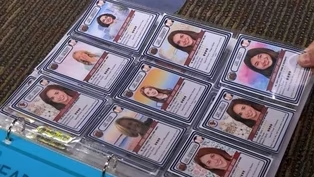
[MUSIC] From baseball cards to Pokemon cards have long been fascinated by trading cards.
Now, card collecting is getting students to read more books at a Bowling Green school.
As our Laura Rogers explains, those cards have some familiar faces.
>> Hannah Ogden is library media specialist at McNeal Elementary.
>> There is a line out the door some days for kids who are checking out books.
>> The library is among the most popular places in school.
>> Our circulation has definitely gone up.
I ran the numbers just a few weeks ago, and there is a measurable difference for Amelia Bedelia.
>> That increased enthusiasm for reading is thanks in part to collectible trading cards for the books students read.
>> Yeah, we all read those.
We know that reading incentives don't work unless it's part of a bigger culture of reading within the school, and the trading cards have have been really instrumental in creating that sort of culture.
>> In fact, it's not just teachers, but custodians and cafeteria workers who have their own trading cards.
>> Mr.
Doyle, Miss Hetty.
>> Even the principal, Miss Emily Mills, has a card to collect.
>> That's one of my favorite things, is to walk down the hall and a student.
Miss Mills.
I get your Carter.
Miss Mills.
I'm going to get your card next Tuesday or Miss Mills.
I'm going to read this book to get your card.
>> To get their principal's card.
Students read her favorite children's book author Mo Willems.
>> 25.
>> Which also encourages conversations around literacy.
>> So I'll tell them my favorite kids author is Mo Willems, and they love that.
And they're like, oh, I've read the Piggy and Elephant book, or I've read the Don't Let the Pigeon Ride the bus.
>> Mills says she's seen growth in students self-confidence with reading.
>> It has taken it to another level for all of our students.
>> And it really does include all of the students in kindergarten through fifth grade.
>> Not a lot these days will excite a five year old and an 11 year old at the same time.
But this does.
>> It's also accessible to every student that's willing to read more books.
>> Do you have Mr.
Kings biography card?
>> Not every student has Pokemon cards or not, every student has the ability to get them, but with these reading trading cards, they do.
>> Hannah Ogden was inspired by a friend's experience at a tech conference in Boston, where she learned of a school librarian doing something similar.
>> We sort of took that and we ran with it.
As far as I know, we were the first school to transfer that over to staff trading cards.
>> A bonus has been students connecting with more teachers and staffers they otherwise wouldn't get to know.
>> Like our our speech teacher, for example.
Not all of our students know her unless they go to her for speech, but now she is the if you give a mouse a cookie card.
And so she's got students running up to her telling her that they earned her card.
>> There are at least 65 cards for students to collect, and they're always changing.
>> To kind of keep it fresh.
We don't want it to get stagnant.
>> They hope to encourage kids to read across several genres and authors, and to learn more library skills.
>> Some reading promotions.
I feel like I'm only reaching students who already loved reading, but this one, it has had such a broad impact.
It's just been a tremendous success.
>> For Kentucky edition, I'm Laura Rogers.
>> When feral cats are brought to animal shelters, it can be difficult to find homes that suit their needs.
In this Kentucky Life extra, our Chip Polston examines how these feline friends are now working and living their best lives.
Chip.
>> Thanks much and it's good to be with you again.
The working Cat project has found a positive solution.
Did you see what I did there?
To finding permanent homes for feral cats?
Their mission is to connect these furry friends with property owners who are struggling with rodent problems in their barns, stables or warehouses.
These cats provide chemical free pest control and find their forever home in the process.
>> She's an early employee.
She gets let out first thing in the morning, screams a little bit for breakfast and gets breakfast, and then she checks her out on the barn, checks around on the stalls.
Pumpkin works sunrise to sunset unless it's super cold, and then she clocks out at five for sure and goes and lays on her fleece blanket or her little snuggly bed in the feed room.
>> And screams about the weather.
[MUSIC] >> I'm Ginger Dannemiller, this is my daughter and business partner, Caroline, and we're at True Blue Farm in Lexington, Kentucky.
[MUSIC] >> We bought the farm in late 2019 and when we took it over, there was a lot of rats and rodents that we didn't.
>> Want, and the rats were literally eating through the sheetrock to get to our grain.
So it was a big issue.
We tried traps, which was really not very fun for anybody.
We didn't want to put chemicals down.
[MUSIC] So we found out about the working Cat project and we got our first two working cats.
No more rat problem in a day, no more rats in the feed room.
And they took them a while to eradicate the rest of the rats in the barn because we did have a lot, but they were amazing hunters from day one.
>> You can learn more about the Working Cats project and see the entire Kentucky Life episode online and on demand at KET dot o r g. Well, the 2028 Summer Olympics are in Los Angeles, but there is a Kentucky connection.
Louisville will host the Olympic gymnastic trials, a first for Kentucky's largest city, and we'll have the details and reaction tomorrow on Kentucky edition, which we hope will join us again for at 630 eastern, 530 central.
We'll be inform, connect and inspire with all the ways you see on the screen.
We'd be glad to hear from you.
And of course, see you on Thursday.
Same channel, same place.
I'm Renee Shaw.
Have a great night and I'll see you
Governor Responds to Legislative Session
Video has Closed Captions
Clip: S4 Ep365 | 1m 13s | Governor Beshear weighs in on 2026 legislative session. (1m 13s)
Lawmakers Finalize Judicial Budget, Filing Fees to Rise
Video has Closed Captions
Clip: S4 Ep365 | 3m 3s | Lawmakers pass Judicial Branch budget, filing fees to increase to cover shortfall. (3m 3s)
Plan for McConnell Statue Moves Forward
Video has Closed Captions
Clip: S4 Ep365 | 3m 45s | Lawmakers override governor's veto of U.S. Senator Mitch McConnell statue plan. (3m 45s)
School Using Trading Cards to Instill Love of Reading
Video has Closed Captions
Clip: S4 Ep365 | 3m 15s | How trading cards are helping Bowling Green students find joy in reading. (3m 15s)
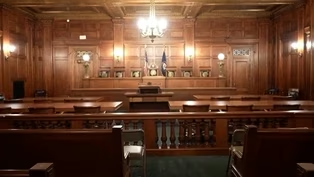
Senate Panel Halts Impeachment Trial of Circuit Judge
Video has Closed Captions
Clip: S4 Ep365 | 3m 13s | Senate committee postpones Fayette circuit court judge's impeachment trial. (3m 13s)
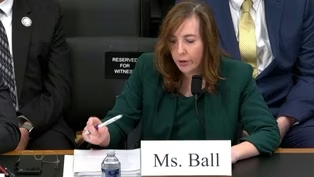
State Auditor Testifies on Capitol Hill
Video has Closed Captions
Clip: S4 Ep365 | 3m 40s | State auditor Allison Ball testified before Congressional panel about Medicaid fraud. (3m 40s)
Providing Support for PBS.org
Learn Moreabout PBS online sponsorship
- News and Public Affairs

Top journalists deliver compelling original analysis of the hour's headlines.

- News and Public Affairs

FRONTLINE is investigative journalism that questions, explains and changes our world.












Support for PBS provided by:
Kentucky Edition is a local public television program presented by KET