
March 3, 2026
Season 4 Episode 334 | 26m 29sVideo has Closed Captions
U.S. soldiers killed in combat in the Middle East were stationed in Kentucky.
At least some of the soldiers killed in Iranian attacks were stationed at Fort Knox, a mother pushes for homeschool students in Kentucky to have the same scholarship opportunities as public school students, a big shakeup for UK Athletics, preparing for severe weather, and how a Kentucky woman is using food to help people learn about other cultures.
Problems playing video? | Closed Captioning Feedback
Problems playing video? | Closed Captioning Feedback
Kentucky Edition is a local public television program presented by KET
March 3, 2026
Season 4 Episode 334 | 26m 29sVideo has Closed Captions
At least some of the soldiers killed in Iranian attacks were stationed at Fort Knox, a mother pushes for homeschool students in Kentucky to have the same scholarship opportunities as public school students, a big shakeup for UK Athletics, preparing for severe weather, and how a Kentucky woman is using food to help people learn about other cultures.
Problems playing video? | Closed Captioning Feedback
How to Watch Kentucky Edition
Kentucky Edition is available to stream on pbs.org and the free PBS App, available on iPhone, Apple TV, Android TV, Android smartphones, Amazon Fire TV, Amazon Fire Tablet, Roku, Samsung Smart TV, LG TV, and Vizio.
Providing Support for PBS.org
Learn Moreabout PBS online sponsorship[MUSIC] The man who has led University of Kentucky sports for more than two decades, is about to step aside.
>> To be able to send hardware to the space station.
Right?
That's that's really neat.
>> For UK engineering students, this assignment is out of this world.
[MUSIC] >> It's not about developing sophisticated chef skills.
It's about community and building relationships with people from other cultures.
>> And in this class, learning is chef's kiss.
Delicious.
>> Production of Kentucky edition is made possible in part by the KET Millennium Fund.
[MUSIC] >> Good evening and welcome to Kentucky edition for this Tuesday, March the 3rd.
I'm Renee Shaw and we thank you for spending some of your Tuesday night with us.
The war in the Middle East is widening, and now CNN is reporting that all six U.S.
soldiers killed in combat were stationed right here in Kentucky.
U.S.
Central Command says the soldiers were killed when Iran bombed a military facility in Kuwait on Sunday.
CNN says the troops were assigned to the first Theater Sustainment Command, based in Fort Knox, Kentucky.
Their names have not yet been released.
Today on social media, Governor Andy Beshear said, quote, America, let's join together and pray for the families of the now six soldiers killed in attacks by Iran, including those based out of my home state, Kentucky.
End quote.
Meanwhile, Iran struck the U.S.
embassy in Saudi Arabia's capital with a drone today, according to the State Department, the strike caused part of the embassy's roof to collapse, but there were no reported injuries and heavy bombing by the United States and Israel continues in Iran, four days into a war that President Donald Trump suggested could last several weeks.
Hundreds of people have been killed.
Now turning to Frankfort news lawmakers are considering bills they hope will ease Kentucky's childcare crisis.
Research from the Kentucky Chambers Center for Policy and Research indicates a stronger childcare system could help.
Between 16,000 and 28,000 Kentucky parents get back in the workforce, resulting in more than $1 billion in new wages in Kentucky and state tax revenues.
Childcare was our topic last night on KET Kentucky tonight, State Senator Danny Carroll, chair of the Senate Families and Children Committee, talked about the need for Kentucky to invest in its children.
>> It's about our children, our children's development.
It's about child care centers succeeding.
It's about schools succeeding.
It's about parents being able to work.
It's about our economy.
There are so many factors that go into this, but we're going to have to make a substantial investment to make sure that we get where we need to be.
It needs to be a gradual growth.
But that's what we're missing in this entire argument.
And getting our legislature to look at it from that perspective, I think that's where we're lacking and where we're going to need to be if we're going to be successful in the future.
So many things hinge on it.
We're going to have to invest in it and look at it as an investment times.
>> And we've talked about child care.
We also talked about an increase in child abuse in child care centers, in part because workers are often underpaid, but yet they're overwhelmed.
>> So we have seen an increase of abuse in child care programs.
Now it's not rampant.
But what we do know is that any case of abuse needs to be eliminated.
And the biggest thing that we see is often entry level staff that don't have enough training yet.
They're left alone in a room full of children.
In Kentucky, one adult can be left alone with ten two year olds, two adults with 22 year olds.
I don't know your all's background.
I have been the one adult left alone with ten two year olds, and it's not an experience I really want to duplicate.
It's very overwhelming.
And if our staff don't have that training, if they're there just because they they desperately need a paycheck, this is an entry level job, then it's easy to become overwhelmed.
We see that children with disabilities are often targets of abuse because they have very challenging behaviors that may come out in the classroom, and staff are not trained on how to support those children to reduce negative behaviors.
And just as when parents stress levels increase and abuse increases, we see that in child care programs.
Also.
>> Right now, child care providers are required to have 15 hours of training per year.
House Bill six.
That's up for consideration this session.
If it is passed, it would require three of those hours to be devoted to training on how to deal with children with disabilities.
You can see last night's full hour long discussion online on demand.
It is streaming there at Keturah Craig Greenberg KY.
Tonight.
Should home school students in Kentucky have the same scholarship opportunities as public school students?
A Somerset Republican says yes, and he's proposing a bill to make changes to the Kentucky Educational Excellence Scholarship or Keys Program for short.
Our Emily Sisk has the details as we begin tonight's legislative update.
[MUSIC] >> It is an opportunity to to level the playing field for the high achieving home schoolers homeschooling students in the state.
>> House Bill 298 looks to change the eligibility of keys money or the Kentucky Educational Excellence Scholarship.
This money is awarded to high school students based on their grades and college entrance exam scores.
The scholarships can be used at Kentucky universities.
A home schooling mother spoke to the House Post-secondary Education Committee today, advocating for homeschool students to have more keys.
Money opportunities.
>> Current opportunities for homeschoolers to receive keys money is through the Act supplement only, which is which we are obviously grateful for.
Whereas students who attend a certified high school in the state of Kentucky have the opportunity to receive money based on their GPA.
>> Right now, homeschool students can earn a maximum of $500 a year for college based on their college entrance exam, while other high school students can earn up to $2,500 a year.
Bill sponsor Republican Representative Shane Baker said with HB 298, homeschool students could receive more money based on their grades and dual credit or Advanced Placement courses.
>> That way, you can measure these students abilities to see what their qualifications should be.
>> HB 298 received nothing but support during the committee meeting with a Northern Kentucky representative and former principal, saying the bill was long overdue.
>> You're not going to use keys money unless the home school or the school that the child is coming through has done their job and can make it in the school.
So I'm really not worried about this money.
It's kind of the same for a high school student who, you know, maybe doesn't have the highest GPA, but gets a few keys dollars and starts college.
>> Representative Baker said at full implementation, House Bill 298 would cost $3.9 million annually.
Keys money is primarily funded by the Kentucky Lottery.
The Somerset Republican said the dollar are a worthwhile investment to keep high achieving homeschoolers in the state.
>> We don't ask people, where did you graduate?
How are you educated?
We know that they're there, they're competent and they do the job, and we're grateful for it.
And that that's all we want to do is make sure that we support these students and help them to reach higher for themselves, their family and their communities.
>> HB 298 was not up for a vote during today's committee meeting, but House Post-secondary education Chair James Tipton said he plans to bring the legislation back for a vote soon.
For Kentucky edition, I'm Emily Sisk.
>> Thank you.
Emily.
The Kentucky Educational Excellence Scholarship Program, or QIs, distributed more than $113 million to students across the state in 2024.
Part of the Kentucky General Assembly's job every couple of years is allocating taxpayer dollars, is deciding its own budget.
This morning, the House Appropriations and Revenue Committee passed House Bill 503, which dictates spending for the legislative branch.
In this draft, the budget for the legislative branch is $180 million over the next two years.
House Budget Chairman Jason Petri says it's the smallest budget of the three branches.
Excessive spending has been a hot topic this session, and the legislative branch is not being left out of that discussion.
House Bill 503 mandates that the Legislative Research Commission reduces costs in areas like travel and food by 20% in fiscal year next year.
The bill also cleared the full House this afternoon and is now headed for the Senate for consideration there.
The General Assembly is also considering what would be by far its largest investment in nuclear energy.
Yesterday, the Senate approved spending $150 million, in large part to help companies construct three nuclear reactors across the state.
Kentucky senators cite increasing energy usage in the nation, including for artificial intelligence.
>> Mr.
president, we are at a tipping point in nuclear energy efforts in our state.
We either invest at a significant level, or we fall back with the states who are not committed and pass up on the numerous opportunities we have been presented to this point and will continue to be presented should we move forward.
And we.
>> Have places in this Commonwealth now, Mr.
President, that companies will not locate because we cannot currently produce the power.
Right now, today, we don't have to think about the future that is happening right now in parts of the Commonwealth.
We have to turn people away.
That would bring good paying jobs to this Commonwealth.
And so this is an effort to speed up the process with the permitting and the development of these nuclear facilities.
And there has been pushed back as to the length of time.
Well, this is an effort to speed up that time.
And there are people who say, well, this could take ten years.
This could take five years, what have you.
But the, you know, the best time to plant a tree is today.
>> The Senate passed Senate Bill 57 unanimously.
Kentucky lifted its ban on nuclear back in 2017.
Since then, it's created Grant programs and a non-regulatory state agency to promote nuclear development.
The environmental advocacy group Kentucky Resources Council told lawmakers last month that Senate Bill 57 could raise residential energy bills by allowing companies to recoup the costs of building new power plants, even if those are never completed.
In other news, Governor Andy Beshear is asking the Trump administration to scrap a plan to cap how much some students can borrow.
The rule change was tucked into last year's so-called one big, beautiful bill in Congress.
It would cap federal student loans for graduate students in a number of fields, including nursing, physical therapy and dental hygiene.
Governor Beshear and 25 other states, in a letter to the U.S.
Department of Education opposing the proposed rule.
Together, they argue, it violates federal law.
In a statement, Governor Beshear said, quote, capping federal student loans would make graduate degrees more expensive and unattainable, while also fueling the dangerous health care shortages across our country.
End quote.
As it stands, the rule change is scheduled to go into effect July the 1st.
[MUSIC] One of Kentucky's big sports leaders is leaving his job.
Details in tonight's look at sports.
The University of Kentucky says Mitch Barnhart plans to retire as UK athletics director, effective in June.
Barnhart has been on the job for 24 years and has overseen numerous coaching hires in football, basketball and other sports.
He is the longest tenured college athletics director in the country.
He will stay at UK in a different role as the first executive in residence at the UK Sport and Workforce Initiative.
According to his new contract, Barnhart will be paid $950,000 a year in that new job.
UK president Eli Capilouto said this in a statement.
Quote, Mitch often speaks of the idea that our goal at UK is for student athletes to place championship rings on their fingers and diplomas in their hands.
Those aren't mere words.
They are aspirations that he continually has helped our program, our people, and our students meet.
End quote.
On another sports note, Lexington Mayor Linda Gordon has declared tomorrow Blue White Day in Lexington.
The University of Kentucky women's basketball team plays South Carolina tomorrow in the Southeastern Conference tournament.
Mayor Gordon urges everyone to wear blue and white to support the team.
Some Kentuckians will see their electric bills go up, but the increase is less than it could have been.
Our Toby Gibbs has details in this look at headlines around Kentucky.
>> Kentucky Power customers.
You'll be paying more to keep the lights on.
The Commonwealth Journal reports the Kentucky Public Service Commission has approved a rate increase of just under 6%, averaging out to $10.76 per month per customer.
The rate would go up another 0.76% next year.
Kentucky Power wanted to raise the rate by 14% in the first year, but the PSC reduced it.
[MUSIC] The Kentucky Lantern reports.
A Court of Appeals judge has denied former Governor Matt Bevin request to keep his adopted son, Jonah, out of his divorce settlement case.
[MUSIC] Jonah Bevin is seeking to be a party to the divorce settlement.
Jonah Bevin claims he was neglected, deprived of an education, and sent to an abusive child residential center in Jamaica at the age of 17.
[MUSIC] Green Energy Parks is on the way to Arlington in Carlisle County.
It's a $142 million agricultural facility that converts waste to energy and makes food grade carbon dioxide and a nutrient rich fertilizer.
[MUSIC] The Paducah Sun says the facility will mean 20 high wage jobs, with hiring to start in the next year.
[MUSIC] From the Bowling Green Daily News, Romania is getting a center to support autistic adults with help from Western Kentucky University.
[MUSIC] Six people from Western Susan Witten Clinical Education Complex will fly to Romania this month to teach professors, doctors and others about autism support.
Romania is building a 231,000 square foot autistic support center to open in 2027.
With headlines around Kentucky, I'm Toby Gibbs.
[MUSIC] >> We have liftoff.
Well, not yet, but soon.
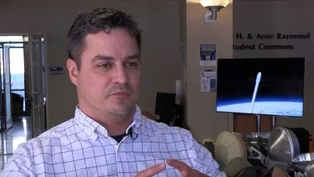
Engineering students at the University of Kentucky are once again working with NASA on a mission.
The Kentucky Reentry Probe Experiment three, or Kreep three mission, will gather data on heat shield performance to help ensure a safe and successful trip to space.
>> 54321 there's a lot of NASA missions, right?
They send a rocket to space.
They need to send the astronauts or the samples home.
So they need the heat shield in order to do that.
So that way it doesn't burn up in atmospheric reentry.
Now, you can you can put a whole bunch of material on and that's that's great.
You'll definitely get home safe.
But that adds weight and that adds size.
So you want it to be as small as possible, but you don't want it to fail because you have astronauts and samples in your rocket coming back.
The big reason that we're doing it, sending it to space versus just testing it here on the ground, is that it's really, really difficult to get all of the conditions exactly how it will be in space.
>> We have reentry vehicles that ride up to the International Space Station on the Cygnus resupply vehicle.
Astronauts pull a pin in them, which starts the flight computer, which is what I designed, and they put them back into the capsule.
Or.
Excuse me, the the reentry vehicle.
It reenters the atmosphere.
That reentry vehicle breaks up, and these capsules come out of their shells and start collecting reentry data.
>> So we have been over the years, over 15 years now, been working on heat shield at the university.
So we've developed this unique expertise in the US as a university to be able to model heat shield, to understand how they work, to numerically replicate in a computer, how they behave.
And one of the things that we decide to do is to add to that expertise, some flight capability.
So that started maybe ten, 12 years ago, where some of the undergraduate at the university came and said, well, we want to have a project where we're instead of just modeling them in a computer, we want to actually do it like build a capsule and use a real heat shield.
It's very important, and it's one of the most unreliable things that we still have difficulties with.
If no heat shield and you lose the entire payload, and that could include humans.
We're also testing the stability as these new shape.
We have a heat shield that it's already deployed deployable.
So this is a concept that NASA has to be able to have larger heat shields.
So think about the umbrella.
For instance.
You can store an umbrella in a pretty close cylinder.
But when you need it it just spreads open.
>> Having the opportunity to to glue one of these capsules together, it came in a bunch of different panels, having the opportunity to glue that together.
You just can't find that anywhere.
It's it's a really unique experience.
And then I mean, to be able to send hardware to the space station, right.
That's that's really neat.
>> So for the most part, it's really academic.
You know, they're designing algorithms or they're creating models and trying to predict what's really going to happen.
But we're building true hardware and experiments to see what happens.
And so I think having that hands on physical experience was really unique and pretty amazing.
>> NASA has scheduled the three mission in early April.
Spring is right around the corner.
Thank goodness.
With warmer air comes though, an increased chance for dangerous storms.
Kentucky averages about 28 tornadoes a year over the last 25 years, but recently we've seen a huge spike in 2021 and 2024.
Kentucky saw more than 60 tornadoes each of those years to help keep you prepared for bad weather.
Because this is severe Weather Awareness Week in Kentucky, meteorologist Christie Dutton sat down with state and local officials to talk about some of the terms that sometimes cause confusion during severe weather.
>> What is the difference between a tornado watch and a tornado warning?
>> Right.
Well, I think a watch is when you would want people to know that a tornado is possible.
The conditions are favorable, that there could be a severe weather event, including up to a tornado that might impact your area.
And that's usually a broad area that's under that tornado watch.
And when we talk about a tornado warning, that's time to take action.
That means that things are about to happen.
That means, like the conditions are right.
The radar is indicating that there's likely a tornado or some circulation in the air.
That may indicate that the tornado is very much impinging on your location.
So when you get the watch, get that state of readiness, when you get the warning, it's time to take action to move to a safe place.
>> Okay.
And I've also seen tornado emergency John.
What is that?
>> Yeah, that started in May 3rd, 1999.
In Oklahoma City.
There was a tornado on the ground approaching the southwest side of Oklahoma City.
And they put out the tornado Mercer and got people prepared and ready and to take their safe plan to do it.
Now, this moment, it's on the ground.
So the weather service has a guide, a bunch of guidelines to do this.
So there's a lot of wiggle room.
I think if you're hitting a major population, a county seat of Laurel County, whatever county it is, Pike County, Montgomery County, whatever it is, or it's going to be on a major interstate major population, they'll put out a tornado emergency.
We also do that with flash flooding.
Same thing.
Flash flood emergency.
To get the word out, I will be Paul Revere and scream and yell.
I used to talk to Doctor Gibson all the time.
Or the governor.
You need to have a plan for these big events.
We're seeing more and more big events.
So you need a plan of action, folks, to save your family.
>> Okay, so tornado emergency sort of supersedes even the tornado warning.
>> The top of the line.
>> Top of the line.
Okay.
>> Top of the line is John.
Gordon.
You got to love his energy, right.
To learn more about how you can prepare, tune in to severe weather.
Staying safe.
That is tomorrow night at 9:00 eastern 8:00 central right here on KET.
[MUSIC] We all know the saying you are what you eat.
Well, if that's the case, the food we prepare and enjoy can tell us a lot about each other.
A Bowling Green woman is using the cuisine of foreign countries to help people learn more about other cultures and ethnicities.
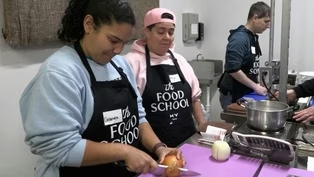
Our Laura Rogers joined a class at the food school.
>> To be something that's kind of.
>> As the child of missionary parents growing up in Thailand, Anna Kulka did pick up some of the language.
>> I say I can speak Restaurant Thai, which is just enough to impress my friends at Thai restaurants.
>> She made that comment as friends were brainstorming career ideas for Kulkarni, who taught high school for ten years.
>> And then someone says, well, what if you taught restaurant Thai?
What if there was a class called Restaurant Thai where you learn to cook some Thai food?
You learn a few Thai words like, wouldn't that be really fun when people do that?
Would people actually want to take a class like that?
Would people buy tickets for that?
>> Turns out they would, and they do.
>> People found us on Facebook and bought full priced tickets like the first class.
>> That was in September of 2024 when the food school was born.
That first class has now led to several.
All of them focused on food from other countries.
>> The house we live in now, one neighbor is Bosnian and the other neighbor's Mexican, and both of them are phenomenal cooks.
>> Anna and her to Bowling Green from California.
They were pleasantly surprised.
City's diversity.
>> Bowling Green is so small, relatively speaking, that you're still going to bump into each other.
That Asian grocery store that I love is right next to the middle school where my friend's kid goes.
>> On this day, she's browsing at another international grocer picking up items for an Iraqi cooking class.
>> What we're teaching is more cultural exposure than it is culinary skills.
>> It starts with a food partner, someone who conceptualizes the ingredients and recipe for the class based on simple, home cooked meals.
>> Every menu that we offer has a real person behind it.
A person who lives in Bowling Green and has a cultural background in this other cuisine.
>> And works with the partner and on her own to perfect the recipe, then shares it with her food school class.
>> It's just so beautiful to me how we meet these food partners.
They just kind of come up out of the woodwork.
People hear what we're doing and want to be part of it.
I have an Indian food partner.
I have a Venezuelan food partner.
Cuban.
>> Tonight's class is making the Iraqi dish of onion dolmas.
>> What's easy?
Accessible, casual.
Normal food.
What would you feed your family on a Tuesday night?
Let's make that.
>> The food.
School has also introduced its instructor to new foods and recipes.
>> We got to use ingredients I have never played with before.
I've never heard of pomegranate molasses before and it is so good and it's accessible right down the street.
And now I know what to do with it, so that's really fun.
Your audience should be soft.
>> She says.
It's also fun to learn the history behind popular dishes, like the origin of tiramisu as a favorite dessert in Ethiopia.
Following Italy's invasion in the 1930s.
>> The two main things they left behind are the word chow and tiramisu.
Everyone loves tiramisu.
This is the most popular dessert in Ethiopia because of the Italians, and I thought that was hilarious.
That was so interesting.
Like, how does this historical thing influence how people eat.
>> And potentially how they better understand each other?
>> We're trying to give people exposure so that they can build relationships and feel comfortable with all kinds of cultures.
>> Giving us all something to chew on.
For Kentucky edition, I'm Laura Rogers.
>> Thank you Laura.
I hope you got to sample some of that.
Upcoming classes at the Food school include favorite dishes from Brazil, China, Germany and Thailand.
You'll see some young faces at the state Capitol tomorrow.
It is Children's Advocacy Day in Frankfort as lawmakers go right to the source for information as they consider legislation affecting Kentucky's kids.
We're going to be there on the scene, and we'll tell you all about it tomorrow night on Kentucky edition, which we hope to see you again for at 630 eastern, 530 central.
We inform, connect and inspire.
We hope that you'll connect with us all the ways you see on your screen the social media channels, Facebook and Instagram that can keep you in the loop on great happenings here at KET and we encourage you to send us a story idea by email to Public Affairs at Keturah, and look for us on the PBS app that you can download on all your smart devices.
I'm Renee Shaw, thanks for joining us tonight, and hope to see you right back here again tomorrow night.
Take good care.
Kentucky Students Partner with NASA
Video has Closed Captions
Clip: S4 Ep334 | 3m 30s | The engineering students are gathering data about heat sheilds. (3m 30s)
Kentucky Woman's "Food School" Showcases Other Cultures
Video has Closed Captions
Clip: S4 Ep334 | 3m 34s | Anna Kulka is using cuisines of foreign countries to help people learn about other cultures. (3m 34s)

Lawmakers Consider Spending $150 Million on Nuclear Energy
Video has Closed Captions
Clip: S4 Ep334 | 1m 53s | If passed, it would by far be Kentucky's largest investment in nuclear energy. (1m 53s)
Mitch Barnhart Stepping Down as Athletics Director at UK
Video has Closed Captions
Clip: S4 Ep334 | 1m 3s | The university says Barnhart will transition to a new role in June. (1m 3s)

Parent Pushes for Scholarship Parity for Homeschool Students
Video has Closed Captions
Clip: S4 Ep334 | 3m 19s | A bill in Frankfort would make changes to KEES. (3m 19s)

U.S. Troops from Kentucky Killed in Iranian Attack
Video has Closed Captions
Clip: S4 Ep334 | 1m 6s | CNN says the soldiers were killed when Iran bombed a military facility in Kuwait. (1m 6s)
Providing Support for PBS.org
Learn Moreabout PBS online sponsorship
- News and Public Affairs

Top journalists deliver compelling original analysis of the hour's headlines.

- News and Public Affairs

Today's top journalists discuss Washington's current political events and public affairs.












Support for PBS provided by:
Kentucky Edition is a local public television program presented by KET