
March 11, 2026
Season 4 Episode 340 | 26mVideo has Closed Captions
President Trump visits Northern Kentucky.
President Trump delivers a speech in Northern Kentucky. State lawmakers advance an omnibus bill regarding gambling. Advocacy groups March for Life in Frankfort.
Problems playing video? | Closed Captioning Feedback
Problems playing video? | Closed Captioning Feedback
Kentucky Edition is a local public television program presented by KET
March 11, 2026
Season 4 Episode 340 | 26mVideo has Closed Captions
President Trump delivers a speech in Northern Kentucky. State lawmakers advance an omnibus bill regarding gambling. Advocacy groups March for Life in Frankfort.
Problems playing video? | Closed Captioning Feedback
How to Watch Kentucky Edition
Kentucky Edition is available to stream on pbs.org and the free PBS App, available on iPhone, Apple TV, Android TV, Android smartphones, Amazon Fire TV, Amazon Fire Tablet, Roku, Samsung Smart TV, LG TV, and Vizio.
Providing Support for PBS.org
Learn Moreabout PBS online sponsorshipmusic >> You could not any longer bet on a Kentucky.
Western Kentucky University player's individual statistics.
Going forward.
>> If you bet on sports or elections, some of the rules could be changing.
[MUSIC] From farms to flights.
The push to turn Kentucky crops into airplane fuel.
[MUSIC] >> Where's the parents?
What are they doing?
They need accountability.
And this brings accountability to the parents.
>> A bill tackling truancy in a new way is getting closer to final passage in Frankfurt.
[MUSIC] >> The time is now.
Louisville is America's new frontier, I'm convinced.
>> And it's a new frontier for Louisville's business community.
When the Chamber merges with the city's economic development agency, what it means for Kentucky's largest city.
>> Production of Kentucky edition is made possible in part by the KET Millennium Fund.
>> Good evening and welcome to Kentucky edition for this Wednesday, March the 11th.
I'm Renee Shaw, we thank you for winding down your Wednesday with us.
President Donald Trump was in Northern Kentucky today.
His visit came after a stop in Cincinnati, where he toured a pharmaceutical company to talk about lower prescription drug prices in Hebron, Kentucky, President Trump visited a logistics packing facility.
He talked about creating American jobs and nuclear energy projects in western Kentucky and what he called, quote, clean, beautiful coal.
Hebron is in Congressman Thomas Massey's district.
Massey has been critical of President Trump on the Epstein files, the war in Iran and the budget.
Trump is backing mass Republican primary opponent L Gallrein, who took the stage this afternoon in northern Kentucky prior to the president.
KET is in Hebron, and we will have much more on President Trump's visit to Kentucky tomorrow on Kentucky Edition.
Now turning to Frankfort happenings.
Several education bills passed out of committee today, including a proposal that would allow teachers to cash out their sick days and one that aims to solve the state's truancy problem with a more family focused approach.
In tonight's legislative update, our Mackenzie Spink brings us up to date on some of the bills that could have a big impact on Kentucky schools.
>> Senate Bill 170 aims to establish a pilot program called Soar, or the Supporting Opportunities for Accountability and Restoration program.
Soar focuses on early interventions for families with truant children, creating individualized plans to meet their needs and improve attendance.
Supporters of the bill say it provides the support and accountability for families that need it.
>> We're going to transition from focusing on the child to focusing on the family, and so the kids are going to have a family plan they've already kind of put together.
And then if there's a problem, the kid's not going back to school or whatever, the CW is going to figure out why that is.
And it could lead to a dependency neglect and abuse referral being made to the cabinet.
Because, you know, if you've got a 14 year old that's not going to school, okay, fine, it's the kid.
Kids got some fault there.
Where's the parents?
What are they doing?
They need accountability.
And this brings accountability to the parents.
>> If passed, the Soar program would start in ten districts in the state chosen by the Chief Justice of the Kentucky Supreme Court.
Participating schools would create what's called a rise team made up of a court, designated worker, school counselor, school resource officer and other members of the school or mental health community.
The goal of the Rise team is to engage with truant children before having to involve the legal system.
>> We know early engagement with these families is key, and so getting them those access to those services and supports and, you know, telling those community partners, this is our need right now and this individual, our school and then the Rise team that's in here within this legislation, those are the movers and shakers, you know, not at a big system level of the community, but actually they have hands and eyes on these children day in and day out.
So we would hope to mobilize those supports very early on versus waiting until the court's involved.
>> Proponents of the bill say it will not only improve educational outcomes for children otherwise missing school, but it will also improve public safety in the long run, citing truancy as an early indicator of criminal behavior.
>> There was a study from Miami-Dade County that found that there are serious offenders.
75 to 85% of their serious offenders had engaged, had been truancy, had a history of truancy as low as a third grade.
>> Senate Bill 170 passed the House Judiciary Committee and will next head to the full House for consideration there in the House Committee on Primary and Secondary Education.
Lawmakers discussed how to tackle the substitute teacher shortage from a new direction.
>> This idea was born out of the problem, really addressing that that sub shortage solution.
And instead of looking at it through the lens of we need more subs, looking at it through the lens of how can we limit our need for subs in the first place?
>> Senate Bill 124 would create an optional sick day cash out program for teachers who have more than 15 sick days acquired.
The bill's proponents say it's to encourage teachers to use their sick days more sparingly, adding that students benefit from having a teacher in the classroom more often, and teachers benefit from having more options for their unused sick days.
>> You know, if teachers choose to cash in these days and they'll have the freedom to use that money how they wish, but if they choose to put it in a retirement account like A 457 B or some type of IRA, this actually can have a significant positive impact to their retirement income, because that money would appreciate at a much greater rate than if they left it in and then cashed in those days at the end of retirement.
>> Senate Bill 124 would also allow teachers to use a sick day for religious holidays that aren't on the official school calendar.
It passed out of a House committee this morning for Kentucky edition.
I'm Mackenzie Spink.
>> Many thanks.
Mackenzie.
Senate Bill two also cleared the House Primary and Secondary Education Committee today.
It would ensure that school administrator pay raises not outpaced those given to classroom teachers.
Now, from horse racing to sports betting and now prediction markets, gaming options for Kentucky adults are ever changing is our June Leffler reports.
House Bill 904 is this year's gambling omnibus bill, and it touches every kind of bet you can imagine.
>> Three years ago, sports betting became legal in the Commonwealth.
Now lawmakers offer some updates.
>> We would raise the age in sports wagering from the age of 18 to 21 to participate.
>> Sponsors of House Bill 904 say the public requested this.
>> I liked.
>> It, I've seen some youngsters get deep in and I think that's a good change.
>> Other sports betting changes.
>> And we would ban prop bets on in state college athletes.
So if you are.
You could not any longer bet on a Kentucky Western Kentucky University player's individual statistics going forward.
>> Another kind of betting prediction markets run by companies like Polymarket and Kelsey.
>> I had a question from a constituent can somebody run a betting on elections?
>> Yes.
Prediction market companies are offering wagers or derivative swap contracts, as they would tell you on election outcomes, on the overturning of dictatorships in foreign countries like the Venezuela issue, and probably on things related to other things going on in geopolitics around the world right now.
>> House Bill 904 is Kentucky's first crack at prediction markets.
The bill would tax these markets but not regulate them.
>> They are regulated at the federal level by the Commodity Futures Trading Commission, and that agency has said that we are preempted from directly regulating those products, even though they look very much like wagering.
>> That may change down the road.
Just this week, a federal judge in Ohio ruled that the state can regulate prediction markets, at least when it comes to sports.
Fantasy sports would also be taxed by Kentucky for the first time under House Bill 904, and horse racing operators could soon offer fixed odds betting, which means payout is locked in when the bet is placed.
>> You're at the track.
I'm sure everybody's been there, you know.
You bet a horse at five or 6 to 1 by the time the race goes off, goes off and halfway around, you realize you might win the race and you've seen the odds have dropped and they're 2 to 1.
And like, how could that have happened?
We're just opening up another piece.
We can go in and lock in your odds and look at that.
>> The bill also creates a charitable gaming task force.
Profits from this gaming go to countless nonprofits, large and small.
>> This summer, we're going to bring all players into the table and have a very comprehensive conversation about that.
>> The House Licensing and Occupations Committee passed House Bill 904 with no opposition.
>> This is the perfect example of good legislating.
You pass a bill, you come back in a year or two years, whatever it is, you make updates, you make changes to better serve the constituents of the state of Kentucky.
And I think that's what we're doing right here.
>> It now heads to the House floor for Kentucky Edition.
I'm June Leffler.
>> Many thanks.
June.
Now Kentucky seniors would have more protection against financial exploitation under a bill OK'd by the House Banking and Insurance Committee today.
House Bill 794 adds seniors 65 and older to the list of those protected under the state's exploitation laws.
It also increases criminal penalties under the law.
Republican State Representative Matt Lockett of Nicholasville sponsors the bill.
He says it also creates stronger safeguards for spotting and stopping financial exploitation, including more training for financial institutions.
>> Senior adults age 65 and older, as you guys know, have been very vulnerable to financial exploitation.
And so what the bill does, it increases the felony limits to to those.
It also requires those of us that are in the business to do do three hours per per year of CE credit that will be included in the 12 hours that's already included.
It.
It also requires firms, if an agent or someone says that they are, they are going to put a a hold on a withdrawal.
They can do that already by state law.
What this says is that if they do that, the firm must have procedures in place to to log that who requested it.
Why all of those those types of things.
And every person in the firm has to be trained on those procedures.
>> According to Kentucky's Adult Protective Services, the abusers and almost 90% of elder financial exploitation cases are family members or trusted caregivers.
Turning food into fuel.
That's the idea behind House Bill 545.
The bill from Speaker Pro Tem David Meade would encourage the use of Kentucky farm products as sources of alternative fuel for airplanes by offering enhanced tax credits for Kentucky grown farm products and Kentucky's refineries.
Meade and other supporters said this is the right time and Kentucky is the right place for this industry to pay off.
>> Airlines across the country are actively searching for reliable supplies of this fuel.
Cargo carriers and passenger airlines are already signing long term contracts and agreements.
And this question isn't whether the industry is going to grow, it's whether or not Kentucky is going to be a part of that.
It's going to capture that investment, but we're going to watch it go to other states.
This is a win for our Kentucky farmers.
The bill creates a new demand for Kentucky agriculture products and byproducts.
Alternative aviation fuel can utilize our soybeans, our crop residues, agricultural byproducts, and that means new markets and more stability for Kentucky's farmers.
>> We are the nation's leader in aviation fuel consumption right here in the state of Kentucky and surrounding areas.
We have a unique opportunity because of the Mississippi and Ohio River to really function as the global leader in this space.
We have the first, third and 12th largest aviation fuel consumers in the world, located within a couple hundred mile span of the Ohio and the Mississippi River.
It would be a travesty for us in Kentucky not to take advantage of this new opportunity that we have in place to be able to work through for not only our farmers, but also our job creators, our manufacturing and our aviation sector for logistics worldwide.
>> Now, you just heard from Agriculture Commissioner Jonathan Schell, who says corn, soybeans and beef tallow are some of the farm products that can be converted into airline fuel.
Getting food to Kentuckians in need faster is the goal of a bill that passed out of the Senate Agriculture Committee this week, the sponsor of House Bill 281, Republican State Representative Robert Duvall says the bill streamlines the process for churches and nonprofits to provide food for homeless shelters, as well as to those who've already been displaced by natural disasters.
>> Mr.
chair.
>> Did you know that these non-profits can't even provide a hot plate of jambalaya to folks in need?
Current law requires an industrial grade kitchen with specific plumbing requirements.
These organizations only wish to provide care for those who are hurting the most in their communities.
In the case of natural disaster, when time is of the essence, we certainly need to expedite the delivery of food to those who have been displaced from their homes.
>> The bill now heads to the full Senate for approval.
It's already passed the House.
Abortion is illegal in Kentucky in most cases, and it's been illegal since the Kentucky General Assembly enacted new laws connected to abortion rights reversal by the U.S.
Supreme Court and overturning Roe versus Wade.
But some Kentucky anti-abortion advocates still say more needs to be done.
That was the message of their annual March for life rally, and students were center stage.
>> Pro-Life movement has always been powered by something simple but incredibly powerful stories.
Every person here today has a story about why they believe in being pro-life.
And today I want to talk about one group whose stories are shaping the future of this movement and an incredible way.
Young people.
For too long, people have assumed that the next generation would drift away from the pro-life movement, that we would accept the culture around us and ignore the fact that over 25% of our generation was aborted.
And that is just in the studies.
We know that we would just ignore it, ignore it, and disregard it.
But something incredible has happened across Kentucky and across the country.
Young people are stepping up.
>> Legislators have filed abortion related bills this session.
One that is creating a stir is House Bill 714, which criminalizes any woman who has an abortion.
[MUSIC] >> The woman who has had an abortion is no less a victim of Satan's temptations than the child who is aborted.
Our approach to these issues has been the healing through the power of the sacraments and the scriptures of those victims, of those who have had abortions and been its victims.
Our approach to women who have had an abortion has been to accompany them, to walk alongside them.
Both women who have taken this action, and women who are in danger of taking this action.
It is an approach that is rooted in the healing ministry of Jesus.
So I see your signs.
No one's ignoring you.
We simply disagree with you.
We simply disagree with your approach.
>> The bishop called for the advocates of House Bill 714 to not lead with anger, but forgiveness.
The right to life.
Kentucky version group also wants to prevent abortion pills from coming into the state.
It's a stance that's the focus of House Bill 646.
[MUSIC] Louisville's two major business development and workforce recruitment organizations are merging into one one Louisville.
That is our Kelsey start six down with the new CEO of One Louisville to find out what it all means.
That is our story.
Focus for the business beat.
>> Well, Trevor Paul is joining us here in our Louisville studio.
He's the new CEO of One Louisville, which is a merger of these two organizations, G. I, the Metro Chamber of Commerce and the Louisville Economic Development Group leader.
So, so explain to our viewers what these two groups historically have done, where they overlap, and what each is kind of bringing to the table in this new organization.
>> I'd love to and thanks for having me.
So Greater Louisville, Inc.
has been around for decades and it is iconic.
It has been the vessel by which businesses from out of market invest into Louisville.
It's been sort of a town square for small businesses and midsize businesses and policymakers to come together.
And Louisville Economic Development Alliance was started by Mayor Greenburg in 2024.
It's actually why I'm in Louisville.
I was in Detroit doing economic development up there, and I came down to run Leda.
And essentially our job was to be the economic development quarterback for Jefferson County.
So if I focused on the ten county region, we were very much focused on the city of Louisville.
Now, over the last year, we've seen historic levels of capital investment into Louisville.
We saw $3 billion in net new capital investment.
That's more than the last two years combined.
And when you pair that with our wages went up 24%, 2800 jobs created.
We are really riding as well.
And not to mention big time headlines like with what GE did, with what Ford has done, Texas Roadhouse doubling down on Louisville.
So it felt like a moment where we had these two organizations that weren't always working off the same metrics, had different boards.
If we combine them, then we could really accelerate our ability to get out and get more companies, get more talent into Louisville, and really make these next few years special for our region.
>> So as these two groups are coming together, this official officially merged on March 1st.
So you've been at it for just a short time.
>> Day seven.
>> Day seven.
So so how's it going so far and what have you all been able to identify or plan to identify as sort of the new vision going forward for these two?
>> Well, the first thing, and maybe this is a public service announcement, but if you're a chamber member, all of your services will move into the new organization.
Now, what's really cool is beyond being a chamber of commerce.
Now we have this economic development function.
We have an advocacy function.
We have a team up in Frankfurt today that is working on various things around getting more money, downtown housing, workforce participation.
And then we also have our regional marketing.
So getting the word out about all the great things happening in Louisville, that is essentially the set of pillars that one Louisville will be built upon.
And having those pillars in the same office, in the same meetings, I mean, that's going to create efficiencies.
That's going to allow us to think bigger.
It's going to allow us to better align with the mayor and the business community and Metro Council and legislators.
I think at the end of the day, this is going to put our best foot forward.
>> So it sounds like Lita is kind of being folded into Gli in a way, because it is still a regional organization.
And how is that how you would describe it being changed as, as far as becoming the one Chamber of Commerce?
>> So I would say that the two organizations came together and formed one versus Lita coming into the Greater Louisville, Inc.
although we're still going to maintain the best of what a Chamber of Commerce provides the best of what an advocacy policy making team provides.
And then also, you know, many of the deals that we're familiar with, Louisville Economic Development Alliance or Lita had a chance to work.
So you're bringing that prowess and that energy into one entity.
So we are truly it's a, it's a merger of, of two organizations that are now one, it's not one going into the other.
>> One, Louisville.
What?
Oh, what a great name.
Yes.
So but it did come with cutting some positions.
Correct.
That also comes with a more streamlined budget.
So you're going to be operating at a lower cost.
>> Yeah.
No you're right.
You know, one of the things that we noticed is that there was sometimes market confusion, not only by customers, but by partners of where the front door was.
And there were some duplicative services.
And also to make this new organization work, you had to break even or run a small surplus in year one.
And so there was it was a difficult process of sort of financial modeling, operational modeling to ensure that we could do that.
So we went through, looked at programs that maybe weren't moving the needle like they used to, and looked at where there were duplication of efforts.
And that ultimately led us to get to 32 people.
We went from 11 and $11.5 million budget annually down to a $9 million budget.
But I don't think there's going to be any sort of decline in service levels.
In fact, I think this allows us to optimize in a way that allows for or creates the conditions for the next few years to do some pretty dynamic things, whether it's around the startup community, whether it's around infrastructure, whether it's around new incentive tools to attract new industries.
Here, the time is now.
Louisville is America's new frontier, I'm convinced.
And this is this is going to be a vessel one Louisville to, to really show show the world what we can do here.
>> Talk more about that funding aspect.
This is a public and private partnership.
Correct.
>> Both sides have skin in the game.
That's how it should be, right.
Both sides impact our economy in a in a major way.
So we will be receiving about a third of our budget from the public sector, and then the rest will come in from the business community.
And then we'll also have some revenue generating activities like events and, and other things that you'd see in a chamber of commerce.
>> What's the main thing people are going to see the difference with this organization?
What do you think the biggest change is going to be?
>> I think we're going to try to do higher impact events.
I think we are going to be more proactive in the types of companies we talk to, the markets we try to activate.
You might see some companies where you're wondering, gosh, I didn't.
They're coming to Louisville.
I didn't think they'd have interest in Louisville because of maybe what they do.
But you know, when you look at our formula right now, the formula that has allowed for things like surgical gloves invented here in America hadn't been produced here since the 1980s and now is being produced in America again for the first time in Louisville.
Wow.
These are these are things that we just have a formula for affordability, supply chain talent.
And I think that can apply across sectors.
So what you're going to see is I think some new industries popping up in the next few years.
>> All right.
Well thank you so much.
We appreciate your time.
>> Thanks for.
>> Having me.
And easy walk right across the street here from your new building and the PNC tower.
We appreciate your time.
Thanks for being here.
Renee.
Back to you.
>> Thanks so much.
Kelsey.
The official launch of the one Louisville brand will happen at their annual meeting that's coming up on March 18th.
[MUSIC] Coming up tomorrow on Kentucky edition.
Continued coverage of the Kentucky General Assembly and regular session highlights from Governor Andy Beshear, his weekly news conference, and we'll recap President Donald Trump's visit to Northern Kentucky.
You'll hear from him Thursday on Kentucky edition, which, you know, to tune in for at 630 eastern, 530 central, where we inform, connect and inspire.
We hope that you'll connect with us all the ways you see on your screen.
You can get email, newsletters and watch full episodes and clips@ket.org and stream some great content.
You can also find us on the PBS app that you can download on your mobile devices and smart TV.
We encourage you to send us a story idea by email to Public affairs@ket.org, and follow us on the social media channels.
Facebook X. Formerly known as Twitter and Instagram to stay in the loop.
Thanks so much for watching.
Be safe tonight.
If you're encountering some bad weather, we will see you right back here again tomorrow night.
Take really good care.
So long.

Anti-Abortion Advocates Hold Rally in Frankfort
Video has Closed Captions
Clip: S4 Ep340 | 2m 43s | Anti-abortion advocates call for more restrictions on abortion pills. (2m 43s)
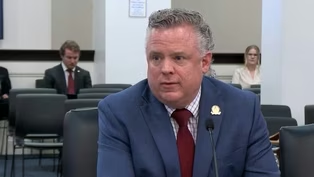
Bill Gives Seniors Financial Exploitation Protections
Video has Closed Captions
Clip: S4 Ep340 | 1m 49s | Measure adds seniors to list of those protected under financial exploitation laws. (1m 49s)

Education Bill Aimed at Student Truancy Advances
Video has Closed Captions
Clip: S4 Ep340 | 4m 16s | Educations bills focused on teacher sicks days, student truancy move forward. (4m 16s)
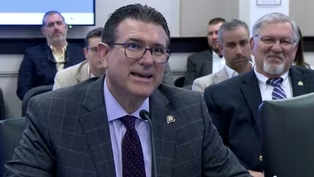
Food Regulations Eased During Disasters Under Bill
Video has Closed Captions
Clip: S4 Ep340 | 55s | Lawmaker wants food to get to those in need faster during natural disasters. (55s)

House Bill Reshape State Gambling Rules
Video has Closed Captions
Clip: S4 Ep340 | 3m 7s | House bill could change some of the state gambling rules. (3m 7s)

Major Economic Organizations Merge into 'One Louisville'
Video has Closed Captions
Clip: S4 Ep340 | 7m 48s | One Louisville's new CEO on merger of city’s major business and workforce organizations. (7m 48s)

Push to Turn Kentucky Crops into Airplane Fuel
Video has Closed Captions
Clip: S4 Ep340 | 1m 45s | Bill encourages use of Kentucky farm products as alternative fuel sources for airplanes. (1m 45s)
Providing Support for PBS.org
Learn Moreabout PBS online sponsorship
- News and Public Affairs

Top journalists deliver compelling original analysis of the hour's headlines.

- News and Public Affairs

FRONTLINE is investigative journalism that questions, explains and changes our world.












Support for PBS provided by:
Kentucky Edition is a local public television program presented by KET