
Kentucky Election F.A.Q.
Clip: Season 1 Episode 251 | 7m 47sVideo has Closed Captions
Trey Grayson and Bob Babbage explain commonly asked questions about Kentucky's elections.
Trey Grayson and Bob Babbage explain closed primaries, off-year gubernatorial elections and other commonly asked questions about Kentucky elections.
Problems playing video? | Closed Captioning Feedback
Problems playing video? | Closed Captioning Feedback
Kentucky Edition is a local public television program presented by KET
Kentucky Election F.A.Q.
Clip: Season 1 Episode 251 | 7m 47sVideo has Closed Captions
Trey Grayson and Bob Babbage explain closed primaries, off-year gubernatorial elections and other commonly asked questions about Kentucky elections.
Problems playing video? | Closed Captioning Feedback
How to Watch Kentucky Edition
Kentucky Edition is available to stream on pbs.org and the free PBS App, available on iPhone, Apple TV, Android TV, Android smartphones, Amazon Fire TV, Amazon Fire Tablet, Roku, Samsung Smart TV, and Vizio.
Providing Support for PBS.org
Learn Moreabout PBS online sponsorshipThere are often frequently asked questions fake news about why Kentucky's elections are the way they are.
On Friday, we asked two former Kentucky secretaries of state why the Commonwealth has a closed primary system, an option for straight party ticket voting, and why statewide constitutional officers like governor are held in off years.
Let's talk about some commonly asked questions that we get after a primary, particularly like the one that we've had here in Kentucky.
I'll start with you, Trey.
Many people say, first of all, why are our primaries closed?
Why can't independents vote?
Well, it's a state law, so it could be changed and it is different in some other states.
Some states you don't even have.
Party primaries are completely open.
Other states, independents can come in.
But it basically goes back to the fact that the candidate, the parties like the fact that it's their own people.
They don't want interlopers.
It also drives people to pick a party.
By forcing you to to be in a political party.
And that's one of the reasons why Kentucky has roughly now 90% in either Republican or Democratic and 10%, whereas like Massachusetts, it's close to 40 or 50% independents because they have an open primary.
But we're growing we're double digits now.
And we weren't just a little while ago.
So which is sort of an indictment of the parties, because these people are willing to say, I'm not going to vote in my party primary, which usually determines the at a lot of local counties, it's who's going to be the winner in the fall is determined in the primary.
And some of our most of our congressional districts.
Whoever wins the primary is going to be the winner in the fall.
And so, yeah, that's that's telling people say, I don't care.
I don't want to be part of either of those institutions.
And the discussions about this haven't really gone very far.
They haven't.
That's because people who are most interested write the rules, whether it's for Medicaid or road building or elections.
And the parties have an interest in keeping elections working the way they were.
So changing.
There's not an independent party that shows up for a convention to say, hey, let's march on the Capitol and get in the process.
Yeah, we Republicans might have wanted it to be open when we were in the minority.
That's right.
Yeah.
Now we're in the majority.
Why would why would you want that?
Same thing with a straight ticket option and benefits the party in power next day.
Yeah, go ahead.
Back in history several years ago, 25 probably.
Several.
Oh, in a slow summer Newsday, a reporter calls me and says, What about open primaries?
I said, I think a great, great idea.
Let's make people have an easy way to participate.
They also called another Bob, the legendary Bob Gable, and he said, great, put them in.
Then several days later, we conferred.
The feedback he got or not got was not particularly canned.
Yeah, it was summarily rejected by our friends in politics.
So it just doesn't it doesn't come around very easily as a point of discussion, although it may now it could.
But to have 10%, I think about one in every ten people you run into is an independent and that number is growing faster than the Republican growth has been to catch up with the Democrats.
And as Trey says, in other states, it can be 2030 is not uncommon in other big states.
Yeah.
So straight party ticket voting, that's another question we get.
Why do we have that option?
Again, it does benefit the party in power in the fight at the local level because there are parts of the state that are very democratic and there are parts of the state that are very Republican.
It also it does speed the time to vote.
Makes it easier to do that.
When I was secretary, actually always recruited at the time a Republican House member to try to get rid of the strategic invoke.
I call it lazy voting.
You know, when I go I'm a Republican Republican.
But I you know, I'm going through race by race.
But it does you know, people kind of like it.
It makes it makes it shorter.
So in some respects, it makes it easier for election administrators because you just color in the one spot and you're done.
Yeah, but it makes a lazy electorate, though, right?
I mean, it takes out.
Some of those.
I would trailer pulling the levers in the old days.
Yeah.
Going right to race.
Whether there's a constitutional amendment or a local stuff or a judicial race or whatever it is.
Yeah.
So with 14.45% voter turnout in the primary this time, why not move the governor primary, the governor's race to a presidential election year to boost up that voter participation?
So in northern Kentucky, we've had a lot of conversation about this because we're generally the area that votes the lowest in primaries and lowest except in the presidential year and the general.
And so we thought, wow, we could really boost our influence in the state because we take our big population and then have a higher voter turnout.
But I think there's again, there's the politics, just like with everything else.
So one is the statewide candidates, because they're in their own year, get to focus completely on them.
It's easier for fundraising for them.
They also don't compete as much with the folks who are running in other years.
So legislators, if you move the statewide to one of those years, all of the state House members would always have to compete with the statewide and the Senate every two years would have to do it.
So that's I think the biggest thing is the politics.
It would increase turnout.
You know, the argument for it is it allows more attention to be paid on those statewide candidates.
And I think it also gives a little more national coverage because we're the year before the presidential.
It would save money.
You know, there's a there's a cost savings.
And that's why we move from having an election every year.
Right.
In the early nineties, we eliminated the counties election and the odd year and moved it.
There was a five year term and so we elected folks in 93 to a five year term, so we moved that to 98.
So there is a precedent for consolidating.
But I do think a lot of it's that that, you know, the politics behind it prevent that from happening.
And it's the status quo.
You know, like as Bob said, the rules work for the people who win.
Right.
That's what I want to change.
Do you want to change nationalization of the races to make it more so than what it is now?
If you stack a U.S. Senate race on top of the state races and congressional races on top and you've got other races than the office like we ran for and served in, secretary of state is squished even further down less attention.
And your fundraising capacity shrinks.
Fundraising is challenged, but you need to raise more to try to compete with all that other information.
Mm hmm.
Now, because I actually I do support it.
I would rather be I think it'd be better to have two big election years and let us focus.
Let's.
It'd be easier on election administrators.
And I do appreciate the higher turnout.
And if we're worried about competition, well, maybe we should neglect as many people to those offices.
Maybe we should eliminate some of those offices to make them appointed.
Like State Treasurer.
Potentially State treasurer or some county offices.
Yeah, County offices.
Yeah.
What are you.
Are you for it or get it.
I can see the point and maybe we ought to move that direction.
But I remember hearing Happy Chandler speak one time.
He said it's like Arkansas.
They change their name.
It reads Arkansas or Kansas, right.
But they don't because they like it.
So we like what we've got.
And a lot of people who set those those frameworks in place probably would say, let's just keep it the way we've got the money factor.
Is there several million dollars to have an election?
But we do get distinction in the nation.
People watch from all directions.
I mean, when are we going to get calls from The Washington Post and other kinds and Politico and other.
Yeah, it was in The Washington Post today referencing my my Senate was it was an article about Cameron and the role of McConnell and like, okay, I'm going to be in the story.
What's my descriptor?
Former McConnell acolyte Trey Grayson lost by a ton when.
I was in Politico for the first time, but it's like a 17 word end of the article barely mentioned, but it's a mention probably in the presidential year.
Not so much.
Not so much.
Right.
Video has Closed Captions
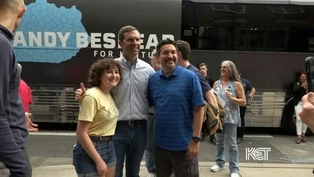
Clip: S1 Ep251 | 4m 2s | KY Gov. Andy Beshear kicked off his reelection campaign with a bus tour across Kentucky. (4m 2s)
Video has Closed Captions
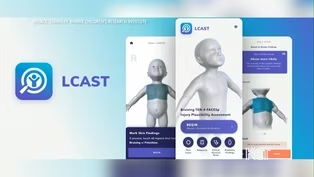
Clip: S1 Ep251 | 3m 16s | An App that analyzes bruising on young children to help identify potential child abuse. (3m 16s)
Video has Closed Captions
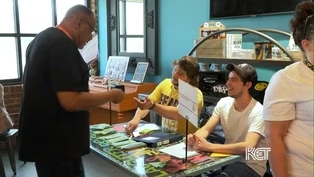
Clip: S1 Ep251 | 3m 12s | An event allowing people to experience what life is like after addiction or incarceration. (3m 12s)
Providing Support for PBS.org
Learn Moreabout PBS online sponsorship
- News and Public Affairs

Top journalists deliver compelling original analysis of the hour's headlines.

- News and Public Affairs

FRONTLINE is investigative journalism that questions, explains and changes our world.












Support for PBS provided by:
Kentucky Edition is a local public television program presented by KET