
Kentucky Lottery Sales Increasing Despite More Competition
Clip: Season 4 Episode 117 | 8m 36sVideo has Closed Captions
President of the Kentucky Lottery talks about facing more gaming competition.
KET’s Renee Shaw talk to Kentucky Lottery president, Mary Harville, about the kinds of partnerships she's brokered, thriving during the COVID-19 pandemic, and how she's been able to increase sales more than $1 billion in her five-year term even in the face of greater gaming competition.
Problems playing video? | Closed Captioning Feedback
Problems playing video? | Closed Captioning Feedback
Kentucky Edition is a local public television program presented by KET
Kentucky Lottery Sales Increasing Despite More Competition
Clip: Season 4 Episode 117 | 8m 36sVideo has Closed Captions
KET’s Renee Shaw talk to Kentucky Lottery president, Mary Harville, about the kinds of partnerships she's brokered, thriving during the COVID-19 pandemic, and how she's been able to increase sales more than $1 billion in her five-year term even in the face of greater gaming competition.
Problems playing video? | Closed Captioning Feedback
How to Watch Kentucky Edition
Kentucky Edition is available to stream on pbs.org and the free PBS App, available on iPhone, Apple TV, Android TV, Android smartphones, Amazon Fire TV, Amazon Fire Tablet, Roku, Samsung Smart TV, and Vizio.
Providing Support for PBS.org
Learn Moreabout PBS online sponsorshipShe's the first woman and the second Kentucky native in over 30 years to run the Kentucky Lottery.
Mary Harville is making a career pivot after five years at the helm of the organization she's contributed to for decades.
I talked with her yesterday at Kate's Louisville Operations Center about the kinds of partnerships she's brokered thriving during the Covid 19 pandemic, and how she's been able to increase sales more than $1 billion in her five year term as president of the Kentucky Lottery.
Even in the face of greater gaming competition.
Well, let's talk about a little bit about you before you came into the lottery.
You were an attorney and you're from private practice.
And so was that a pivot for you?
And what did you set out to do when you took over as the head of the lottery five years ago?
What specifically was it?
Well, I came to the lottery and out of private practice, I became the general counsel, senior vice president, and general counsel.
So I'd had a lot of years of experience.
And I worked next to Arch Gleason at his right hand.
Learned a lot from him and was able to see how to best move us forward.
Of course, everything is changing in the lottery industry.
We know that player habits change and you got to stay up with that.
So I had a bird's eye view of that.
And when I became president and CEO, I thought we could do a better job connecting all across the board with our players, with our retailers.
We have 3500 retail locations, everything from a Kroger store to, a smoke shop.
And we have 3500 locations to be able to connect with and with our vendor partners to better connect with them.
Of course, the governor is my boss, and we need to be able to connect with him and our legislators.
So I wanted to get busy being out there with the people and making the most of that and being a Kentuckian.
I was excited to be able to have that opportunity.
So those are the things I've been busy with, as well as putting the team together to make it all happen.
Well, let's talk about the changes with the lottery and the competition that has stiffened since the lottery came on board.
Decades ago.
Now we have sports betting.
You have, HHR historical horse racing machines, which people think are kind of slot type devices going.
And I'm curious, because I've watched you testify, before the legislative hearings about all of these expanded forms of gaming.
How much of a threat has that been to the lottery?
Well, I wouldn't think of it in terms of a threat.
I would say that we better get our act together and go compete with it.
And that's what I've always said.
I don't think the folks in Frankfort or want to hear us cry about having competition out there from legal forms of gaming.
It's legal, and we better be able to deal with it.
And that's what we're doing.
We're finding ways to be able to deal with that.
And sports wagering is popular.
I know I have a couple of 30 year old sons that do that, and they they love doing that.
But we have things we can do still.
Those 3500 retailers that we have where the legal gaming that's in there and we've got that market and we're online and we have lottery online so we can make the most of it.
You talked about the in the hundreds of retailers of places where you can get lottery products.
What about the big box retailers.
Is that on the to do list is could you would you ever want to go into I won't name a particular store that people frequent for a lot of retail goods and say, okay, I want to get my lottery ticket there and win on what would be the disadvantage or, barrier to that?
Well, it is a matter of the technology of making sure everyone's connected and connected with the lottery.
But I can tell you, I know our vendors, our partners that have the wherewithal to do that, make that happen.
They are working on I mean, how wonderful would it be to walk in and buy Kentucky Lottery ticket wherever you are?
And we know that it's all about convenience, right?
I had an epiphany, on Halloween night.
I saw the trick or treaters leaving my street, which is a back street, and heading out to the main street, and I looked to see where they were going.
They're going out to the main street in the neighborhood, because that's where it all was.
It was the main part of the neighborhood, and parents were literally parking the cars on that street, let the kids out, and they walked down the street and they sat in the car.
They be on their phones, or maybe they would be driving the car down the street and the kids would get in.
But what that told me was convenience is number one, right?
Right.
So we've got to be the same way.
We've got to find out where those people are that want to purchase our tickets and make sure our tickets are there.
And of course, there's always a concern about compulsive gambling, habitual gambling, problem gambling.
I mean, how does the Kentucky Lottery ensure that there is a responsible, plying of the lottery?
We absolutely do want to ensure there is responsible play.
We, support one 800 gambler.
It's a number that folks can call if they feel like it's not fun anymore.
Because lottery games are fun.
It's not fun.
Then you need to get help.
So we've got that sticker on everything.
It's on the back of all our scratch tickets.
And when you play online, you'll see a clock.
There's the ability to self exclude if you wish to, for varying amounts of time.
There are limits on how much you can deposit into your account.
So there are many controls as well as training that we conduct.
We're affiliated with the Kentucky Council for Problem Gambling, as well as the national organization.
As well.
So we do have a robust.
Program, and some of those proceeds go to those organizations.
We do support one 800 Gambler, and we do pay for the individual counselor that you will get if you go to one 800 gambler and you want to text or chat, we pay for the training of those counselors that are there.
Just to go back about five years.
Right when you came in, actually, and there was a little thing called the Covid 19 pandemic, when entertainment options were shuttered because of contagion concerns.
But you could still go to a grocery store, get a lottery ticket.
I mean, when you look on the other side of Covid, not to say that that would be a silver lining, but did that expand markets?
Because for a while there weren't any entertainment options for people, but the lottery was still there and accessible.
You got it.
We benefited greatly from that.
No question about it.
We were watching those sales, and as those businesses, our competition were shuttered, the racing, the tracks, that.
Yeah, we could see our sales going up.
Let's say there's another component to that, too.
And it was all hands on deck, because in some grocery stores, there was the machines that were the problem.
Right?
They remember we weren't supposed to stand next to each other, so people were in line, right?
Right.
All of us.
It was all hands on deck and I remember talking to several grocery store chains out in eastern Kentucky and saying, could you please work with us on this?
Just leave those machines, open?
I think we can work a line out where you can put people so they won't be in the way, and we had to really work on that.
But you're exactly right.
We did benefit from that.
We had a wonderful distribution, scientific gains.
We had a wonderful effort to make sure those tickets were delivered and, and the machines.
And we had so many people say, we're just so grateful you were there.
It made me feel like, there was still something we could do that was fun and entertaining.
So when people were looking for an entertainment, we provided it.
Yeah.
And those people still hung around rides.
They did.
That's where the extra effort had to come in.
You know, we saw this, trajectory, this upward trajectory due to Covid.
We had to find out how to keep it and keep it going, and we did for a while.
But of course, it's reset somewhat if you look at it.
Of course, we went went up, but then the whole trajectory has reset a bit as we've gone back to normal.
We'll bring you part two of my interview with Mary Harville tomorrow night.
I ask about when our anonymity at legislative efforts to shield prize winners identity, and we'll talk about how lottery proceeds are helping many Kentuckians get a college education and change their lives for the good.
Tune in for that discussion tomorrow night on Kentucky Edition.
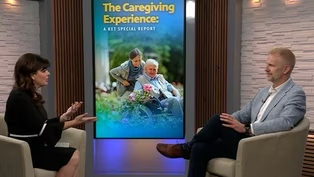
Emotional Challenges of Caring for Elderly Parents
Video has Closed Captions
Clip: S4 Ep117 | 6m 50s | Dementia and aging expert on emotional challenges of caring for elderly parents. (6m 50s)
Providing Support for PBS.org
Learn Moreabout PBS online sponsorship
- News and Public Affairs

Top journalists deliver compelling original analysis of the hour's headlines.

- News and Public Affairs

FRONTLINE is investigative journalism that questions, explains and changes our world.












Support for PBS provided by:
Kentucky Edition is a local public television program presented by KET