
Kentucky Native Discusses Political Reporting Career
Clip: Season 4 Episode 382 | 5m 5sVideo has Closed Captions
Michael Collins has reported from 27 states and four foreign countries.
Born in Whitesburg, Kentucky Journalism Hall of Fame recipient Michael Collins was once a statehouse reporter in Northern Kentucky. Since then, he's reported from 27 states and four foreign countries and is now a national correspondent for USA Today. Renee Shaw sat down with Collins for this Reporter's Notebook interview.
Problems playing video? | Closed Captioning Feedback
Problems playing video? | Closed Captioning Feedback
Kentucky Edition is a local public television program presented by KET
Kentucky Native Discusses Political Reporting Career
Clip: Season 4 Episode 382 | 5m 5sVideo has Closed Captions
Born in Whitesburg, Kentucky Journalism Hall of Fame recipient Michael Collins was once a statehouse reporter in Northern Kentucky. Since then, he's reported from 27 states and four foreign countries and is now a national correspondent for USA Today. Renee Shaw sat down with Collins for this Reporter's Notebook interview.
Problems playing video? | Closed Captioning Feedback
How to Watch Kentucky Edition
Kentucky Edition is available to stream on pbs.org and the free PBS App, available on iPhone, Apple TV, Android TV, Android smartphones, Amazon Fire TV, Amazon Fire Tablet, Roku, Samsung Smart TV, LG TV, and Vizio.
Providing Support for PBS.org
Learn Moreabout PBS online sponsorshipNow for part two of Renée Shaw's interview with veteran Washington based journalist Michael Collins.
Born in Whitesburg and Eastern Kentucky, the Kentucky Journalism Hall of Famer was once a statehouse reporter in Northern Kentucky.
Since then, he has reported from 27 states, four foreign countries and the U.S.
Virgin Islands and is now a national correspondent for USA today.
Renee talks with Michael Collins in today's Reporter's Notebook.
When you think about the evolution of journalism, because you've been around a long time and you've seen particularly the print newspaper industry change, right?
And how that's impacted local community driven journalism versus what the bigfoots can do.
I mean, how do you contextualize, the journey of journalism these last 20 years?
Well, it's changed dramatically.
You know, started my career.
I worked for, as I said, the Kentucky Post, and we published, two editions.
And then once you finished that, you once you finished the edition for that day, you started working for the next paper.
Well, that's not the case anymore.
Everything.
It's it's almost like you work for a wire service now where stories have to be filed immediately.
They have to be updated frequently and sometimes you are as, as a reporter.
You are particularly on breaking news stories.
You are writing those stories and putting them online.
A couple of paragraphs at a time.
So the pace is very different than it was when I first.
Started many years.
As you said, you were a white House correspondent.
And I remember seeing on social media times when he had gone to the white House Correspondents Dinner.
Right.
And you did not go, this past time.
But I know you have colleagues who still have probably some very vivid memories and reflections about being there this past occasion.
Can you share with us any of those thoughts?
Sure.
I as you said, I've covered I've been to the dinner multiple times, I think probably a dozen or more.
I was not there.
When?
A few days ago, when we, you know, had the, the, the unfortunate shooting, but yeah, I had, lots of lots of my colleagues, were in the room at the time, and one of my colleagues told me that, you know, there were people ducking underneath the tables because they just, you know, they weren't really sure what was happening, but there was a lot of, you know, the chaos in the room.
And one of my colleagues told me that that was probably the most frightful 10s of his life.
So it was a very, very disturbing, thing for the people who were there to witness.
And I even though I did not go to the dinner, I got the called in to help with the coverage.
That, that, that shooting.
So I've done quite a bit of, coverage, the event itself, even though I was not in the room that particular night.
And can you speak to.
I don't even know if it's secondary trauma.
Perhaps it's even primary trauma.
If you're on the scene and you're there during the dinner or these other occasions where there's mass violence or violence of any sort, where reporters are almost the second responders, if you will, on the scenes, I mean, what how how do you deal with those types of incidents over and over and over again?
Because that is exposure to trauma.
It is.
But, you know, as a journalist, I think your, your, your, your, your journalistic instincts kick in.
I talked to so many people who were at the dinner and they almost all of them told me the same thing, which was it was very frightening.
It was very frightening for a few seconds.
And then once things settle down, everybody started doing what journalists do.
They started interviewing people.
They started, you know, shooting videos, they started taking photos.
And I think that, you know, when you're trying to be a journalist like we are, you go into these situations, and that can be frightening.
But your your instinct, your journalistic and say just takes over and you do the job.
Yeah.
So from my perhaps another kid from Whitesburg, Kentucky is watching this right now and thinking, gosh, how do I end up taking the path of a Michael Collins and end up working for USA today or some other very, high national profile publication?
What would you say for that to them who think it's not possible?
I would say it is possible.
And all you have to do is, you know, put yourself out there and work very hard.
Don't be intimidated.
You know, you're you're just a smart, as any of the, anybody else that's out there.
So just do it.
Work hard and don't be intimidated.
And don't let people tell you that you don't belong because you don't.
Yeah, well, we know you belong and we miss you and Kentucky, but we love seeing your byline.
And we appreciate all your great work, for all seasons.
And just thank you, Michael Collins, for spending a little time with us.
Thank you for having me.
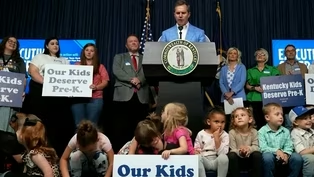
GOP Lawmakers Blast Beshear's Pre-K Pilot Project
Video has Closed Captions
Clip: S4 Ep382 | 2m 8s | The governor's use of workforce development dollars is prompting some criticism. (2m 8s)
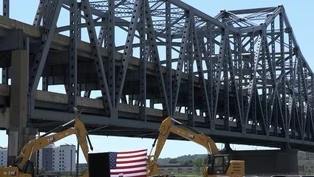
Leaders Break Ground on Brent Spence Bridge Project
Video has Closed Captions
Clip: S4 Ep382 | 2m 40s | Federal and state leaders gathered in Cincinnati on Friday for the groundbreaking. (2m 40s)
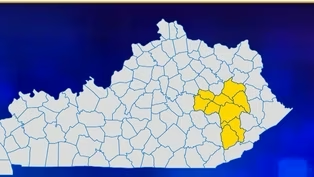
Previewing State Senate District 30 GOP Primary
Video has Closed Captions
Clip: S4 Ep382 | 3m 26s | The race is between a 25-year incumbent and current state representative. (3m 26s)
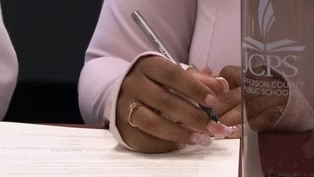
Program Inspiring New Generation of Teachers
Video has Closed Captions
Clip: S4 Ep382 | 3m 27s | Some seniors received conditional job offers from Jefferson County Public Schools. (3m 27s)
Providing Support for PBS.org
Learn Moreabout PBS online sponsorship New Episode
- News and Public Affairs

Top journalists deliver compelling original analysis of the hour's headlines.

- News and Public Affairs

FRONTLINE is investigative journalism that questions, explains and changes our world.

 New Episode
 New Episode
 New Episode

 New Episode
 New Episode
 New Episode
 New Episode
Support for PBS provided by:
Kentucky Edition is a local public television program presented by KET