
Kentucky Public Service Commission Chair on High Energy Bills
Clip: Season 4 Episode 342 | 9m 15sVideo has Closed Captions
Renee Shaw sits down with the chair of the Kentucky Public Service Commission.
Kentucky Public Service Commission chair, Angie Hatton, talks with Renee Shaw about rising rates, bigger bills, and unhappy customers.
Problems playing video? | Closed Captioning Feedback
Problems playing video? | Closed Captioning Feedback
Kentucky Edition is a local public television program presented by KET
Kentucky Public Service Commission Chair on High Energy Bills
Clip: Season 4 Episode 342 | 9m 15sVideo has Closed Captions
Kentucky Public Service Commission chair, Angie Hatton, talks with Renee Shaw about rising rates, bigger bills, and unhappy customers.
Problems playing video? | Closed Captioning Feedback
Where to Watch Kentucky Edition
Kentucky Edition is available to stream on pbs.org and the PBS app.
Providing Support for PBS.org
Learn Moreabout PBS online sponsorshipThe head of the Public Service Commission, or PSC, says it's the most important agency.
Many have never heard of.
But the PSA members often get an earful about steep spikes in ratepayers energy bills during extreme cold snaps or heat waves.
Angie Hatton is chair of the Public Service Commission that sets utility rates in Kentucky.
She stopped by our studio mid-week to discuss the causes for the sometimes wallet draining power bills, and whether the PSC has the power to make sure your power bills are affordable.
Nationwide and utility bills are increasing at more than double the rate of inflation.
It's every utility and every state.
And, you know, I travel to conferences and meet, public service commissioners from around the country, and they're seeing the same things that I am.
And the three years that I've been on the Public Service Commission, affordability has risen to, the top priority and topic of discussion at all of these conferences.
You know, public service commissioners across the country are increasingly, targets of folks who are so angry and scared about the the rise in their utility bills.
And there's only so much we can do.
But, you know, commissioners, in other states have had to hire full time security, travel with security.
They've had death threats.
It's, it is a very intense respo I think that folks are acting out of fear, as much as anger, because they some of the bills really are, are getting, getting pretty high and pretty scary.
Yeah.
So let's let's talk a little bit about, you mentioned and other states, public service commissioners have gotten security.
Is that the case in Kentucky and who would pay for that?
We have security at our public comment hearings, and that's usually local law enforcement, local sheriff's departments, and then the state police, capital security, provides security at our hearings when we need it.
And some of the more contentious cases, I have not had death threats.
I've had a lot of social media.
Oh, I don't know if we'd call it harassment, but, some, some very, very angry people in high numbers.
Of it rise to the level of really causing you concern and have you run it by security to ask their thoughts on whether or not you should be more concerned and should take precaution?
I didn't, but other people have run certain things by security on my behalf because they were concerned.
But my mother says that I have more nerve than sense.
So that maybe I don't don't have the sense to actually be scared.
But, I want to give everyone grace who says things to me and about me because I understand where it's coming from.
You know, I have to set rates for myself.
From my grandmother, for my neighbors, for my, every friend I've got.
And it's a it's not an easy thing to do.
Yeah.
So let's let's talk about that a little bit.
What kind of parameters do you have when you're deciding rates.
And is it first and foremost the thought of how it's going to affect the ratepayers and the advocacy groups that may petition the PSC on ratepayers behalf?
Or do you can look at it clearly from an objective point of view?
Which side are you on?
Some would say.
We're supposed to be the balancing authority.
You know we are.
We are supposed to make sure that the power can stay on, that it's reliable that the service is reasonable and adequate, but also that the rates be fair and reasonable.
And so we have to, we're not allowed to just make decisions based on emotion.
If we were, it would be a lot easier, you know, if we could just hear emotional.
But you never do a rate increase, right.
If the case.
Yeah.
Yeah, that that would be a wonderful scenario.
But we have to make sure that utilities get enough money to provide the infrastructure, the maintenance, the upkeep of the lines.
And it's actually a constitutional taking if we don't, what do.
You mean by.
That?
Confiscatory.
So confiscating, confiscatory rates are those that don't provide the reasonable cost for utilities.
And just like our cost, utility costs have gone up.
So the cost of the transformer has doubled.
The cost of a power pole has gone up 75% in the last, like, 6 to 8 years.
And so, if if we don't give adequate rates to cover the cost for the utility, it's a taking under the Constitution, we have taken private property from a private company and redistributed it to the public without recompense.
So the and the.
Consequence would be.
Well, we'd get overturned, by the circuit court.
Or if we weren't, the utility would not be able to operate.
And when you turn your power switch on, nothing would happen.
I mean, we're we're the buck stops with us if we don't give adequate rights, there's not going to be adequate service.
People would question, why are the rates going up?
What's the reason?
Well, you know, inflation across the country at all costs are going up, you know, and these utilities have to buy gas the same as we do.
They have to hire workers the same as we do.
But then there's also the consideration of the expansion of demand for electricity.
So we have data centers and I and, electric vehicles are more a problem in other parts of the country than, than they are here.
I don't mean problem, but yeah, more electric vehicle use in other parts of the country and that's contributing to it.
But the more demand for electricity is, the more the electricity companies power companies have to keep up with, with, the infrastructure that feeds that demand.
You are from eastern Kentucky, right.
And you served in the state House and was a leader there.
And, you know, this conversation that you hear from folks in that part of the state where it rivals their mortgage?
I mean, 800 to $1000 a month.
We just heard it the day that we recorded this conversation, a woman was living in a single wide trailer, two bedroom and was paying 800 or $600 a month to heat her home.
And so you think, my gosh, that's out of reach and not sustainable for someone to be able to heat their home or cool their home?
Yeah.
It is, it's heartbreaking.
And we still have an open case with Kentucky Power because we just made a ruling, on their rate case, but it's still open for appeal.
And so the applicant, the power company, could appeal and other parties could appeal.
You know, the attorney general made a a plea for 0% increase.
So I assume they could appeal since we didn't feel we were able to do that and let a court decide whether we could, so any of the parties could still appeal.
So I don't need to get into details of that.
However, we can talk about that territory.
One of the main issues with that territory is the population.
They've lost 12,000 customers over the last, like 12 to 14 years.
They're looking at potentially as much as another 40% decrease in population.
And none of these systems were designed to for decreasing population.
Because, you know, I'm the very last house in my holler where I live and I pay my electric bill.
So I'm entitled to service.
And, if there used to be 100 houses on that holler and now there's 60, you're dividing the cost of that infrastructure among much fewer people.
And so they have 162,000 customers, over 20 counties.
But they used to have a lot more, and they don't have industrial customers anymore.
With the downturn in the coal industry, people moved away and businesses closed.
And so there's not industrial customers to pay industrial rates and pick up a whole lot more of that infrastructure.
So the I mean, until the population changes, you know, because of economic development, it is really hard to see a light at the end of that tunnel.
So we we do everything we can to cut out any unreasonable costs.
But the fact is those costs are being spread among fewer people.
You know.
I'll have more with Angie Hatten, who's also an attorney, next week when we talk about the impact data centers could have on the power grid and rates and the prospects for nuclear power in Kentucky's energy portfolio, that's part of our conversation.
That will air Monday night on Kentucky Edition.
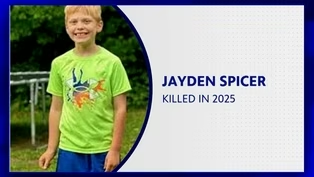
Bill Would Make Child Abuse Homicide a Capital Offense
Video has Closed Captions
Clip: S4 Ep342 | 1m 46s | Those guilty of child abuse homicide would be eligible for the death penalty under bill. (1m 46s)
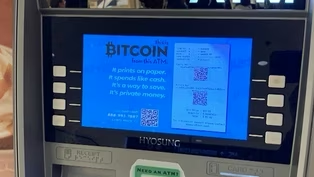
House Advances Crypto Currency Measure
Video has Closed Captions
Clip: S4 Ep342 | 2m 45s | House passes bill to regulate crypot currency kiosks. (2m 45s)

Lawmaker Wants Kentucky to Take Lead in Ibogaine Research
Video has Closed Captions
Clip: S4 Ep342 | 3m 23s | Senate bill sets up a framework for clinical research of ibogaine. (3m 23s)
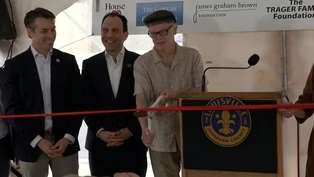
Louisville Opens Housing Unit for those with HIV/AIDS
Video has Closed Captions
Clip: S4 Ep342 | 3m 41s | Advocates say housing is key to stability for those living with HIV/AIDS. (3m 41s)
Providing Support for PBS.org
Learn Moreabout PBS online sponsorship New Episode
- News and Public Affairs

Top journalists deliver compelling original analysis of the hour's headlines.
 New Episode
- News and Public Affairs

Today's top journalists discuss Washington's current political events and public affairs.


 New Episode
 New Episode
 New Episode
 New Episode
 New Episode
 New Episode
 New Episode
Support for PBS provided by:
Kentucky Edition is a local public television program presented by KET