
Kentucky Secretary of State Outlines His Legislative Asks
Clip: Season 4 Episode 322 | 7m 39sVideo has Closed Captions
Secretary of State Michael Adams says he wants to see payraises for county clerks.
Kentucky's top election chief has an item or two to add to state lawmaker's to-do list in the remaining 32 days of this year's legislative session: a pay raise for county clerks and outlawing the impersonation of elections officials. Kentucky Secretary of State Michael Adams he talks about those priorities, and what political post the term-limited official is eyeing next.
Problems playing video? | Closed Captioning Feedback
Problems playing video? | Closed Captioning Feedback
Kentucky Edition is a local public television program presented by KET
Kentucky Secretary of State Outlines His Legislative Asks
Clip: Season 4 Episode 322 | 7m 39sVideo has Closed Captions
Kentucky's top election chief has an item or two to add to state lawmaker's to-do list in the remaining 32 days of this year's legislative session: a pay raise for county clerks and outlawing the impersonation of elections officials. Kentucky Secretary of State Michael Adams he talks about those priorities, and what political post the term-limited official is eyeing next.
Problems playing video? | Closed Captioning Feedback
How to Watch Kentucky Edition
Kentucky Edition is available to stream on pbs.org and the free PBS App, available on iPhone, Apple TV, Android TV, Android smartphones, Amazon Fire TV, Amazon Fire Tablet, Roku, Samsung Smart TV, and Vizio.
Providing Support for PBS.org
Learn Moreabout PBS online sponsorshipKentucky's top election chief has an item or two to add to state lawmakers to do list in the remaining 32 days of this year's legislative session, one a pay raise for county clerks and two outlawing the impersonation of elections officials.
And part two of my interview with Kentucky's Secretary of State, Michael Adams.
He talks about those priorities and what political post the term limit official is eyeing next.
First, we pick up on the possible impact of artificial intelligence in our elections.
Let's talk about AI, since we're talking about it in so many other spaces and sectors.
What are the opportunities or even threats to election security as we understand AI now and how it could evolve?
So AI is is a tool.
You know, it's like the internet or anything else.
There's going to be a lot of good and a lot of bad that that comes from it.
It's not inherently benign or inherently malignant.
The trick is, can you get the best out of it?
Bigger states than ours, with bigger budgets, honestly, than ours are already using AI in a positive way to automate functions.
To be able to have smaller offices with fewer staff and perform more services with AI like chat bots.
You think of AI as being.
You know how in the movie, 2001 it could be a chat bot.
It's just that simple.
For us, we run the numbers, and right now we don't think that the current cost of AI is worth accepting because the savings isn't isn't going to counteract it.
That may be a different decision for my successor someday.
The cost may drop as, like, big screen TVs are super expensive, and now everyone's got them, right?
Right.
Yeah.
So right now, we're not.
We're not using it, but it's not because we're afraid of it.
It's just it's too expensive right now.
But there is a sunny side to it.
The darker side of it is, of course, the deepfakes.
And I have legislature, and I'm continuing to ask the legislature to make it an election offense to impersonate, whether it's the secretary of state or a county clerk, any election official, and put up false information about our elections.
I'm sure you remember two years ago someone put out a deep fake robocall of Joe Biden that was very convincing, with the president at the time, saying, don't vote in the New Hampshire primary.
Save your vote for November.
That's the kind of mischief that could really impact low information voters and change an outcome.
So I think it's really important that we get that done.
Yeah.
What pieces of legislation are you either advocating for or maybe playing defense on that the General Assembly is considering at this particular point.
So this has been a relatively quiet session, generally and on elections as well.
I'm not complaining.
I've had six really, busy sessions with election legislation.
The biggest thing for me, I'm not asking for more money for myself, but I am asking for more money for the county clerks.
The funding formulas that we have in the law were written 40 years ago, and it's dollar amounts that are set by statute, and they just don't reflect the cost of running elections in the 21st century.
If you want more security, you have to spend a little more money to make sure that you have that.
So I have asked that the clerks get that money.
This is not a good session asking for money.
Money's really tight right now, but my biggest priorities are, number one, funding for the clerks that hire poll workers and different locations.
It's getting harder and harder every year.
And of course, the deepfake technology bill as well.
Open primaries for it or against it.
Oh, I've been for it for years.
Really?
From from almost day one.
To me, it's absurd that we have independence.
The fastest growing voter bloc in Kentucky.
I have been close.
We have them out registering Republicans in, in many months.
And they're taxpayers and and they are not allowed to vote in elections.
That's crazy.
And the primaries are becoming more and more important because, increasingly because of polarization, we have red places getting redder and blue places getting bluer, and the primary becomes the general.
So we should we should welcome our voters into that process.
What I've proposed, not formally, but I've, I've said in media interviews is it might be a big ask to just change the law that dramatically right now, maybe what we ought to do is make it voluntary and let the parties decide.
If you want to have an open primary, it's your party's decision and your party can decide.
We're not going to force it on you.
My guess is one of the two parties would do that, and the other party would see that happen and say, we should do that too.
It's in the it's in both parties interests to compete for voters.
Neither party has a majority of voters.
Republicans have 48% now, which is better than we used to be.
But it's not a majority.
Nobody can win, let's say, pick off voters who aren't part of their own comfort zone.
There's always concerns about the interlopers, right, who have nefarious, actions to do detriment to a particular nominee or possible nominee.
I wouldn't have wanted Democrats voting in my primary if never would be the Secretary of State right now, if it had happened.
I'm not for mischief.
I'm not for letting D's vote in our primaries, and vice versa.
I'm not for that.
So when we talk about open primaries, what's the working definition of that?
Letting independents pick which party they want to vote in.
That's what New Hampshire does when you vote for president in New Hampshire.
If you're a Republican, you get to vote in the Republican primary.
Democrats get to vote in their primary.
Independents can decide which one they want to vote in, and both parties actively encourage the independents to come join them and be part of their process.
Pay attention to their candidates.
Get invested.
Right.
It helps them in the general election.
Right?
Because some people think when they think of open primaries.
Oh, well, I'm a Republican, but I really do want to have a say in who's going to be the Democratic nominee for U.S.
Senate.
Let's just say.
I really yeah, I don't want gamesmanship and states to have fully open primaries and even have Partizan registration.
I'm not advocating that.
All I'm advocating is that independents are growing quicker than anybody else.
They're they're politically detached.
And whichever party courts them is going to win the election.
So let both parties court them.
As you mentioned, this is your seventh go round.
So this means, you know, you're not.
Getting the hang of it.
You're getting nothing.
You're just settling in your groove.
Right.
So now that you're just getting your groove, what are you going to do after this?
I haven't decided yet, but I'm considering a lot of different options.
What are the options you're considering?
Retirement is.
This is option.
I'm looking at running for governor as well, but right now we have a Senate race going on.
I won't make any decisions until at least this primary is over in May.
Why?
Governor?
As a consideration.
Honestly, I don't think I am a good fit for anything else right now.
I think my style of approach of of being a rational, intelligent person and being fact based in state office is a better fit for that than federal right now.
What do you think your chances are in a primary against a James Comer, perhaps?
I think they're pretty good.
I won't know until I pull it, which I'll be doing later this year.
But I think, you know, every single day, all day, every day.
I have people encouraging me to do it and I'm looking at it.
Yeah.
Well, perhaps many people would think that if you can survive the primary, you have a pretty good shot in the general because you have been bipartisan and moderate by most measures.
Yeah.
And I'm the only person talking about state issues.
I've got this land all to myself.
No one else even talks about it.
They talk about the average of the day on social media or whatever.
And I think Kentucky voters have shown that they want an adult in the room, in the state capitol, in in the center office, and they don't have a lot to pick from right now.
But do you think, should you get to that point, that you would have to get into the culture war conversations and things that you haven't had at this point to engage in?
I think voters want authenticity, and I think that's why they like President Trump.
They see him as sui generis and authentic.
I'm a different personality type than he is, but I'm authentic, and I'm the only person who's not a bootlicker and thinking for myself and in my own man.
I think voters like that.
Well, thank you, Secretary Michael Adams, thanks so much.
Good to talk to you.
You too.
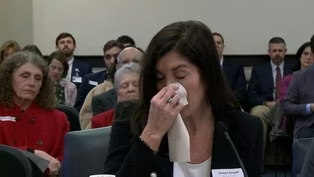
Bill Seeks to "Modernize" Mental Health Statutes
Video has Closed Captions
Clip: S4 Ep322 | 2m 25s | House Bill 485 would update state statutes on mental health. (2m 25s)
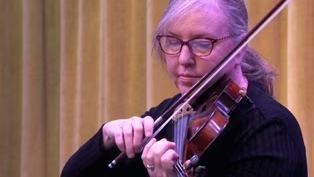
Instruments From the Past Helping Tell Holocaust Stories
Video has Closed Captions
Clip: S4 Ep322 | 3m 38s | Violins of Hope uses instruments to shares stories of World War II Jewish musicians. (3m 38s)
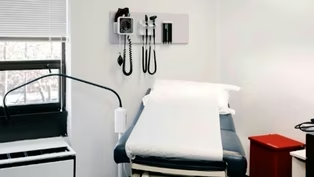
Religious Liberty in Medicine Bill Advances in Frankfort
Video has Closed Captions
Clip: S4 Ep322 | 3m 33s | Bill allows providers to deny services based on religious beliefs. (3m 33s)
Providing Support for PBS.org
Learn Moreabout PBS online sponsorship
- News and Public Affairs

Top journalists deliver compelling original analysis of the hour's headlines.

- News and Public Affairs

FRONTLINE is investigative journalism that questions, explains and changes our world.












Support for PBS provided by:
Kentucky Edition is a local public television program presented by KET