
Kentucky Senate Majority Hold Annual Retreat
Clip: Season 4 Episode 113 | 3m 42sVideo has Closed Captions
Senate majority hammers out priorities for upcoming session.
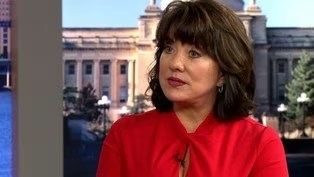
The Kentucky Senate Majority gathered in Bardstown today for their annual retreat. It's where the caucus is hammering out its priorities for the next legislative session that starts in January. Our June Leffler has more.
Problems playing video? | Closed Captioning Feedback
Problems playing video? | Closed Captioning Feedback
Kentucky Edition is a local public television program presented by KET
Kentucky Senate Majority Hold Annual Retreat
Clip: Season 4 Episode 113 | 3m 42sVideo has Closed Captions
The Kentucky Senate Majority gathered in Bardstown today for their annual retreat. It's where the caucus is hammering out its priorities for the next legislative session that starts in January. Our June Leffler has more.
Problems playing video? | Closed Captioning Feedback
How to Watch Kentucky Edition
Kentucky Edition is available to stream on pbs.org and the free PBS App, available on iPhone, Apple TV, Android TV, Android smartphones, Amazon Fire TV, Amazon Fire Tablet, Roku, Samsung Smart TV, and Vizio.
Providing Support for PBS.org
Learn Moreabout PBS online sponsorshipThe Kentucky Senate majority gathered in Bardstown today for their annual retreat.
It's where the caucus is hammering out its priorities for the next legislative session that starts in January.
Our Jane Lefler has more on that.
2026 will be the 10th year that we've had Republican majorities in the House and the Senate working together to define what we view the role of government to be.
Kentucky's Senate now has 32 Republicans and just five Democrats.
Republicans say that speaks to what they've accomplished.
Healthiest trust fund in history of the Commonwealth.
Highest level of education.
Investment in the history of the Commonwealth.
Those sorts of things we've made, we've been able to do at the same time that we've been paying down our pension liability.
Another feat lowering the state income tax.
Initially 6% down to 3.5% for the year that we're going to be moving into 2026.
A House Republican has called for lowering the rate again, despite the state not meeting certain revenue and spending expectations to trigger another cut.
The Senate president pushes back.
We set a policy in process, and when you set the policy and process, you should follow it.
And we try to follow.
Now we know that you have to modify on occasions.
In the last session we did to where it may not be as big of an incremental decline, but we set some different triggers that would still give us the ability to hit those incremental spots to make incremental declines.
I think from that perspective, we just want to keep following our policy.
If we hit it, we hit it.
If we don't, we don't.
Though a state budget office flagged falling revenues earlier this year, the Senate president suggests Kentucky's financial situation is not so dire.
We'll have five months of data, and by the time we get into the session, we'll have a half a year.
And the governor call the consensus forecast group.
Then after two months, if there is a need to cover it and that the governor's office won't deal with it with some minor adjustments, we have the money to cover it.
The state did end the recent fiscal year with the surplus partly due to reduce spending, and the state's rainy day fund sits at $3.7 billion.
Lawmakers highlight issues of urgency, one being a statewide housing shortage.
We've got to incentivize housing in some way, even if it's the baby step.
But talking about reforms, in, in the, in the process of approvals and things like that, that may be a baby step, but more of a bigger step might be having a loan pool or improving tax credits.
These latter options would require funding.
Another urgent concern artificial intelligence.
Policymakers want to embrace this emerging technology.
It's just a matter of it's energy costs.
Well, this is going to be passed on to the residential consumer.
Say like Grandma Lula.
Well, this is where you have what's called full cost allocation.
If you do a full cost allocation that there is any need for additional infrastructure.
When we say infrastructure, that's your grid.
That's your line, that's your transformers, that's your substations.
If that's going to be developed to service that consumer for artificial intelligence, then they have to bear the cost and not be put back on the residential consumer.
The lawmakers also recognize Senator Jimmy Higdon, who will be serving in his last session in the General Assembly.
His district covers Bardstown, Lebanon and other central Kentucky communities.
For Kentucky Edition, I'm Jim Leffler.
Thank you.
June.
The 60 day lawmaking session begins January the 6th.
Kentucky Chief Justice Honored for Mental Health Reforms
Video has Closed Captions
Clip: S4 Ep113 | 8m 8s | A Kentucky Chief Justice honored for advancing mental-health responses, reflects on historic role. (8m 8s)

'"Ratatat Man" Making Stage Debut
Video has Closed Captions
Clip: S4 Ep113 | 4m 25s | Radio play makes its way to stage in Frankfort. (4m 25s)
Providing Support for PBS.org
Learn Moreabout PBS online sponsorship
- News and Public Affairs

Top journalists deliver compelling original analysis of the hour's headlines.

- News and Public Affairs

FRONTLINE is investigative journalism that questions, explains and changes our world.












Support for PBS provided by:
Kentucky Edition is a local public television program presented by KET