
Kentucky Students Assist NASA on Historic Artemis II Mission
Clip: Season 4 Episode 359 | 3m 45sVideo has Closed Captions
Morehead State University providing support for NASA's Artemis II mission.
The astronauts on NASA's Artemis II mission are currently making their way back to Earth from the first crewed trip to the moon in over 50 years - currently tracking the spacecraft's location and velocity is the ground station team at Morehead State University's Space Science Center.
Problems playing video? | Closed Captioning Feedback
Problems playing video? | Closed Captioning Feedback
Kentucky Edition is a local public television program presented by KET
Kentucky Students Assist NASA on Historic Artemis II Mission
Clip: Season 4 Episode 359 | 3m 45sVideo has Closed Captions
The astronauts on NASA's Artemis II mission are currently making their way back to Earth from the first crewed trip to the moon in over 50 years - currently tracking the spacecraft's location and velocity is the ground station team at Morehead State University's Space Science Center.
Problems playing video? | Closed Captioning Feedback
Where to Watch Kentucky Edition
Kentucky Edition is available to stream on pbs.org and the PBS app.
Providing Support for PBS.org
Learn Moreabout PBS online sponsorshipI'm Toby Gibbs.
>> Now to some news that's out of this world.
The astronauts on NASA's Artemis two mission are currently making their way back to earth from the first crewed trip to the moon in over 50 years, currently, tracking the spacecraft's location and velocity is the ground station team at Morehead State University Space Science Center.
The school's nine story tall antenna makes it one of the only stations in the world capable of tracking a deep space mission.
NASA is using the data gathered by faculty and students to see how non NASA operated stations can be used to track future deep space missions.
>> It's huge for us to have been selected by NASA to support the Artemis two mission.
We're the only non NASA owned node on the Deep Space Network, and we primarily support NASA's lunar missions.
When you fly spacecraft beyond low earth orbit, you're well above the GPS constellation.
So how do you know where you are and how you're moving?
And we do that through a process called tracking, which the spacecraft sends a signal out and we collect and analyze the signal.
>> This is live telemetry for, sorry, live flow from the capsule.
We're able to pull it down, record it, and process it in order to get the Doppler data that they're asking for.
So if this wasn't pointed at a spacecraft, it would look pretty much just like a big square.
There would be no any bumps or ridges.
It would just be a straight, flat wedge.
>> NASA's running kind of an experiment this time to see who around the world that's not a NASA ground station can provide the best radiometric data for their navigation teams.
>> When I found out we were going to be tracking Artemis two, I was really, really excited.
I've been a ground station operator here for a few years now, but being like first, like hands on during a real life human spacecraft mission has been really cool to do.
During the mission, I've really been monitoring our systems as we track the Orion spacecraft.
So I'll monitor our dish, make sure nothing goes wrong, and if something does go wrong, troubleshoot as it comes up.
>> NASA confirmed that these measurements are asked to use as we'd like in the future, so we're going to surely include some of these into classroom and homework activities so that students can get experience with real data.
I can foresee students using them in radio frequency classes, satellite communications, ground station operations, Astrodynamics classes.
It's, you know, I think it's a treasure to have for us to teach students with this.
>> Aerospace is the number one industry in Kentucky.
And most people don't really realize that there are companies all over the state that are providing mission support activities and technologies that collectively make up about a $14 billion industry in the state.
And so we've created this ecosystem in Kentucky, where we can produce graduates at the universities that don't have to go to Colorado or Texas to get jobs anymore.
They can stay here in Kentucky.
>> I feel like this mission specifically is like telling, you know, this is what we're doing here in Morehead.
We are, in fact, having an impact on the space world, and we're going to probably keep having an impact on throughout different Artemis missions.
So it's, it's really cool to, to tell students like that, that we are doing that here.
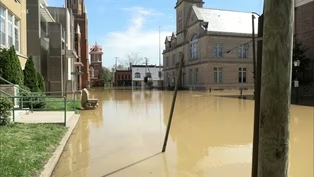
Frankfort on Road to Recovery after Historic Flood
Video has Closed Captions
Clip: S4 Ep359 | 4m 49s | Frankfort road to recovery one year after historic flooding. (4m 49s)
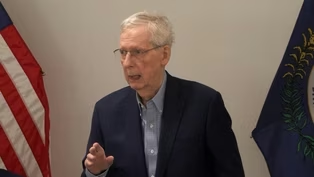
McConnell Reacts to Trump’s Threat Toward Iran
Video has Closed Captions
Clip: S4 Ep359 | 2m 30s | Sen. Mitch McConnell on President Trump's threat to destroy "a whole civilization" in Iran. (2m 30s)
Providing Support for PBS.org
Learn Moreabout PBS online sponsorship New Episode
- News and Public Affairs

Top journalists deliver compelling original analysis of the hour's headlines.

- News and Public Affairs

FRONTLINE is investigative journalism that questions, explains and changes our world.

 New Episode
 New Episode
 New Episode
 New Episode
 New Episode
 New Episode
 New Episode
Support for PBS provided by:
Kentucky Edition is a local public television program presented by KET