
Cottonwood Connection
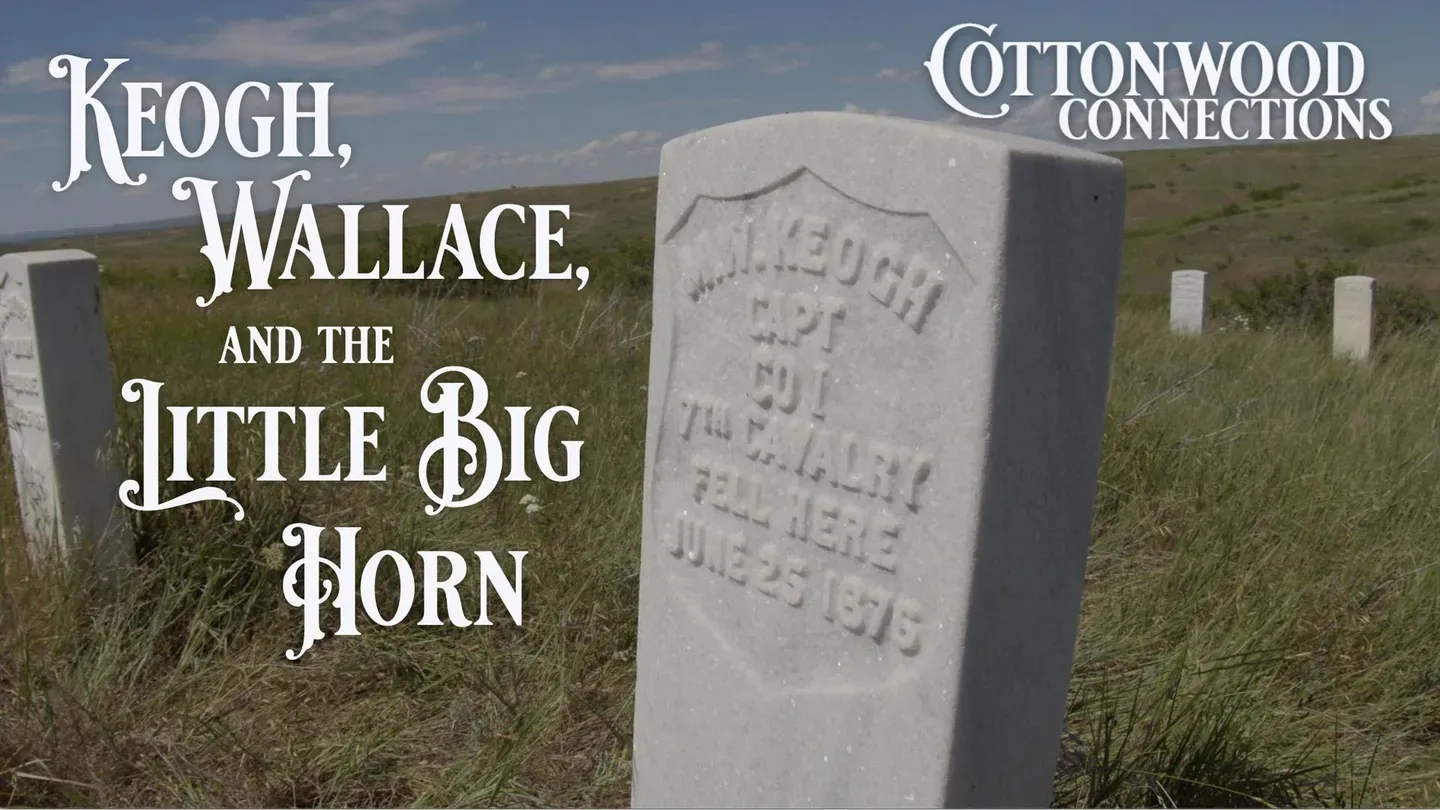
Keogh, Wallace and the Little Big Horn
Season 9 Episode 1 | 24m 55sVideo has Closed Captions
The life & career of Miles Keogh, the Irish immigrant who commanded Fort Wallace
In the 150th anniversary year of the Battle of Little Big Horn, we take a look at the western Kansas connection through the life and career Miles Keogh, the Irish immigrant who commanded Fort Wallace but ultimately met his fate with Custer.
Problems playing video? | Closed Captioning Feedback
Problems playing video? | Closed Captioning Feedback
Cottonwood Connection is a local public television program presented by Smoky Hills PBS
Cottonwood Connection
Keogh, Wallace and the Little Big Horn
Season 9 Episode 1 | 24m 55sVideo has Closed Captions
In the 150th anniversary year of the Battle of Little Big Horn, we take a look at the western Kansas connection through the life and career Miles Keogh, the Irish immigrant who commanded Fort Wallace but ultimately met his fate with Custer.
Problems playing video? | Closed Captioning Feedback
Where to Watch Cottonwood Connection
Cottonwood Connection is available to stream on pbs.org and the PBS app.
(soft music) 2026 marks the 150th anniversary of the Battle of the Little Bighorn or the Battle of the Greasy Grass as it is known by Plains tribes.
One of the clearest connections between Little Bighorn and Kansas is an officer who left his home in Ireland to join the Union Army in the Civil War and stayed in the US military and served to command and largely build Fort Wallace.
(soft music) In 2026, the Fort Wallace Museum set a theme for the year's events, focused on the life of the historic Fort's most beloved commander, Captain Myles Keogh.
Deb Goodrich, author and Garvey Texas historian and residence at Wallace, sat down with Don Rowlison at Cottonwood Ranch to discuss Keogh's life and legacy, a life cut short at the Battle of the Little Bighorn.
With Keogh, Myles Walter Keogh, I get two dates when he's being born.
Some are 1840, most of them are.
And then your some of 1842.
I think it's 1840.
So if he is born in 1840, he takes command of Fort Wallace in 1866.
He's 26 years old.
You know, he's a kid.
And for the time, what I understood, Keogh was college educated.
He went to college for two years.
He was very well educated.
He comes from a fairly prominent family.
He takes advantage of that education and he has the wanderlust.
He goes to fight in the Pope's army.
Gosh, how old would he have been then?
18 to 20, somewhere in there.
The Pope even presented him a medal.
Yes.
And maybe two, which what is allegedly said in the folklore that he was still wearing one of them when he was killed at a Little Bighorn.
His actual medals were stolen and he had duplicates made.
Cause he was very proud of those.
And so the legend is, you know, those soldiers bodies were mutilated following the battle and his was not.
And those medals are one reason.
And the fact that he was protected by his non-commissioned officers is another reason that's cited, that the native warriors saw the regard that his men had for him and thought he was something special and was so brave that he deserved to be treated differently.
Yeah, so in the civil war, he earned medals too.
He was incredible in the civil war.
So when the civil war breaks out, so many of the officers were from the South that the union was facing a real problem having enough qualified officers.
They go recruiting in Europe.
Keough is one of those guys who is recruited.
And he is a very fine cavalry officer.
So he is in the biggest cavalry engagements of the war.
He is with Buford, serves under General Buford.
He's on his staff at Gettysburg.
Buford became ill and died a couple of months after the Gettysburg campaign.
And then he's assigned to Stoneman.
He goes on the Stoneman campaign and is taken prisoner.
They're actually headed to Andersonville and they're going to liberate all the union prisoners that are held there when they get captured at Macon.
So he's a prisoner of war for a couple of months, gets exchanged, but he's really sick after that.
But then he is on Stoneman's march to the sea, which is an arm of Sherman's march to the sea.
Then when the war is over and they have the big review of the troops in Washington in May of 1865, and he is in the Gettysburg viewing stand along with General Hancock and all these other important people, you had to be not only well thought of, but you had to have had an important role to deserve being in that spot.
And there he is.
And that's a real testament to how well regarded and how well he performed during the Civil War.
And so in 1866, a year after the Civil War, he was out in the plains.
The Indian War had gone on.
The Indian War of 1864 was here because the Native Americans took advantage of most of the soldiers being in the East.
They were pretty free moving.
The buffalo were still there.
They were still moving around maintaining their culture that they had in the plains.
They had traded with the American traders in the later years, but before that, the English traders and the Spanish traders.
So they had guns and things that were very expensive and not too reliable, not as reliable as a bow with arrows.
Even before the war, 1850s, they're talking about the transcontinental railroad, but the Civil War interrupts that progress.
Well, as soon as it's done, man, we're headed west.
Those native tribes, the plains tribes that Don was mentioning, they really haven't changed their ways much, but man, 1865, it starts changing because we're laying track.
There are more surveyors.
There's more interference with the buffalo herd.
There's more cry to get these people out of the way.
Let's move them.
This is when you really start talking about forcing them onto reservations and it really changes the atmosphere.
Yeah, because the Homestead Act was passed during the Civil War.
Right, right.
So afterwards, there was a big flood of people coming out for the free land.
Right, and that free land, you're not getting free land in Virginia.
Yeah, it's all taken.
You're getting free land in the west where nobody is using it, you know.
Because in the early years, with the bands of trappers and hunters and traders, they were passing through.
The people going to Oregon on the Oregon-California Trail and stuff, we don't have to do anything about it.
And like you said, there was a lot of trade.
Yeah, so there's some advantages.
So it's maybe an uneasy alliance there, but kind of mutually beneficial.
But yeah, 65, that's all gonna change.
And so that pressure caused a lot of stuff because Native American tribes found out that the people came to stay.
Was prior to that, they were passing through.
And so it caused a lot of conflict and Keogh came right in the middle of it.
He did.
In 2024, Deb traveled to Ireland, spoke at the Carlow County Museum about Keough's time at Fort Wallace, and visited Keough's family home.
This opened the door for the Fort Wallace Museum as an element of its year of programming to invite members of the Keough family from Ireland to visit Western Kansas and learn more about this time in the Irish officers' life and service.
Myles' life was so much more than his time at Fort Abraham Lincoln and at the Battle of Little Bighorn, and he had a real life here.
From November of 1866 to August of 1867, this was life.
This was a real life, and we're so proud here to be a part of his story.
And I'm so proud to welcome this generation's Myles Kehoe, who actually lives in the Orchard House, where Keogh was born and has been home to the Keogh since 1740.
Well I'm Miles Keogh as well, and I was born, and raised and still living on the farm where he was born.
He would be my great-great-grand-uncle.
I am John Fanning.
I am a great-great-grand-nephew of Myles Keogh, and I am here having an absolute ball.
It's a wonderful honor to have paid us and Myles.
So I'm Margaret Kennedy.
My mother was a Kehoe, and she lived in the same house, was born in the same house as Miles Keough.
He's my great-great-grand-uncle, but that orchard is the kind of center of where all the different relatives came and went since.
So Myles, I'm so thrilled to have you.
Talk a little bit about the Orchard House and Leighlinbridge and what that means to the Keogh family, and what that's like, what the town is like and your farm.
Our farm is about 160 acres, it was 200 acres, which doesn't sound like a lot by acreage here in this state, but we're at a reasonably good living, all of us.
We got a lot more rain in Ireland, I can tell you.
I want to talk about what you raise on your farm, because I think a lot of what they raise now is pretty familiar.
But talk about the barley.
Anybody here raised barley or ever raised barley?
And where did the barley go?
I found it.
So you raised it for feed?
Yeah.
So where does your barley go?
Some of it, the middle quality goes Guinness.
And then the top quality goes for whiskey, for distilling.
So you have brewing and distilling.
Brewing and distilling.
Yeah, so that varies, depending on the quality.
So you don't need the high quality for beer?
You do, but not as high as for whiskey.
Not for Irish whiskey.
For the really good stuff?
He was not home when I visited, and his sister showed me around the farm.
And she showed me, I guess you had it planted in wheat then, the field where all the Keoghs learn to ride horses.
The front field, yeah.
Yeah, so the horses have been a big part of the Keogh family for a long time.
Yeah, we've always had horses.
Now that area is very famous for horses, right?
Some of the top trainers in Ireland, especially for the jumping horses.
So it's no mistake that Keogh was a cavalryman, and that when he came to Wallace, and the stable had been built, but had no roof on it, because the army didn't ship them nails, and he was just irate about that.
And he said, "My horse is suffering."
And so he was always so concerned with the health and the care of the horses.
Yeah, it sounds like him, yeah.
You're just a few miles from the village of Leighlinbridge.
Yeah, and Captain Keogh, he went to school in Leighlinbridge until he was 14.
And then there's a kind of a gap of a year or two.
We think he went to a college in Carlow, but there's no actual records, but he certainly got more education somewhere, because it allowed him to be, to go to the Papal Army first.
You know, he had to have a reasonable standard of education to become an officer in the Papal Army.
So our parents always told us about our history.
We were always very aware, but just because the timing was right and we were retired, and we said, in honor of our own history and parents, we'll come.
Our knowledge of Myles would have been scant enough.
We knew about Little Big Horn, we knew about him being stationed in Fort Wallace, but we didn't really know any of his details of his life really late.
It's under Keogh that we really start taking shape as a fort.
They were telling us here that when they were building the fort, Keogh looked after the Army soldier first, before he looked after the, himself, or the commissioned officers.
He showed clearly that he was a good human being.
So when Keogh arrives at Fort Wallace, it's just a ramshackle mess of tents and buildings that are not complete.
And there's some evidence that he really understood building.
And he has, as his quartermaster, Frederick Beecher.
And Frederick Beecher is one of the most competent people I have ever heard of in the Army.
Keogh knows what needs to be done, and Beecher can get it.
Keogh is an excellent commander in that he has rules, but he puts the men's needs ahead of his.
So he is tremendously respected.
He becomes beloved by his men.
He and four other officers, for example, that first winner, 66 to 67, live in a tent with no heat because the Army had shipped stoves but no stovepipe to vent it.
And there was no wood.
And there was no wood.
And, but he finishes a barracks for the men before the officers get quarters.
And you know, the men see that.
They see him taking care of the horses.
We're going to get a roof on that stable.
He establishes the first school and the first library on post.
So for him to arrive at that post, and you don't even have a barracks that's livable or anything for anybody to live in, to by the time he's gone, you've got a school and a library is incredible.
Those kind of things we wouldn't have known about at all.
And it's nice to know about things outside of war.
And that's why all the conversations are excellent because every day there's something actually that we hear, that I hear that I wasn't aware of.
He was the man of the people, or it appears to me that he was the man of the people.
That's why we're so happy to be here because this section of his life we as a family don't know really very little about.
Now I'm sure there was commandant officers here for much longer than him.
But he was, the year he was here, he seems to make a big impression, doesn't he?
Yeah, absolutely.
Okay, so fast forwarding to 1874, the Black Hills have been off limits.
The government has said that the tribes that are there, that's your place, you stay there.
But somebody finds gold and word gets back to the federal government and so Custer takes an expedition to the Black Hills.
So they go up there and they look around and it's like this is gorgeous country and yeah we got gold and we got all kinds of things.
So now what's going to happen?
The Black Hills that have been, much of which has been sacred ground to especially the Sioux, nah, we want it now too.
So the hostility, the focus of the Indian wars at that time shifts to the northern plains.
This is when the war department and those generals who were in command are like we're going to concentrate forces here.
So you have pieces of the 7th Cavalry that may have been stationed elsewhere through the plains but now we're going to focus.
So we're going to push everything we've got up here.
And again you've always got to look at where the railroad is going.
All these tribes are just being pushed to the breaking point, all up and down the great plains.
You know last stand, I think those tribes felt like it was the last stand in many ways.
That you know we have tolerated, we've gone along, we've signed treaties, we've done all the stuff we've done, you know and this is where we've stopped.
We're not being pushed any farther.
At Fort Wallace Museum we have a D.K.
Clark lecture series and that is in honor of our dear friend, retired Lieutenant Colonel Dennis K. Clark.
There is no equivalent in his knowledge of the U.S.
Army history, American history.
He has taught at the Army's Command and General Staff College.
There are very few people who have studied the Battle of the Little Bighorn more than D.K.
He was one of our speakers at the visit by the Keoghs.
At the end of this presentation I hope to impress upon you the final seconds of Myles Kehoe's life.
The hundreds of decisions he had to make in an instant and no matter what the decision was, it was doomed to failure.
And it was primarily because of this person right here.
And this is a guy by the name of White Bull.
This warrior, White Bull, was 27 years old when he confronted, literally confronted Myles Kehoe at the Battle of the Little Bighorn.
And this was part of his ride.
And I'll show the whole ride and why this is a significant Calhoun Hill right here is where Myles Kehoe spent his final breath.
Right here at Little Bighorn.
Myles Kehoe, again, there's his company.
He's got Company I. He's got half a company C and Company L. And he's going to make decisions from that point that every time he makes a decision he's overwhelmed by the factors changing.
But if you can imagine, from right in here is Gall, one of the Hunc Papa tribe, with 500 to 700 warriors and for a half hour or so they're shooting into Company L. But Crazy Horse comes around and he gets in a depression in behind Kehoe and his company.
But before he gets here, we have White Bull.
White Bull on his second charge chides Crazy Horse into attacking at the same time warriors out of the village coming up here.
So you can imagine, begin to imagine the chaos, the confusion that's going on here as push through some, let's just say 800 warriors, Crazy Horse, another 150 warriors, could have been, all total there was about 1250 warriors in on this attack from three directions.
This line is what's sort of left of Kehoe.
As he comes out in his line and they're all rushing to Lastan Hill, most of them on foot outnumbered eh, rough guess, 12 to 1.
The Indians describe the fight as a buffalo hunt because they're on horses and they're slinging the coo sticks and stuff and they're slaying the 7th Cavalry guys as they're running on foot trying to get down to the last defensive position where Custer was.
Not Kehoe, not his sergeants.
In the very first opening fight of the fight, a lucky shot goes through the left knee of Kehoe, through Comanche, out the right knee.
Kehoe can neither ride his horse, he can't stand, he can't walk and what happens in that crucial part of the fight, he's still alive, they move him to the ground so he's sitting holding the reins of Comanche, his horse.
And his sergeants surrounded him and fought to their last breath probably within 3 to 5 minutes.
That started me on this path in 1973 or 1974.
Why would all the sergeants and the corporals surround Miles Kehoe willing to die?
Because if you sit there to defend him, he can't walk, he can't ride and why would anybody love their commander so much that they were going to die for him?
The Kehoe family's journey took them from Wallace to the battlefield at Little Bighorn to see for themselves where their ancestor fell.
What was it like for you having been here before but now you've got your family with you?
Yeah, absolutely, because they've been telling them about it and now they can see.
All my life I've heard about Myles Kehoe through my mum and through my grandparents and it's so far away from home, you know.
We've had a good tour there and we've seen how spread out the battle was and you can read the books but you have to see it to kind of understand the landscape, to see how it unfolded.
So it was great today because it was very real when you see a name on a tombstone and certainly all the stories about the battle leading up to his death.
It's just very emotional, just so emotional.
I thought, I hope Myles that you're free and happy wherever you are.
I said a little prayer.
And then I thought to myself that I was proud this whole trip, what he did in Fort Wallace.
I think it meant a lot to the Kehoe family to see the regard that we have for him too and that he is still beloved to us.
He was without a doubt the most beloved commander that the Post ever had.
Nobody knows who the other commanders are essentially.
You know, he is the one who turned it into a real place and of course he is legendary in part because of his death at the Little Bighorn and because of Comanche, his horse who is on exhibit at Kehoe.
But when you strip away the legend, there was a very decent man doing the best he could in a very difficult time.
In a country he had chosen.
He could have inherited 250 acres of land in Carlow and lived happily ever after.
But he chose to fight.
Chose to fight a fight that wasn't his.
So you know, I have very mixed feelings about the thing.
I hope you understand.
You know, the Little Bighorn is one battle.
It is the final battle but it is still just one piece of an incredible life.
They were able to see what he had done at Wallace and the impact he had and the impact that was positive exhibiting such concern for the enlisted men.
These men seem to have stood by him when he appears to be wounded and couldn't go any further and he seems to have had his own little last stand here before the main action up at the top of the hill.
It's really just a sense of pride really, you know.
That's it.
You check off the list of qualities you want an officer, he's got them.
I will take back the pride that I have in what he did in Fort Wallace and how much his soldiers loved him obviously and how much the people, the ordinary people in Fort Wallace and Wallace County loved him, which is very, very clear.
[music]









Support for PBS provided by:
Cottonwood Connection is a local public television program presented by Smoky Hills PBS