One-on-One
Kessler Foundation & Advancing Patient Care with Innovation
Clip: Season 2024 Episode 2743 | 10m 6sVideo has Closed Captions
Kessler Foundation & Advancing Patient Care with Innovation
Steve Adubato and One-on-One Correspondent Mary Gamba are joined by Karen J. Nolan, Ph.D., Associate Director, Center for Mobility and Rehabilitation Engineering, Kessler Foundation, who talks about advancing patient care through innovation.
Problems playing video? | Closed Captioning Feedback
Problems playing video? | Closed Captioning Feedback
One-on-One is a local public television program presented by NJ PBS
One-on-One
Kessler Foundation & Advancing Patient Care with Innovation
Clip: Season 2024 Episode 2743 | 10m 6sVideo has Closed Captions
Steve Adubato and One-on-One Correspondent Mary Gamba are joined by Karen J. Nolan, Ph.D., Associate Director, Center for Mobility and Rehabilitation Engineering, Kessler Foundation, who talks about advancing patient care through innovation.
Problems playing video? | Closed Captioning Feedback
How to Watch One-on-One
One-on-One is available to stream on pbs.org and the free PBS App, available on iPhone, Apple TV, Android TV, Android smartphones, Amazon Fire TV, Amazon Fire Tablet, Roku, Samsung Smart TV, and Vizio.
Providing Support for PBS.org
Learn Moreabout PBS online sponsorship(upbeat music) - Recently, my colleague Mary Gamba and I had a conversation with Dr. Karen Nolan, who is one of the researchers at Kessler Foundation.
Karen's area of research is about brain injury, people recovering from brain injuries, helping people frankly improve the quality of their lives through different technologies that will help them physically move around better, navigate in their world after a serious brain injury.
It's a compelling, important conversation.
And this is Dr. Karen Nolan.
We welcome Dr. Karen Nolan, Associate Director of the Center for Mobility and Rehabilitation Engineering at Kessler Foundation, one of our longtime partners.
Hey, Karen, describe your role at Kessler Foundation.
- So I'm the Associate Director of the Center for Mobility and Rehabilitation Engineering.
My primary job is to do research in mobility impairments, post-stroke and brain injury, and also to provide training to new scientists and to really bridge the gap between research, industry and new innovation that's coming out, as well as getting the research that we do into the hands of patients and the medical professionals that need to implement new technologies and strategies.
- Along those lines, Mary and I have worked together with Kessler Foundation and the great CEO Rodger DeRose for years.
And we've actually just finished a round of the Advanced Kessler Foundation Leadership Academy.
Karen was part of that.
One of the things I've picked up about you and your colleagues is the tremendous passion that you have for your work.
Where does your passion for this work and the people you serve come from, Karen?
- So we love what we do and we're helping individuals with disabilities.
So we're helping people walk again.
So the patients and the individuals that I deal with have had a brain injury, a stroke, or a traumatic brain injury, and they're unable to move in the way they were able to move before their injury.
And so I am able to do innovative research to bring techniques, strategies, technology, robotics, whatever it is to help them regain their movement.
And that could be walking again independently so that they could get the mail.
That could be walking again, so they could go to the mall That could be walking again so they could safely cross the street.
So it's really just helping give back independence.
And I have the ability to research really innovative things that can help people.
- What's better than that?
I can't imagine much.
Mary, pick it up.
- Sure thing.
Let's talk a little bit more about that innovation that you were just referring to.
How has really the technology... Now there's artificial intelligence.
What role has technology and AI, artificial intelligence, really played in the innovation?
Or has it played a role in the past, say 10, 15, 20 years?
How is what you're doing in innovating, how is it evolving?
- So it's amazing 'cause I've actually been at the foundation for almost 19 years.
And when we first got there, the strategies for helping people with mobility impairments was really to provide bracing.
It was to provide assistance or to provide a compensation for the deficits that they have.
And now with the new technology, the new way we can use data, what we're really trying to do is provide solutions or recovery.
And so we can do that many different ways.
We could provide innovative training, which provides people the ability to train more, to get more steps, to get more rehabilitation, to do it in a personalized and very innovative way so that they regain function.
Whereas in the past, what we were doing is really compensating for whatever deficits they had.
So the innovation that we're using is new technology, new robotics, and we've been applying robotics for about 10 years, really successfully in clinical trials.
And what we're seeing is recovery of walking function, which really relates to quality of life.
So we're able to provide not only feedback to the industry to make that technology better, but we're able to put it right on the unit.
So Kessler Foundation is located inside Kessler Institute for Rehabilitation, and we work hand-in-hand with the clinicians.
So many of our clinical trials are right on the hospital unit, getting it right to the bedside, right to the patients so we can make an immediate impact.
- Karen, beyond the innovation, beyond the technology, beyond the advancements in the field over this past several years, to what degree is the work you do with people who are dealing with brain injuries, serious traumatic brain injuries, to what degree has it become or has it always been personal for you?
- The people that we work with are amazing.
So the patients that we encounter are amazing.
And because we truly love what we do and we want to help people get better, we listen to their needs.
And over the years that I've been there as a researcher, I get to ask questions and then I get to do research to solve those questions.
But it's very personal.
- Give us a such as.
Such as?
- So somebody comes in and they're not walking as fast as they'd like to.
And so the opportunity comes to give them... And maybe their ankle is not lifting when they walk, which provides...
It causes people to trip.
So if your ankle isn't working, your knee isn't working, it's very difficult to walk.
It's something that prevents somebody from taking that next step.
You need both limbs when you have to take a step, You take one step, then you take the next step.
I often describe walking as a series of very coordinated falls.
'Cause when you take a step, the reason you don't fall is you put out that next step.
You put out that next side, the left side, then the right side.
Unfortunately, after a brain injury, you have a very uncoordinated one side.
It's either paralyzed, weak, could have spasticity.
There's many different injuries that happen after a stroke or brain injury, usually on one side.
So what we're doing is giving people the ability to sort of function in a more independent way by giving them either bracing or helping them recover.
So one specific example is we worked with a company to look at functional electrical stimulation braces, and that electrical stimulation provided the lift and movement at the lower limb that they didn't have.
So we're using intelligent technology in a very smart way to replace what's been lost.
But instead of compensating, meaning bracing, providing rigid support, we're giving active support that people can participate more fully and return to the activities they wanna do.
- Wow.
Mary.
- I'm just sitting here in awe and it's making me think a lot about.
- Same here.
- I know, I love it.
And Karen, we talk a lot about wellness here on "Lessons in Leadership" all the time.
What impact is this innovation that you're talking about, what impact is it having on... Obviously, you talked about your own wellness and that you love what you do, but how about for those patients?
How is it helping their wellness and wellbeing?
- So recently, we had one participant come in, one patient, and we had known her from being in the hospital.
She had had a stroke and her love was cooking in the kitchen and she really wasn't able to stand and walk around her island.
She had a pretty large kitchen and every time she came in, she kept talking about, "I wanna walk around my kitchen and make you lasagna.
I wanna make the whole team lasagna.
I wanna have everyone come over."
But it was difficult for her to grab and reach, do and really have a lot of participation in the kitchen independently.
And so she actually just recently participated in one of our clinical trials.
She was in a robotic device that helped not only her ankle move, but her to help learn how to balance a little more effectively.
So obviously all of those are skills that are needed, walking around your house, moving around, reaching, moving outside the base to your support you need to balance.
So after she was in our trial, her balance got better, her movement and her foot got better.
And my entire team went over to her house and we had a giant family-style lasagna dinner.
- Oh my gosh.
- And everybody participated.
- I'm gonna cry.
(laughs) - It was amazing, it was amazing.
- What did you see in her while she was doing that?
- I saw a spark.
I saw her returning back to what she wanted to do.
I saw her returning back to no limitation and being able to choose what she wanted to do in the community rather than thinking about what she was able to do in the community.
- Hey Karen, to you and your colleagues at Kessler Foundation, it's an honor to work with you and Rodger and the team and learn from you and realize the difference you make every day in the lives of others.
Thank you, Karen.
- Thank you so much.
It's always a pleasure.
- You got it.
I'm Steve Adubato.
That's Mary.
That's Karen Nolan.
- [Narrator] One-On-One with Steve Adubato is a production of the Caucus Educational Corporation.
Celebrating 30 years in public broadcasting.
Funding has been provided by The New Jersey Economic Development Authority.
Valley Bank.
PSE&G, Delta Dental of New Jersey.
The Healthcare Foundation of New Jersey.
The New Jersey Education Association.
The North Ward Center.
NJ Best, New Jersey’s five-two-nine college savings plan.
And by The Turrell Fund, a foundation serving children.
Promotional support provided by ROI-NJ.
And by Meadowlands Chamber.
The North Ward Center continues to expand their services and outreach in Newark, from the childhood years to the golden years, Offering programs like preschool, youth leadership development, Casa Israel Adult Medical Day program our Family Success center, as well as a gymnasium.
And most recently Hope House, a permanent home for adults with autism, supporting and nurturing our autism community with Hope House 2 coming soon.
The North Ward Center.
We’re here when you need us.
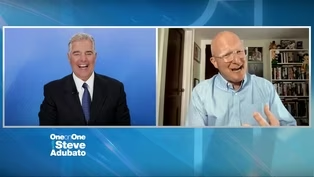
NJ.com Columnist Talks College Sports & 2026 FIFA World Cup
Video has Closed Captions
Clip: S2024 Ep2743 | 17m 1s | NJ.com Columnist Talks College Sports & 2026 FIFA World Cup (17m 1s)
Providing Support for PBS.org
Learn Moreabout PBS online sponsorship
- News and Public Affairs

Top journalists deliver compelling original analysis of the hour's headlines.

- News and Public Affairs

FRONTLINE is investigative journalism that questions, explains and changes our world.












Support for PBS provided by:
One-on-One is a local public television program presented by NJ PBS