
Kevin O’Toole; Dr. Nicole McGrath-Barnes; Jens Audenaert
2/13/2021 | 27m 52sVideo has Closed Captions
Kevin O’Toole; Dr. Nicole McGrath-Barnes; Jens Audenaert
Kevin O’Toole discusses the need for civility in politics and the importance of having a split government; Dr. Nicole McGrath-Barnes shares the connection between oral health and overall health and the importance of talking about systemic racism in health care; Jens Audenaert talks about the importance of diversity & inclusion in the workplace in 2021.
Problems playing video? | Closed Captioning Feedback
Problems playing video? | Closed Captioning Feedback
Think Tank with Steve Adubato is a local public television program presented by NJ PBS
Kevin O’Toole; Dr. Nicole McGrath-Barnes; Jens Audenaert
2/13/2021 | 27m 52sVideo has Closed Captions
Kevin O’Toole discusses the need for civility in politics and the importance of having a split government; Dr. Nicole McGrath-Barnes shares the connection between oral health and overall health and the importance of talking about systemic racism in health care; Jens Audenaert talks about the importance of diversity & inclusion in the workplace in 2021.
Problems playing video? | Closed Captioning Feedback
How to Watch Think Tank with Steve Adubato
Think Tank with Steve Adubato is available to stream on pbs.org and the free PBS App, available on iPhone, Apple TV, Android TV, Android smartphones, Amazon Fire TV, Amazon Fire Tablet, Roku, Samsung Smart TV, and Vizio.
Providing Support for PBS.org
Learn Moreabout PBS online sponsorship- [Narrator] Funding for this edition of Think Tank with Steve Adubato has been provided by Horizon Blue Cross Blue Shield of New Jersey.
NJM Insurance Group.
Serving New Jersey'’s drivers, homeowners and business owners for more than 100 years.
The Healthcare Foundation of New Jersey.
Investors Bank.
RWJBarnabas Health.
The Robert Wood Johnson Foundation.
New Jersey Sharing Network.
The North Ward Center.
And by The Russell Berrie Foundation.
Making a difference.
Promotional support provided by The New Jersey Business & Industry Association.
And by AM970 The Answer.
[MOTIVATIONAL MUSIC] - Hi, I'm Steve Adubato.
This is a compelling conversation about to have with our good friend Kevin O'Toole Chairman Board of Commissioners Port Authority of New York, New Jersey, Former State Senator for just a few years, New Jersey and also a your law firm Kevin is?
- O'Toole Scrivo.
- Yeah so let's get this out of the way.
This is part of our Democracy at a Crossroads series.
Senator O'Toole writes his column every Tuesday, right?
Is that true?
- Correct.
- Every Tuesday in New Jersey Globe our media partner, check it out but the column you wrote got my attention.
Is it called the Overton-- - Window.
- The Overton window.
What the heck does the Overton window have to do with Democracy at a Crossroads?
- I have no idea.
So I'm having dinner with my son a couple of weeks ago and he says, dad, he goes "politics, Overton window".
I said, what?
So he explained it to me, my son, the scientist.
And he said, "Look, here's the deal."
So I looked it up as I talked to a couple of folks who know about this Overton window developed by James Overton.
And it basically talked about there's a level of accessibility that the public will take and accept within a range.
The high highs, the low lows really wide left and wide right that kinda ultimately will lead to either a politician's rejection if they embrace it or the public's rejection either of the party or the individual.
And basically I was watching Matthew McConaughey the actor, he was on a last week, he was talking about just politics in general that he's daring people to go and go to the center.
He goes, "I'm daring people to go to the center."
He's tired of the wide right and left.
Like he says, in 2016, the Democrats, they lefts refuse to accept the idea that the Republican candidate won.
This year he says the Republicans are failing to accept that Biden had won, he goes, "That's gotta stop.
"The hypocrisy on both sides has gotta stop."
And he, in his own way, not that he's a scientist says "I'm daring everyone to go to the middle."
Really a cool concept.
- And that's the Overton concept theory?
- The Overton concept is basically the public is only gonna tolerate so much.
It's within this window of acceptability reasonableness, accountability, responsibility within this so-called pane.
If you go too far, right, or too far left or too far high or low, it becomes too extreme, too little extreme.
And the public ultimately will reject it, which will lead to the rejection of a particular candidate or a party.
- So let me disclose this, Kevin and I had a conversation.
I often call him mostly for advice but this was an offline conversation.
I was telling him about this Democracy Works series.
And I wanted you to tell folks what you told me about when you were in the legislature for more than a couple of years, right?
How many years?
- 22.
- Okay I was there for two and I leave it alone.
Leave it alone Kevin, okay?
- '83 to '85.
- Thank you, so you ready?
- Yes.
- Kevin O'Toole had this reputation where he worked with Democrats.
He got things done across the aisle.
No matter who the governor was who are the legislators were.
In Congress that's like what?
We're not doing that.
How does that advantage us politically?
Am I overstating it?
And what does that have to do with Democracy at a Crossroads, Kevin?
- So listen in '06 Governor Corzine's Democrat government shuts down.
The Republicans were like clapping and rejoicing.
And I sat as one of the Assembly Budget Committee members said, "We have to get this together."
I joined with four Democrats at the Budget Committee put together votes to really push through an emergency budget essentially and broke the log jam and people...
The Republicans said, "Why are you doing that?"
I go, "'Cause it makes sense you've got to do that."
And at that time, it dawned on me that it plays to the right politics in the political world to have the Republicans and Democrats fighting each other.
And from a public policy standpoint, we've got to dare each other go to the middle and just work together.
Republicans are not gonna be in power in New Jersey in the foreseeable future.
I don't see it certainly in the legislative branch you've gotta work together with the Democrats and the Democrats should be willing to work with the Republicans, but there's too much of a...
They postulate and posture way too much Steve, it's against your politics.
The extremes in both parties left and right are really the undoing of both parties.
- What do they win?
Senator, Kevin, let me ask you this, what do they win?
What does Mitch McConnell, I don't know where he's gonna be listen as we do this program, the Georgia elections for Senate haven't taken place we don't know what the balance of power is gonna be in the Senate.
We don't know if we're gonna split government or not.
We just know that Joe Biden is gonna be the President there's a Democratic House.
Long-winded question, what about if McConnell says, "No, you guys didn't give us what we wanted, "we're not gonna give," what do they win?
What do the Democrats win, go ahead.
- For Mitch McConnell's politics he won, 'cause they were projecting he was gonna lose every seat, North Carolina gonna lose his own seat, he was gonna lose all of these tight races.
He didn't, he's now at the very least it's gonna be 50, 50.
He's probably gonna win at least one of those two, in fact two of those two in Georgia-- - So what's his incentive for compromise like Kevin O'Toole?
- For his politics it makes sense.
And I'll tell you, when you look at this long-term having a split government may be the best for everybody for the foreseeable future.
- Because?
- Because I think what happens if the Democrats take all three or the Republicans take all three means the House and the Senate and the Presidency, it's gonna allow the dictates of the extreme of the parties.
I think to have a controlling hand there somehow.
So having the split party, having a split of leadership, I don't think it's the worst thing to happen for this time in 2021.
- Is the Republican Party, and I'm gonna be sensitive to this because you are the Chair of the Port Authority, you deal with a lot of complex issues.
You have to deal with both sides of the aisle and transportation between New York and New Jersey dependent upon Kevin and his colleagues at the Port Authority but let me ask you this, moving forward to what degree do you think people make decisions in Washington about New York, New Jersey transportation tunnel, the Gateway, whatever based on, "Hey they didn't vote for me.
"The Democrats didn't vote for me in those two states," that's a blue state, that's a purple state, that's a red state."
I just often feel like we're just not the United States of America.
I know I'm being overly simplistic and naive, go ahead.
- So when you look at like Superstorm Sandy some of the people in the delegation in the Southern states, Texas in particular, they weren't really fond about giving New York and New Jersey some of that money.
And it came back to haunt them and they had their storms to deal with whether it Maria or others, they needed a hand out as well.
We're all in this thing together.
And I'll tell you, in terms of the legislative people that I deal with the New York and New Jersey, Republican, Democrat, by and large Democrats they are 100% invested to make sure we're working together to get the transportation needs whether it's Gateway or whether it's... We're at a $3 billion hole, the Port Authority with the COVID dilemma that we're having right now, they're totally invested.
I'm hoping at the end of the day that they're gonna be able to work with the incoming president to make sure that this region gets what they need.
- I asked this of everyone who's appeared, got a minute left Senator, who's appeared on "Democracy of the Crosswords."
Where is the silver lining the reason to be positive about our representative democracy Kevin?
- I think we have lessons that we learned, like there was 23 swing districts in the country that people they all happen to be Republican even though the top of the ticket went Democrats.
I think it's interesting that I think middle America wants to have a centrist government, Republican Democrat working together to make sure there was a common goal, a common policy to be worked on.
I think that's the message that was sent to us while we did, the Republicans didn't lose in the House, they picked up and may be within five seats which was nobody predicted that in the House.
And they're probably have at least 50, if not 51, 52 in the Senate while having a Democrat president they wanna have accountability.
And the only way you can do that in this day, in this time is to have a split representation.
- Check out Kevin O'Toole it's called the O'Toole Chronicles every Tuesday in New Jersey Globe, one of our media partners I wanna thank you, Kevin O'Toole Chairman of the Port Authority, O'Toole Scrivo is his law firm.
They happen to be supportive of what we're doing in terms of our public policy programming.
Also Former State Senator.
Kevin thank you so much for joining us.
We'll continue this series Democracy at a Crossroads.
You'll continue to talk to us.
- Thank you - Thank you, my friend.
- Good seeing you.
- I'm Steve Adubato, we'll be right back.
To watch more Think Tank with Steve Adubato, find us online and follow us on social media.
- We are now honored to be joined by Dr. Nicole McGrath-Barnes, Founder and CEO of the KinderSmile Foundation.
Good to have you with us doctor.
- Oh, good to be here once again.
I think this is my third time on the Steve Adubato show, so I'm honored, thank you.
- That's what happens when you're popular.
Not me, you (laughs).
Hey, tell everyone what the foundation is.
- Sure, KinderSmile Foundation is a 501c3 nonprofit dental organization, whose mission is to increase oral care access and oral care education for uninsured and underserved children ages zero to 18, and we extend that to age 21 for our special needs population and also perinatal mothers up to three years postpartum.
But most recently, we've just expanded to Trenton.
We have a dental home in Trenton where we've seen adults so.
- Yeah, talk about that Trenton expansion.
I know the folks down in Jersey Manufacturers care deeply about that.
One of the organizations, corporations, big in supporting the, that's our state capital, let's not forget that, Trenton.
What is going on in Trenton, and why is the expansion of your organization there so critical?
- Okay, so as we all know, the state capital, and there's such a dire need here in the city of Trenton for access to oral care.
We have 95% of the population Black and Latino, Black and Brown community, and they have been plagued over the decades with a lack of access to quality affordable, affordable oral care services.
So we have been blessed by the supporter from the Estelle Debbie Sands Gartenberg, her foundation to expand and to increase access to care here for the indigent population.
- Doctor, you know, I'm not sure people understand the connection.
You and I have had many conversations about this, and I want you to expand on it, the connection between oral health and our overall health.
And I'll complicate that in a moment with the COVID discussion, so go ahead.
- So oral health is truly the gateway to total health.
If you think about it, everything starts with the oral cavity.
And for many decades, even centuries, the oral cavity has been displaced.
It seems like the population believes that it's another organ, you know, separated from the body, but that's where everything starts.
Systemic diseases, if your oral cavity is not in good shape, let's say, or if oral cavity, the oral diseases, are not under control, it affects your entire body.
Children getting teeth prematurely extracted due to baby bottle syndrome or a lack of access to care, what does that affect, their speech.
And teeth that are extracted prematurely, they are labeled now speech impediment, and they, the Black and Brown community, are plagued with all of these labels.
But if you understand that there's that direct correlation and connection, you can better take care of your mouth and visit the dentist regularly.
- You know, and by the way, the whole range of, check out our other interviews with Dr. Nicole McGrath-Barnes.
We've done several as she said before.
We've talked in greater detail about some of these things as well, but, you know, there's a graphic that's gonna be up on the screen in just a moment.
It's simply called Confronting Racism.
It's an ongoing series we've been committed to to try to confront racism in all its forms.
Do you believe, doctor, that part of the reason for the Black and Brown community suffering the way it has and not getting access to oral care that is needed that affects our overall care is in some ways connected to racism.
- Absolutely, and unfortunately, Steve.
- What's that based on?
Like our kids, and when I say our kids, our children, we were blessed and fortunate to get them the oral care that they needed all the way through, all the checkpoints, all that, whether they do what they're supposed to do or not right now with flossing it has nothing to do with other than laziness.
That being said, that's not always the case for others in certain communities, disproportionately Black and Brown.
In Trenton, 34% of the families had children living below the poverty level.
- Living below, - That's not a, that's not, Oh yeah, of course, you're gonna do that.
That in some ways is the exception, not the norm, correct.
- 100%, 100%.
- Why should we all care about that because I know we should?
- Because they're human beings, they need to be edified and dignified and poured into, just like you, those who are fortunate.
And unfortunately, we don't have the funding that's poured into a lot of the community organizations to uplift and to educate the population.
It really starts with the education and the compassion to care.
We need more funding in our inner cities.
We need more funding, just not for programs, continuous funding.
We need partners.
We need large partners to come in and realize that this is systemic racism, and it's unfair.
- Let me try this.
COVID has complicated things.
We're taping this at the end of 2020, it will be seen in 2021.
To what degree has COVID-19 adversely impacted oral health care, particularly in urban communities that you're serving?
- Oh, gravely and drastically.
When you talk about the indigent communities' lack of access to care, many of them visit the hospitals because they don't have the facilities or the access to care to go to that's affordable.
They visit the hospitals, and they believe that the hospitals are, that's their dental home.
They go for palliative treatment, a swelling and an infection.
The swelling, the infection goes down, they think they're good.
They go back.
COVID has completely revealed to everyone nationwide that there's huge problems in our indigent population.
And I know with KinderSmile Foundation, our three dental homes, we were closed for three months, but we had over 36 emergency tele-dentistry cases that we had to address.
I was on pins and needles because not too many people realize that this oral disease, this infection, can spread to the brain and people can die, just like Deamonte Driver in 2007.
- Remind people real quick, doctor.
I don't want people to forget.
Go ahead, I'm sorry.
- Yes, this is the reality of what's happenin' in our community.
- What happened to Deamonte, please remind folks.
- Deamonte Driver, a 12 year old Black boy, who resided in Prince George's County, Maryland, a predominantly (indistinct) county in Maryland.
He had Medicaid, and he was unable to see someone to prescribe medication for him for a tooth infection.
Medicaid lapsed, mother didn't have the funds to pay for a prescription, a simple prescription, Steve, antibiotics.
He would have been alive today, but to no avail.
And, the mom ended up burying her 12 year old boy due to a brain infection caused by a dental abscess.
What I see every single day in this indigent community.
November 9th, we had our grand opening, - A few seconds, go ahead.
- November 9th, we had our grand openin'.
We get a call from Capital Health Regional Medical Center.
An emergency room physician called and said, "Doctor we have an 11 year old boy here "with an abscess swelling the size of an orange."
I said, "Bring him in."
Right after the grand openin', he was the first patient we saw.
Literally Steve, the size of an orange, nowhere to go, never been to the dentist here in Trenton, 11 years old.
He could have been a Deamonte Driver.
This is what the Black and Brown community is experiencing on a daily basis.
It's a reality.
This is what they're living with, and it's unfair, and it's unfortunate.
And that's why we are here in Trenton and other indigent areas to increase access to care for all.
- If that doesn't move you, nothing will folks.
We're honored to be joined, once again, by Dr. Nicole McGrath-Barnes, Founder and CEO of KinderSmile Foundation.
Doctor, I wanna thank you so much.
Keep doin' what you're doin'.
- Thank you so much, Steve.
Thank you so much.
Really appreciate this opportunity.
- You got it, we'll be right back.
To watch more Think Tank with Steve Adubato, find us online and follow us on social media.
- We're now joined by our good friend, Jens Audenaert who is a, Division Vice President General Manager WorkMarket at ADP.
Good to see you Jens.
- Great to see you Steve.
Thanks for having me back on the show.
- You got it by the way, check out SteveAdubato.org to check out the last interview Jens did with us.
Last time we talked, we talked diversity, inclusion, forget about 2020.
We're doing this in the end of 2020 and 2021 in the workplace.
What does diversity and inclusion really mean?
Not with the rhetoric, but the reality of it.
- Yeah, I think it's going to be more important than ever for organizations to really embrace diversity, equity and inclusion in 2021 and ADP obviously does a lot of research with our client base and with the employees of our client base and it was one of the top five trends that we identified for 2021, really for companies to look at diversity and inclusion and equity.
And so, we talked about this the last time but diversity is really the representation of underrepresented minorities and obviously after 2020, there's a lot of focus on black communities and communities of color but also that inclusion really having this culture and this value set that embraces differences.
And a lot of people now are also talking about equity and that's really making sure that you not only have the representation but that they have equal access to opportunity, they get promoted in the same way that they get paid equally to their counterparts.
And so, I think that's gonna be a big focus that we're going to see this year but definitely also going forward.
- Jens, how has COVID-19 impacted this initiative, this effort, this commitment to a culture of diversity and inclusion?
- I actually think at the onset of COVID a lot of organizations ADP included had all of their employees, for us that's 58,000 employees globally almost overnight work from home and I think that some of the diversity and inclusion initiatives and specifically business resource groups which are really these initiatives that are voluntary and employee led were really an asset in this time where employees were working from home in less than ideal circumstances, they might have personal anxiety and so that was a great avenue for them to connect with these other employees and these business resource groups to find support, to remain engaged while all of this was going on.
So, I think that our 10 business resource groups at ADP were really an asset that as we were trying to kind of move from being in the office to completely running the certification from home.
- We've had many conversations with the folks at ADP they support what we do, our commitment to diversity and inclusion but the term intersectionality, it feels and sounds jargony to me but I'd like you to make it real Jens so that people go, "Oh that's what Jens is talking about, that's what Steve's talking about."
Because I hear it a lot, but I wanna make sure people understand it intersectionality.
- Yeah, it's definitely an interesting concept and it's a big word.
It's really thinking about all the different aspects of someone's social identity, if you will.
So we often think about things like gender and gender identity, race, sexual orientation.
It's a lot of other things too.
It could be religion, age, ability, immigration status, all of those different things really create someone's identity and that's really, what's gonna determine if you're sometimes advantaged or disadvantaged.
And so, I think it's very important for HR leaders, for DNI professionals to really start looking at that intersectionality.
So to can make it very concrete, you can look at the pay gap between let's say men and women and finding a certain organization that women are underpaid.
But if your women are disproportionately of color unless you actually look at all the different aspects you don't know whether you have a pay gap based on gender or on race - Or age as well.
- Or age, you got to look at all of it.
You may not realize this Jens, but I'm older than you.
(Jens laughs) Jens don't laugh so hard, okay.
But age is part of it, is it not?
- Age is part of it absolutely, absolutely.
- Real quick on this, I know we talked a little bit about this last time but it's important 30 seconds on ADP Pride.
- So ADP Pride is a business resource group.
As I alluded to earlier those are really employee led, voluntary groups and they always focused on a certain area.
So for ADP Pride that's really fostering diversity and inclusion for LGBTQ plus employees at ADP and so we obviously also involve our straight allies in that effort.
- How much progress are we making as it relates to the LGBTQ community and the things that need to be done, the policy changes, the culture changes the societal changes, loaded I know?
How much progress, in your view, have we really made in the last couple of years?
- It's obviously very uneven across the globe and even if you look at the US it's uneven across organizations, I think corporations are doing a great job.
As we discussed last time the 1964 civil rights act doesn't really include workplace protection or LGBTQ plus - No, it doesn't.
and so, I think companies need to continue and many already do, but there's still mid-size and small companies that need to continue to really have the right workplace protections in place and look at the right HR policies and benefits or large organizations like ADP, we have a perfect score on the human rights campaign for 11 years in a row now.
So we have all of that in place but as we talked about before, I think everyone can always continue to up their game on really having that inclusive culture, that equity across all the different employees.
And again, that focused on intersectionality.
So we did a lot after the tragic killings of (indecipherable), Taylor Ahmaud Arbery, really looking at what is it like for our black LGBTQ plus associates and those of color and really focusing there as well.
- Yeah.
The commitment to diversity and inclusion does not take a vacation because of COVID.
I just wanna be clear.
That's not an editorial statement, it's just a fact.
So Jens Audenaert, who is in fact Division Vice President General Manager world market at working, excuse me, WorkMarket at ADP.
Jens I wanna thank you so much for joining us, keep educating us in this area and we all have a lot of work to do.
Thank you Jens.
- Thank you so much Steve, stay safe.
- Same to you, I'm Steve Adubato thank you so much for watching, we'll see you next time.
- [Narrator] Think Tank with Steve Adubato has been a production of the Caucus Educational Corporation.
Funding has been provided by Horizon Blue Cross Blue Shield of New Jersey.
NJM Insurance Group.
The Healthcare Foundation of New Jersey.
Investors Bank.
RWJBarnabas Health.
The Robert Wood Johnson Foundation.
New Jersey Sharing Network.
The North Ward Center.
And by The Russell Berrie Foundation.
Promotional support provided by The New Jersey Business & Industry Association.
And by AM970 The Answer.
- [Narrator] If you need to see a doctor, RWJBarnabas Health has two easy ways to do it from anywhere.
You can see an urgent care provider 24/7 on any device with our Telemed app, or use our website to book a virtual visit with an RWJBarnabas Health medical group provider or specialist.
Even as a new patient, you've taken every precaution.
And so have we.
So don't delay your care any longer.
RWJBarnabas Health.
Let's be healthy together.
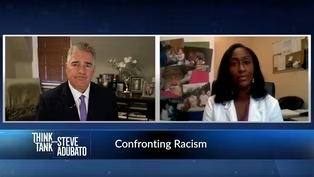
The Connection Between Oral Health & Overall Health
Video has Closed Captions
Clip: 2/13/2021 | 11m 7s | The Connection Between Oral Health & Overall Health (11m 7s)
The Importance of Diversity & Inclusion in the Workplace
Video has Closed Captions
Clip: 2/13/2021 | 7m 51s | The Importance of Diversity & Inclusion in the Workplace (7m 51s)
The Need for Civility in Politics
Video has Closed Captions
Clip: 2/13/2021 | 9m 22s | The Need for Civility in Politics (9m 22s)
Providing Support for PBS.org
Learn Moreabout PBS online sponsorship
- News and Public Affairs

Top journalists deliver compelling original analysis of the hour's headlines.

- News and Public Affairs

FRONTLINE is investigative journalism that questions, explains and changes our world.












Support for PBS provided by:
Think Tank with Steve Adubato is a local public television program presented by NJ PBS