
Key conversations from the 2024 Detroit Policy Conference
Season 8 Episode 29 | 26m 46sVideo has Closed Captions
Explore conversations about growing Michigan’s population and attracting new businesses.
We take you to the 2024 Detroit Policy Conference hosted by the Detroit Regional Chamber. Hundreds of people attended the annual conference to talk about what it will take to grow the state’s population. One Detroit contributors Stephen Henderson, Nolan Finley and Zoe Clark sit down with business and policy leaders in the region to talk about attracting talent and businesses to Michigan.
Problems playing video? | Closed Captioning Feedback
Problems playing video? | Closed Captioning Feedback
One Detroit is a local public television program presented by Detroit PBS
Key conversations from the 2024 Detroit Policy Conference
Season 8 Episode 29 | 26m 46sVideo has Closed Captions
We take you to the 2024 Detroit Policy Conference hosted by the Detroit Regional Chamber. Hundreds of people attended the annual conference to talk about what it will take to grow the state’s population. One Detroit contributors Stephen Henderson, Nolan Finley and Zoe Clark sit down with business and policy leaders in the region to talk about attracting talent and businesses to Michigan.
Problems playing video? | Closed Captioning Feedback
How to Watch One Detroit
One Detroit is available to stream on pbs.org and the free PBS App, available on iPhone, Apple TV, Android TV, Android smartphones, Amazon Fire TV, Amazon Fire Tablet, Roku, Samsung Smart TV, and Vizio.
Providing Support for PBS.org
Learn Moreabout PBS online sponsorship- Coming up on "One Detroit," we are at the Detroit Policy Conference hosted by the Detroit Regional Chamber.
Hundreds of people are here to talk about what it's gonna take to grow our state's population.
Just ahead, we're gonna hear from top business and policy leaders in the region about attracting talent and businesses to our state.
So stay right there, "One Detroit" is coming up next.
- [Narrator] From Delta faucets to Behr Paint, Masco Corporation is proud to deliver products that enhance the way consumers all over the world experience and enjoy their living spaces.
Masco, serving Michigan communities since 1929.
Support for this program is provided by the Cynthia and Edsel Ford Fund for Journalism at Detroit Public TV.
- [Narrator] The DTE Foundation is a proud sponsor of Detroit Public TV.
Among the state's largest foundations committed to Michigan-focused giving.
We support organizations that are doing exceptional work in our state.
Visit dtefoundation.com to learn more.
- [Narrator] Nissan Foundation and viewers like you.
(upbeat music) - Hey, I'm Stephen Henderson.
- And I'm Zoe Clark.
"One Detroit" is coming to you this week from the Detroit Regional Chamber's Detroit Policy Conference at the Motor City Casino Hotel.
- This year's conference is focusing on how to grow Michigan's population.
And that's a topic we have been hearing a lot about since Governor Whitmer announced the formation of the Growing Michigan Together Council at last year's Mackinac Policy Conference.
So this idea of growing the population, I feel like we've been talking about this for 20 years.
- I was going to say decades and decades.
I think longer than 20 years.
- Exactly.
And it's great that Governor Whitmer said, "Alright, I'm not just gonna talk about it.
I'm gonna put a task force together.
And we're gonna come up with recommendations."
The key though is what does that mean?
What's the action that comes out of this?
And does it really get people to move here?
- There's this list of recommendations.
It's whether there's actually support, bipartisan support, whether you're gonna have the right stakeholders to sort of lean into making it happen.
Or does it become just another lengthy bureaucratic report that goes in the desk drawers, and I think really this next year and the State of the State address and the budget is really gonna decide whether or not something is made of it.
- Yeah, and I keep saying one of the focuses you have to have here is on young people.
Not just attracting young people from other places to come live here, which we don't do a great job of.
But keeping young people.
How many people do you know who have kids who say, "Well I don't expect that they'll stay here, they're gonna go to college, they'll go to Chicago, they'll go to the East Coast, they'll go to the West Coast.
Maybe someday they'll come home."
We gotta get them to think, I'm staying in Detroit, or I'm staying in Grand Rapids, or I'm staying in Traverse City because there's opportunity here.
- So it's like housing affordability, childcare.
And then quality of life, whether it comes to roads or just like stuff to do.
And be close to a big city.
- It's gotta be cool.
And that's a phrase from a former governor.
Blue cities, didn't work out, but it was the right idea.
We gotta make it work.
So first off, the conference sessions featured conversations on the future workforce, education, creating vibrant communities, and the city of Detroit's efforts to attract new residents.
Here are some of the highlights.
- If we want to be the state that we know we can be, first we have to recognize our greatest asset, our people.
And we are losing our people.
- Our best and brightest are wanting to live in places like Chicago, New York, San Francisco.
- When we saw data that told us that only 30% of the fourth graders in the state, not in metro, in the state are proficient in reading and math, we were again taken aback.
- We're competing against other regions in the country and we're getting our butt kicked in some ways by some regions that in my humble opinion we shouldn't be losing to.
And it's because we don't have our collaborative act together.
- In order to really grow the state, we need to wrap arms around first the folks that are here and are making decisions every day about where they're gonna build their future.
- As we are learning about all of these great recommendations in order to grow Michigan, one thing I want us to keep in mind is that we have to realize that Detroit has a value proposition today.
And Michigan has a value proposition today.
- Think about the last time you had friends in from out of town who hadn't been here and you bring them down to Detroit.
What do they say?
"Oh my God, I never knew this was Detroit."
Take them down to the riverfront.
They said, "I never knew you had a riverfront.
I never knew you had all this construction."
We have a national image fueled by the images 10 years ago of bankruptcy and when we had the highest homicide rate, highest unemployment rate, highest poverty rate in the country.
Those are the images that are fixed in the minds of people nationally.
The only way to undo this is not some story in the Los Angeles Times, but get people here to see it.
- So Stephen, you and our colleague Nolan Finley and I all had a chance to sit down with a few of the guest speakers here at the conference to talk about making the city of Detroit and the entire state really attractive to visitors, potential residents, and businesses.
Let's take a look.
- We're joined now by Ambassador John Rakolta He's the chairman of Walbridge company, but also co-chair of the Growing Michigan Together Council, which is what this session today has been mostly about.
Now John, you've taken unusual position for a guy who chaired a council whose goal was to figure out ways to grow Michigan's population.
Now you say we can't grow Michigan's population, at least not anytime soon, why is that?
- I looked at the studies that were done by the demographers, and one after another showed us that the four drivers of population growth were all trending in the negative direction for Michigan.
And it would take more than one population council report to reverse those trends.
Those trends are low birth rate amongst a low young cohort, high death rates amongst 65 and over population, no migration from other states, and very little international immigration.
These are the four drivers of growing the population.
And every one of those in Michigan is basically in the tank.
And there's no way of changing those in the short term.
- So John, if we can't grow population, what can we do?
- We can increase productivity because people aren't interested in just growing population for population's sake.
What this is all about is growing prosperity, making our state a richer state, having our citizens make more.
And what that requires is a better understanding of how innovation and education play a role in the gains of productivity of virtually anything that's done on the face of this earth.
- Before we get into how to grow prosperity, let's talk about what's happened to Michigan's prosperity.
This one time was the land of opportunity and it's not so much anymore.
- That's true.
Starting in 1952, we were approximately 117% of the national average.
That means we were 17% higher than the average.
Over the ensuing 72 years, we've gone from that high state to today, our per capita income is stuck at 86%.
So now we aren't even at the national average.
And the difference, just to get back to national average, is $6,000 a year per worker.
So we've got a lot of catching up to do.
- So John, to grow prosperity, what do we need to be doing here?
- We have to increase the educational quotient of the entire state.
The high paying jobs in America today are all wrapped up in new innovation, old manufacturing processes that have been improved through automation and the like, artificial intelligence, we have to adopt those things and implement them widely across the state.
And we have to have labor and management join together.
So as this innovation comes forward, that there aren't any obstacles to implement it.
And the only way you can do that is to show the workforce that this is in their best interest.
That in the long run, the outcome will be positive for everybody.
It's not trickle down.
It's from bottom up.
- So you grow prosperity bringing in the kind of jobs younger people are looking for, ultimately you grow population?
- Yes, ultimately people will come here, but it takes a long time for you to change the K through 12 outcomes that are currently, I mean it took us 25 years to go from 10th place to 40th place in terms of outcome.
We're not gonna change that overnight, but we have to identify that as a major problem and start putting our thinking and our resources and our cohesion toward that.
- Now you said that education's the number one issue.
You've been involved in trying to make that happen here for a long time.
What are the obstacles for improving education outcomes here?
- We've never valued education very highly because we had all these great blue collar jobs.
You could make a good middle class living with a high school education.
That's not true anymore.
We need to recognize that that's come upon us a lot faster than we ever had anticipated.
- What will this take in terms of the politics of the state, the political will to make all this happen?
- The political will is always just on one side.
We have this unfortunate moniker called the Michigan 180.
That is that successive administrations seem to reverse most of the policy implementations of the prior ones.
We need to stop that.
We need to coalesce and to put forth policies that survive the current administration.
That's number one.
Number two, we have a history of being uncohesive.
It's not only in politics, it's in labor management, it's in race relations, it's in county city.
All of those groups have to look more closely at the better meant of Michigan as a whole because we're all gonna succeed together or fail together.
And this past 70 years, we've seen this slow decline that you never see in any one day, month, or year.
Now that you look back, you see how massive it is, and you ask yourself the question, where have we been and why haven't more politicians emerged identifying these issues?
And I don't know the answer to that.
- We have to find them though, if we're gonna get through this, right?
- That's true.
- I'm here with Angelique Power, President and CEO of the Skillman Foundation.
Welcome to "One Detroit."
- Thank you so much.
Glad to be here.
- If you had to name the top three levers to pull in our state to get more people to stay here, more people to come here, I mean education would absolutely be at the top of that list.
We don't do a good job, and it's not just Detroit, it's not just urban areas, the whole state.
We have fallen way behind in terms of our investment, structure, design, strategy, all of it.
- You get it.
I mean, for 20 plus years, we've been underfunding public education in Michigan.
And so I think we tend to think that one area is doing okay and another area is struggling.
But when you look at the numbers, you see that Michigan ranks 36th, 38th in the nation.
There's a direct correlation between how much you are willing to invest in the system itself and what the outcome is.
And the other thing I'll say is that we look at a lot of scores of reading scores and math scores and we think to ourselves that it's an indicator of an individual student.
But those scores are indicators of a system, how well it's functioning, how well it's funded.
And so the big news from Grow Michigan Together is that four subgroups, pillars, two of them focused on education.
Everybody's saying we need an upgraded system and we need it yesterday.
- For a long time there's been a strain in Michigan between the idea of the state school board and the governor's office, who's in charge?
Who's got their hands on the wheel?
I feel like that's held us back from what some other states have been able to accomplish because the power is more centralized.
I wonder what you make though of how we navigate that to get to a better space.
- So the pre-K through 12 subgroup had four recommendations.
And the very first one was a cohesive vision for education.
- Amen.
We've never had one.
- We don't have one.
And so if you look at not having a cohesive vision, then you understand how you end up with 850 school districts, which is similar to California, which is four times bigger than we are.
And so absolutely we need a cohesive vision.
Our structure is a state school board, Michigan Department of Education, a state superintendent, a governor.
And like all of them are not cohesive.
And I think that where people start today is they say like, "Well we want the sup to report here or we want the state board to have this change."
But actually we need that vision first.
And then absolutely we need to structure around it and then we need to fund it like we-- - Right, right, right, we have never funded education in the way that we should in Michigan either.
I want to give you a chance to talk about Skillman and the role that it's playing in thinking about these things and turning a path forward.
- So I've been at Skillman for a little over two years now and I've spent one year listening and one year building and all of it in community.
And what we've heard so much is that Detroit of 10 years ago is different than Detroit of today.
And that Detroit 10 years from now is going to be very different.
And we are at a critical moment in Detroit.
Some may say we're in a fight for our soul.
So who are we gonna be in 10 years and who is going to be here?
And so we are planning with students, with teachers, with principals, with parents to do community driven education, policy change for the future.
And we're building on our legacy.
I'm so honored to walk on the path laid by the incredible Carol Gauss and Tanya Allen.
And both of them were very much invested in community and very much focused on the horizon line in policy.
So we're lifting the best of Skillman and we're going full throttle into making sure that young people are in these rooms on these stages.
You're hearing from teachers, you're hearing from organizers, and you're hearing from policy makers who are warriors themselves in many ways trying to be more connected to community - Equity and opportunity and access I think permeate every one of the questions we have in this state about things like education.
I know Skillman also works in this area, but talk about how important it's to keep that front and center as we talk about how we improve education to grow population.
- What's really interesting to me is that people use the word equity.
It's a buzzword in some ways.
And they have no idea what it means.
And so it's so applicable in education because what it means is every child that needs more gets more, that's it.
So when we're talking about equitable education systems, we're talking about young people that live in poverty, they come to school and they need different things.
We're talking about students that arrive with special needs.
They come to school and need different things.
And often we're talking about young people who English is the second language that they know.
Now a lot of these overlapping systems that beat down on different populations have like a triple impact on Black and brown young people.
And so we are also saying, let's do a racialized analysis of education systems in addition.
And these all overlap.
So if you look at a lot of students with special needs, a lot of them are Black and brown students or those that live in poverty.
But we're linking arms with people all across the state because rural communities are just as marginalized and oppressed and that we all need more to fit our customized needs of the moment.
And what a cool education system that actually plans for that.
That's hives of places where everyone is a learner.
That's how Michigan becomes makers of the future is when we fund it like we mean it.
- Ashok Sivanand with Integral, welcome.
- Thank you so much for having me.
- So you took the stage and you really told this story of how you came to Detroit and then stayed in Detroit.
And I feel like it's the story that the Growing Michigan Council really wants.
So not just folks from Michigan staying in Michigan but coming to the state, experiencing it, and then not leaving, tell us your story.
- Yeah, I'll say first off, I'm really lucky that there were maybe this first wave of folks that already made downtown Detroit and the tech ecosystem here just really hospitable.
When I moved here in 2016, we hadn't gotten the press yet.
So it was a job opportunity where I was here for six months that brought me here.
And my plan based on everything I heard about Detroit was to go back and I was gonna get promoted.
And there were a lot of sort of intellectual or financial reasons that brought me here to try it out.
And when I came here, I realized that what we hear about Detroit and what I got to experience here are completely different.
- So let's start with what you heard about Detroit versus what your experience was.
- I'll put it this way.
I had already gotten to work with some folks here before I moved here.
And there would be a number of them that were very excited that I was moving from Toronto to here and they get to hang out with me more and everything.
And they would say, "Hey, if you're moving here as a single person from downtown Toronto, be careful which suburb you pick because it could be kind of boring."
And then they'd all do this thing where they say, "And of course don't live in Detroit, so live in Royal Oak."
And nothing against Royal Oak, I feel like, when I first chose to live there with my corporate housing and everything and it was exactly what I expected.
It was a downtown neighborhood in a suburb and it had all the amenities and it was cool and hip and fun sort of, but it didn't really have anything to compare to downtown Toronto where it was a super personification of all of those things.
I found myself coming downtown Detroit though, and it wasn't what people told me to do, but it was a whole different energy that I felt here.
The sense of community here was so strong.
Anytime I met someone and told them I was building a team here, there were even some folks you could argue were competitors that would say, "Hey, I love that you're doing this here.
Thanks for moving down here.
Here's the three folks you should talk talk to, and guess what, I'm gonna introduce you to all three."
Which is an unheard thing of in the bigger cities.
When you're in this sort of hand to mouth rat race, either it's because of competition or because people's calendars just really filled up.
It's hard to think outside of what you need to get done for this fiscal year or whatever and think towards community.
And so I hadn't really not experienced that very much and so it really drew on my curiosity.
And then I made a lot of friends and the more I put in, the more I got back.
And it's been really wonderful.
- So if you were trying to sort of be that cheerleader, that this Growing Michigan Council, they wanna see, right, that's what they want is someone spreading the word.
What would you tell someone about either coming to Michigan or staying in the state?
- I think if you're looking at it from a purely intellectual standpoint and you're trying to do the math or the bullet points, it's probably never gonna work out.
If you're looking at it not just from an intellectual standpoint, but also maybe an emotional and a spiritual standpoint and you're looking inward about how you want to grow, and it's not just in your career, but you wanna grow as a person and a member of the community, I think Detroit has a lot more to offer then, including the intellectual side of things.
There are global brands here.
I grew up just loving cars.
So that's another thing I'd say if you've kind of been drawn to manufacturing or the auto industry, like everyone here is a car person.
Even people who are not car people are car people anywhere else in the world.
So that was something that drew me.
And then that sense of community, figuring out, hey, what am I beyond my career?
Where can I contribute?
Where can I make a difference?
This has helped me personally with learning more about myself and what my purpose is and what kind of vision I wanna have for myself.
- I think one of the things we're talking about when we're talking about growing population or the city of Detroit itself is sort of, who is this future Detroit for?
So I think there's a lot of folks born and raised in Detroit and sort of see this what we who may not live in the city or be from the city call this sort of rejuvenation.
And they're like, that's great, and people coming here, but like who is the city for?
And I'm curious what you hear when you talk to folks who are lifelong Detroiters, if there is some tension there about like making sure the city still feels like it is a city of people who built the city rather than folks who are coming simply because there is this sort of rejuvenation or because it's cool now or something like that.
- I think there's a lot of this kind of rejuvenation, in other rooms, maybe it's called gentrification, right?
It's happening in a lot of cities.
One thing I'll say about Detroit is that there is a deep, deep history even before the auto industry and outside of the auto industry, which is what Detroit's really known for.
If you look at the art scene here, the cultural scene, the civil rights movements and how it's really changed the world.
And so for me, I never thought I could be someone who had a chance at standing on a stage and having a little ding in the universe.
And when you come to an environment like this, it feels a lot more accessible because that community really helps put you on that stage.
And I think very quickly, the folks who are gonna thrive here are the folks who wanna help build that community too.
Not just take from the community.
And I think if there are folks who really get those dopamine hits from going out and volunteering or serving and you're not sure how to do it in the big cities you live in the other cities, this is a great place to do it where there's a lot of history and we can be part of a lot of future too.
- So you came from Canada to Detroit.
You've been in Detroit for years now.
Are you gonna stay?
- I would say, I moved from Toronto, it might always be my favorite city, but Detroit is the place where I feel at home and it's hard to say where business will take us.
It's hard to say where my dreams will take me.
But I think it's gonna have a special place here always.
I've been here for almost seven years and let's put it this way, I don't know where I'm moving next.
There isn't a destination, this place is so...
The pull is so strong that it's not a place that I would wanna run away from.
It'd be only if there was something else that I felt that I wanted to run toward that I can see myself moving away from him.
- That'll do it for this week's special edition of "ne Detroit" coming to you from the Detroit Policy Conference at Motor City Casino Hotel.
Thanks for watching.
- You can see more "One Detroit" stories, including an ongoing series on the future of work at onedetroitpbs.org.
- And as always, connect with us on social media.
Take care and we'll see you next time.
(upbeat music) - [Narrator] From Delta faucets to Behr Paint, Masco Corporation is proud to deliver products that enhance the way consumers all over the world experience and enjoy their living spaces.
Masco, serving Michigan communities since 1929.
Support for this program is provided by the Cynthia and Edsel Ford Fund for Journalism at Detroit Public TV.
- [Narrator] The DTE Foundation is a proud sponsor of Detroit Public TV.
Among the state's largest foundations committed to Michigan-focused giving.
We support organizations that are doing exceptional work in our state.
Visit dtefoundation.com to learn more.
- [Narrator] Nissan Foundation and viewers like you.
(upbeat music) (gentle music)
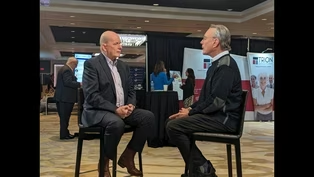
Fmr. Ambassador John Rakolta, Jr. on Michigan’s population
Video has Closed Captions
Clip: S8 Ep29 | 6m 6s | Fmr. Ambassador John Rakolta, Jr. on Michigan’s population (6m 6s)
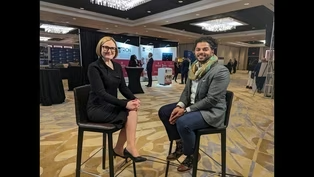
Integral CEO Ashok Sivanand on why he calls Detroit home
Video has Closed Captions
Clip: S8 Ep29 | 6m 44s | Toronto transplant Ashok Sivanand explains why he decided to move to and live in Detroit. (6m 44s)
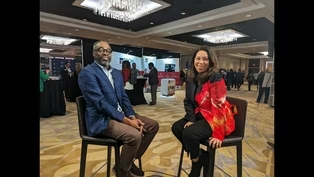
The role of Michigan’s PreK-12 system in growing population
Video has Closed Captions
Clip: S8 Ep29 | 6m 39s | The Skillman Foundation’s Angelique Power on how education can grow Michigan’s population. (6m 39s)
Providing Support for PBS.org
Learn Moreabout PBS online sponsorship
- News and Public Affairs

Top journalists deliver compelling original analysis of the hour's headlines.

- News and Public Affairs

FRONTLINE is investigative journalism that questions, explains and changes our world.












Support for PBS provided by:
One Detroit is a local public television program presented by Detroit PBS