Florida Road Trip
Key West
Season 2026 Episode 5 | 26m 46sVideo has Closed Captions
Set sail through the history, culture, and legends of Key West.
Join the ride to Key West, where shipwrecks, maritime trade, and multicultural roots shaped a one-of-a-kind island. Explore the legacy of the wrecking industry, a working presidential retreat at the Little White House, and a remote fortress at Dry Tortugas. Florida Road Trip uncovers the people, places, and stories that make Key West unlike anywhere else in Florida.
Problems playing video? | Closed Captioning Feedback
Problems playing video? | Closed Captioning Feedback
Florida Road Trip is a local public television program presented by WUCF
Watch additional episodes of Florida Road Trip at https://video.wucftv.org/show/central-florida-roadtrip/
Florida Road Trip
Key West
Season 2026 Episode 5 | 26m 46sVideo has Closed Captions
Join the ride to Key West, where shipwrecks, maritime trade, and multicultural roots shaped a one-of-a-kind island. Explore the legacy of the wrecking industry, a working presidential retreat at the Little White House, and a remote fortress at Dry Tortugas. Florida Road Trip uncovers the people, places, and stories that make Key West unlike anywhere else in Florida.
Problems playing video? | Closed Captioning Feedback
Where to Watch Florida Road Trip
Florida Road Trip is available to stream on pbs.org and the PBS app.
Providing Support for PBS.org
Learn Moreabout PBS online sponsorship>>This program is brought to you in part by the Paul B. Hunter and Constance D. Hunter Charitable Foundation, a proud partner of WUCF and the Central Florida community.
>>On this edition of Florida Road Trip, we're headed to Key West, where the sea, the struggle to survive, and the people who call thi island home shaped its history.
>>In any direction you look, w don't look like a Florida town.
>>Where dangerous reefs help build one of the island's earliest industries.
And today, those same waters still hold stories beneath the surface.
>>It's not the industry of being a pirate.
It's the industry of salvage and providing a life saving service.
>>Where a quiet navy hous became the working White House.
>>He viewed this as his White House.
>>At the end of the road, these stories and more are just getting started.
Join us as Florida Road Trip explores Key West.
♪♪ >>Hi there and welcome to Florida Road Trip.
I'm Scott Fais.
At the southernmost point in the United States, you'll find an island with its own sense of style.
Juan Ponce de Leon named this Bone Island back in 1513 and then Key West became a U.S.
territory in 1822.
And ever since, it's made history in its own special way.
>>Originally we were settled and considered part of Spain, and you'll see a lot of that in the food and the tie ins to Cuba.
But then the English come in and they bring a whole different set of rules and laws and people.
You really star seeing what I think is the best part of the multicultural parts of Key West are really based and rooted in those Spanish and English, and then the United States really taking hold of this island.
>>But early life on the island came with a major challenge for all the beaut surrounding the island, Key West didn't have one thing tha every permanent community needs.
>>We're getting a lot of indigenous coming out of the Marco Islan area and out of the Everglades.
Tequesta and the Calusa are two main indigenous groups that come here because we don't have fresh water, they don't stay for long periods of time.
They're using this place for hunting, gathering from the ocean and trading with the Cubans.
>>By the 1820s, permanen settlement began to take hold.
The first people who make a real go a living on Key West were the people who understood how to live with the sea and how to make a living from it.
>>The draw is in the money.
For folks coming here, it's not just the wrecking.
We also are into commercial fishing.
We're into commercial sponging, into turtling.
I think once the outside world sees that the money that's being made on a two by four mile Island, they want a piece of the action, they want in.
>>The active shipping industry led to the island becoming a place deserving of attention and protection by Washington.
>>The federal government deemed this place to be that important.
With the amount of mone that this place was generating, that they needed to protect their assets, and they built Fort Zachary Taylor.
They built Fort Jefferson and two additional forts on this island to help protect it at being the entrance and exit to the Gulf of Mexico.
>>Today, Old Town' historic homes also reveal Key West's Bahamian influence built with island knowhow, and in some cases, these homes arrived piece by piece from across the water.
>>When I say that they ar Bahamian in architecture, it's because they were in fac built in the Bahamas originally, and the access to materials was so difficult here in the Keys that it was easier and cheaper for them to disassemble their homes in the Bahamas, put them on a barge, sail them to Key West and reassemble them here.
>>That blend of influence and ingenuity is partially why Key West feels separate from the mainland.
Sure, it's Florida, but with its own identity.
>>I think in the culture, the food, the heritage, I mean, any direction you look.
We don't look like a Florida town.
>>Even the locals have their own language.
[HORN BLOWS] People born in Key West are known as Conchs.
And for those who move here and stay long enough, there's even a title for them too.
>>I am not a Conch, I'm a freshwater Conch.
I've lived here longer than seven years and that qualifies me as a freshwater Conch.
>>Above the water, the Overseas Railroad connected Key West to mainland Florida, and the railroad opened the island to more visitors and settlers, changin the balance of influence here.
>>Once the railroad comes then you can get more tourists and settlers coming from the mainland.
It makes it a lot easier.
So it kind of changes the trajectory.
>>Decades later, Ke West would show its personality in a very modern way.
In 1982, a Border Patrol roadblock near the top of the Keys hurt tourism.
Key West responded with its own special brand of humor, protest, and a new identity.
What makes Key West the quirky, fun, unique place that it is toda is really the secession in 1982, when Key West secedes from the United States in a tongue in cheek way that they placed a roadblock at the top of the keys and we were, outside of it, declared ourselves the Conch Republic, our own micronation, as an answer to that, because it was hurting our tourism industry.
That was the root of it.
I think it was so fun and it was so weird and it was so wonderful.
>>That independent streak is part of the island's draw.
Key West never asks anyone to fit the same old mold.
>>We've welcomed it all and we encourage it.
We like people to come down and be themselves.
The history, the culture, the people, the trade, the money, the influences, the notabl people that have visited here.
I mean, it's incredible and I can't think of a plot anywhere else that's small, that has sort of embraced and has been the catchall for everything.
♪♪ >>According to the Florida Keys National Marine Sanctuary, these waters are home to hundreds of shipwrecks scattered on the floor below.
Some are a haven for divers.
Others are shrouded by coral reefs or buried under layers of sand.
Yet each shipwreck has its own story that can bubble up from the bottom below.
For centuries, ships passed the Florida Keys carrying people and goods.
But before modern navigation those busy waters proved risky.
One wrong turn could put a ship on a reef.
And when that happened, Key West proved quick to respond.
>>The world's shipping was sailin by Key West in the Florida Keys.
Think about going to the hardware store today or going to the grocery store today.
Going to a mall to go shopping.
Every imaginable thing that you would need for a young nation's move west was sailing by here, making it way into the Gulf of Mexico to then make its way to New Orleans and to begin to move west.
>>Despite the name, wrecking didn't mean causing a wreck.
The term refers to the coordinated response after a wreck occurred.
>>I think the wrecking industry gets a bad name sometimes because it's synonymous with pirates in some ways, but this was a very legitimat business that was run down here.
Our wreckers had to be licensed.
They would go out to shipwrecks, they would work in tandem.
And the first priority for them was to save lives.
And once that was, people were secure.
They can then go to those ships and start taking off cargo, trying to make the ship a little lighter.
And the hope was at the next high tide, that ship would be lifted up off that coral reef and could float on its own.
>>If they could bring everybody and everything here into Key West, they would then appear before court, and the court would adjudicate the case and say, okay, you, Mr.
Wrecker, for your efforts.
You get so much money or you ge a percentage of what you save.
>>Think of a tow truck, okay.
Tow trucks are referred to as wreckers because they are providing a salvage.
So wrecking is actually salvaging.
>>Technology made the waters safer.
But many wrecks remained below the waterline.
>>The wrecking industry saw its decline partly because of better charts, lighthouses, but more so because of technology.
The transfer from sail to steam now meant that you weren't reliant on the wind to move your vessel, and you could go opposite of the Gulf Stream.
As the lighthouses began to make their way as the charts of the waters become better, you just began to see fewer and fewer wrecks.
Ultimately then, leading to the closure of the wrecking courts here in Key West in 1921.
>>Sometimes treasure isn't the goods, but the story that bubbles back up with the wreck.
It would be pretty difficult for divers to amass all of that treasure if they had to hold their breath.
Fortunately, there's dive helmets and several of them are designed and made right here in the Sunshine State.
Diving in the keys began as work.
People went underwater to salvage wrecks, repair ships and study what was below the surface.
Before scuba, divers depended on heavy gear, airlines, and help from the surface.
The diving hood was important because it made underwater accessible for easy access.
When a diver would go down in a Jake suit, they were 100 reliant on their surface tenders and it would take up to seven surface tenders for every one diver that was underwater.
It literally could go 1 to 1 shallow water.
But for everything, primarily in the Keys for your purposes, that was fine.
And the other thing is a safety measure because if I got into trouble, I could take the helmet of and just swim up to the surface.
If my umbilical went 30ft and what I needed to recover was five feet more, I could take the helmet off, walk over five feet, bring it to me, put my helmet back on and then get back to the ship.
>>This kind of equipment made shallow water diving more practical, keeping divers close to the bottom, walking, workin and recovering what they could.
>>In Popular Mechanics, they had advertisements that even fine ladies could go underwater and see what it was lik without getting their hair wet.
And this, again, was that early time period when people were using the diving hoods.
So actually around World War II is when fins were finally mass produced.
Before the 30s and the 40s, everything was walking on the ocean floor.
And primarily for work.
You get those few people that could do it for fun, but primarily for work.
So now they had transitioned to what was known as swim diving and that's when fins were used.
Swim diving, skin diving.
And then finally, when they realized that it was self-contained, it went to Self-Containe Underwater Breathing Apparatus.
And everybody just refers to it as scuba as a word.
>>Some wrecks in the keys are natural wrecks shaped by storms in the sands of time.
Others were placed underwater on purpose to create artificial reefs and give divers another way to experience the ocean.
>>We have other wrecks like the Spiegel Grove.
It's an artificial reef.
But again, through your dive briefing, you learned that it was a retired Navy vessel, that it was put on purpose to have artificial habitat for the reef and to give relief to the actual corals.
And it gives divers more things to look at.
But you learn about the historical value of that artificial reef.
A lot of people come t the Florida Keys to go diving.
It's the recreational capital of the United States.
Having the history of what got us here, the early pioneers, the equipment that was made in Miami, tested in the keys and then shipped around the world, is extremely important for divers, so that that preserves the history and helps them to understan the importance of what they're using now.
♪♪ >>Originally built in 1890 as naval housing, this structure behind us became the command central point for the United States.
Who possibly could have lived there?
Well, if you take on look at the side of their car, that seal right there gives it away.
Hello.
How are you?
>>Good, sir.
How are you?
>>We're doing very well.
And today everyone can feel a little presidential.
Forward!
In Key West, history has a way of sneaking up on you.
At first glance, this looks like quite the island home.
Yet this house sits on the ground that helped shape Key West long before the president of the United States eve walked through the front door.
The United States gets possession of Florida, and the Navy is sent to Key West.
This is Gibraltar of the Mediterranean.
The naval station starte right here where we are sitting.
The Navy was right off shore.
This was open water.
And they set up tents here on the shoreline, living out of tents.
They stabilize the Caribbean.
And in 1890 they pull the tents up, build this house.
It was built as a duplex originally, then turned into a single family home and was sitting empty.
When Harry Truman need a place to relax.
>>By the time Truman came here, he was carrying the weight of the presidency.
Key West offered something Washington, D.C.
could not: distance, warmth, and a chance to just breathe.
>>He was traveling around the US looking for fraud, waste and abuse.
But what happened as president.
He's exhausted.
He's got a bad heart.
Persistent cough.
He just needs to relax.
And they're trying to find places for him to get away and relax.
He took the presidential yacht on a trip, and that was not relaxing.
He went to Shangri-La, which is today, Camp David.
That presidential retreat was not what he needed.
So Harry flew in on the 17th of November.
The first trip was so last minute they didn't have vehicles here.
He had to borrow the mayor's car.
That first wee he falls in love with Key West.
>>Of course, even in Paradise, the job followed him.
The pace may have felt different here, but the responsibility did not.
When he was here, he was signing his name, he was reading dispatches, reading congressional reports, reading newspapers, meeting with people, getting phone calls.
Secretary of State Marshall visited.
CIA Director "Beetle" Smith, the World War II general.
He was having people come here to meet with him, you know.
So he was working every day.
>>Off the clock, the house provides visitors a glimpse of Truman's lif in Key West after the work day.
The small details on display make history feel a little more human.
>>The poker table behind me, made by the Navy.
That's Key West Mahogany Layer.
And they had a top.
Because gambling was illegal.
>>Truman may be the name most connected to this House.
Yet other presidents felt at home here too.
Over the years, the guest list has become part of the story.
>>Franklin Roosevelt stayed here for a week in the 1920s.
Wasn't president yet, but he's looking for a cure for polio.
And then after Truman, Eisenhower had a heart attack and he stayed down the street because the admirals living here.
But Eisenhower used the house on a couple of occasions for meetings, for meals.
Kennedy had lunch at the table in 1961, right before the Bay of Pigs invasion.
He met with British Prime Minister Macmillan.
He's the last president to use the House while in office.
The most significant thing he'd signed here was an executive order requiring companies to have minorities that were going to bid on a federal contract.
They had to have been minorities employed.
And he signed and dated i and then wrote The White House, Key West, Florida.
>>And then, there's history on wheels.
This Lincoln Cosmopolitan limousine adds a little fun to a visit, and makes the presidential connection feel a lot more personal.
>>This limo her was used for executive travel, and we do understand Truman, Kennedy and Eisenhower potentially wrote in that one based on the modifications in it.
>>So Rick, tell me, what is this?
>>This is a jump seat.
There are two jump seats back here facing forward.
That' just how this limo was designed.
And it's a little roomier.
So you can wear your hat in here.
But yes President Truman would sit here.
Someone would be next to him talking, and there might be two people up front in Secret Service driving.
We acquired it a few years ago, and we enjoy offering rides.
So it's actually a presidential limo that the public can ride in.
>>But unlike other museums where you're sitting there and having to look through the gates or like around the chains.
>>At Truman's little White House, history feels large and in reach.
It's alive in the rooms, through the stories and rooted in the island that gave a president room to think.
>>I'm honored to help preserve the history here, and I love it when people come and they learn things that you did not know before.
♪♪ >>70 mile west of Key West sits Garden Key and this 19th century era coastal fortress.
Today, Fort Jefferson remains one of the largest masonry structures ever built in the Americas.
These walls have stood the test of time and are ready for their next mission to tell not only their history, but the story of Americas.
>>The earliest Spanish explorer we know to come through the Florida Keys area was Juan Ponce de Leon in 1513.
He sailed through here, actually stopped at the Dry Tortugas, gave them their name, called them the "Islas Tortugas" Islands of Turtles because he saw so many sea turtles there.
>>The dry part comes later, a warning tha there was no fresh water here.
But in the 1800s this remote location became valuable for another reason.
>>I would describe this place as a 19th century engineering marvel.
If you wanted to understand the limits of technology at that time.
This space exemplifies that in every way, shape and form.
>>Today, most visitors reach Garden Key by ferry or seaplane departing from Key West.
However you arrive, the trip makes the isolation clear.
We are 70 miles awa from Key West, which is really the closest logistical hu for anything, and it's amazing to think about the struggle of bringing millions and millions of bricks, thousands of pounds of cement and mortar, pretty much everything that you need to live.
This is one of the most difficult places to work in the National Park Service, because of literally anything we need from a daily basis has to come from the mainland in some way, shape or form.
>>Brick by brick, the fort grew across Garden Key.
Even the colors embedded in the walls reveal where those bricks came from.
>>There is a lighter colore brick that is slightly larger, and that is a Pensacola based brick, and they were sourced from Pensacola prior to the American Civil War.
Obviously, with the outbreak of war, that supply source was no longer viable.
So they ended up getting bric from up north in the northeast.
And you can see that difference.
I think they're smaller bricks and they're darker colored.
So you actually pull up to Fort Jefferson, it's one of the very first things you see is that top laye where they were still working on the fort are those darker bricks from the north, whereas the bricks that were installed earlier are the lighter color Pensacola bricks.
So it's a neat way that this place helps tell a story if you know where to look.
>>Looking far from the battlefields, Fort Jefferson became a part of the Civil War in a different way.
>>The principal use of this fortification throughout the American Civil War, and even afterwards, was as a military prison.
And so you had a military garris >>One prisoner's story still draws attention today.
>>Doctor Mudd is probably on of our more infamous prisoners.
He was a Lincoln conspirator who was associated with the assassination of President Abraham Lincoln.
He specifically was the doctor who set John Wilkes Booth's leg after he had jumped from the Ford Theater.
Because of his association, he was imprisoned.
And part of his punishment was that he was imprisoned here on the Dry Tortugas.
>>Inside the fort, his story i still tied to a specific space.
>>Historically, we have a description from Samuel Mudd that this was his cell.
He actually describes his vie from the rifle ports above me.
And this is the only spot in the park that actually matches that.
He actually sat there and drew out.
This is where I live.
>>But Mudd's story took a different turn during a deadly outbreak at the fort.
>>There was a yellow fever outbreak in 1867.
The main surgeon died out here on duty, and Samuel Mudd stepped up to kind of fill that gap and eventuall helped save a number of people.
And eventually that gained him his freedom.
>>Yellow fever left behind question archeologists are still working to answer.
>>There was a major yellow fever outbreak that occurred in the late summer early fall of 1873.
During that time, 15 individuals contracted this disease and died.
And there's a number of stories of individual kind of heroes that emerged from this.
Specifically, the officer in charge at that time, Lieutenant Edward Bell.
He made the critical decision of removing the garrison from the fort to Loggerhead Key to try to quarantine the sick here as much as possible.
>>That outbreak left one soldier's story hidden inside the walls of the fort.
>>There was only one account of any military member ever being burie within the confines of the fort, and that was a private George Tupper.
And he was a soldier who enlisted in Hyde Park, Massachusetts, in 1872.
>>His burial became a mystery inside the fort walls.
>>He was the very last individual to die in the yellow fever epidemic of 1873, just as a major hurricane blew up.
And so, a the storm had kind of rolled in, they weren't able to take the body to the usual place of burial which was a small island about half a mile away from here.
So they weren't able to do that, but they obviously didn't want the body out and potentially getting other people sick.
So they commanded to have him buried in a small win pit near the Western magazine.
And that's really the last that we've ever known.
>>More than a century later, archeology helped bring that story back into focus.
>>We did a ground penetrating radar survey with limited excavation, and in one of those excavation units, we did find the remains of what appeared to be an exhumed grave, had buttons, had did have some clothing, had a lot of debris from the 19th century.
There was some fragmentary human remains, very tiny bits of bone, but obviously the main portion of the body had been removed.
Going back to some of those first hand accounts of that yellow fever outbreak in 1873, it pretty much matched where Captain Loomis Langdon said they had that hasty interment for George Tupper.
It's very different to read an account in a book or read a firsthand account in a letter.
It's very different to stand in the spot where something happened.
>>The story of Fort Jefferson also extend beyond Garden Key's shoreline.
I'm principally an underwater archeologist.
My main interest is in shipwrecks, and we are surrounded by the because not only is this a main defensive point in the Gulf, it is also a ship trap.
So vessels were wrecked here constantly.
In the archeological record we have at least a dozen examples of vessels that wrecked bringing material here.
For visitors, the challenge may be deciding what to do first.
>>It's a little overwhelming to see just the size of this place and to know what to do, bu you can take a tour of the fort.
You can hear about the history.
You can learn about the ecology.
You can go swim.
There's a lot to do out here.
If you like anything on the ocean, this is definitely the place to do it.
>>Still, the story here is bigger than the view.
>>This is an absolute marvel of engineering, but it is also a human stor that there are a lot of people who lived and worke and were imprisoned and enslaved and died here, and their stories ar what I want people to take away.
This fort stands as a monument to the ingenuity of the American people, to the perseverance of the American people, the challenges and sometimes the heartbreak, the suffering of the American people.
It is all of it.
And that is the important thing to take away from here.
>>From the Dry Tortugas to right back here in Key West, this is one part of Florida whose past will continue to illuminate its future.
Well, we've come to the end of this edition of Florida Road Trip.
Thanks for joining us.
I'm Scott Fais.
We'll see you down the road.
Until then, safe travels everyone.
♪♪ >>This program is brought to you in part by the Paul B. Hunter and Constance D. Hunter Charitable Foundation, a proud partner of WUCF and the Central Florida community.
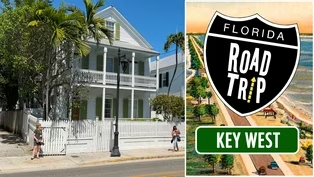
Preview: S2026 Ep5 | 30s | Watch a preview of the Key West episode of Florida Road Trip. (30s)
Providing Support for PBS.org
Learn Moreabout PBS online sponsorship












Support for PBS provided by:
Florida Road Trip is a local public television program presented by WUCF
Watch additional episodes of Florida Road Trip at https://video.wucftv.org/show/central-florida-roadtrip/