State of Affairs with Steve Adubato
Khamele McLeod-Cato; Dr. Ronald Nahass; Junius Williams
Season 5 Episode 23 | 27m 14sVideo has Closed Captions
Khamele McLeod-Cato; Dr. Ronald Nahass; Junius Williams
Dr. Khamele McLeod-Cato shares her personal connection to early childhood development and child care; Dr. Ronald Nahass discusses communication challenges during the crisis and the issues with politics vs. public health; Junius Williams talks about the leaders who made an impact on Newark’s history, including: Ken Gibson, Amiri Baraka, and Mayor Ras Baraka.
Problems playing video? | Closed Captioning Feedback
Problems playing video? | Closed Captioning Feedback
State of Affairs with Steve Adubato is a local public television program presented by NJ PBS
State of Affairs with Steve Adubato
Khamele McLeod-Cato; Dr. Ronald Nahass; Junius Williams
Season 5 Episode 23 | 27m 14sVideo has Closed Captions
Dr. Khamele McLeod-Cato shares her personal connection to early childhood development and child care; Dr. Ronald Nahass discusses communication challenges during the crisis and the issues with politics vs. public health; Junius Williams talks about the leaders who made an impact on Newark’s history, including: Ken Gibson, Amiri Baraka, and Mayor Ras Baraka.
Problems playing video? | Closed Captioning Feedback
How to Watch State of Affairs with Steve Adubato
State of Affairs with Steve Adubato is available to stream on pbs.org and the free PBS App, available on iPhone, Apple TV, Android TV, Android smartphones, Amazon Fire TV, Amazon Fire Tablet, Roku, Samsung Smart TV, and Vizio.
Providing Support for PBS.org
Learn Moreabout PBS online sponsorship- [Narrator] Funding for this edition of State of Affairs with Steve Adubato has been provided by The Turrell Fund, supporting Reimagine Childcare.
PNC, Grow Up Great.
PSE&G, committed to providing safe, reliable energy now and in the future.
The Healthcare Foundation of New Jersey.
The Fidelco Group.
Horizon Blue Cross Blue Shield of New Jersey.
Here when you need us most, now and always.
New Jersey Institute of Technology.
NJIT makes a difference in our students' futures.
MD Advantage Insurance Company.
And by The New Jersey Education Association.
Promotional support provided by NJ.Com, keeping communities informed and connected.
And by The New Jersey Business & Industry Association.
[INSPRATIONAL MUSIC] - Hi, I'm Steve Adubato.
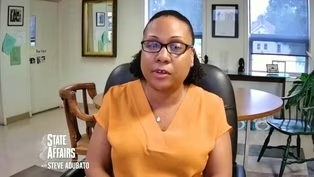
Welcome to a very compelling program that we kick off with Dr. Khamele McLeod-Cato, who is the Executive Director of The King's Daughters Day School.
Good to see you, doctor.
- Thank you for having me.
- Tell us, first of all, about the name of the school and what the school is.
- So, King's Daughters Day School is a nonprofit, private, early care and education program located in Plainfield, New Jersey.
And we have been here for 115 years.
We actually just celebrated our 115th year anniversary.
And we provide early care and education for children from 11 months to 13 years, in our infant and toddler, preschool and afterschool programs.
And our mission is to provide children of working parents with developmentally appropriate experiences and a nurturing environment so that they can be successful in life.
- Doctor, how has COVID impacted your work?
- Aside from you know, losing some staff and of course, not being able to hire the highly qualified staff that we need, which was a problem pre-COVID, we have been, you know, in addition to that, there's an increase in, increase in costs for PPP, and you know, all the other cleaning solutions that we have to get in order to keep everyone safe.
And so, we have, you know, we have just been trying to stay afloat and with partners such as the Turrell Fund, you know, who have been a partner to us throughout the years, they have, they have truly helped to support us throughout this time.
- Yeah.
And by the way you mentioned Turrell, this is a part of our initiative called Reimagine Childcare.
And so I'm curious about this because the children you serve with the challenges they face doctor, why has it been so hard for so long, for so many of these children, and their families to get access to the quality, affordable care they need?
- Because childcare overall is just very costly, it's too, it's too high.
And most of our families are from low income communities.
And so they cannot afford to pay for high quality early care and education.
So it's important for programs such as mine to be around, to remain in existence so that we can provide the children and families this access that they would not typically have.
- Doctor remind folks, particularly for children zero to three why those years are so critical to learning and what those infants and toddlers need, zero to three.
- Infants and toddlers need loving care.
They need, they need persons who are able to provide them with the developmental assistance that they need.
They need persons who will be, will show, who will show up for them every day.
They need the consistency.
They need highly trained, or they need persons who are trained in infant and toddler care and development.
And so with, and so when we have children who start in pre-K or start who start in education or start their education in, early, from zero to three, they're likely to become more successful when compared to their, when compared to their other peers.
- Let me ask you something Doctor, your commitment to this cause to these children is professional, but it's also personal.
Is it not?
- It is, it is.
- Because?
- It is because, so I grew up in Jamaica the West Indies, and I have a brother who was, he was expelled from school from pre-K because he had seizures.
And he was also, he was also a bit delayed.
We didn't find out until he was around 12, that he was autistic.
And so my mom lacked the resources, the financial resources, and also the knowledge to find him the care and education that he need, that he needed.
And so it is with that, that I am committed to this field because I want to make sure that we are doing all that we can to educate the children, support the families, so that we can in turn, build stronger communities.
- So well said, so important.
Before I let you go, the role of the state government in helping to provide the care these children need?
- Increasing access to not only threes and fours, but access to zero to three care for parents and also providing more funding to early care and education programs so that we can remain open for parents.
And so that we can, offer the competitive salaries to retain and attract highly qualified staff, which is important at this age.
Doctor, thank you so much for joining us.
- Thank you so much for having me.
- You got it.
Stay with us, we'll be right back.
(grand music) - [Announcer] To watch more State of Affairs with Steve Adubato, find us online and follow us on social media.
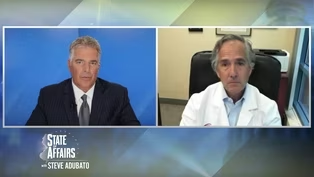
- We're now joined by Dr. Ronald Nahass, President of ID Care.
Good to see you, Dr. Nahass.
- Good to see you, Steve.
Thanks for having me on.
- You got it.
Tell everyone what ID Care is.
- ID Care is a large, single-specialty infectious disease practice.
We have locations in over 130 sites in the state of New Jersey, 10 offices, 15, 16 hospitals, and over 100 long-term care facilities, in which we see patients with infectious diseases.
- So let's talk COVID, let's talk public awareness, and let's talk, let's say some miscommunication or messaging issues.
My question is this, to what degree do you believe that the public health community, the leadership and the public health community, has been effective and consistent in their messaging to often very confused citizens, as we tape this program at the end of June, 2021?
- I think that's been one of the challenges, for not only our public health officials, but the politicians.
I think those in leadership have struggled to be able to have a uniform message.
And that's been one of the biggest challenges for those of us that do this work out at the frontline.
Certainly been one of the biggest challenges for us, that is, managing the information.
The information's coming at you like water out of a fire hydrant.
It's extraordinarily difficult to separate out what's important, what's real, what's misinformation?
And honestly, our public health folks, and our politicians, haven't always done a great job, they just haven't.
- How much does it bother you when, quote unquote, politics gets involved and mucks up, if you will, conversations about science and public health, regarding COVID?
- Well, it's been terrible because the politicians have the bully pulpit, so to speak.
And if you have a microphone, and you don't know, or are not sure, of what the details are that you're speaking to, you shouldn't comment, because it really creates confusion for the public.
It creates confusion for providers.
It creates confusion for all of us, honestly, in trying to carry out a uniform approach to something that's been so catastrophic.
That's not to say that the information is always clear, it's not, that's the problem of a pandemic.
But that attempt, that messaging, confounded or confused it even further.
- So, you know, it's so interesting you just said that, because as a student of leadership, I often wonder when a leader, whether in the public health arena or in government, as an elected official, appointed official, whatever.
If he or she simply does not know, if the scientists do not know, because they- it's a novel Coronavirus, do you believe it's acceptable, and in fact, appropriate at times, to say, "We don't know, we're trying to find out, but we don't know right now."
Go ahead, I'm sorry.
- Yeah, that's absolutely the right thing to do.
I think that's one of the first principles of, you know, disaster communication or pandemic communication, is, say what you know, when you know it, but say what you don't know.
And if you don't know, that's way better than speculating or suggesting something else, because it just adds to further confusion.
So totally on board with that, I think that's an absolutely critical principle of how we need to communicate in this kind of a setting.
- You believe in so-called vaccine passports?
- I think the vaccine passport is an important concept that should be fleshed out, and should be considered strongly.
We have precedent for this.
There are several examples that we've had for many decades, in fact.
For example, most listeners, I'm sure you're familiar with the fact that you can't have your child in public school without having a measles, mumps, or rubella vaccine.
That's a passport.
In order to go to public school, gotta have a vaccine.
If you want to travel to Central Africa or South America, you must have a yellow fever vaccine.
And you actually have to get a card, an international certificate of vaccination for yellow fever, in order to go to those countries, that's a vaccine passport.
So I think for the purposes of public health, public safety, and just good overall care, vaccine passports have a role.
And in this case for a pandemic, absolutely.
- Devil's advocate, some people watching right now, people I know, people you know, say- and I've asked this of so many public health experts, infectious disease experts like yourself, "It's my right!
", not to get the vaccine, "I don't want to and the government's not gonna tell me I have to."
Okay.
The consequences of that are...?
- Then you cannot participate in public activities.
The concept of personal rights is important, and I'm all for it, right?
We should all have our individual rights.
However, if that individual right infringes on others, that's a different story.
So the example that I've used is a tetanus vaccine.
Let's use that as an example.
Tetanus is a disease you get from the proverbial rusty nail or a dirty item outside in the yard.
And you injure yourself.
You don't wanna get a tetanus shot if you get exposed like that.
That's okay, because if you get tetanus, you can't transmit it to me or to you.
But tuberculosis, yellow fever, COVID, measles, mumps.
Those are diseases you as an individual, can transmit to somebody else.
So your decision to not take a vaccine affects me, affects my family, affects your friends.
And so it's not solely a decision for you.
It's a public decision that we're in together.
How concerned are you about a recurrence, of a significant surge again, of COVID cases?
- Well, you probably saw the stories of what's going on yet again in South America?
- With the Delta variant?
- Yeah, different variant in South America.
And we're now seeing a mini-surge, you know, down in certain states of the country where vaccination rates are low.
Will we have a major surge like we had in the beginning of the COVID pandemic, here in the US or this past winter?
No, because we've had a fairly substantial portion of the population that's been vaccinated.
But the risk, the risk is that the reservoir of unvaccinated individuals, that could harbor the virus, result in a variant that mutates, that could then infect those of us who are vaccinated, is a potential real occurrence.
Will it occur?
We do not know.
But what we do know is that that possibility exists.
And we've seen that happen in India, we've seen that happen in South America.
What we don't want, is we don't want that to happen here.
We all need to get vaccinated.
- Wow.
Dr. Ronald Nahass, who is the President of ID Care and infectious disease specialist.
And I want to thank you so much for joining us and sharing your perspective and insight.
From our vantage point, particularly those of us involved in public broadcasting, this is a purely public health question.
It's not about politics, it's not about anything else.
It's not my opinion, it's just a fact.
So we're here to provide the facts, and you decide for yourself.
But it's not just for yourself, as Dr. Nahass said, it's other people as well.
Thank you, Dr. Nahass.
- Thanks, Steve, appreciate it.
- You got it.
I'm Steve Adubato, we'll be right back.
(grand music) - [Announcer] To watch more State of Affairs with Steve Adubato, find us online and follow us on social media.
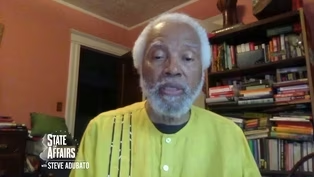
- We are honored to be joined by Junius Williams.
Who's the official Newark historian.
He's an author, a civil rights activist, host of a podcast called Everything's Political.
Good to see Junius.
- Good to see you too Steve, it's been a while.
- It has, and this is a really important segment because it's part of a series that we're doing simply called New Jersey Leaders Who Matter: Powering Equity and Social Justice.
There are three leaders who we are going to feature.
Ken Gibson.
The great mayor, Ken Gibson of Newark.
Amiri Baraka, playwright, poet, novelist.
And also the mayor of Newark today, Ras Baraka.
Three Newark and New Jersey and American leaders who matter.
Junius, let's start with Ken Gibson.
We're gonna be showing some pictures of different, of these three folks that we're gonna be talking about.
Elected to mayor, elected in 1970 as the mayor of Newark, the first black mayor of a major Northeastern city.
Why was Ken Gibson so important beyond being the first in that regard?
- Ken Gibson represented a power shift in the city of Newark.
For some time, black people had been in the majority and yet the official hierarchy of running the city didn't reflect that population.
We had two Councilmen, one at large and one for the Central Ward.
And that was it.
The police department was 95% white, mostly Irish and Italian.
Most of the people in city who worked in the City Hall at the high positions were white - And did not live in the city.
- And did not live in the city.
And so it was time for a change.
So Ken was our choice.
I was his first campaign manager.
And what we had to do was to convince people that a black man could win.
Despite the numbers, a lot of people just didn't believe it.
And of course Addonizio had a lot of friends and the blacks... - The previous mayor who went to jail for corruption and frankly being tied to the mob, but also Mayor Gibson, who I was honored to know as a young man growing up in Newark, He also brought a sense of calm to the city after the 1967 rebellion, did he not?
- Yes, I think that was probably the greatest gift that he had and that he used.
Ken was very laid back, very calm and I think that convinced a lot of white people that they didn't have anything to worry about.
And that was important during that day because the city was very racially polarized.
There was a man named Anthony Imperiale in the North Ward.
- My neighborhood, - Your neighborhood, my neighborhood now.
Your father's neighborhood.
As a matter of fact, your father and him had a run in as to who was gonna be the chairman of the democratic party and your father won.
So this was a time of a racial polarization.
Unlike anything that I seen.
Until now, I would say that the Imperiale people were like the proud boys and the folks who stormed the White House.
I'm sorry, the Capital - The Capital.
And then folks, check it out it's not an understatement what Mr. Williams is sharing right now.
It was a bad time.
It just really was.
But, I want to ask you this about Amiri Baraka.
Playwright, poet, activist.
His contribution, and by the way, I was honored to interview Mr. Baraka at NJPAC, I believe in the last year of his life.
What was his greatest contribution in your view?
- He combined art and politics like nobody else that I knew.
He was a nationalist, but at the same time, he kept his eyes on the prize.
And the prize was to win in the mayoralty and the majority of the City Council.
Now we didn't do it at the first time, but eventually we did get the council as well.
I think in '74 to represent it to be more representative of the people that were here.
But Amiri Baraka was one of a kind, he had a national and international reputation as a poet, as a writer, as you said, various times.
But during the rebellion in 1967, a policeman hit him in the head and gave him a concussion, bloodied his head.
And he became known thereafter for his politics because he then had a platform that he hadn't, that he didn't have before.
And he used it to help get Ken Gibson elected.
Ken Gibson depended upon the organization that Baraka set up, called Committee For a Unified Newark.
More than Ken Gibson wanted to admit.
He did not, there was something that was Baraka's idea.
And it was called the black and Puerto Rican convention at which time for the election in 1970, people were supposed to come to that convention in 1969 and show their wares.
Some people did, most people didn't, but by that time, most of us had decided we wanted Ken and like all conventions they would say, let's say it was, people like Ken a lot.
But at the same time there was this idea.
And I think that idea was probably one of the most, it was not only generous, but I think it was a very influential idea and people ought to do it more.
- Yeah and It's so interesting.
I remember being a kid growing up in the city, that year, that election, and I'm not going to go into this except to say, in the neighborhood I grew up in, and Junius Williams knows this better than most, in the neighborhood I grew up in a 1970, in the race between Ken Gibson, who was an engineer and Hugh Addonizio, Mayor Hugh Addonizio who was indicted and ultimately went to jail for being quote mobbed up in my neighborhood.
Largely Italian-American, virtually everyone voted for Hugh Addonizio.
My father happened to go in a different direction and be supportive of Ken Gibson but that being said, the argument was even if he was corrupt, at least quote, he was white and that's how it was.
And then Junius am I overstating that?
Before we move to Ras Baraka, - No.
- that's basically the way it was.
- The runoff between Addonizio and Ken Gibson was a campaign that Addonizio directed toward Amiri Baraka.
It was strictly based on race.
You can't trust Gibson because Gibson's got Baraka.
Now they didn't know that Gibson turned around and just kind of pushed Baraka aside.
They didn't know he would do that at the time, but that was very important.
We had, the other thing I wanted to say was we had a platform coming out of that convention, and that was a very important platform for us, but Ken, more or less ran on what Ken wanted to run.
- By the time we have and again, I wish we had more time.
You are doing with Ras Baraka, Mayor Baraka of Newark.
You are involved in an initiative, what is it exactly?
- The mayor wants to turn the fourth precinct, now first precinct into a museum and an office building, but I'm going to talk about the museum.
Cause that's what I'm involved in.
He wants to convert that place into a music, you know, to contribute Newark's history, to talk about the civil rights history, to talk about the black power history, to talk about people's memories of what Newark was like and what they wanted to become.
So it's going to be a people's museum, whatever the final title is.
So that came out of the fact that he wanted to, people were saying, well, you ought to, you ought to get rid of the police.
You ought to defund the police.
He said, no, we need the police.
What we're going to do is to take part of the police budget and do two things with it.
Number one, we're going to show that we can help create a culture of non-violence in the city, but we're also going to do this, we're going to do this museum.
- Junius, let me ask you this, what would you say?
And by the way, you've interviewed Mayor Baraka many times, check out our website to see those interviews.
What would you say his greatest contribution to date is as a New Jerseyan who matters greatly.
- He tells the truth and he has, he has come from an activist household where his mother and his father had certain beliefs, the beliefs sometimes, most time ran counter to what the traditional wisdom was.
And he's now in a position where he can correct some of the wrongs that he's seen.
For example, this museum is a good example.
The housing that he wants to build, it's called Kawaida Towers, which was a very controversial housing project in the North Ward.
People said, well, the water is messed up.
Well, he has been able to turn that around he had trained people from the city of Newark to come out and fix the housing that way the work problem was existing.
I'm trying to think of how many units of housing, how many units have done, but thousands have been corrected.
The pipes have been changed, where there was lead in those pipes, all those things combined make him a good man.
- That is Junius Williams.
This is part of our series that deals with New Jerseyans who matter.
And I want to thank you for joining us.
And by the way, checkout Junius' web, excuse me, his podcast called Everything's Political.
Junius, thank you so much for joining us.
- Thank you for having me.
- I'm Steve Adubato, we'll see you next time.
- [Narrator] State of Affairs with Steve Adubato Is a production of the Caucus Educational Corporation.
Funding has been provided by The Turrell Fund, supporting Reimagine Childcare.
PNC, Grow Up Great.
PSE&G, The Healthcare Foundation of New Jersey.
The Fidelco Group.
Horizon Blue Cross Blue Shield of New Jersey.
New Jersey Institute of Technology.
MD Advantage Insurance Company.
And by The New Jersey Education Association.
Promotional support provided by NJ.Com, And by The New Jersey Business & Industry Association.
- New Jersey's early educators and childcare providers are more than twice as likely to live below the poverty line versus the general workforce.
Reimagine Childcare formed by a coalition in New Jersey is dedicated to improving accessibility, affordability and quality of childcare and re-imagining the way we support these essential providers.
COVID Misinformation and Vaccine Passports
Video has Closed Captions
Clip: S5 Ep23 | 9m 17s | COVID Misinformation and Vaccine Passports (9m 17s)
COVID's Impact on The King's Daughters Day School
Video has Closed Captions
Clip: S5 Ep23 | 6m 46s | COVID's Impact on The King's Daughters Day School (6m 46s)
Recognizing Leaders Who Made an Impact on Newark's History
Video has Closed Captions
Clip: S5 Ep23 | 11m 54s | Recognizing Leaders Who Made an Impact on Newark's History (11m 54s)
Providing Support for PBS.org
Learn Moreabout PBS online sponsorship
- News and Public Affairs

Top journalists deliver compelling original analysis of the hour's headlines.

- News and Public Affairs

FRONTLINE is investigative journalism that questions, explains and changes our world.












Support for PBS provided by:
State of Affairs with Steve Adubato is a local public television program presented by NJ PBS