
Kids' Mental Health/Heidelberg
Season 49 Episode 11 | 23m 55sVideo has Closed Captions
Kids' Mental Health/Heidelberg | Episode 4911
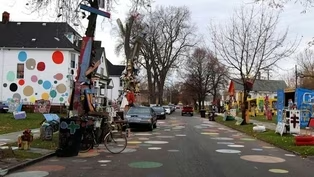
How has the pandemic affected the mental health of children over the past year? Stephen has a candid conversation that every family needs to hear. Plus, Detroit’s Heidelberg project changes with the times and the latest on the famous outdoor art installation. Episode 4911
Problems playing video? | Closed Captioning Feedback
Problems playing video? | Closed Captioning Feedback
American Black Journal is a local public television program presented by Detroit PBS
Kids' Mental Health/Heidelberg
Season 49 Episode 11 | 23m 55sVideo has Closed Captions
How has the pandemic affected the mental health of children over the past year? Stephen has a candid conversation that every family needs to hear. Plus, Detroit’s Heidelberg project changes with the times and the latest on the famous outdoor art installation. Episode 4911
Problems playing video? | Closed Captioning Feedback
How to Watch American Black Journal
American Black Journal is available to stream on pbs.org and the free PBS App, available on iPhone, Apple TV, Android TV, Android smartphones, Amazon Fire TV, Amazon Fire Tablet, Roku, Samsung Smart TV, LG TV, and Vizio.
Providing Support for PBS.org
Learn Moreabout PBS online sponsorshipComing up on "American Black Journal," how has the pandemic affected the mental health of children over the past year?
We're gonna have a candid conversation that every family needs to hear.
Plus, Detroit's Heidelberg Project changes with the times.
We're gonna get the latest on the famous outdoor art installation.
Stay where you are.
"American Black Journal" starts right now.
Announcer 1: From Delta faucets to Behr paint, Masco corporation is proud to deliver products that enhance the way consumers all over the world experience and enjoy their living spaces.
Masco, serving Michigan communities since 1929.
Announcer 2: Support also provided by the Cynthia and Edsel Ford Fund for Journalism at Detroit Public TV.
Announcer 1: The DTE foundation proudly supports 50 years of "American Black Journal" in covering African-American history, culture and politics.
The DTE Foundation and "American Black Journal," partners in presenting African-American perspectives about our communities and in our world.
Announcer 2: Also brought to you by AAA.
Nissan Foundation.
Ally.
Impact at Home.
UAW, solidarity forever.
And viewers like you.
Thank you.
♪♪ Welcome to "American Black Journal."
I'm Stephen Henderson.
It's hard to believe, but it has been one year since the first COVID-19 cases were confirmed here in Michigan and the nation went into lockdown mode in an effort to stop the spread of the deadly virus.
Restrictions were placed on gatherings and schools were shut down.
The crisis has affected us all.
But today, we want to talk about the pandemic's impact on our children and on their mental health.
Here's my conversation with Debora Matthews, who is the CEO of the Children's Center, and Carlynn Nichols, who is the agency's Chief Clinical Officer.
And I think it's especially important to talk about our children, and not just the effect of the pandemic itself, the public health threat of the pandemic itself, but the mental health threat that it poses, especially to kids who deal with disruption in a really different way than we do as adults.
So Debora, I'm gonna start with you.
And just give us a sense of one year in, what you're seeing and what you're hearing from the children in our city.
Well, it's a long story and somewhat challenging over this last year.
And the Children's Center has been serving children and families now since 1929.
A long haul in pretty much our same community that we're in now for the most part.
And the primary services we provide is behavioral health and child welfare.
So foster care and adoptions.
And so when the pandemic began, we had to very, very quickly pivot.
Didn't have but days really to come up with a solution to be able to continue to serving our clients, because typically they're used to coming to our location and, you know, getting their therapy done there, participating in everything going on on our campus.
And all of a sudden now, everything's shut down and they can't come to their appointments.
So we had to shift very quickly to a tele-health version of providing those services via either video, preferred video, or audio, talking to them on the phone.
And of course at that time everybody was afraid and panicky.
So initially we saw the parents connecting with us to be just a lot lower.
You know, fewer folks wanted to talk even via tele-health because they were dealing with the real issue of what's going on now in the household with the kids being stuck at home, parents having to work from home.
Managing all of that has been a great challenge.
They had to deal with illnesses that came about as a result of people in their family or themselves.
So it's been extremely challenging.
And obviously we weren't able to reach all of the families initially.
But now it's kind of built back up and it's getting better.
So it's been a really tough time for the kids.
Yeah, and if you had to sort of point to a couple of indicators, the effect this has had on kids and how that's different from adults, what would those be?
Yeah, I'll let Carlynn focus in on the difference for children.
But what I can say overall is, we were seeing 4,500 behavioral health clients in a given year.
And for that to go now way down to less than 3,000 initially, to annualize that.
And that means we're missing a lot of kids.
So our first concern is what's happening to those kids who are isolated at home.
They're not in schools.
So schools, principals, and teachers didn't have eyes on them, you know?
So we were concerned.
Were they safe?
Were they getting enough food?
So in general, it really did cause concern for us that children and families weren't getting what they needed.
Yes, I think what we're seeing is a direct result of what Debora's speaking to.
Children live in families.
And if families are stressed, children are a product of that stress.
So what COVID has caused is challenges with employment and healthcare and food.
And so you have families who have those stressors.
So children experience those stressors too.
And we have children who are in the stages of their life where social interaction with peers is important.
How we learn our social skills is by engaging in play.
We engage in exercises and activities.
We go to a school building and we engage with our classmates.
So that is no longer taking place.
You know, we live in a world where we've been told less screen time.
So now we have children with more screen time.
So they are on the screen and just the capacity to interact with their peers, interact with their teacher to get the extra help is a problem.
How do you learn when you have a parent who has to work?
And so there's a real concern that we have a generation of children who are missing out on this year of education.
And these are the same children too who some of them go to school and they get two square meals a day in the school.
And so we also are concerned about them going hungry.
And so the stressors of being at home and the fact that they have a lack of interaction with peers, with their teachers, and now we're also competing for screen time too.
Debora mentioned that tele-health.
So if this is a child that needs a therapeutic appointment, how do they do screen time at school and also do screen time with their therapist?
So we are really concerned that these are children who, parents are having to choose, you know?
They're having to choose what their children get.
And some parents have chosen, well, I can't use my data that I need for my work for you to have this extra activity, therapy, or school.
So there's some real challenges in our community.
Yeah, Debora, we are just starting to get back to some kind of normalcy.
Yes.
With the vaccine.
But I imagine that there are some things that may not be able to go back.
Well, we are certainly hoping that our campus and the activity of having families come back to campus and engage in their therapy, do all of our extra enrichment activities.
We're hoping that can resume.
There are some of our clinicians and other workers at the organization that were primarily in the community anyways in that they would work in a co-location, such as Children's Hospital.
They'd work in schools.
They'd go to homes to see the clients.
So those have been able to resume a lot quicker with respect to going to homes and Children's Hospital.
Of course schools are not all open now and we're primarily working in Wayne County.
So once those schools begin to open, we very well expect that we'll have our clinicians back in those schools and taking all of the necessary precautions.
And then with our foster families, we've had to continue that engagement.
Once the state opened back up, we had to have parent visits with birth parents and siblings, and going to look after the safety of the child that's in a foster home.
So we've had to continue all of that.
And we expect that once we bring all of our clinicians back to our campus, that we'll be able to reengage with these kids and families and have them return to the campus as well.
And Carlynn, there's damage that was done here to children and their sense of normalcy.
Right.
Normalcy probably isn't quite enough.
There's going to be a need for real focus on reacclimating them.
We would certainly call this experience traumatic for our community, right?
And our children, we can't forget the impact on our children.
So we have families who have lost family members.
Families who have lost homes.
Family who have gone hungry.
And again, our children have been impacted directly by this.
So we really do believe that we need to be prepared to address the impact all these things are having on our children, to be ready to provide support and services to the families that we serve, whether it's connecting them with services in the community and providing some therapeutic intervention for children who have experienced some grief and loss.
You know, we can't underestimate the impact of something as simple as going to school has.
There has been a loss.
We have a whole group of children who, even young people who did not graduate high school, think of the loss that they had.
Think of all of the things that we just are used to having in a regular routine.
Children spend a great, most of their time in school.
When you think of how much time and what they gain in that interaction that they have lost.
Friends, opportunities to learn and grow.
And so we stand at the ready, really we do, to provide the much needed assessment and services for those children, whether it is again coming to this space called the Children's Center or going to homes and working through the grief and working through the fear, because they're still, we're anxious.
We are all anxious in our community about the impact and the future and what it means and what that new normal may look like.
And so talking through that and creating plans and really thinking about how, what does that new normal look like for each of us, individual, for us as a family, for a child going to school, becomes a very important conversation.
Detroit's Heidelberg Project is famous not only here, but all around the world.
The outdoor art installation sits in the center of a neighborhood on the City's east side and was created by artist Tyree Guyton 35 years ago.
One Detroit's Will Glover spoke with Heidelberg's President, Jenenne Whitfield, about how the project has changed over the years and what's to come in 2021.
First things first.
Let's introduce people who may not be among the initiated when it comes to the Heidelberg project.
So just give us a little bit of insight as to what the Heidelberg Project is, where it is, and you know, how long it's been around.
Sure, so the Heidelberg Project in Detroit is this outdoor, funky, cool, colorful art environment that's located in the heart of an urban community on the east side of Detroit.
It has been, believe it or not, we're in our 35th year.
It's hard to believe that Tyree Guyton has been caring for this art installation for the last 35 years.
But that's the case.
And it is made up primarily of found and recycled materials.
It used to cover a two block area, but as we go through the metamorphosis of the Heidelberg Project now, it is changing.
And we're focusing now Heidelberg more linear, where it's one street and it goes straight down the street now and it meets at our headquarters.
So Heidelberg has always been just this amazing, colorful outdoor art environment that has intrigued the entire world.
The Heidelberg is run completely by women.
Is that correct?
It is now, darlin'.
I mean, for the most part.
Tyree Guyton has always been supportive.
And I've worked with Heidelberg for 27 years.
In one of our pieces of promotional materials, Tyree said that when he was a boy he always gave his money to the women in his family 'cause he know he could depend on them.
And I think that in some ways he's kind of carried that over into the organization and putting me in front to lead us through or to that next evolutionary place or state, which is Heidelberg 3.0.
And that is consisting of Heidelberg now as this arts district, arts community.
I would say it's not necessarily an effort.
It just so happens that we're all women.
So my staff consists of women, but we're all surrounding Tyree, so it's a good thing.
But yeah, it's all women.
And I do have to point out the fact that it's never a big deal if it's an all male staff, so.
No, it's not, is it?
Like you said, it just happens to be all women and you're doing a great job.
One of the other things I wanted to talk about was the fact that the Heidelberg Project isn't just an arts destination.
And you kind of alluded to it just now when you were talking about the community space and the interaction with the community.
But it also helps economically.
Can you talk a little bit about that?
Man, listen, you know.
There was a study done by Williams College in, I believe it was 2011 when they did the first study.
And what they did was they took a fraction of our visitorship, which we boasted at that time 200,000 people annually.
They took a fraction of that, being 50,000.
And what they wanted to determine is what is the impact, economic impact of the Heidelberg Project, on both the city and the larger Wayne County region.
And what they determined in 2011 was that we contributed 3.2 million to the local city and something like 3.7 million to the Wayne County region.
Now that was in 2011.
But because they were so in awe of the economic power behind the Heidelberg Project, they left us on their website.
Meaning that if you go in and plug the numbers of 2020 today, if you still use that fraction of our visitorship, you will see that, well, I'll say 2019.
That's the last time we checked.
You will see that today it's something like 7.5 million in terms of the, and what that translates into is that the people that are coming to see Heidelberg are also coming to see other places.
They're spending more time in Detroit.
They're spending money in restaurants.
Now keep in mind this was all before COVID, right?
So you can see that the innovation that Tyree came up with here in the city of Detroit really had more of an impact than just art and creativity, but it also affected our economy.
One of the things that I saw that you guys recently got was an award as one of the leading culture destinations.
Tell me a little bit about that.
Man, that was crazy.
That came right before the pandemic.
And what happened is we were nominated for best cultural activation.
And we were nominated on a worldwide scale.
Our competitors was the, oh, my gosh, I'm not gonna remember this, but there is a House of Blues or something like that in Toronto.
And then another cultural institution in South Africa.
And Heidelberg won.
And I actually flew to Berlin to accept the award in person.
And it was just, it gave us an opportunity in Berlin to come together with other cultural makers around the world who were doing things that were innovative and cutting edge.
So it was incredible.
But I have to admit that COVID put a damper on it because look, while I was in Berlin, I'm like, I need to get home 'cause this is not good.
Yeah, I'm sure.
But it was amazing to have that kind of acknowledgement.
And you know, we've got awards racked up that people just would not believe.
Obviously, it means a lot to you.
Can you just tell me a little bit about what it actually means to you personally?
Sure, I will tell you in the way of the experiment that the artist performed with me.
He asked me if I'd help him and I said no.
Said I don't even understand what you're doing.
And so then he asked me if he could do a little experiment with me.
And I said, okay.
So he blindfolded me.
He gave me paint, crayons, paper, pencil, all of this.
And I sat on the floor like a child blindfolded.
And he said, now paint what you see.
And what I painted, after I finished, now I'm completely inhibited, right?
I got no reference, I can't see.
So I just have fun.
And there's a very symbolic message in that.
And so that painting that I created I framed.
And I hang it on my wall.
It's with me all the time because it is a reminder that we must challenge ourselves to go to a place that is often uncomfortable in order to grow.
See, if we're just complacent and settled in what we already know, then how do you innovate?
How do you challenge the status quo?
How do you go to the next level?
Heidelberg Project has taught me what it means to go beyond and to aspire to something that you didn't even know you could.
Right, and for people who want to help contribute, be it financially or they just want to experience the Heidelberg Project, where can they go to do that?
Oh, they can go visit our website.
We have a very, very active website and social media platform.
We're on all the channels, Facebook, Twitter, Instagram.
And they can also just email information at Heidelberg.org.
Everything is Heidelberg.org.
That's where you'd find us.
That's where you can get in contact with us.
And then we're right in the community.
So because we do have a lot of space, you can also knock on our door.
That is gonna do it for us this week.
Thanks for watching.
You can find out more about our guests at americanblackjournal.org.
And as always, you can connect with us on Facebook and on Twitter.
We're gonna leave you this week with a performance by dancers from the SKilSet Movement Studios on the Marygrove Campus.
Enjoy, and we'll see you next time.
♪ It's not simple to say ♪ Most days I don't recognize me ♪ ♪ But these shoes and this apron ♪ ♪ That place and its patrons ♪ Have taken more than I gave them ♪ ♪ It's not easy to know ♪ I'm not anything like I used to be ♪ ♪ Although it's true ♪ I was never attention's sweet center ♪ ♪ I still remember that girl ♪ She's imperfect, but she tries ♪ ♪ She is good, but she lies ♪ She is hard on herself ♪ She is gone but she used to be mine ♪ ♪ And you're not what I asked for ♪ ♪ If I'm honest, I know
Video has Closed Captions
Clip: S49 Ep11 | 8m 14s | Heidelberg | Episode 4911/Segment 2 (8m 14s)

Video has Closed Captions
Clip: S49 Ep11 | 11m 2s | Kids' Mental Health | Episode 4911/Segment 1 (11m 2s)

Video has Closed Captions
Clip: S49 Ep11 | 1m 19s | Skilset Performance | Episode 4911/Segment 3 (1m 19s)
Providing Support for PBS.org
Learn Moreabout PBS online sponsorship
- News and Public Affairs

Top journalists deliver compelling original analysis of the hour's headlines.

- News and Public Affairs

FRONTLINE is investigative journalism that questions, explains and changes our world.












Support for PBS provided by:
American Black Journal is a local public television program presented by Detroit PBS