
Kiese Laymon on His Poignant Memoir, "Heavy"
Clip: 4/8/2019 | 17m 7sVideo has Closed Captions
Michel Martin speaks to Mississippi author Kiese Laymon about his poignant memoir “Heavy.”
Michel Martin speaks to Mississippi author Kiese Laymon about his poignant memoir “Heavy,” which takes a look at what it means to grow up in a society that oppresses black people, from eating habits to domestic violence, and how his upbringing was marked by struggle, a disciplinarian mother, and racism.
Problems playing video? | Closed Captioning Feedback
Problems playing video? | Closed Captioning Feedback
Kiese Laymon on His Poignant Memoir, "Heavy"
Clip: 4/8/2019 | 17m 7sVideo has Closed Captions
Michel Martin speaks to Mississippi author Kiese Laymon about his poignant memoir “Heavy,” which takes a look at what it means to grow up in a society that oppresses black people, from eating habits to domestic violence, and how his upbringing was marked by struggle, a disciplinarian mother, and racism.
Problems playing video? | Closed Captioning Feedback
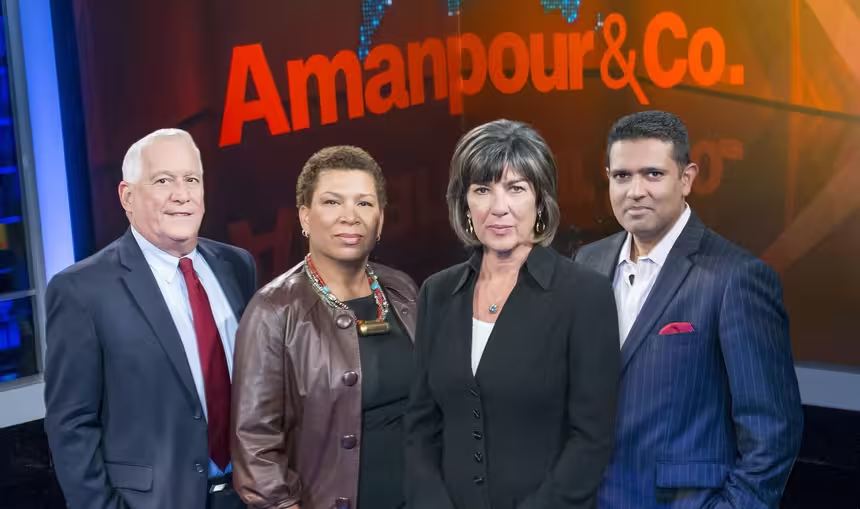
How to Watch Amanpour and Company
Amanpour and Company is available to stream on pbs.org and the free PBS App, available on iPhone, Apple TV, Android TV, Android smartphones, Amazon Fire TV, Amazon Fire Tablet, Roku, Samsung Smart TV, and Vizio.
Watch Amanpour and Company on PBS
PBS and WNET, in collaboration with CNN, launched Amanpour and Company in September 2018. The series features wide-ranging, in-depth conversations with global thought leaders and cultural influencers on issues impacting the world each day, from politics, business, technology and arts, to science and sports.Providing Support for PBS.org
Learn Moreabout PBS online sponsorshipIn his poignant and raw autobiography, Heavy, the author key essay, Laymon looks at what it means to grow up in a society that oppresses black people.
From eating habits to domestic violence.
His memoir tells the story of himself as a small boy with his mother in Jackson, Mississippi, and struggling to take control in the society that gives you so little of it.
Michel Martin sat down with KSA and asked him to connect the dots of his multifaceted life.
There is so much here.
There's so much to talk about.
It's about family relationships.
It's about food.
It's about weight.
It's about being heavy.
Right?
It's written really as a lengthy letter to your mother.
She is a very how can I put this interesting character?
If you look at her as a character.
Tell me a little bit about her.
She's interesting.
She's complicated.
She had me when she was 19.
She became a political science professor at 24.
So we moved from Mississippi to Wisconsin, back to Mississippi when she was about 24 and she gave her life to know as black students at State University, she gave her life to our region.
And like most parents, she just, you know, had a hard time being a human and being a parent at the same time, especially to, you know, a little black boy growing up in Jackson, Mississippi.
But she never wavered in terms of like what my writing practice was going to be.
You know, I mean, we see our parents sometimes become people and part of this book is like admitting that, like, I wasn't sure how to talk about my mother becoming a woman, not just becoming my mama.
And she just made sure early on in life that I understood that writing and revision were key to what she would call survival.
She was what definitely one these black parents who believed that you could write and revise your way into a particular kind of safety.
Another another hand.
I mean, I think it's okay to say that you know, I think my mother was a bit physically abusive.
A bit.
I mean, yeah, I think that she was physically abusive.
And I think she learned to be physically abusive from the nation, but also from the culture.
Do you know, like talk more?
We grew up in a part of this country where parents, black parents especially taught their children that, like, whatever they did to their bodies was going to be less harmful than what the police might do to you, than what the teachers might do to you and what white mobs might do to you.
So my mom was very physically, aggressively trying to discipline my body into anticipating what white supremacy and white people would do.
And and it took me a while to understand that that was abusive.
And it took me a while to see that you know, there were patterns of abuse.
It wasn't just a my mom was abusive.
This is what was happening in most of the homes that I grew up in or that I saw.
But you really believe that somehow like, she could protect my body by beating my body and protect my body from, again, white supremacy, which is an interesting and sort of sad sort of dialog on where we are.
Because when my teachers failed me, I would get a weapon.
And I knew that at the time, you know, if my teachers, you know, said I talk back, or they said that they saw me was something I shouldn't have.
Whether I had it or not, I know when I got home, I would get beaten because my mom pretty much would say, you should have known better.
And with this beating, you will know better.
The book, I'm very laudatory of my momma, very thankful for everything she gave to me.
I just don't know that those beatings ever actually did help.
Do you want to read this passage?
I was debating whether.
Can you read it?
Sure.
Do you mind?
I don't see this is passage here.
Just the first paragraph of this this chapter which you call Hulk.
Okay.
Here you go.
Just the first.
Yeah.
Oh, yeah.
Yeah.
Oh, yeah.
Okay.
Hulk you were on one integral momma's couch yelling at me while I was on the other end, grasping the side of my face.
We weren't back in Mississippi for longer than a week when you smashed me across my face with the heel of a Patrick Ewing Adidas.
Because I talk back, the side of my face started to swell, but I couldn't understand why getting hit in the face with the heel of a Ewing didn't hurt as much as it had before we left Jackson.
I was six, one £215, nine inches taller, and over £40 heavier than you.
The softer parts of my heart and body were getting harder, and those harder parts didn't want to hurt you, but they wanted to never ever be hurt by you again.
I find that passage so remarkable because, you know, black women whooping on their kids is almost a joke, right?
In some parts of the black community, do you feel like you've opened the door to a secret in a way like a family secret by talking about this?
Great question.
A part of me worries that I open the door to a secret that will further pathologize black women.
And what I wanted to do in the book was show that, you know, the black women who raised me were incredibly complicated.
And one of the things that they were taught was to physically discipline their black children into survival or excellence.
And I'm one of those black children who was beaten into survival and excellence.
And I'm and and I want people to understand it.
I'm using the art that my mom and my grandmamma gave me to talk about, among other things, the belief that beating children into excellence works.
I mean, it doesn't it didn't work with me.
Did you say that?
No.
I mean, and one might say to me because I'm here.
Yeah, exactly.
That's the tricky piece, isn't it?
One might say, well, you know, I think I would have been here a lot earlier.
Do you feel that in a way, you've broken a taboo?
And my worst I wonder if if I broke a taboo that should not have been broken You still question that?
Well, because I do want to go around this country and our black people who I think respect and love me and us who are like, I don't you know, there's some things you actually should have kept in the house and air and dirty laundry and the dirty laundry.
Why?
Why do they say that?
I think they worried it because the same reason my mom beat me.
I think they worry about what happens when white people see us, like see our secrets, like what they will do.
And I think what we know is that there's no length to what they will do.
But what I'm trying to say, and I don't know if I did it effectively or not, is like absolutely white folk going to a white folk I don't do.
But can we be healthier?
Can we be more honest?
Can we be aggressively aggressed?
Can we aggressively listen and wander around like our memory with each other, holding each other's hands like, wow, those people do whatever these people are going to do.
And I think we can I think we can make ourselves, ironically, heavier, but we have to be willing to face yesterday.
My mom is someone who often says I'm not I wasn't born with rearview mirrors and I was like, okay, but less than been like, let's invent the rearview mirror and let's look back together.
Do you know?
And that's what I'm trying to say and do, which means we have to do what the nation has taught us not to do, which is to look back and regretfully say, these are some things that I should not have done.
Let me talk to you about why I did them.
And hopefully going forward, I can be a better person, less violent, less abusive.
How do you understand her beating you?
Because some people would say, you know what, it was your frustration at?
It was her frustration at not getting child support from your father.
Her frustration at, you know, trying to take care of you, take care of herself, improve herself, go to school.
It was just it was pressure and poverty and lack of any other skills or knowing any any better.
So how do you understand?
I mean, I understand that.
And I understand that my mother in so many other ways took what society and culture said she should do and be.
And she made a different she she went a different way in this way and the way she disciplined her child.
She did exactly what I think culture taught her to do, which is to, again, discipline your son into submission so he will not be killed by white people or could it be just that she did not have personal discipline?
I mean, could it be her?
Is there any part of this could just be her.
I mean, I think we just did not have, I think, the patience to be a mom I think if you read the book, you see that I feel as a person who doesn't have a child, I feel unfair making that critique.
But that critique is there.
Of course, my mom, I think, knows that she failed in beating me as much as she did.
And I think that she knows that part of that was like as much as it was influenced by our culture and much of the influence by a nation.
It was obviously her and she regrets that.
So true that you are very adamant about the fact that this is a bigger story.
Oh, this isn't just the story of Casey Case and his mom and his mom hitting him a lot.
Right.
To the point where you still bear scars from it.
Emotional scars mainly as well as physical scars.
But that is bigger.
Tell me why you think it's bigger than that.
Well, I never got a beating in my life where my mother didn't talk to me about what white people were going to do.
Like, I never just got a beating.
You know, I mean, the beatings came along with a critique of the nation, with the critique of white supremacy, which, again, which is a familiar critique for those of us who got beaten in the south, which is, believe you me, what I'm doing to you is nothing compared to what they're going to do.
And, you know, I could see.
Right.
Like I talk about in the book, you know, like what's interesting is like, I saw Rodney King get beaten and I watched cops watch cops beat Rodney King.
Right.
And we watched it.
I remember I think it was on ABC.
And that night I came home and my mother found out that I was in my first relationship ever and I was in a relationship with the white woman.
And she she beat me.
And it was one of the strangest times in my life.
I was like, wow.
I actually felt like I deserved that beating.
Which which which says a lot about like 15 year old black boys sort of psychological makeup.
But also it had to do with what I just seen on TV, because in so many ways, my mother was trying to say, I'm beating you so you won't be Rodney King.
Of course.
And I know they don't kill you so they don't kill you and and get off for killing you.
Right.
What I have to do as a writer that she raised is critique the impulse, you know, and critique my mom publicly.
Which is hard.
But I'm also trying to say that I understand that there are scripts that we're all supposed to follow in this nation.
And sometimes we be here and we make like healthy moves outside of the script, and sometimes we stay inside of the script that my mom often when it came to parenting, I think she she followed a particular kind of script.
But what's interesting is that I saw her so often break that script as a teacher, you know, as a woman, as a daughter, as a lover.
And retrospectively, what I'm trying to say is, Mom, I wish you would have broken that script with me.
And I'm trying to break that script now as a son, as a writer, as a citizen.
Spoiler alert, your mom is very much alive She did read the book.
She has responded to the book.
Yes.
So I want to spend some time on that.
But I also want to point out that it's not just about her her hitting you and how you feel about it.
It's about a lot of things.
It is about food.
Yes.
Heavy you are heavy, right?
You're heavy.
And food is very much a part of.
And sexual violence and and people treating each other very poorly.
In a sexual way, starting at a very young age.
Do you think those are all connected?
I absolutely think they're connected.
I don't think that they're causal, though.
This is this is a difference, right?
Like, I, I don't think that, for example, my mom beat me or that, you know, different people in my life were sexually abused.
Purely because somebody else was abused.
I think that in my experience, my mom beat me partially because of white supremacy, partially because of mass evictions.
Partially because of mass incarceration.
I think that we're not lucky enough.
I'm not lost a man beat her because a man beat her to.
Right.
And I'm not lucky enough, though, to say in my life that it was just because my mom got beat and it was just because it is right.
We're not I'm not lucky enough to live in that world.
There are just so many things colliding that I think encourage my mom sometimes to not treat her child.
The way she wishes she would have.
And conversely, I know that I eat too much lots of times in my life because I was trying to deal with, you know, not just my mom, but the world.
And I starved myself for years for the same reason.
Right.
I was trying to grasp control and so on.
I think it's paradoxical.
On one hand, you want to control what you're putting in because you don't have any control of your surroundings.
But on the other hand, there was a times in my life when I wanted to make myself feel pain.
And this circles back to what we talked about earlier, like when my mom was beating me, I felt a lot of things, but I did also feel at least she cares, right?
When I was pushing my body to places, I should have never pushed my body, I thought I was doing it out of a sense of care.
So like this desire sometimes to hurt ourselves again is something I think has been ingrained.
And what about the sexual violence?
I mean, I just tell you it's it's just full.
Right.
It's your book is beautifully written, right?
It's a hard read.
It's a hard read, especially.
I don't know.
Especially especially who?
Especially anybody.
I mean, I have a daughter and a son and I. Mm.
It's just really hard.
So it's hard to think about girls just being treated as if they were tissues to be wiped off.
Absolutely.
And it's hard to read about, you know, boys being expected to treat girls in that way in order to preserve their standing with boys and also boys, in some cases, being trained that way.
How do you how do you understand that?
How do you understand that?
Why sexuality becomes so compromised and so connected to violence?
I think my explanation is I know that the boys that I know who aggressively sexually assaulted people were encouraged to sexually assault people were taught particularly to black girls, would recover no matter what, but also taught we don't have to care about black girls if they recover in that right, which is a very interesting and sad state of affairs.
But also like those black boys and I was one of those black boys when I started the book with my being like this bystander watching these boys, listening to these boys sexually assault this young woman to show that like it takes lots of people to create a culture of sexual violence, not just the perpetrators.
I was a young boy who knew what was happening in that room was wrong.
I didn't know exactly what was happening, but I could have intervened.
At that age, I knew that if I intervene, those older boys who I wanted to like me were going to do something to me that I didn't want.
Do you not mean so?
It takes actual perpetrators.
But as we also know, it takes a culture that encourages it.
And often it takes bystanders who just watch impact themselves on the back for knowing it was wrong but not intervening.
I did that at 12 years old.
I was never going to run a train on or sexually assault anyone, but I also was never going to stop anyone from being sexually assaulted.
At 12.
I knew that that was something I should not do.
That's learned.
That's learned.
How are you now?
How are things now?
How am I the day I know that my mama loves me.
I know I love her.
We're giving ourselves the opportunity to work through the hard, tough parts.
And that's that's not deliverance, but that's better than we were.
She did read the book, but she actually wrote a long blog post.
She wrote the post, which was going to be at the end of the book.
And she took and we decided end of the day, not to put it in there, but she.
But you posted it on your purse.
I wanted people to see and I wanted people to see it.
And what did she say?
She said, you know, she says that we see things differently.
But she also apologized, which was a big deal to me.
And she also agreed that this book has given her tools that she wished she had before she even had me to be to be not just a better mother, but just a a better citizen, a better human being.
You know, I'm saying so I felt when my mother wrote that letter, I felt loved and I felt cared for.
And she didn't have to do that.
Do you know what I'm saying?
So I some of the people who responded to her post, though, are very critical of her.
All the critiques of my mom that have been made, I listen to them sometimes.
I hope she doesn't.
But when it comes to the messy work of creating a chore, beating was part of what she did to me.
Which I think she didn't have to do it.
But the reason I'm sitting here with you is because she was also so good at the other things which are instilling a love of black people, instill in the love of black literature, and instilling a right and practice that loves black literature and loves black people.
Without that, I'm not here without the beatings, I think I'd be here earlier.
But the thing that she made was a black writer who wants to be the best at this essay.
Lena, thank you so much for talking with us.
Thank you so much for having me.
So I appreciate it.

- News and Public Affairs

Top journalists deliver compelling original analysis of the hour's headlines.

- News and Public Affairs

FRONTLINE is investigative journalism that questions, explains and changes our world.












Support for PBS provided by: