One-on-One
Kim Guadagno; Charles Vialotti, MD; NJ Symphony “Transcend”
Season 2022 Episode 2571 | 27m 56sVideo has Closed Captions
Kim Guadagno; Charles Vialotti, MD; NJ Symphony “Transcend”
Former Lt. Governor of NJ, Kim Guadagno, talks with Steve Adubato about ways to end generational hunger; Dr. Charles Vialotti, Medical Director at Villa Marie Claire Residential Hospice, Holy Name, talks about dying with dignity; Steve and Executive Producer, Georgette Timoney, discuss the new "One-on-One: The Arts Connection" special-series by featuring the award-winning film, “Transcend.”
Problems playing video? | Closed Captioning Feedback
Problems playing video? | Closed Captioning Feedback
One-on-One is a local public television program presented by NJ PBS
One-on-One
Kim Guadagno; Charles Vialotti, MD; NJ Symphony “Transcend”
Season 2022 Episode 2571 | 27m 56sVideo has Closed Captions
Former Lt. Governor of NJ, Kim Guadagno, talks with Steve Adubato about ways to end generational hunger; Dr. Charles Vialotti, Medical Director at Villa Marie Claire Residential Hospice, Holy Name, talks about dying with dignity; Steve and Executive Producer, Georgette Timoney, discuss the new "One-on-One: The Arts Connection" special-series by featuring the award-winning film, “Transcend.”
Problems playing video? | Closed Captioning Feedback
How to Watch One-on-One
One-on-One is available to stream on pbs.org and the free PBS App, available on iPhone, Apple TV, Android TV, Android smartphones, Amazon Fire TV, Amazon Fire Tablet, Roku, Samsung Smart TV, and Vizio.
Providing Support for PBS.org
Learn Moreabout PBS online sponsorship- [Narrator] Funding for this edition of One-On-One with Steve Adubato has been provided by Horizon Blue Cross Blue Shield of New Jersey.
Here when you need us most, now and always.
PSEG Foundation.
Bank of America.
The Turrell Fund, supporting Reimagine Childcare.
Community FoodBank of New Jersey.
Johnson & Johnson.
The Russell Berrie Foundation.
Making a difference.
The Fidelco Group.
And by The Adler Aphasia Center.
Promotional support provided by The New Jersey Business & Industry Association.
And by New Jersey Monthly.
The magazine of the Garden State.
Available at newsstands.
- This is One-On-One.
- I'm an equal American just like you are.
- The way we change presidents in this country is by voting.
- I'’m hopeful that this is the beginning to accountability.
- Life without dance is boring.
- I don't care how good you are or how good you think you are, there is always something to learn.
- I did do the finale, and guess where my trailer was?
A block away from my apartment, it couldn'’t have been better!
- People call me 'cause they feel nobody's paying attention.
-_ It'’s not all about memorizing and getting information, it'’s what you do with that information.
- (slowly) Start talking right now.
- That's a good question, high five.
(upbeat music) - Hi everyone.
I'm Steve Adubato.
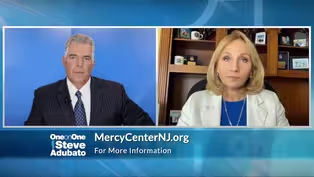
Way more importantly, we are honored to welcome the former Lieutenant Governor of the great state of New Jersey, Kim Guadagno, who is the Executive Director of Mercy Center.
Good to see you, Kim.
- Good to be with you, Steve, thanks.
- Real quick, as we put up the website for Mercy Center, let everyone know why it is and the important work that is being done there.
- So Mercy Center is in Asbury Park and their vision is to end generational poverty in the greater Asbury Park area now.
And it's aspirational, but I think it's attainable and that's what we do every day, work to help people get out of poverty and then stay out of poverty.
- How'd you find your way to Mercy Center, Kim?
- What you really mean, Steve, is what's a mean girl like you who spent eight years in Trenton doing in a nice place like this?
- I did not say, not even thinking that.
- Well you would not be the first.
Look, I left government and went back to doing what I had been doing for 25 years before I got involved in any kind of political realm.
And that's practicing law.
I got involved with a group called Fulfill, which is the food bank in Monmouth and Ocean County, got a chance to go lead them during COVID, and found that after COVID, people needed help on the ground.
And Mercy Center and I click.
They're about 20 minutes from where I live right now which is perfect for an old lady like me.
And they literally were transitioning from nuns who were running the operation for 38 years, it is a ministry of the Sisters of Mercy, and they needed somebody to replace them.
And I thought it was kind of amusing for a politician to replace a nun but I think it's really good for all of us because we've made some changes that really achieve the goal of helping people.
- Our mutual friend, Larry Downs, talked to us about Mercy Center, and one of the things he told us about, we were talking about some of the programs and we're gonna highlight some of 'em, but also go on the website to find out more.
When we talk about the Family Resource Center, one stop shopping, for what?
- Well, so the whole theory is end generational poverty, and it's three pieces.
One is if you're hungry now, get fed.
And that's what we've started to do in a stigma free way.
We can talk about that in a minute.
I mean the numbers are off the charts.
And then once you satisfy the hunger in your stomach, then help make sure families, especially women and children, stay together, and that's the Family Resource Center.
So we have 10 licensed social workers who speak Creole, Spanish, Arabic, three dialects in Indian.
They work to meet families where they are and get them the help they need.
So we do a lot of interesting programs involving domestic violence and sexual assault, also immigration, also co-parenting.
We do a lot of time at the county jail, stabilize the family so that they can live and be productive members of society today.
And then the last piece, I mean how do you end this cycle, that is that people continuously go to the pantry, continuously need help in their families.
You get kids a good education.
And so we have a girl's school, tuition free, private, not related with any particular entity.
- Excuse me, sorry for interrupting, Kim, is that the Sisters Academy?
- It is the Sisters Academy.
- Go ahead, I'm sorry.
- It's in a tough section of Asbury Park.
It's for fourth to eighth grade girls.
And the idea is get those girls the education they need to get into a good high school and later on, a good college if that's where they wanna go.
And it's working, one child, one family at a time.
- I'm curious about this.
You know, we've known each other a long time.
We did many really thoughtful, often spirited, interesting interviews when you were lieutenant governor and the governor you served with as well, always spirited, that's the word I'm using.
- That was always spirited, I'm sure.
- I'm just going with that.
But here's what strikes me.
You have a legal background, you have a prosecutorial background.
you're a prosecutor, you go into government to make a difference, and now you make a difference here at Mercy Center.
Biggest difference between attempting to make a difference in government versus at a significant not-for-profit like this?
- Well, you know, it is all about service.
The single thread through the entire last 50 years, well 40 years, okay, of my professional life has been service.
- Go with 40, I'd go with 40.
- I'm going with maybe 30, but 40, you know service is really the line.
And you find out that you can serve in a lot of different ways.
And with the 10th anniversary, Sandy coming up we found that we could serve in a lot of different ways as a government official.
But there's nothing like having someone come into the pantry, look you straight in the eye and say, "I'm hungry.
Can you help me?"
And the answer to the question is yes.
And it is something that I focused on while I was lieutenant governor.
I'll never forget walking into an Atlantic City food pantry where the mother came up to me with tears running down her face and said, "My daughter is a Marine.
And if she knew while she was serving her country I had to come here in order to feed the rest of my family, she would be mortified."
That stuck with me for the last two decades.
And that's what we're doing here now.
We're helping people, we're engaging them in their own language so they trust us.
And so when they come in to ask for help, and that takes a lot for all of us, to ask for help, we give it to them in a stigma free way, in an honest way and we do it the best we can.
And to me, the one-on-one interaction with people is what fills me up and what I hope helps them the most.
- Again, no money, no mission.
I've mentioned this before.
We were actually interviewing the head of public broadcasting in our state, Joe Lee, and I was saying, you know, for those of us who lead nonprofits, three-quarters of our job is raising money.
Is that your world as well?
- It is.
We do not charge for the girls that go to the Sisters Academy.
- Really?
- It's not a charter school, it's not a public school so we get no state funding in that sense.
We get what every child is entitled to, so Chromebooks and things, but other than that, we are on our own.
I raise about a million dollars a year to keep that school operational.
We thought during COVID it would be unfair to charge families tuition of any sort when they could barely make ends meet as it was.
So there's 15 kids in every class.
There's classes from the fourth to the eighth grade and we raise the money and send 'em to school for free.
The parents have skin in the game or the caregivers because they're asked to volunteer.
So it's not free in that sense.
But the Family Resource Center we get a lot of state grants.
They're very rich as you as you know from this year's state budget now and we're planning for when that budget doesn't allow for it.
And the pantry, we have a lot of different partners.
We have the food bank as a partner, we have the hospitals as a partner, we have leftover Cares Act money that allows us to feed, you know, Steve, I don't know if you've got the numbers, but last year, this time, this month, we fed 100 people.
Last full month was September, we fed 100 people.
Because we've changed the way we're feeding people and because we've changed the quality of the food, in other words, fresh produce, and because I think the economy is awful and people can't afford food and because we live in a food desert, our numbers are now more than 3,600 people a month.
And so you have to be out there.
I always said there's no shame in raising money for a good cause.
And let me tell you, it is much easier to raise money for hungry kids than it is to raise money for a political campaign and it's much more satisfying and easier to ask.
Kim, first of all, it's also, I also want to add this, before I ask about immigration, got a minute left, a lot, I'm gonna say easier, I'm not gonna say easier, as a former state representative, I'd rather raise money to do public broadcasting, a public policy program than election.
That being said, real quick on immigration services, got 40 seconds.
- So immigration, you know, when families come to us, they need solutions.
They can't get state benefits unless they are in the system.
They can't get in the system if they are not properly registered with immigration officials.
And we've been seeing, we've been seeing Ukrainian refugees, Venezuelan refugees and we are trying to bring them in, we have certified paralegals who speak Spanish and we're working on one who speaks Creole to make sure they get the resources so that they can become legal citizens so they can get the services that they need.
They come to us, they get the services.
I don't care who they are or what their background is, they need it, they get it, but let's do long term.
Let's end generational poverty by getting them the licensing, the permissions they need to stay in this country.
- Kim Guadagno is not just the former lieutenant governor in New Jersey but she's the executive director of Mercy Center.
We've had their website up throughout the program.
They're doing important work.
Cannot thank you enough.
Kim, all the best to you and to the family, the team at Mercy Center.
Thank you, Kim.
- Thank you very much.
Thank you, Steve.
- You got it.
Stay with us, we'll be right back.
- [Narrator] To watch more One on One with Steve Adubato find us online and follow us on Social media.
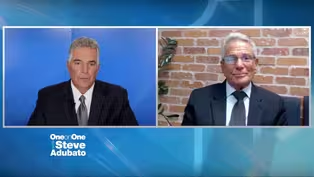
- We're joined once again by Dr. Charles Vialotti, who is a medical director at Villa Marie Claire, a residential hospice which is at Holy Name Medical Center.
Good to see you, Charles.
- Great to see you, Steve.
- For those who haven't seen, by the way, go back on our website, steveadubato.org, see previous interviews we did with Dr. Vialotti.
Tell everyone what Villa Marie Claire is because it's such an important residential hospice at such a critical time in our lives, particularly on the back end, if you will.
- Yes, Villa Marie Claire is a very, very unique residential hospice, which is operated by Holy Name.
The hospice itself is in Saddle River, New Jersey.
It's on 27 pastoral acres.
It's in 100-year-old Tuscan mansion.
We offer cutting-edge end-of-life care for patients and their families that is probably unmatched anywhere in the country.
We are able to offer our patients and families a home-like setting, which is both comfortable and compassionate, which encourages living with dignity, not dying with dignity.
Our focus is not on death, but it's on the finest quality of life that can be experienced at the end of life's journey.
- Let me disclose that Holy Name Medical Center is an underwriter of our healthcare programming.
Charles, let me follow up on this.
As we do this program, it's literally the two-year anniversary of my dad passing, and my sisters, myself, my mom, our family all there, you know, we were blessed, fortunate to be with him at the end.
But I often think about how difficult it is, how difficult it was for our family, how difficult it is for so many families to talk about end-of-life issues.
For ourselves as well.
You and I have had this conversation offline, on the air as well.
Are we any better at that, Charles?
- Well, culturally, I think we avoid conversations about end of life.
We all like to be in control of everything we do during our active lives.
We like to decide where we're going to school, what our profession is going to be, if we're gonna marry, who we're gonna marry, where we're going to live.
We like to have total control over our lives, but for some reason, culturally, we're uncomfortable about thinking about what would happen if we suddenly lost the ability to express what our preferences were for the way our lives would be lived when we come to the end of life's journey.
And we are beginning to get better at that, but still have a long way to go.
There's a wonderful new release that Holy Name has just put out that is a video program talking about how to develop, how to compose a plan for the end of your life.
It's called an "Advanced Directive."
And we encourage people to try to think very clearly about what they would like at the end of their lives.
To look at where would they wanna live, how would they wanna live, what treatment would they accept, what treatments would they prefer to avoid?
And this wonderful document also gives people the opportunity of creating a video of themselves talking to their loved ones about what their beliefs are, what their passions are, what their wishes would be, and explaining to them the important decision that they've made of who is going to be their healthcare proxy when the time comes that they can no longer express their personal wishes and their personal beliefs.
Very often, if you haven't designated a healthcare proxy, if you become unable to take care of your wishes and express your wishes, you're just assigned a proxy who is the closest relative to you.
That may or may not be good.
If they think the way you do or they understand what you would've wanted, you'll get what you want.
But they may have very different beliefs and very different feelings and may not be able to give you the kind of transitional period in your life that you would've preferred.
- Yeah, you keep referring to, Dr. Vialotti, healthcare proxy.
Are you advising people, regardless of their age, particularly those of us who are older, to have that conversation and to designate someone as our, "I can't do it, this person's my proxy, this person can vote for me, this person will tell you what my wishes are"?
You're saying it's important to do that?
- It's very important because when you lose the ability to express what you would want during this phase of your life, if you haven't appointed someone who you trust and who you know respects you enough to carry out your wishes, you've lost that control.
What we're encouraging people to do is to name a person who they know will carry out their wishes.
And if they've created either a formal document, like a healthcare proxy, or have actually created a video where they explain to their families why they've chosen this person, they'll avoid all the stress and all the conflict that can develop among family members when this tragic end-of-life period begins to embrace them, really.
We have found families break apart because they disagree on what should be done for mom, or dad, or their child when life is threatened.
But if they've clearly stated what they want and if they've picked the correct healthcare proxy, it's a very smooth transition.
Everyone understands what they would want.
And certainly, we should always be able to control our lives, and certainly nothing is more important than controlling that final part of life's journey.
- And also, again, Dr. Vialotti is talking about Villa Marie Claire, but regardless of where you are geographically in the New Jersey metropolitan area, everything that Dr. Vialotti is saying right now is relevant to you.
You know, I don't know if everyone has access to a video at their individual healthcare situation, but the proxy you can do.
And that's what Dr. Vialotti is talking about.
Charles, I've never asked you this, why did you get into this line of work and why are you so passionate about it?
- Well, I was initially a radiation oncologist by board certification, but in 1978, I responded to a RFA from the National Cancer Institute for community hospitals that might want to develop a comprehensive cancer program.
Part of that required that we develop a hospice.
I've been doing hospice care since 1978 because we were funded.
But as I have gone through life and experienced with these thousands of families the traumas, the stresses of end-of-life issues, the financial stresses, the emotional stresses, and then experience some very, very deep, personal losses that were not memorable in a positive way.
My younger sister who passed away 18 years ago and my beloved Sandy who passed away 13 years ago in New York hospitals did not have comfortable, dignified, fair, compliant deaths that were things that they would've wanted.
They suffered, they struggled.
And I made a promise to them, because I could not control what was being done by the hospice teams in those two hospitals, that no one who was entrusted to my care would ever have that painful death, that frightening death, and no family would ever have that searingly painful memory embrace them and damage them for the rest of their lives.
None of us were offered any kind of supportive care or bereavement care after these losses.
And it really is a commitment I made to those who I've lost and those who I've witnessed losses in my years of caring for people at the end of life that it can be better.
It can be a good experience.
It can be a life-enriching experience if it's managed in the proper way.
- Charles, thank you.
I have a feeling you helped a lot of people deal with an incredibly difficult topic, but a topic that you just, none of us can avoid, Dr. Charles Vialotti.
Thank you, Charles.
All the best.
- Thank you so much, great seeing you.
- You got it.
Stay with us.
We'll be right back.
- [Narrator] To watch more One on One with Steve Adubato find us online and follow us on Social media.
- Hey everyone.
Steve Adubato here.
My colleague Georgette Timoney, the executive producer of One on One also the creator of a new mini series within One on One called The Arts Connection.
Georgette, what's up with that?
- (laughs) What's up with that is that it's a way for us to celebrate artists.
Artists that are involved in dance, in music, in theater, in film, writing poetry.
It's an opportunity for us to highlight artists in New Jersey as well as the entire tri-state area and we're really excited about it.
The arts are so important.
- You know, One on One does a whole range of programming but the arts big part of it.
And in some, in many ways, the Arts Connection is very much in line with your background, your history, your passion in the arts.
Just give everyone, I'm gonna old school it, the Reader's Digest version.
- Okay.
Well, it all began as an infant.
I mean, I was even in the high chair, I'm like dancing and everything, throwing my food all over the place.
So that, and being incorrigible I think certainly lends one to the artistic community, but it really was I think I was very blessed.
My parents were really into the arts so from a very young age, I would get hauled into museums every place, I would go to the opera and see film and it really developed an appreciation for me but it also developed an appreciation for people and places and cultures I had never met.
And I think it develops a sense of empathy for you that's very unique because the arts touch your emotions so much.
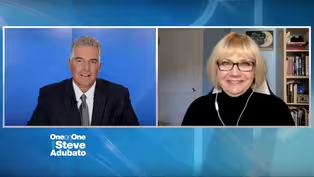
And that's why I think we wanted to create this series in an effort to find unique, in this case, what we're going to be seeing is in a beautiful film that was put together by Dream Play Films and features The New Jersey Symphony which is celebrating its centennial season.
And there's a reason why they've been around for a hundred years.
But Georgette was talking about this piece that you're about to see, this part of a film called Transcend.
Transcend, if you will, but also the Arts Connection.
We'll be featuring arts organizations, people who are making a difference in the arts and making, if you will the connection that is Georgette Timoney.
I'm Steve Adubato.
Georgette, throw to the, people are tired of listening to me.
Why don't you throw the to the film - Please?
Enjoy Transcend highlighting the New Jersey Symphony.
Enjoy.
- Gentle wind, trains in the distance.
Orchestral strings rising...
String section begins playing.
Orchestra continues to play, slow, deep, moving... Orchestra picks up tempo.
Music becomes stronger, deeper... Strong, deep, moving orchestral sounds.
Music becomes softer.
So, Georgette, that's Transcend.
Awesome.
- Right?
It was amazing.
Just beautiful.
The music's beautiful.
The visuals from Dream Play films, gorgeous.
- So what should we tell people to do as part of the Arts Connection if they wanna find out more about Transcend?
- Well, they definitely have to check out the New Jersey Symphony website.
And if you can and you're able, please go and see them.
They actually tour throughout the state so they'll probably be coming to a town near you.
- Before I let you go, how exciting is the Arts Connection?
- It's awesome.
I'm so thrilled we're doing this and it's a dream come true to share the arts around New Jersey, New York and the nation with our audience.
So I'm glad we're on this journey together.
- Yeah, one of us is a real actor and an artist and it's not the guy with the blue background.
Thank you.
Thank you Georgette.
For Georgette Timoney, in our entire One on One, the Arts Connection team.
Thanks for watching.
Tell 'em we'll see 'em next time, Georgette.
- See you next time.
- See, I told you.
- [Narrator] One-On-One with Steve Adubato has been a production of the Caucus Educational Corporation.
Funding has been provided by Horizon Blue Cross Blue Shield of New Jersey.
PSEG Foundation.
Bank of America.
The Turrell Fund, supporting Reimagine Childcare.
Community FoodBank of New Jersey.
Johnson & Johnson.
The Russell Berrie Foundation.
The Fidelco Group.
And by The Adler Aphasia Center.
Promotional support provided by The New Jersey Business & Industry Association.
And by New Jersey Monthly.
The Importance of Dying with Dignity
Video has Closed Captions
Clip: S2022 Ep2571 | 10m 16s | The Importance of Dying with Dignity (10m 16s)
New Jersey Symphony - “Transcend”
Video has Closed Captions
Clip: S2022 Ep2571 | 7m 34s | New Jersey Symphony - “Transcend” (7m 34s)
Ways to End Generational Hunger
Video has Closed Captions
Clip: S2022 Ep2571 | 10m 41s | Ways to End Generational Hunger (10m 41s)
Providing Support for PBS.org
Learn Moreabout PBS online sponsorship
- News and Public Affairs

Top journalists deliver compelling original analysis of the hour's headlines.

- News and Public Affairs

FRONTLINE is investigative journalism that questions, explains and changes our world.












Support for PBS provided by:
One-on-One is a local public television program presented by NJ PBS