State of Affairs with Steve Adubato
Kim Hanemann; Jeff Vasser; Kaitlan Baston, MD
Season 9 Episode 2 | 27m 58sVideo has Closed Captions
Kim Hanemann; Jeff Vasser; Kaitlan Baston, MD
Kim Hanemann, President and COO of PSE&G, talks about energy affordability, accessibility, and her commitment to safety. Jeff Vasser, Executive Director of the New Jersey Division of Travel & Tourism, discusses tourism in the Garden State, including the FIFA World Cup. Kaitlan Baston, MD, Commissioner of the New Jersey Department of Health, examines key public health issues in the state.
Problems playing video? | Closed Captioning Feedback
Problems playing video? | Closed Captioning Feedback
State of Affairs with Steve Adubato is a local public television program presented by NJ PBS
State of Affairs with Steve Adubato
Kim Hanemann; Jeff Vasser; Kaitlan Baston, MD
Season 9 Episode 2 | 27m 58sVideo has Closed Captions
Kim Hanemann, President and COO of PSE&G, talks about energy affordability, accessibility, and her commitment to safety. Jeff Vasser, Executive Director of the New Jersey Division of Travel & Tourism, discusses tourism in the Garden State, including the FIFA World Cup. Kaitlan Baston, MD, Commissioner of the New Jersey Department of Health, examines key public health issues in the state.
Problems playing video? | Closed Captioning Feedback
How to Watch State of Affairs with Steve Adubato
State of Affairs with Steve Adubato is available to stream on pbs.org and the free PBS App, available on iPhone, Apple TV, Android TV, Android smartphones, Amazon Fire TV, Amazon Fire Tablet, Roku, Samsung Smart TV, and Vizio.
Providing Support for PBS.org
Learn Moreabout PBS online sponsorship- [Narrator] Funding for this edition of State of Affairs with Steve Adubato has been provided by Valley Bank.
The New Jersey Economic Development Authority.
Hackensack Meridian Health.
Keep getting better.
NJM Insurance Group.
Serving New Jersey’s drivers, homeowners and business owners for more than 100 years.
The Turrell Fund, a foundation serving children.
United Airlines.
The Port Authority of New York and New Jersey.
Moving the region through air, land, rail, and sea.
The New Jersey Education Association.
And by New Jersey Sharing Network.
Promotional support provided by New Jersey Monthly.
The magazine of the Garden State, available at newsstands.
And by Meadowlands Chamber.
Building connections, driving business growth.
[INSPRATIONAL MUSIC] - Hi everyone, Steve Adubato, we kick off the program with a very important, compelling conversation, everything you need to know about energy with Kim Hanemann, who's President and Chief Operating Officer at PSE&G, a longtime underwriter of public broadcasting and our programming at the Caucus Educational Corporation.
Kim, great to have you with us.
- Great to be here, Steve.
- You got it.
Kim, let's do this, most pressing aspect or piece of the energy equation in New Jersey in 2025 is?
- Oh, the most pressing, I think safety and reliability continue to be our most pressing concern.
And then a third would be affordability.
- Let's take that in pieces.
When we say reliability, from a practical point of view, Kim, explain what that means?
We're taping this in late January, 2025.
Will be seen a little bit later.
So it's freezing today.
It'll be freezing for a while.
But then there are summer issues having to do with reliability, air conditioning, et cetera.
What exactly does reliability mean for your millions of customers?
- So reliability for our customers mean that their lights are on, their homes are powered, their homes are warm in the winter and then cool in the summer.
But the thing, in order to deliver that, deliver our customer's expectations, we need to do a lot of improvements in our infrastructure to deliver that.
And let me talk a little bit about that is, I've been in this industry for a very long time.
I would say events like Superstorm Sandy have made us think very differently about reliability and really resiliency is a new part of the discussion that we're having.
So in the past 12 years since Superstorm Sandy, we've had more severe weather events than my first 25 years.
So we've undertaken a great deal of investments in order to make our system more resilient.
So example being after Superstorm Sandy, we raised and rebuilt over 60 stations, substations.
- What are substations?
- So substations are, what happens is they take the high voltage transmission voltage, they drop it down, and then they feed the circuits that feed resident streets and things.
So really integral part and really impact the number of customers if they fail or if they go underwater, like some of them did with Sandy.
- So a lot was learned from Sandy, and changes were made accordingly?
- Yes, absolutely.
So as we said, it really made us think about our assets differently and how to make them more resilient to severe weather events.
- Kim, you talked about affordability as well.
Energy affordability is, are energy costs higher in part be because of, well, I don't know the reasons, but the governor and others are trying to bring more and more businesses into the state.
As more and more businesses come into the state, we lose some as well, as more businesses come into the state, does that by itself increase cost?
- No, that doesn't increase cost.
- Does it increase demand?
- Well, it can increase demand, and we're seeing that all around, increases in demand and electricity, and caused by a few things.
So you think about last summer, June and July, we had an incredible heat wave, right?
So people use more power to cool their homes during that time.
And then you also think about, as we attract new businesses into the state, like data centers, that load increases as well.
So those are all part of it.
And electrification happens, so EVs and things, that all also uses additional electricity.
So when we plan our infrastructure investments, we look more than 10 years out to the future.
- Talk more about the EV piece of this.
What should we know?
- Well, so EVs continue to grow in this state of New Jersey, the adoption of EVs, and I believe by the end of 2024, we'll be at almost 300,000 registered EVs in the state.
About 280 I think is number.
So we are continuing to see growth there, and that growth will use electricity.
We'll see whether that growth slows down or not, but we have not seen a slow down yet in New Jersey.
- You are one of the top leaders in the state.
You look at any list of leaders who matter, and Kim's on that list.
Let me ask you this, your leadership journey...
Number one leadership lesson you have learned over the years being in key leadership positions would be?
- My greatest leadership lesson is, learn from the people doing the work.
So I have a degree in engineering, teaches me how to solve problems.
But one of my greatest lessons is, I made a point of learning early in my career in the field from people who do the work, and then how can I use my problem solving as an engineer to make the business better and help them.
So that is clearly my greatest one.
My dad was a union leader.
I'm a Jersey girl through and through.
- Where'd you grow up, Kim?
- Rahway, I was born in Rahway.
- Got it.
But let me ask you, he was a union construction leader?
- Yeah, my father was a union construction worker.
So started in construction in the CBs, had a union construction job as he got out the service.
So every meal on our table, my college education was all paid for by union wages.
And I was first generation, my siblings and I, that had the opportunity to go to college.
- Why engineering?
- You know, I was one of those, I would say Tomboys who liked to work with my hands and fix things, and I had two older brothers who used to let me help 'em fix their cars.
So just, the natural, construction was always the conversation too, back then.
- That's so interesting.
But I'm curious about your engineering background.
You said earlier, when I asked you about the leadership lesson, that your engineering background helps you solve problems.
Question, I don't think those of us who are not in engineering really understand it.
Sometimes I think it's very exact and linear and logical, and leadership ain't.
So how do you balance, Kim, that training and the way your brain is wired, if you will, as an engineer with an engineering background, with the complexity, the nuance, and uncertainty of leadership?
- So I think once again, I think it goes back to that problem solving.
Here's the problem, here's what we need to fix.
And you need to think about, as a leader, of how you bring the right skill sets to the table to fix that.
And we talk about diversity of background and thought.
So it's all embedded within that.
Here's the problem, what do we have to fix and bring the right people?
You kind of think about some of the movies about the space launches and where they had to solve problems and figure things out.
So that's not linear.
That is, if you unleash people and allow them to be creative and you have diverse ideas, you come up with really creative solutions.
- Well, Kim Hanemann has been coming up with creative solutions for a couple of years plus, making a difference every day as the President and Chief Operating Officer at PSE&G.
Kim, thank you so much for joining us.
We appreciate it.
- Okay, thank you for having me.
- You got it.
Stay with us, we'll be right back.
(grand music) - [Announcer] To see more State of Affairs with Steve Adubato programs, find us online and follow us on social media.
- We're now joined by Jeff Vasser, Executive Director of New Jersey Division of Travel and Tourism.
Jeff, good to see you again.
- Great to be with you again, Steve.
Thanks.
- Jeff, we're doing this in the fall of 2024.
What is the most compelling reason why New Jersey tourism and travel is hot right now?
- Well, because of the diversity of offerings that we're promoting.
People historically just thought of us as the Shore.
And frankly, after Labor Day, people weren't thinking much about New Jersey anymore.
And what we're doing is talking a lot about what there is to do in the fall and the winter.
And additionally, we're talking to an expanded audience.
Our reach is now into Europe, Canada, Mexico, and a lot of it has to do with the upcoming World Cup.
It just gives us a new audience, and a new way of talking to folks.
So now we're talking about agritourism.
In the fall of 2024, we're talking about the 750,000 acres of farmland that we have, and how people can go do pumpkin picking and apple picking, and go to a variety of festivals and enjoy the farm-to-table restaurants that we have to offer.
So there are a lot of new things to talk about.
And I think that's why people are now focused more on New Jersey, right after Labor Day.
- You mentioned the World Cup.
Connect the World Cup to tourism in the state.
What could it really mean when it comes to New Jersey?
- Well, first of all, Steve, the economic impact for the World Cup is gonna be tremendous.
And New Jersey is unique in a sense that, not only are we hosting eight games, including the finals at MetLife Stadium.
We're also going to benefit from the six games that are being played in Philadelphia.
So South Jersey is going to get a tremendous economic impact.
North Jersey is going to get a much greater economic impact.
And we are centrally located for all the people that are gonna be doing Philly, New Jersey, Boston, Toronto.
So what we're trying to do is encourage people to make base camp, if you will, in New Jersey, because we're central to being able to veer off, and try other venues.
Additionally, during the off game, the off days when there's no games being played, take advantage of the fact that you're in the middle of 2026 and it's the Revolutionary War celebration, the Semiquincentennial, the 250th anniversary, all of those things.
And New Jersey has more than 150 Revolutionary War sites.
And we want to encourage people to go explore that, and take advantage of the attractions and the restaurants and everything that's nearby.
So we're encouraging our destinations to bundle, if you will, hotels, restaurants, other attractions, and incorporate all of the things that people wanna see and do on the days that they're not experiencing a match at the World Cup.
- Jeff, you cannot watch television or any media platform without seeing a 30-second spot, a travel and tourism spot.
To what degree do you change those 30-second spots, you and your team, and the marketing folks?
How do they change?
And do they change by season, events, opportunities?
Like, what's the strategy there?
- It's primarily by season, Steve.
So in March, April, we're starting to talk about summer, because we want people to book, - Okay.
- In advance and get, and whether you're doing a hotel room or you're doing an Airbnb, or renting a house.
So March, April, we're focused on those attractions.
When we get to the tail end of summer, we're starting to talk about fall and the changing leaves.
So on TV, we're doing a broader outreach, but then when we're in magazines, or we're doing Facebook or other digital, we're zeroing in on specific attractions.
For example, many people don't realize that Cape May is one of the top birding destinations in the country.
So, - Is that right?
- We'll be focused to those folks, and, - Birding, hold on one second.
Jeff, birding is big?
- Birding.
Cape May is known as the second best location in the country for birding.
It's where the northern and southern cross currents meet and the World Series of Birding is held every year in Cape May in the spring.
It's a tremendous, tremendous attraction down there, yeah.
- I was also gonna ask if there's going to be special marketing and promotion connected to the World Cup?
Meaning, do you promote based on events as well as seasons?
- We do.
So one, for instance, you mentioned World Cup.
We're gonna be doing a lot, - Yeah.
- Internationally as well.
The international folks don't necessarily care about our history.
But if we talk to the German market, our research has shown that the German market really cares about the beaches, they care about Americana.
So we're gonna be talking about a lot of our downtown, cool walking areas in Collingswood, in Madison, in Chatham, in Morristown.
We're gonna be talking a lot about the things that they can do and what appeals to them.
Same thing with the UK.
We're gonna be talking about what appeals to them.
We're gonna be talking about golf and a lot of our outreach.
They're interested in golf, and the beach, and the restaurants.
They wanna see what we do.
And of course, we want to push our vineyards.
We have over 100, - They're awesome.
- 150 breweries, and the wineries, and everybody wants to see those.
- I'm curious about this, Jeff.
How did you find yourself in this position, leading travel and tourism in the state?
- Well, I used to be the President of the Atlantic City Convention and Visitors Authority, which happens to be a state authority for years.
So some of the people that were involved in the Murphy administration remembered my work from there.
And when the Murphy administration came in, they were looking for somebody to head up tourism.
And I was the guy.
But my background, Steve, goes back 35 years in tourism and hospitality, primarily in New York City, but also in New Jersey.
I'm a proud Jersey boy, so it's great to be back doing this.
- Since you mentioned New York.
Real quick before I let you go.
World Cup, Northern New Jersey at MetLife.
Are we competing with New York for where people are going to be when games are not played?
- No, no, we are, our bid was New Jersey and New York City.
So they are our partners in this.
So when we are advertising, when we're promoting internationally, we're gonna be working with New York City.
And we're gonna be using, frankly, New York City as a hook.
Everybody wants to go to New York City, primarily first-timers.
So we want to encourage them to go to New York, and then come over here, and experience something different.
Not the least of which is, no tax on clothes.
- No tax.
That should be a slogan by itself.
Jeff Vasser is the Executive Director of New Jersey Division of Travel and Tourism.
Jeff, thanks so much for joining us, we appreciate it.
- Thanks for having me, Steve.
- You got it.
Stay with us, we'll be right back.
(grand music) - [Announcer] To see more State of Affairs with Steve Adubato programs, find us online and follow us on social media.
- We're now joined by Dr. Kaitlan Baston, who is the commissioner of the New Jersey Department of Health.
Commissioner, thank you for joining us.
- Oh, thanks so much for having me.
- You got it.
Public education about, an awareness about critical health issues, more important than ever before.
We're doing this in late January, 2025.
Let's jump into a couple things.
I just mentioned vaccines real quick.
What do people need to know?
Last Friday, I got my COVID and my flu shot.
It may have been too late in the season.
Who knows?
What's true?
What's confusing disinformation?
Please.
- Great question.
I'm so glad vaccines came up.
Primarily just because I don't think we could talk enough about them in the public.
And it's never too late, Steve, I'm really glad you got your flu and your COVID shot.
Just in general, these things are so valuable for families, because we think about, you know, as a mom, right?
I wanna stay healthy.
I do anything I could to keep my kids healthy and keep 'em out of a hospital.
And we take for granted.
I think the fact that vaccines, especially the routine ones, help keep kids from getting really sick.
We used to live in a country where kids could die from illnesses that are now vaccine preventable.
Kids could get polio, measles, and you know, it's really, when I think about it, a bipartisan issue.
And I say that because still over 90% of families in New Jersey get their kids their routine vaccines.
And I think today it's just so important.
As new ones come out and we're getting more information, what people need to know is, Hey, these are safe.
And they can keep my kids outta the hospital.
They can keep families outta the hospital.
They can keep us from missing days of work.
This is really a no-brainer.
And we wanna answer all those questions for folks from the Department of Health.
- And rest assured that as the new federal administration, the Trump administration moves into place, what is being said out of that administration, particularly from health officials, we will monitor, try to make sense of, and have experts who will break it down because it matters to you.
It's not politics, it's people's health.
So Commissioner, lemme try this.
A couple areas that I know you want to talk about.
Can we do reproductive rights first?
And this birth control... Accessing birth control without a prescription in Jersey.
What the heck is that and why is it so important, Commissioner?
- Reproductive rights in general is so critical, and to the majority of people in this country, they wanna protect those reproductive rights.
And as a woman, right, it's so important to me, the fact that when you wanna have a family, you should be able to plan for that.
And you should be able to be in charge of your own body.
And you should make all those decisions with yourself and your healthcare provider.
And the standing order for contraception, which is what that is, which is really, I wrote a prescription that anybody can access in the state of New Jersey, and it sits at pharmacies.
And so you have medical professionals, you know, you have pharmacists there who can walk people through, who come into that pharmacy and want birth control.
They can walk them through how to get that safely, what's the right choice for them and what's available.
And it's right there at the pharmacy.
And what that means is you don't have to go to a doctor's visit or see a doctor or another healthcare provider to get birth control, which is a safe and routine medicine if you know how to take it and who it's safe for.
And it also unclogs your primary care office, right?
You wanna see a doctor when you really need one.
I don't wanna wait as long to get into primary care and this kind of unclogs that system.
So it's great for people, it's easy access, low barrier, and it really unclogs our primary care system.
- PS.
We'll talk to the Commissioner in a future segment on why this disproportionately impacts the Black and brown communities in particular, Where access is even more of a problem.
Can we do this?
You've talked extensively about the opioid crisis and what do you see the Department of Health's role being as it relates to fighting that fight?
A and B, how are we doing?
- Absolutely.
As you know, I'm an addiction doctor, so you know, I have a specialty in this area and it's so critical that we keep talking about it.
We are making great strides.
And I will say that just because it's so important for the public, you've probably heard that.
First and foremost, the CDC puts out amazing information on this, as do we in New Jersey.
It is the number one cause of death for young people still.
In our country.
That's age one to 44, number one cause of death for young people.
The top three causes of death are actually overdose, suicide, and homicide.
Nationally, for people age one to 44.
You know, you've heard we have a mental health crisis in our country, right?
But those statistics really drive it home.
And so it is so critical.
That's why it's so critical to me and why I ended up studying addiction medicine after primary care.
I was doing a lot of women's health and I ended up wanting to do a fellowship in addiction medicine because it also really impacts families and people when they're pregnant too.
It's the number one cause of pregnancy associated death also.
So when we talk about wanting to drive down maternal mortality, we have to treat addiction in order to do that.
We are doing a ton at the Department of Health right now, just to give you a couple things.
Number one, we have to get harm reduction out there because that helps people, keeps people from dying, keeps people from getting infections.
And we have gone full steam ahead with this.
There were only seven harm reduction centers in the state of New Jersey when I came on.
Now we have over 55 approved, and we have one approved in every single county.
We also are getting medication to people because medication is what actually treats these diseases and keeps people from being sick and keeps them from dying.
So, could talk about it all day, of course, but there's a ton that we're doing.
Big picture, we're starting to turn the tide.
We see overdose deaths flattening out and even coming down.
Historically, that was not true for the Black and brown populations in our state.
But we finally have done a ton of focus on those disparities.
And you know, we're still crunching the numbers, but it looks like we're turning the tide now for all populations, which is a huge win.
- Michelle, lemme ask you a big picture question.
I saw a, I would call it a PSA, A public service announcement that you did recently.
It was in the middle of a sports event that I was watching on the air.
How important do you believe it is that public officials, public health officials, are out there creating greater public education and awareness and trying to create more trust, greater trust in the public health?
I hate calling it infrastructure because you're human beings, but why are you out there doing that, and what does it have to do with this public trust issue or lack thereof?
- Listen, I'm a primary care doctor.
I'm a mom, right?
I'm a person.
And the reason I work in this system and for public health is because I learned early on as a primary care doctor that I couldn't work in the system without working on the system.
There's a lot that we need to do to make it work better for people.
People get frustrated because our health system doesn't always work, right?
It's normal human nature to be frustrated when there's ambiguity or we don't see clear answers or we don't have clear information.
And I think during the pandemic, while it was a new disease and we were all learning together, it was very normal that the public had fear and a lot of confusion.
And we did actually, I think, an incredible job of getting on top of that science, learning it, understanding it, and keeping people alive as best we could.
And today, more than ever, it's important just as a routine, right?
As a doctor, as a mom, as the commissioner of health, that I'm out there telling families, "Hey, this is how we can empower you with information so that you can take the best care of yourself."
There's a lot of misinformation.
The internet is now the wild west, right?
You can find anything on there.
And so it's really important that we know who to look to.
You know, Mr. Rogers used to say like, "Look to your neighbors, look to your police officers, look to your teachers, look to your public health officials."
- He didn't say "Look on your phone, on the internet."
- (laughing) He did not say, "Look on social media."
Right?
We have to be that.
Government has, historically, attracted the best and the brightest.
Because they're people that really wanna make a difference for our society.
We show up every day as public servants because we care about our neighbors, right?
I went into medicine because growing up in rural Appalachia in southeast Ohio, I saw poverty every day.
And I saw how the opposite of poverty isn't wealth, right?
That it was health.
That it's people having access to food and clothes, and a house.
And people being healthy physically and mentally so that they can provide for their families.
That's the bread and butter of the United States, right?
That's what we need and that's what I strive for every day.
And I want people to know that that's what we're here doing.
- Commissioner, I cannot thank you enough for joining us.
It will not be our last conversation.
- So excited to hear that.
Always wanna get more information out there.
Good information into the hands of people, which is where it's really needed.
So thanks for the opportunity.
- Thank you Commissioner.
See you next time folks.
- [Narrator] State of Affairs with Steve Adubato is a production of the Caucus Educational Corporation.
Funding has been provided by Valley Bank.
The New Jersey Economic Development Authority.
Hackensack Meridian Health.
NJM Insurance Group.
The Turrell Fund, a foundation serving children.
United Airlines.
The Port Authority of New York and New Jersey.
The New Jersey Education Association.
And by New Jersey Sharing Network.
Promotional support provided by New Jersey Monthly.
And by Meadowlands Chamber.
- (Narrator) A cancer diagnosis changes everything.
- So does where you go for treatment.
- (Narrator) Where other cancer centers offer radiation, at Hackensack Meridian, John Theurer Cancer Center, We’re utilizing the world's most advanced precision radiotherapy... - That can pinpoint and destroy your cancer.
- (Narrator) Some performed clinical trials, but we have one of the nation's most rapidly growing drug discovery programs... - Providing hope with the medicine of tomorrow.
New Jersey's best cancer center.
Know the difference.
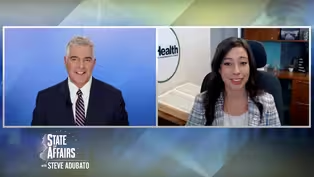
Addressing key public health issues in New Jersey
Video has Closed Captions
Clip: S9 Ep2 | 10m 36s | Addressing key public health issues in New Jersey (10m 36s)
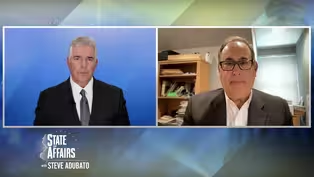
Bringing tourism to The Garden State for the FIFA World Cup
Video has Closed Captions
Clip: S9 Ep2 | 9m 14s | Bringing tourism to The Garden State for the FIFA World Cup (9m 14s)
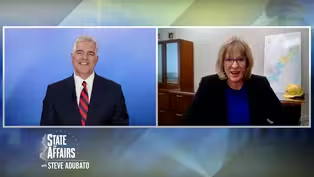
President of PSEG talks energy affordability & accessibility
Video has Closed Captions
Clip: S9 Ep2 | 9m 2s | President of PSEG talks energy affordability & accessibility (9m 2s)
Providing Support for PBS.org
Learn Moreabout PBS online sponsorship
- News and Public Affairs

Top journalists deliver compelling original analysis of the hour's headlines.

- News and Public Affairs

FRONTLINE is investigative journalism that questions, explains and changes our world.












Support for PBS provided by:
State of Affairs with Steve Adubato is a local public television program presented by NJ PBS