One-on-One
Kimberly Scott-Hayden; Rep. Donald Payne; Joel Finkelstein
Season 2021 Episode 2426 | 25m 47sVideo has Closed Captions
Kimberly Scott-Hayden; Rep. Donald M. Payne, Jr.; Joel Finkelstein, Ph.D.
Kimberly Scott-Hayden talks about the importance of Education Support Professionals and the NJEA Human and Civil Rights Committee; Rep. Donald Payne, Jr. discusses the impact of the American Rescue Plan on NJ and the importance of the Gateway Tunnel Project; Joel Finkelstein shares social media’s role in the Capitol riots and the ways the institute identifies viral outbreaks of online extremism.
Problems playing video? | Closed Captioning Feedback
Problems playing video? | Closed Captioning Feedback
One-on-One is a local public television program presented by NJ PBS
One-on-One
Kimberly Scott-Hayden; Rep. Donald Payne; Joel Finkelstein
Season 2021 Episode 2426 | 25m 47sVideo has Closed Captions
Kimberly Scott-Hayden talks about the importance of Education Support Professionals and the NJEA Human and Civil Rights Committee; Rep. Donald Payne, Jr. discusses the impact of the American Rescue Plan on NJ and the importance of the Gateway Tunnel Project; Joel Finkelstein shares social media’s role in the Capitol riots and the ways the institute identifies viral outbreaks of online extremism.
Problems playing video? | Closed Captioning Feedback
How to Watch One-on-One
One-on-One is available to stream on pbs.org and the free PBS App, available on iPhone, Apple TV, Android TV, Android smartphones, Amazon Fire TV, Amazon Fire Tablet, Roku, Samsung Smart TV, and Vizio.
Providing Support for PBS.org
Learn Moreabout PBS online sponsorship- [Narrator] Funding for this edition of One-On-One with Steve Adubato has been provided by The New Jersey Education Association.
PSE&G, committed to providing safe, reliable energy now and in the future.
New Jersey Sharing Network.
Horizon Blue Cross Blue Shield of New Jersey.
Here when you need us most, now and always.
RWJBarnabas Health.
The Turrell Fund, supporting Reimagine Childcare.
The Healthcare Foundation of New Jersey.
The North Ward Center.
And by Wells Fargo.
Promotional support provided by Insider NJ.
And by AM970 The Answer.
- This is One-On-One.
- I'm an equal American just like you are.
- The jobs of tomorrow are not the jobs of yesterday.
- Look at this.
You get this?
- Life without dance is boring.
- I don't care how good you are or how good you think you are, there is always something to learn.
- Do you enjoy talking politics?
- No.
- People call me 'cause they feel nobody's paying attention.
- Our culture, I don't think has ever been tested in the way it's being tested right now.
- That's a good question, high five.
(upbeat music) - Hi, I'm Steve Adubato.
I wanna thank you so much for joining us.
We kick off the program with a woman we met she was on a panel, Excellence in Education panel.
It was just so powerful.
It was terrific.
And here she is.
She's Kimberly Scott-Hayden.
She's a 2021 National Education Association National Education Support Professional of the Year.
That's otherwise known as an ESP, correct?
- Yes, sir.
- And also Inventory Control Clerk, East Orange Public Schools.
Good to have you with us.
- Thank you sir.
Thank you for having me.
- By the way.
What's an Inventory Control Clerk?
- We actually assist in the shipping and handling of the district.
All fixed assets that the district receive.
We have our own warehousing system in our school district where you order paper, pens, different school supplies as the students may need, or the office staff may need.
We deliver to every school.
We have 22 buildings in our district.
So we handle a lot of logistics.
We're barcoding, actually inventorying different items that the district has to have in the system that we purchased through our funding.
So just keeping records of those types of things various transactions between the school and vendors.
- Got it.
Hey, listen.
The other thing that you brought up in the conversation about being an organ donor for your husband.
And we have a collaboration with the New Jersey Sharing Network.
We do public awareness around organ and tissue donation.
Just for those who missed that segment.
Recount, if you will, what happened there?
- So my husband was diagnosed with kidney failure, when they reach stage five they had put him on the donors list - living or deceased donor.
So we started going into some counseling sessions to find out what type of dialysis was available.
Looking at the two dialysis that were available and having background information.
'Cause my dad was also in kidney failure and on dialysis prior to passing.
So I knew how detrimental that was going to be for him and for his health.
And my husband is young, he's only 54 years old.
So it's like, you know do I really want to see him go through these things?
He's a retired police officer first and foremost.
So I knew he had did a lot of public service work and helping people.
So I said, "you know what?
Let's look at the possibilities of finding your -, he has two sisters.
So maybe one of your sisters can be an organ donor."
So we went to his younger sister and she was going to be an organ donor.
But through some testing and research, we found out she had her own underlying issues that prevented her from doing so.
So we remained on a donor list.
We started taking educational classes around that.
So in doing that, I said to my husband, I said.
"how about if I see if I'm a match?"
I said, And lo and behold, I was.
So after September 16th of 2020, I donated a kidney to my husband.
It has been very successful.
Thank God for that.
He is thriving, all of the health issues that he had prior to, have since dissipated.
Myself, I just had my blood work and tests done on myself to make sure that the one kidney that I have.
Is functioning at the levels that are enough for me to not have any issues going forward.
And lo and behold, I am doing well as well.
So I am happy, that I was able to help him and give him a second chance on life (intelligible) together.
Yes absolutely.
- That's beautiful, by the way.
Let me disclose my wife, Jennifer, is a kidney donor as well - - Oh, wow nice!
- And she's doing great and has been for a long time.
Hey, listen in the time we have left.
You are an educator.
You are committed, but racial equity and justice a big priority for you.
Got a minute left.
Talk, please share with us.
- As the chair of the human and civil rights committee for NJEA and part of the Amistad work group.
It is my priority to make sure that our students are getting the curriculum that is required.
Right?
So in other words the Amistad curriculum speaks to the contributions of African-Americans not just the contributions around slavery as there's more to our history.
Our history is much more richer than just slavery.
So the contributions of African-American as far as inventing things, from building buildings just telling our story, right?
Our real story, of who we are as a people.
- Civil rights.
- Exactly.
So we are trying to as educators across this nation across the state of New Jersey, build this curriculum out that identifies the Amistad work that should be happening.
As it is a law in the state of New Jersey.
Many districts are not teaching it or those that are using it are not using it to its full potential.
So actually trying to incorporate a curriculum that crosses from K to 12 but also is incorporated at every level of teaching, right?
So whether you teach art, music, English or whatever you're teaching there is a way to incorporate the Amistad curriculum.
So that speaks to the racial and social justice piece for most, for my people, I should say, right?
But there's also inequities in other races that we must identify.
- Absolutely.
- Whether they were at school system, whether they are in the workplace because we know it happens all day.
We could see what's going on in America.
The last four years, where we are as a country speaks to a lot of social, and racial injustice that has taken place.
So for me, I'm impassioned about the work.
I'm impassioned about making sure that our students are educated beyond what we have been doing.
So, that's just my personal story.
I've learned a lot through that work.
Things I didn't even know, as an African-American woman about my own people.
I was educated on being in a room full of educators and various stakeholders across this great state.
- Hey Kimberly, you're not just a great guest but you make a huge difference every day.
And so to all the education support professionals.
We say thank you to all the educators.
We say thank you, on very often.
They're one in the same.
Thank you, Kimberly.
- Thank you so much, Steve.
Thank you for having me.
- You got it.
I'll be right back right after this.
- [Narrator] To watch more One on One with Steve Adubato find us online and follow us on Social media.
- We are honored to be joined by the honorable United States Congressman Donald Payne, Jr, from the 10th Congressional District.
Congressman, great to have you with us.
- It's great to be here with you, Steve.
Thank you.
- Congressman tell everyone, your committee assignments are so significant and there's some new developments.
So talk about that.
What exact committees are you on?
- Well, I initially, I serve on the Homeland Security Committee for the House of Representatives and also transportation infrastructure where I just become the chairman of a rail pipelines and hazardous materials.
- Important stuff.
Do this for us, the American Rescue Plan, the $1.9 trillion Biden if you will plan, impact on New Jersey and your district.
And also you've had a hand in that as well.
- Well Steve we worked very diligently since last May to try to get some relief to the state and local governments it was very important to us.
Not only making sure that our constituents receive the $1,400 stimulus check which was very important to many people, but we knew that the strain that the COVID pandemic placed on governments was very serious.
And so we advocated since last May actually to get them some relief.
And finally, under President Biden, we were able to do so in the American Rescue Plan.
You know, it was very good for New Jersey and along my colleagues, we advocated that the state will get more than $10 billion to help pay for COVID expenses and other government related expenses.
So I fought for my district to get almost $920 million.
So I'm very proud of that.
- And the, we're taping on the 6th of April.
This will be seen later.
The infrastructure bill, and because you understand infrastructure more than most.
It's not a sexy topic, but boy is it important Congressman, correct?
Talk about why that particularly matters in our region.
- Oh my goodness.
It is critical to our region for the simple fact that we have the gateway project that we're trying to accomplish.
Is a multi-billion dollar project that would add an additional tunnel going into New York city under the Hudson river and is crucial to us really repairing the other two tunnels.
We need a third tunnel in order to do the repairs on the others because you can't just have one with two-way traffic obviously.
And so we need to create the third tunnel in order to do the repairs on the other two that are over a hundred years old.
And believe me, Steve, you are glad that you go through there in the dark because you would not wanna see the disrepair of those tunnels.
- And that's just Gateway, but you've got mass transit in there.
You got clean energy in there.
You've got a whole range of initiatives, particularly in an older urban community.
By the way, let's I was remiss congressmen.
Let everyone know the specific communities you represent in the 10th District - I represent communities in Hudson, Union and Essex counties.
- It's a very diverse district.
- Very diverse, very diverse.
Everywhere from Northern New Jersey to Glen Ridge.
So and everything in between.
So I have some of the most affluent Americans in the country and some of the neediest as well.
- Congressman let's talk January 6th, the Insurrection, the attack on the United States Capitol.
We asked your colleague Congresswoman Bonnie Watson Coleman this, we've asked Mikey Cheryl, Congresswoman Cheryl, we've asked others.
Just give us your view of why it was such a tragedy for this nation, and is such a tragedy for this nation.
- You know it Steve, it was still pretty surreal for me with what we witnessed that day.
So-called American Patriots storming the Capitol with the Confederate flag and using that as one of their mantels.
It is a site that for the life of me, I can not get out of my head.
You know, these rioters and it's interesting.
It's interesting the difference when you have white Americans in the streets they're protesters and their civil disobedience, but when it's African Americans or blacks that do the same thing, they're rioters.
And this situation I call them the treasonous insurrectors.
And that's how I labeled them.
It was-- - The former president, one second.
I'm sorry for interrupting Congressman.
The former president Trump says "Come on," it really quote, I'm paraphrase.
He not only said it that bad.
He said in many ways they were heroes.
- (sighs) Well, I, thank goodness, Thank goodness he's the ex president.
I think that's the-- - How much damage you think he did to our nation Congressmen?
- Oh, It's gonna take us years to clean up a lot of the mess that he made.
It is a situation that God forbid that he had had another four years, I don't know if this country could have survived.
I finally, Steve, I finally saw how fragile and people said it all my life.
You know how fragile this democracy is.
I got to see just how fragile it was.
It was a situation that I was worried were we gonna be able to survive this president, but this country is resilient.
The people are strong.
And goodness and fairness won out in the end.
And thank God he's the former president of the United States.
- Congress, you mind if we do this?
You talked about how you grew up and what you heard about democracy being fragile.
If you don't mind staying there, I would like to just as we end this segment, can I just do a couple of minutes with you in a separate interview that will air in a different program?
We're actually doing a series looking at prominent African-American leaders in our nation.
Some of whom are no longer with us.
And one of them, frankly, at the top of the list is your dad, the late Congressman Donald Payne, making history in our nation.
The first African-American to serve in the congressional Delegation in our state.
Do you mind doing a couple minutes with us right after this to talk about your dad and why his legacy continues to be so important?
Not just for the district he represented, the state, but most importantly, the nation.
Do you mind doing, doing that?
- Not at all.
Not at all.
- Congressman thank you for joining us for this segment.
Go ahead.
Is there anything else you want to add?
- Yeah.
I just want to just wanted to mention while we're on the topic of the 6th of January, I introduced a bill a week or so ago which is the No Honor For Treason Act.
And this bill will deny proper military funeral honors to any service men or women convicted of a felony for the Capitol riots.
- Important.
Thank you Congressman, stay right there.
That is Congressman Donald Payne the 10th Congressional District.
We're honored by you joining us.
Thanks so much congressmen.
- Thank you.
- Stay with us, we'll be right back.
- [Narrator] To watch more One on One with Steve Adubato find us online and follow us on Social media.
- We're now joined by Joel Finkelstein, who is Co-founder and Director of the Network Contagion Research Institute.
Joel, good to have you with us.
- Thanks, Steve it's good to be here.
- Tell everyone what the Institute is and why it matters so much.
- Well, the Network Contagion Research Institute uses machine learning and big data approaches.
Almost like a telescope, to try and resolve emerging threats to democracy that are coming out of social media and festering as kind of, you know, extremist and disinformation threats, you know, within our democracy both in the virtual and real worlds.
And so our goal is to really cast a floodlight of transparency on that and contextualize these trends that are so important for our democracy, for lawmakers, for the media, for public institutions, and just as a kind of the people's intelligence agency as it were.
- So as we put up on the lower third, our series, Democracy at a Crossroads, I'm going to ask you about January 6th and what the data that you and your colleagues found that made January 6th not that shocking at all.
- Yeah.
Well, I have to say, I think many in the field, and we're included there, could tell that January the sixth could well be the next Charlottesville or worse.
That was an assessment shared by many people in the field.
Now, I think that how this happened is, it's really important for people to understand how an event like January the sixth unfolded.
And you had, for, you know, for literally for almost several years in advance, you had black box algorithms from groups like Twitter you know, back in June, we notified Twitter that this group QAnon was growing on their platform.
Speaking to executive leadership there, using our big data approaches to resolve the coded language and the conspiracies that were growing on the network, doubling within the month we'd study it.
And we said in that report, "Listen, this is turning into a revolutionary threat.
They have an apocalyptic myth that's taking aim directly at law enforcement officials and lawmakers.
They're arguing that they're going to put those lawmakers in jail or harm them or worse, and they have an all at once go signal.
This is going to happen.
This is likely something that's in the cards."
So back in June, this is something we were warning the leadership of Twitter about, reporting to the department of Homeland Security on, speaking to the Congress about.
And so by the time the events of January the sixth happened, what we'd seen is that this wasn't an accident, this was something that had been in the works for literally a year or more, right?
The conspiracy that set this off was the idea that they were going to march into the Capitol to put lawmakers in Guantanamo Bay, to arrest a pedophile ring.
Right?
All of this had been put in the cards, you know, months and months in advance.
And, they had practiced, you know, coded communication with the president to create a kind of... - So for example, coded communication with the president, what does that mean?
You mean then President Trump.
- Yeah.
So at that point, what we had back in June and far afterwards, was that the White House Twitter feed was creating a coded rapid interactive network to network communication with these conspiracy groups where they would put forward populous conspiracies.
Just beneath the surface of those populous conspiracies were dark and sinister implications.
And the president would pick some of these populous code words and all of these nasty conspiracies would come along for the ride.
So it's like a super spreader event where the White House Twitter feed would pick out a code word that QAnon networks would generate and then the selection of the code word created a kind of huge celebration amongst the QAnon networks, within the media, so this is a way of creating a coded language, an internal wink and a nod, literally, between the press... - I'm sorry for interrupting, but social media played a role in this.
You're saying then President Trump played a role, the leaders of this organization, QAnon, played a role.
What about us in the so-called mainstream media?
- Well, I mean, I think that this is a huge issue, that the information ecosystem is very favorable to this information because it's sensational.
I mean Twitter is making a lot of money off of QAnon.
They were monetizing this in a way that allowed them to pull in more advertising... - Well, what responsibility, excuse me for interrupting, then what responsibility does Twitter have, or other social media platforms that are "making money" off of not just hateful disinformation, but more importantly, dangerous misinformation?
- Well, I think, you know, going back to your original question, Steve, you said, "What can we learn from January the sixth?"
Well, Twitter isn't alone in monetizing apocalyptic, militia cults.
Facebook did the same thing with the Boogaloo.
It's fair to say that these platforms...
It's not that extremist threats organize on them, it's that they organize extremist threats to our democracy.
They're allowed to do that and decide who stays on and who stays off.
Until those threats emerge on the doorstep of our nation's Capitol and murder people.
Then they decide who to censor.
If they're the ones making the decisions about which threats to monetize, if they're the ones making the decisions about which threats to censor, then at the end of the day, what we've learned from January the sixth is that the platforms won that revolution.
They're becoming sovereign.
They're becoming ungovernable.
And these black box algorithms are essentially, you know, outgassing this kind of extremism and disinformation into our democracy.
- But Joel it's such a scary, negative, dark picture you create.
My only question is what can and should be done to, not fix, we don't fix, but deal and confront this situation as best we can?
- So, we're calling for new modes of transparency.
The approaches that we, that the NCRI and others use, can create a floodlight of transparency on these threats long before they emerge.
And these threats, they're targeting law enforcement officials, they're targeting lawmakers, they're targeting the people who implement our democracy, right?
So, those people have a right to know they're being threatened.
And in terms of the protections we're offering these platforms, we should be asking ourselves, "If we're protecting the platforms, how are they deserving that protection and protecting us?"
Right?
We need to make this a negotiation.
We need to break the black boxes that are hiding our ability to have transparency on the threats that are affecting everybody.
And no single person should have the right to monetize those threats on our behalf.
- Got about a minute left.
The connection between your organization and the Eagleton Institute, and our friends down there, with the director, John Farmer, who they've been actually sharing information with us and suggesting people like you join us.
What's the connection to my alma mater at the Eagleton Institute at Rutgers?
- Well, I have to say, you know, we work very closely now in partnership with the Critical Intelligence Studies program at Rutgers and through the Eagleton Institute.
And this has been absolutely transformative for our work.
We have students from Rutgers who are actually in the Network Contagion lab, which has partnered with Rutgers, who are providing us, who we are training with our tools, who provide us critical intelligence.
You know, these students in many ways are our front line into these problems... - Few seconds, Joel, few seconds.
Go ahead.
- Just, you know, you have social media savvy, you know, students who are really fighting for their democracy instead of being, you know, instead of being subject to a pasture that someone else is having them graze on.
- Being passive, a status quo approach will not work here, correct?
- That's right.
The, you know, the last point, Steve, you know, the rudest myth that has occurred because of our relationship with these platforms is human obsolescence.
They want us to believe we're obsolete.
That is the cruelest lie, and it's never been more false.
We've never been needed more than now.
That's the problem.
- You know, I've said this for years and my staff sometimes laugh when I say democracy is not a spectator sport.
It has never been more true than given the conversation we just had with Joel Finkelstein.
Joel, thank you so much for joining us.
- Thank you, Steve.
Pleasure.
- I'm Steve Adubato.
Thank you so much.
And remember that.
It is not a spectator's sport.
We're talking democracy.
See you next time.
- [Narrator] One-On-One with Steve Adubato has been a production of the Caucus Educational Corporation.
Funding has been provided by The New Jersey Education Association.
PSE&G.
New Jersey Sharing Network.
Horizon Blue Cross Blue Shield of New Jersey.
RWJBarnabas Health.
The Turrell Fund, supporting Reimagine Childcare.
The Healthcare Foundation of New Jersey.
The North Ward Center.
And by Wells Fargo.
Promotional support provided by Insider NJ.
And by AM970 The Answer.
- Hi, I'’m Joe Roth.
In New Jersey there are nearly 4,000 residents in need of a life saving organ transplant, and one person dies every three days waiting for this gift of life.
One organ and tissue donor can save eight lives and enhance the lives of over seventy-five people.
You have the power to make a difference and give hope.
For information or to become an organ and tissue donor visit www.njsharingnetwork.org, and be sure to talk with your family and friends about this life saving decision.
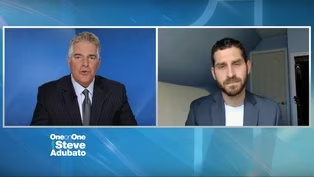
Identifying Viral Outbreaks of Online Extremism
Video has Closed Captions
Clip: S2021 Ep2426 | 9m 30s | Identifying Viral Outbreaks of Online Extremism (9m 30s)

The Importance of Education Support Professionals
Video has Closed Captions
Clip: S2021 Ep2426 | 7m 16s | The Importance of Education Support Professionals (7m 16s)
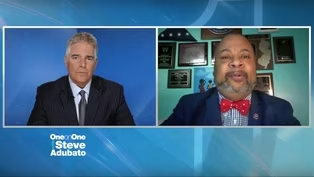
Rep. Donald Payne on American Rescue Plan and Infrastructure
Video has Closed Captions
Clip: S2021 Ep2426 | 9m 54s | Rep. Donald Payne on American Rescue Plan and Infrastructure (9m 54s)
Providing Support for PBS.org
Learn Moreabout PBS online sponsorship
- News and Public Affairs

Top journalists deliver compelling original analysis of the hour's headlines.

- News and Public Affairs

FRONTLINE is investigative journalism that questions, explains and changes our world.












Support for PBS provided by:
One-on-One is a local public television program presented by NJ PBS