Across Indiana
Koorsen Fire Museum
Season 2026 Episode 5 | 7m 32sVideo has Closed Captions
Let three centuries of firefighting history spark your interest!
Did you know one of the first ever motorized fire trucks was made right here in Indiana by the Howe Engine Company, or that the first self-contained breathing apparatus was developed in Indianapolis? Or that this entire museum collection was gathered by just one person? Follow WFYI’s Kevin Ratermann as he discovers how Randy Koorsen’s passion lit an educational fire at the Koorsen Fire Museum.
Problems playing video? | Closed Captioning Feedback
Problems playing video? | Closed Captioning Feedback
Across Indiana is a local public television program presented by WFYI
Across Indiana
Koorsen Fire Museum
Season 2026 Episode 5 | 7m 32sVideo has Closed Captions
Did you know one of the first ever motorized fire trucks was made right here in Indiana by the Howe Engine Company, or that the first self-contained breathing apparatus was developed in Indianapolis? Or that this entire museum collection was gathered by just one person? Follow WFYI’s Kevin Ratermann as he discovers how Randy Koorsen’s passion lit an educational fire at the Koorsen Fire Museum.
Problems playing video? | Closed Captioning Feedback
How to Watch Across Indiana
Across Indiana is available to stream on pbs.org and the free PBS App, available on iPhone, Apple TV, Android TV, Android smartphones, Amazon Fire TV, Amazon Fire Tablet, Roku, Samsung Smart TV, and Vizio.
Providing Support for PBS.org
Learn Moreabout PBS online sponsorshipOn a chilly morning on the east side of Indianapolis, you would think the loudest thing you'd hear all day is the distant roar of Interstate 70.
But it's not even close.
That sound you're hearing is a 100 year old siren politely disagreeing While trying to destroy poor Chris's shoulder.
Now, this very large Mack truck is just one very small part of the Koorsen Fire Museum.
Located inside of Koorsen Fire and Security.
Every item you see tells a short but crucial part of the story.
That is the history of fire protection and firefighting.
And all of it is currently curated by this man, Tyler Rice.
Sometimes we feel like it's the best kept secret here in Indianapolis, and we're working very diligently to make that not be the case.
To be able to look at the history ... the very specific history, the history that was born out of protecting other people, that was born out of protecting their property.
It was born out of evolving to do that job easier, faster, better to save more lives.
Tyler's the type of director that really enjoys showing people around.
This is a display of the Vajen-Bader mask, which was the original SCBA or self-contained breathing apparatus.
It saved a lot of lives.
The Vajen-Bader Company started here in Indianapolis in the 1890s.
Prior to the Vajen-Bader invention.
You had helmets, actually, that you could use, but they would be connected to a pump.
Obviously, there's a lot of restrictions around that.
So being able to go to a Vajen-Bader mask that was a self-contained breathing apparatus was quite a revolution.
Pressurized with a bicycle pump.
The 6 pound mask gave firefighters 30 minutes of clean air to breathe, and much more freedom to walk around when working inside of a burning building.
Now Those masks and everything else in this collection were all brought together thanks to just one man.
Hi, I'm Randy Koorsen, CEO, of Koorsen Fire and Security.
Welcome to our museum.
That's Randy Koorsen.
He brought the passion, the knowledge and the name to this museum.
Randy was literally raised by the fire protection industry here in Indiana.
In 1946, the same year he was born.
His own grandparents started the family business by refilling fire extinguishers in their own garage.
In 1968, before Randy was even out of college, His father helped spark his passion for collecting by giving him this one of a kind, Phoenix fire extinguisher.
I've never seen one like it since.
And got me really interested in the history of portable fire extinguishers.
and over the next 50 plus years, Randy's passion and collection grew by leaps and bounds.
Now there are nearly 3000 more items on display here.
A few of those pieces he acquired were not only made here in Indiana, they also have a connection to firefighting history.
Hailing from central Indiana, the Howe Engine Company specialized in making hand pumpers apparatus that required firefighters to pump water themselves.
Eventually, they moved on to motor driven pumpers using an engine to make it easier to move the water.
But if you look closely at the front of this wagon, you'll notice it was still pulled by horses.
How exactly would Howe make it easier for fire departments to get their newer gas powered pumps to a burning building?
In 1905, they actually delivered the first motorized pop on a motorized vehicle to LaRue, Ohio.
It was the very first one in the United States.
using the motor to power both the car and the water pump was nothing short of revolutionary in 1905, nothing like that was sold in the country before then.
It was very important to get that motorized to save you some money.
Vehicles at the time aren't necessarily more reliable, but horses were much more expensive.
Details like that is what gives each item in this collection its own unique story.
now how each story was told visually, that was a whole other matter.
He wanted it to look perfect.
He wanted it to look exactly like it came off the factory floor, like it was a brand new piece.
I'm more of a petina guy.
I want to see how it was used and show the war wounds of it being used.
since it was his collection, you can see by the showroom shine just how often Randy's preference prevailed.
But if you look closely, a few pieces in here were still left scuffed on purpose.
So this is a very unique piece.
A very special piece for us here at Koorsen.
This is an 1896 Amoskeag steamer.
you see this steamer, which is an apparatus that use steam power from a boiler to pump water.
Was originally just a wagon pulled by horses.
When it came time to replace this with a more modern way to get around.
Someone had an interesting idea to leave that perfectly good boiler be.
They cut off the frame.
The front portion threw that away and attached a purpose built Christie tractor.
They turned this horse drawn wagon into a new front wheel drive firefighting machine.
All those modifications, added another decade to the steamer service life and another decade of wear and tear to the vehicle, Which meant that when it came down to restoration, a compromise had to be made on whether or not this was going to look brand new.
We knew that we couldn't make this like Randy would want it as far as that bright, shiny, perfect piece.
We made it to where it was restored to 1928, which is the year that this came out of service.
We want it to look just like it was used in the city of Boston.
which meant a lot to Tyler.
But the compromise was also born out of necessity.
You see, by this time, Randy Koorsen had gotten sick and his health had started to decline.
Knowing this, Tyler and many others worked very hard to get this piece of history back to the museum as quickly as possible.
This apparatus is very special to me.
It was one that Randy was extremely interested in.
It was a dream piece for him, and he knew it was going to be the centerpiece for this collection.
We were able to move it back.
December 16th of 2023.
And that just coincides with Randy Koorsens last visit.
It's extremely special for me, but also a sense of pride that washes over me when I look at it.
Randy Koorsen passed away less than a month later at the age of 77.
Randy Koorsen may be gone.
But the memories made with him, the stories told about him and the collection he cherished still remain.
And that's why Tyler works so hard, Making sure this museum and the memory of Randy Koorsen are around to spark more interest in fire protection and firefighting for years to come.
They're going to see a lot of Randy.
A lot of his happy place, his stuff that was very important to him.
We don't want it to be the best kept secret in Indianapolis We think that we have a lot to share.
A lot of things that will make you go, wow, I didn't know that.
Wow.
That's beautiful.
Or.
Oh, my God.
Firefighters really had to use that.
Yeah.
It's pretty neat place.
To discover more stories, visit WFYI.org/AcrossIndiana
 New
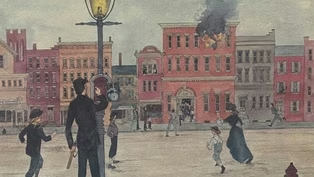
NewHow Did People “Call” 911 in the 1800s?
Video has Closed Captions
Clip: S2026 Ep5 | 1m 51s | Check out this ingenious way to call for help. (1m 51s)
Providing Support for PBS.org
Learn Moreabout PBS online sponsorship













Support for PBS provided by:
Across Indiana is a local public television program presented by WFYI