
Life Before Contact
Clip: 6/11/2026 | 6m 35sVideo has Closed Captions
An intimate look at the First Peoples of Southern California before contact.
An intimate look at the First Peoples of Southern California before contact, exploring their sophisticated and scientific knowledge of the land, governance, trade networks, culture, spirituality, and enduring traditions that continue to thrive today.
Problems playing video? | Closed Captioning Feedback
Problems playing video? | Closed Captioning Feedback
Historic Places with Elsa Sevilla: California's History is a local public television program presented by KPBS
Life Before Contact
Clip: 6/11/2026 | 6m 35sVideo has Closed Captions
An intimate look at the First Peoples of Southern California before contact, exploring their sophisticated and scientific knowledge of the land, governance, trade networks, culture, spirituality, and enduring traditions that continue to thrive today.
Problems playing video? | Closed Captioning Feedback
Where to Watch Historic Places with Elsa Sevilla: California's History
Historic Places with Elsa Sevilla: California's History is available to stream on pbs.org and the PBS app.
Providing Support for PBS.org
Learn Moreabout PBS online sponsorship- Our region is rooted in the First People of the Kumeyaay Nation who have lived here for millennia, but change was coming to their traditional territory.
Hello, I'm Elsa Sevilla.
Welcome to Historic Places where we document and share the region's history.
As we lead up to the American Revolution, what was happening here in San Diego and on the East Coast may surprise you, both in the parallels and the differences.
(water flowing) They are the first peoples of Southern California, the Payomkawichum, Cupa, Cahuilla, and the Kumeyaay.
Before contact, they lived in clans and village-based extended families, from the coast to the desert, guided by deep knowledge and tradition and living from the land.
We were invited into their traditional village and way of life where ancestral life ways are still preserved and thriving.
(rock knocking) - They were so intelligent and scientific about knowing what seasons were the harvest, what time of the year to move.
And we have evidence that they also put markers up for the time of the year.
So if the sun comes up in a certain place, when you're standing on that marker, it'll tell you it's time to harvest.
- [Elsa] While each nation holds its own traditions, many methods are shared, from daily life to governance and spirituality.
Their beliefs are rooted in responsibility and respect, and it is carried forward through generations.
That same knowledge extends to the sky, guiding their celestial understanding and connection to the stars.
- The moon, the sun rises, all those things, and tying that to either ceremony, tying that to harvesting, tying that to basically our survival and recognizing that this is our way of life.
- [Elsa] Leadership was collective with families, clans, and village leaders working together in a system grounded in community voice and accountability.
They harvested, hunted, and fished.
Trade routes sustained daily live.
(water flowing) (birds chirping) - So you have a leader who represents a family, a family leader or a clan, and they would meet with other family leaders.
They would represent a village or small community.
And when they would all come together, you had the leadership who represented the people.
And so today, we would describe that as representative government.
Today, we would describe that as a form of democracy.
And so our people have been democratic since pre-colonial times.
(folk traditional performance) - [Elsa] Culture, language, and traditions like bird songs, dances, and peon games carry their story forward through generations, preserving identity, history, and connection to the land.
- I will continue and I see that it'll be carried through our culture, our traditions, our songs, our language throughout our children, and for the younger generations to carry it on so that it's not lost.
As we are Kumeyaay people, you know, it tells us who we are.
(folk traditional performance) - [Elsa] For millennia, this way of life sustained the first peoples of Southern California, rooted in balance, knowledge, and resilience that continues today.
It is not the past, it is who they are today.
They are still here and thriving.
(folk traditional performance) To learn more about the Kumeyaay Nation's history, Lorraine Orosco, Education Executive Director San Pasqual Band of Indians and Kumeyaay Community College Board of Trustees, is here to talk more about this history.
Who are the Kumeyaay people in this region?
I think a lot of people don't realize the length of history of the Kumeyaay people.
Who are they?
- So the Kumeyaay people are the first people of San Diego and Southern California.
We've been here for, our stories say time immemorial, and we are the descendants of the people.
- So how do you describe the territory, the traditional territory of the Kumeyaay nation?
- Currently are San Diego, up to the riverside, San Luis Rey River, and down to Ensenada at the Fedora.
And we have stories on all these places.
- The Kumeyaay would sort of migrate or travel between the coast, the valley, the mountains, and the desert.
How do you describe this and how did the Kumeyaay people survive and live off the land?
- And migrated from the ocean to the mountains to the deserts and following the patterns of harvesting animals.
There are way too many.
There are very important.
All the native plants very much so are so important and they were so intelligent and scientific about knowing what seasons were the harvest.
- I'm really interested in the cosmology and how they use the stars and how to travel, how to migrate, how to hunt, and all those.
So how did they use the stars and the cosmology?
- The sky was our calendar.
It told us different things about what was happening.
We have names for the constellations Kumeyaay and what they meant to us.
And that has been passed down luckily that we do have elders that were able to pass down this information.
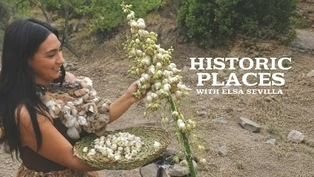
First Peoples of Southern California Preview
Video has Closed Captions
Coming 6/11 learn how the First Peoples of Southern California lived before the American Revolution. (30s)
Video has Closed Captions
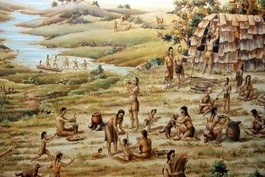
The First Peoples of Southern California face the beginning of colonization, marking a turning point (6m 32s)

Video has Closed Captions
The First Peoples of Southern California faced destruction of their territory and traditions. (6m 48s)
Video has Closed Captions
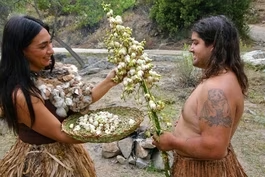
How encroachment of the Spanish brought profound destruction to the First People's lives. (6m 5s)
Providing Support for PBS.org
Learn Moreabout PBS online sponsorship












Support for PBS provided by:
Historic Places with Elsa Sevilla: California's History is a local public television program presented by KPBS