Here and Now
Kurt Kotenberg On Tracking Wildfire Smoke Across Wisconsin
Clip: Season 2300 Episode 2347 | 7m 8sVideo has Closed Captions
Kurt Kotenberg on wildfire smoke in Wisconsin and the potential for such conditions.
National Weather Service Green Bay forecast office meteorologist Kurt Kotenberg considers wildfire smoke air quality alerts in Wisconsin and the potential for such conditions to return going forward.
Problems playing video? | Closed Captioning Feedback
Problems playing video? | Closed Captioning Feedback
Here and Now is a local public television program presented by PBS Wisconsin
Here and Now
Kurt Kotenberg On Tracking Wildfire Smoke Across Wisconsin
Clip: Season 2300 Episode 2347 | 7m 8sVideo has Closed Captions
National Weather Service Green Bay forecast office meteorologist Kurt Kotenberg considers wildfire smoke air quality alerts in Wisconsin and the potential for such conditions to return going forward.
Problems playing video? | Closed Captioning Feedback
How to Watch Here and Now
Here and Now is available to stream on pbs.org and the free PBS App, available on iPhone, Apple TV, Android TV, Android smartphones, Amazon Fire TV, Amazon Fire Tablet, Roku, Samsung Smart TV, and Vizio.
Providing Support for PBS.org
Learn Moreabout PBS online sponsorship>> Smoke from Canadian wildfires this week left Wisconsin in a state of haze and health warnings.
Midweek, Milwaukee had the worst air quality in the nation.
As the fires burn and new ones break out, it could be a summer-long threat.
Kurt Kotenberg with the National Weather Service in Green Bay shares the forecast for smoky conditions.
And thanks a lot for being here.
>> Absolutely, thank you for having us.
>> So as to this week's smoky conditions in Wisconsin, do you know how they stack up historically, like was this worse than we've seen?
>> Sure, so a lot of this is originating from the Canada wildfires and the wildfires at this current rate that they're going are definitely above normal.
And what makes it unique for us here in Wisconsin this year is just the wind pattern and the wind direction.
For the past few weeks, there's been a high pressure area over the center of the country.
And so really, taking a step back here, what helps get the wildfire air down to us in Wisconsin is the wind direction at the high levels of the atmosphere.
And we've had just this pretty persistent weather pattern over the past few weeks and that's been a weather pattern that's had very strong winds over Canada that have literally been pointing the winds into Wisconsin.
They're blowing at about 125 miles an hour at 20,000 feet.
So very high up there.
You're getting very fast winds that are ushering all of this wildfire smoke into Wisconsin.
And comparing trends from now versus the past 10 years, the trends are above normal for wildfires that have been occurring in Canada.
And it's just kind of a more of a local thing as to why that smoke is reaching us here in Wisconsin.
Some year, it's a different weather pattern, where the smoke is not being brought down into Wisconsin, but this year, unfortunately, it is and has been.
And it seems like the wildfire trend is only going to continue to get worse in Canada.
So if the local weather conditions continue to bring that air down here, unfortunately, we may see a very smoky and hazy year ahead here for the summer.
>> And yet the weather pattern that is bringing kind of the wind aloft, the smoke with it, into Wisconsin, is that something that you can predict going forward?
>> So as we get better and better at our computer models over extended periods of time, generally like three to four weeks out, we can get a general sense of, are winds going to be coming from the northwest, are winds going to be coming from the southwest, is a big pattern.
So weather is the day-to-day, like, so the overall pattern might favor winds from the northwest for the next three to four weeks, but that's not going to be consistent in every day.
Some days, we'll have winds from the southeast, sometimes from the southwest.
But when you put every single day on a map for a four-week period, that gets the general trend.
And that general trend, I do believe, unfortunately, is going to continue to feature winds coming from the west and northwest into Wisconsin.
So again, unfortunately, it's looking like we may see, not every single day is gonna feature poor air quality, but more often than not, we might start to see days with poor air quality here in Wisconsin for June, July, into maybe even August and September.
>> Should we expect some version of this every summer?
>> So yeah, so generally, so it's kind of interesting, I don't know if interesting is the right word, but there's a trend, looking in the past 10 years for wildfires, the number of wildfires might actually be on the decrease a little bit.
However, the wildfires that do start are more intense.
And so that's what we're seeing.
We're seeing a lot of large wildfires out there.
So for instance, there's one wildfire that's burned over 100,000 acres so far, which is pretty large.
And just on a daily basis, you know, right now with it being so warm and dry out there, we're seeing wildfires pop up by the hour.
And so the challenge is, what are the weather conditions when those wildfires pop up?
Is it occurring in a dry area?
Is it occurring where there's strong winds to help the fire spread?
And so that's, getting down to that small scale, you know, we can't exactly predict that because we can't exactly predict where a wildfire will occur.
Kind of like a tornado.
Like a tornado, we can say, "Central Wisconsin's favored."
Wildfires are kind of the same way.
Like, you know, certain areas might be more favored, like they've had more dry conditions over the past few weeks.
Then, looking ahead, like we're forecasting very strong winds.
So if a wildfire were to occur in this dry area, the conditions are favorable for it to spread.
So as kind of a weather community, that's what we're looking at.
And then bringing it back into Wisconsin, we take a look at the wind speed and wind direction aloft.
So if those wildfires occur in Canada, which, again, we can't predict exactly when and where they'll occur, but if they do, what will that mean for us in Wisconsin based on the wind speed and the wind direction?
So that's what we're looking at here.
And again, that's where pure miles come into play and where it's showing that the conditions do remain favorable for dry, hot weather up in Canada and northern parts of the United States.
And so if we continue to see those winds come towards us here in Wisconsin, I think we'll continue to see days of poor air quality.
>> I was gonna ask, how do warming temperatures or climate changes play into these conditions?
>> So yeah, so that's tough to tell at this point.
It's kind of one of those, the scientific communities just needs more data and more years of data.
And again, here on the local level, it's not so climate change just as much as it is the current weather patterns and the wind speed and wind direction, which climate change really doesn't, isn't an influence on that.
Like this is more the small scale day-to-day type weather.
But overall as a community, there's fire weather experts, there's experts, universities, that are researching to see if there is or is not a link.
So that's kind of getting a little bit out of our area.
So again, at the Weather Service here, we're just looking at the day-to-day, doing what we can to alert people and warn people if we're expecting poor weather conditions, lead to poor air quality, we're trying to get that alert out to the public to help keep families safe here in Wisconsin.
>> Well thank you for that.
So we should be checking with the National Weather Service, if we wanna know going forward, in the coming days or weeks, whether we think we might have those kinds of smoky conditions.
>> Yes, and we work well with the Wisconsin DNR also, so like Wisconsin DNR and the EPA here across the state, too.
We coordinate with the three of them.
So I would check with those agencies as well.
>> Interviewer: All right.
Kurt Kotenberg, thanks very much.
>> Absolutely.
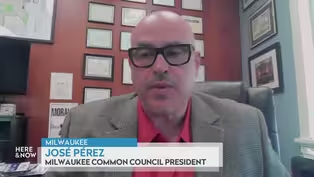
Alderman José Pérez On ICE Arrests of Milwaukee Immigrants
Video has Closed Captions
Clip: S2300 Ep2347 | 5m 55s | José Pérez on community support for residents of Milwaukee who were detained by ICE. (5m 55s)
Here & Now opening for June 6, 2025
Video has Closed Captions
Clip: S2300 Ep2347 | 1m 4s | The introduction to the June 6, 2025 episode of Here & Now. (1m 4s)
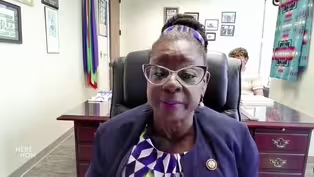
Moore, Pocan Seek To Visit ICE Detainees At Juneau Facility
Video has Closed Captions
Clip: S2300 Ep2347 | 1m 53s | Gwen Moore and Mark Pocan visit an ICE detention facility after an immigrant was framed. (1m 53s)
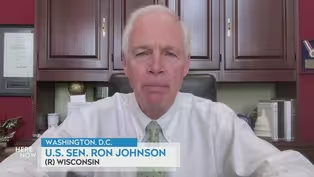
US Sen. Ron Johnson on a 2025 Tax Bill and the Federal Debt
Video has Closed Captions
Clip: S2300 Ep2347 | 11m 21s | Ron Johnson on a 2025 reconciliation policy bill cutting federal taxes and spending. (11m 21s)
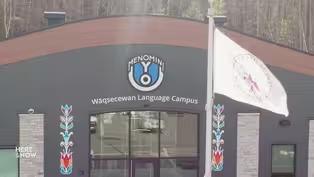
Wisconsin Native Languages Shift From Silence To Celebration
Video has Closed Captions
Clip: S2300 Ep2347 | 7m 29s | A movement to revitalize Indigenous languages is taking root across Wisconsin. (7m 29s)
Providing Support for PBS.org
Learn Moreabout PBS online sponsorship
- News and Public Affairs

Top journalists deliver compelling original analysis of the hour's headlines.

- News and Public Affairs

FRONTLINE is investigative journalism that questions, explains and changes our world.












Support for PBS provided by:
Here and Now is a local public television program presented by PBS Wisconsin