
KY Reporter Discusses Covering Deadly Storms
Clip: Season 3 Episode 266 | 6m 11sVideo has Closed Captions
Karyn Czar is the assistant news director of WKUY-FM in Lexington.
Karyn Czar is a veteran reporter and the assistant news director of WUKY-FM in Lexington. She's covered natural disasters for years. In an interview with Renee Shaw, she discusses her job that requires objectivity without sacrificing humanity.
Problems playing video? | Closed Captioning Feedback
Problems playing video? | Closed Captioning Feedback
Kentucky Edition is a local public television program presented by KET
KY Reporter Discusses Covering Deadly Storms
Clip: Season 3 Episode 266 | 6m 11sVideo has Closed Captions
Karyn Czar is a veteran reporter and the assistant news director of WUKY-FM in Lexington. She's covered natural disasters for years. In an interview with Renee Shaw, she discusses her job that requires objectivity without sacrificing humanity.
Problems playing video? | Closed Captioning Feedback
How to Watch Kentucky Edition
Kentucky Edition is available to stream on pbs.org and the free PBS App, available on iPhone, Apple TV, Android TV, Android smartphones, Amazon Fire TV, Amazon Fire Tablet, Roku, Samsung Smart TV, and Vizio.
Providing Support for PBS.org
Learn Moreabout PBS online sponsorshipIn other news, the death toll is now 20.
After storms hit Kentucky in May.
The state says a man died in McCracken County.
In addition to the people killed in Laurel, Pulaski and Russell counties.
Veteran reporter Karen Zar, the assistant news director of Wuky FM in Lexington, has covered natural disasters for years, and today's Reporter's Notebook segment.
She talks with us about a job that requires objectivity without sacrificing humanity.
Talk to us about how you prepare for going into the field to do these kind of stories, and what your purpose is and your goals are.
When you're on the ground.
You know, I think of when I first started in news, which was many moons ago, it was the ice storm in Lexington, which was in oh five.
Yeah, yeah.
And that was my first time doing something like that.
And so each time it's horrible to say.
But as you know, from being in the field, you learn so much every single time.
And unfortunately we've had so many back to back recently, I believe Governor Beshear said at the last press conference.
There have been 16 during his administration alone.
And we have a very small news team, and I'm kind of the boots on the ground reporter.
So I've covered almost all of them.
And I think the thing I always try to remember going in, first of all, the adrenaline kicks in.
You want to make sure you get all the information correctly as quickly as you can, but more importantly, correctly for the people in the affected areas is the number one concern.
Making sure they know if they need emergency care right away?
Where do they go?
If they need housing, they have nowhere to go and they're without a home.
Where do they go within the next six hours?
Where can they get food and water?
All those kinds of things.
And just remembering that there are people behind the story, right?
These are people who are hurting right now.
And it's not about me getting something on the air.
It's about me making sure that Kentuckians are taken care of and beyond the people who are the storm victims, getting information to other Kentuckians, and even nationally so that we can get relief here that we need.
Yeah, we've talked before about how often our jobs are meeting and talking with people on the worst day of their lives, and you've been in this situation more times than you can probably count.
How does May 16th compare to the other experiences that you've reported on?
They're also difficult.
I think what made May 16th different is I look back at, say, Mayfield or the tornadoes from from that year.
It was so widespread and I think which is horrific in and of itself.
But what made this different is it was so concentrated being in that area.
And I was in Sunshine Hills in particular.
It was you were literally talking to everyone who was affected instead of people in different parts of different communities.
And so it was an entire neighborhood in one spot.
And to talk to all those people who were just so devastated.
But there were so many beautiful bright lights you would see down the street.
You could literally see where the tornado had cut through, and you couldn't tell where one house used to be until you saw a driveway and the debris was moved, but then a few streets over where they weren't affected, there were these families who were like, you know what, let's open the garage.
Let's get the supplies in my garage, get some ATV's over here.
And they became the neighborhood points for people to come get supplies.
And it was so beautiful to see everyone come together.
Right.
What is Fred Rogers say?
That in these times of tragedy and crises, you know, look for the helpers.
Yes.
And in that case, the neighbors were the helpers, along with the whole disaster response team.
Of course.
Absolutely.
First responders were just incredible.
I think the difference when you see a widespread disaster as opposed to something, again, this was widespread.
I'm not saying it's not.
But there were certain concentrated, highly concentrated, so people could really focus and be there 24 over seven and put all their attention on those areas, which was nice to see.
Yeah.
You were there last Friday.
You were in Washington County again and with the National Weather Service.
So talk to us about what you learned there and what that experience was like.
They were, first of all, thank you to them for allowing me to do that.
They let me embed with them that entire day.
So from the moment they arrived, I was with them as they traveled around, and it was so fascinating to see how they figure things out, because I think in my head I always thought, okay, they look at monitors and they look at the radars and things like that, and then they go on the ground and see destruction.
It is so much more than that.
They know, okay, that is an oak tree.
And it has internal damage.
So I can tell the wind speed based on the damage of the tree or if it was cracked in half as opposed to uprooted.
So what, they're horticulturists as well, which is amazing.
But the technology has grown so much.
They have, of course, drones.
So they could get a bird's eye view of everything, but they have, apps now where they can plug in.
Okay, again, that was an oak tree.
It snapped.
Some of the bark is missing.
They put in all the information along with pictures, and the app can give them an approximate wind speed of the tornado.
So I was with them and they literally within the first ten minutes of their first point were like, we're considering this in F1 with wind speeds of about 110, 115.
And as the day went on, they go to a certain amount of points.
I think they hit five that day.
At their second point, they knew it was an F2.
Wow.
And they were able to determine all that on the ground.
It was pretty incredible.
The work that they do and how quickly they can do it.
Right.
Well, thank you for your excellent reporting.
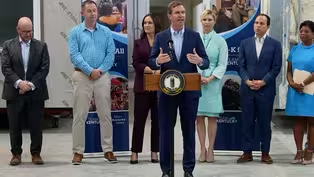
Beshear Renews Push for Universal Pre-K
Video has Closed Captions
Clip: S3 Ep266 | 1m 8s | Beshear has launched the "Pre-K for All" initiative. (1m 8s)
Make America Healthy Again KY Task Force Convenes
Video has Closed Captions
Clip: S3 Ep266 | 3m 34s | The task force was created by the Kentucky General Assembly earlier this year. (3m 34s)
What Eliminating Job Corps Would Mean for One KY Community
Video has Closed Captions
Clip: S3 Ep266 | 4m 15s | The Trump administration wants to defund the Job Corps program. (4m 15s)

When Will the Cicadas Go Away?
Video has Closed Captions
Clip: S3 Ep266 | 3m 43s | Cicadas are the loudest insect on Earth. (3m 43s)
Providing Support for PBS.org
Learn Moreabout PBS online sponsorship
- News and Public Affairs

Top journalists deliver compelling original analysis of the hour's headlines.

- News and Public Affairs

FRONTLINE is investigative journalism that questions, explains and changes our world.












Support for PBS provided by:
Kentucky Edition is a local public television program presented by KET