
KY Secretary of State Discusses Push to Nationalize Elections
Clip: Season 4 Episode 321 | 7m 28sVideo has Closed Captions
Kentucky's Republican secretary of state says it's time to move on from the 2020 election.
The state's chief elections official says lingering skepticism about the outcome of the 2020 presidential election needs to be put to rest. Kentucky Secretary of State Michael Adams dropped by the KET studios Thursday to discuss recent actions by the Trump Administration to seize ballots in Georgia, the President's push to nationalize elections and take over the voting process.
Problems playing video? | Closed Captioning Feedback
Problems playing video? | Closed Captioning Feedback
Kentucky Edition is a local public television program presented by KET
KY Secretary of State Discusses Push to Nationalize Elections
Clip: Season 4 Episode 321 | 7m 28sVideo has Closed Captions
The state's chief elections official says lingering skepticism about the outcome of the 2020 presidential election needs to be put to rest. Kentucky Secretary of State Michael Adams dropped by the KET studios Thursday to discuss recent actions by the Trump Administration to seize ballots in Georgia, the President's push to nationalize elections and take over the voting process.
Problems playing video? | Closed Captioning Feedback
How to Watch Kentucky Edition
Kentucky Edition is available to stream on pbs.org and the free PBS App, available on iPhone, Apple TV, Android TV, Android smartphones, Amazon Fire TV, Amazon Fire Tablet, Roku, Samsung Smart TV, and Vizio.
Providing Support for PBS.org
Learn Moreabout PBS online sponsorshipand $700 million.
[MUSIC] The state's chief elections official says lingering skepticism about the outcome of the 2020 presidential election should be put to rest.
Republican Kentucky Secretary of State Michael Adams dropped by our studios today to discuss recent actions by the Trump administration to seize ballots in Georgia, the president's push to nationalize elections and take over the voting process.
And if those actions are sowing skepticism about the integrity of the midterm elections this year.
Here's part one of my interview with Secretary Adams.
Secretary Michael Adams, thank you so very much for your time.
>> Thanks.
Great to be back.
>> I want to talk to you about some recent developments in the news, perhaps a relitigation of the 2020 presidential election.
As you very well know, the FBI seizure of Georgia ballots, Fulton County in particular, of those 2020 presidential ballots.
What are your thoughts about that action?
And are you concerned that that is precedent setting in any way for future actions like that?
And that could even impact Kentucky?
>> Well, I don't have any inside.
>> Information about it.
I assume that they got a warrant, and therefore a judge looked at this objectively and signed off on it.
I hope that it's not precedent, though.
In other litigation.
So there's 24 states, I think, right now that are in litigation with the Department of Justice for whether they turn over voters personal information to the department attached to the voter rolls, to the extent that that is used against any of those states or against our state, I'd be very concerned about that.
But I think if they were going to do that, they would just do it.
>> Why are we still talking about the 2020 presidential election?
>> I'm not.
>> I know you're not, but I'm sure you're asked about this when you make lots of appearances.
What do you say to voters who are still Kentucky voters, who are concerned about the integrity of the 2020 election?
>> I think it's time to move on personally.
But I've said for years, I think that the election is over.
And the president was sworn in, Joe Biden won the election, and it's time to focus on the current reality.
>> Because there's not a conversation about the 2024 election results.
Correct?
>> Not that I've heard, no.
>> Let's talk about some action that has impacted Kentucky.
Last year, the you did receive a request from the DOJ about voter registration data.
What were you mandated to turn over and comply with?
And is the law very clear about what you're supposed to submit to the DOJ?
>> Well, the law is clear about some things.
It is clear that any citizen of the United States can request our voter rolls.
Any citizen of Kentucky certainly can.
And it's very normal for those requests to come.
When I ran for office, I wanted the voter file.
I wanted to find out how to reach voters so I could campaign the parties.
Get it.
The special interest groups, the PACs, the we all get it.
It's a public document.
The federal law says not just any voter in Kentucky or any citizen here, but any citizen in the country is entitled to request it and receive it.
That's crystal clear.
Federal law from 1993.
So obviously the AG asks for that.
We're going to cooperate.
We're going to provide that.
What's not clear and has never happened before, to my knowledge, is a request, not just for the public file that everyone gets, but voters personal information, their driver's license numbers, Social.
>> Security numbers.
>> Social Security numbers.
And in Kentucky, we have data protection laws.
We have limits on the government's ability to release people's private information.
And so we have kind of a square peg in a round hole that we have a vague federal law saying people can ask for the file, and we have specific state laws saying this is private information, this is not for distribution.
And so generally federal law is supreme over state law.
But if the federal law is vague and the state laws specific, it may not work that way.
So my position is we've provided and we did a long time ago, provided the public file to the Department of Justice.
That's the right answer.
What you see among my colleagues is different approaches.
We have very liberal Democrats who are saying we're not going to give you anything, not even the public file.
There's no basis for that.
That's that's not the law.
We also have Republicans on the other side who have just given up everything, and maybe they don't have the data protection laws.
I don't know in their states, but I'm more in the center.
And that's where most Democrats and most Republicans are on this issue, which is, well, we've got these laws and those laws.
We need a court order, probably to tell us which ones we need to follow, which ones Trump and which ones don't.
>> Right, right.
So for viewers who are just hearing this or hearing your explanation of it, and they're concerned about, oh, somebody has my Social Security number because Michael Adams gave it to them.
You say what.
>> We haven't done that we haven't complied with that.
And may I point out if if I had a data breach in my office, if we gave up all this stuff, I'd be sued.
My staff would be sued.
It would be a liability issue for the Commonwealth.
It doesn't change if we give it up voluntarily.
Like people have certain protections.
It's my obligation to the law to protect that, unless I'm told otherwise by a judge.
>> Since the beginning of his second term, President Donald Trump has attempted to expand the role of the federal government in the voting process.
And I want to just read verbatim what he has said in recent times.
Some of these moves are mired in litigation.
Earlier this month, he said, and reassertion of his control to get more control over voting.
He said at least in some parts of the country, that Republicans should say, we want to take over.
We should take over the voting, the voting in at least as many as 15 places.
The Republicans ought to nationalize the voting.
Is there some historical precedence for that to happen, and what are your thoughts about that on nationalizing elections?
>> So I don't know exactly what the president means.
His spokespeople have said he means that Congress should have federal laws they passed that improve the election process nationally.
And the Constitution, of course, says that the states decide this stuff unless Congress steps in.
I'm not sure what he meant, so I can't really speak to that.
But as to precedent, the reason that we have a Department of Justice, the reason it was created by the Grant administration after the Civil War was because of Jim Crow and because of southern states not letting African-Americans register and vote.
And the feds had to come in and make sure that people's rights were respected.
And you did have a federal troop presence at the polls in some cases.
So I don't want to say there's no precedent.
Obviously, the precedent rationale is a little different, right?
Here's my view.
We've shown the world how well we can run our elections.
We've shown that we can do this in a respectable way, that enfranchises people, that expands access, that tighten security, that has mass support from all sides of the political spectrum.
We got this.
We don't really need the help of some bureaucracy in Washington.
>> Do you think all of these conversations, all of these actions by the white House, by the Trump administration, is sowing seeds of doubt about the integrity of the midterms, election, midterm elections?
>> I don't think I don't know whether it's having that effect.
I've not seen any effect of that.
I will say that at the grassroots level, in my perspective, it's not really catching on.
A lot of the heat that I've been getting for years and years has really dissipated the last couple of years.
I don't know if that's the intent.
It's not the effect.
At this point.
>> I'll have more of my interview with Secretary Michael Adams tomorrow when we discuss his position on open primaries, challenges in recruiting poll workers, and what his political future could hold after he finishes his second and final term next year.
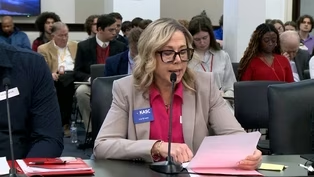
Bill Sparks Debate Over Parental Involvement in Schools
Video has Closed Captions
Clip: S4 Ep321 | 3m 47s | Bill puts policy-making authority in the hands of school principal or superintendent. (3m 47s)
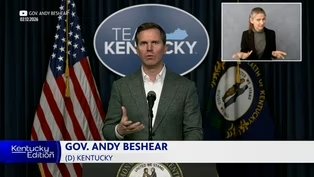
Governor Questions Auditor's Report on Questionable Spending
Video has Closed Captions
Clip: S4 Ep321 | 1m 11s | Gov. Beshear responds to auditor's claims about questionable spending in executive branch. (1m 11s)
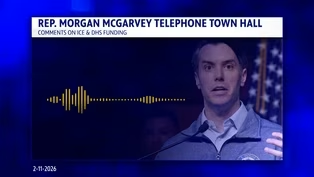
KY Congressman on Federal Budget and ICE
Video has Closed Captions
Clip: S4 Ep321 | 2m | Congressman Morgan McGarvey outlines ICE reforms he wants to see. (2m)
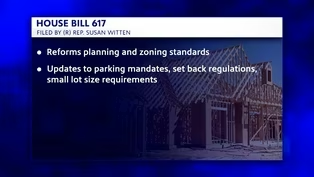
Lawmakers Introduce More Bills Focused on Housing
Video has Closed Captions
Clip: S4 Ep321 | 3m 35s | Three new bills introduced to address state's housing shortage. (3m 35s)
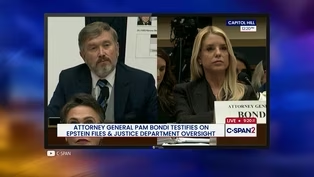
Massie Grills U.S. Attorney General over Epstein Files
Video has Closed Captions
Clip: S4 Ep321 | 1m 20s | Congressman Massie gets in heated exchange with U.S. Attorney General over Epstein files. (1m 20s)
Providing Support for PBS.org
Learn Moreabout PBS online sponsorship
- News and Public Affairs

Top journalists deliver compelling original analysis of the hour's headlines.

- News and Public Affairs

FRONTLINE is investigative journalism that questions, explains and changes our world.












Support for PBS provided by:
Kentucky Edition is a local public television program presented by KET