Utah Insight
Labor Shortage Solutions
Season 3 Episode 9 | 27m 13sVideo has Closed Captions
Utah's unemployment is at historic lows. Learn how that's impacting businesses in the stat
The state of Utah continues to see record low unemployment numbers, leaving many employers scrambling to fill open positions. We examine how the COVID-19 pandemic, "the Great Resignation", and other market forces are impacting Utah businesses. Plus, the demographic shifts that could help and hurt the situation.
Problems playing video? | Closed Captioning Feedback
Problems playing video? | Closed Captioning Feedback
Utah Insight is a local public television program presented by PBS Utah
Utah Insight
Labor Shortage Solutions
Season 3 Episode 9 | 27m 13sVideo has Closed Captions
The state of Utah continues to see record low unemployment numbers, leaving many employers scrambling to fill open positions. We examine how the COVID-19 pandemic, "the Great Resignation", and other market forces are impacting Utah businesses. Plus, the demographic shifts that could help and hurt the situation.
Problems playing video? | Closed Captioning Feedback
How to Watch Utah Insight
Utah Insight is available to stream on pbs.org and the free PBS App, available on iPhone, Apple TV, Android TV, Android smartphones, Amazon Fire TV, Amazon Fire Tablet, Roku, Samsung Smart TV, and Vizio.
All Episodes Now Streaming
Hosted by Jason Perry, each week’s guests feature Utah’s top journalists, lawmakers and policy experts.Providing Support for PBS.org
Learn Moreabout PBS online sponsorship(bright music) - [Narrator] Funding for "Utah Insight" is made possible by viewers like you.
Thank you.
- [RaeAnn] Next on "Utah Insight," you may have spotted more help wanted signs in the Beehive State.
- It's like volatile.
Like, people find, get a job, they apply for the job, they come in, we hire them, and then three weeks later, they find another job that pays them more or- - Coming up, we'll talk about the labor shortage and how it's impacting your day-to-day life.
Plus, some of the changes that need to happen now to meet the needs of the labor market.
(upbeat music) Welcome to "Utah Insight," I'm RaeAnn Christensen.
In March of 2022, Utah was tied for the fifth highest quit rate in the nation with Montana.
This is according to the US Bureau of Labor Statistics.
As you can see, the latest numbers on this map tell a more optimistic story.
In April, quit rates decreased in Utah and 10 other states, with Utah and Wyoming reporting the highest drop in quit rates from non-farm workers, both states down 1.1%.
As the Great Resignation starts to level off, business leaders in Utah are still concerned about the state's critically-low unemployment rate, which currently sits at 2%.
Joining us to talk about this topic, we have Mark Knold, the Chief Economist at Utah's Department of Workforce Services, Bailee Woolstenhulme, the Public Information Officer with the Utah Department of Agriculture and Food, and Darren Hotton is the Program Director for the Utah Division of Aging and Adult Services.
Thanks so much for being here to talk about this important topic.
Mark, can you set the stage for us by sharing how Utah and our nation got to this point?
- Sure, we really need to go back 60, 70 years to set the stage for what is going on in our current environment.
If the slides before you will show, take us all the way back to 1960.
Now, what we have here is what we call population age trees.
On the left is Utah, on the right is the United States.
Now, understand that Utah is just a little blip inside of the United States age tree, but what will you do is you put the boys on the left, and the girls on the right, and you build five-year age increments upward from low to high.
And so you can see that in this diagram that there's a dark coloring on the bottom.
That's the Baby Boom generation.
The yellow coloring would be the older generation, let's call that the working age population.
So the economy can really only be as big as the working age population.
And so you can see with them, I kind of give a little visualization with the vertical yellow lines as to what the size of the economy, United States economy is in 1960, but we're on the verge of this large bulge, almost a doubling of labor, that's gonna be aging in over the next 20 years.
You can see 31% of the entire population in 1960 was 14 years and younger.
Only 9% was 65 and over.
I have Utah over here on the left to...
The story is really about the United States population in this regard, but there's a powerful contrast by having Utah beside it.
So when we move to 1970, we can now see that the Baby Boom generation is here in full.
Part of it's starting to move into the labor force.
You can see it on the Utah side also.
But by 1980, something different starts to happen on the left hand side, versus over on the right hand side.
You can start to see now that Utah's Baby Boom generation is reproducing itself, and then some, in terms of the children being born.
The real story, though, is what's missing over on the United States side, that you don't have the Baby Boom generation over there reproducing itself in large numbers.
This is early on in the Baby Boom generation introduction into the labor force.
They're trying to make the economy bigger.
They're trying to squeeze it out.
High unemployment.
They're in their training.
They're in their education years.
But by 1990, you start to get them more integrated in the economy.
You can see on the left hand side, more of the young population being born in Utah, but not over on the right hand side.
By the year 2000, you have moved the boomers to a much higher area of the economy.
They have now had 20 years to stretch that United States economy.
They're into their careers.
They're done with their educations.
They're into their professional lives.
Again, even over on the left hand side, you can start to see the grandchildren being born over there on that side.
So by the year 2010, largely you get to a point where the Baby Boom generation has fully stretched the United States economy to a new level.
But what you can also see on the peripheries there, on the sides on the lower, is there's actually a dearth of workers.
Again, over on the left hand side, Utah's population age tree is a whole different structure.
You still have more younger workers coming into the process.
For every two boomers who might retire out, you can make the argument there's one young... Or excuse me, for every boomer that goes out, there's two young workers to come in behind and fill the vacuum.
You don't have that over on the right hand side.
You're lucky to have it one to one.
And so by the time we are at the year 2020, we now see that what was a smaller economy is now fully stretched out to the Baby Boom generation, but you don't have that four-to-one ratio of young to old, like you did in 1960.
Now it's 18%.
It's below age of 14, and 16% is 65 and older.
So these are the impacts of where we have gotten to.
The future, keep walking it out through there, but there is gonna be more repercussions of this.
But the moral of the story is that the Baby Boom generation has taken the United States economy and stretched it to its fullest size.
For the economy, for the population to keep growing into the future, you need more workers, you need more production.
It's not there.
Internally, it's not there.
We have maxed out.
And so we're really moving into a new paradigm going forward, where we have always had to deal with growing the economy, legislation, dealing with increasing population, and so on.
And now we're at a point where we have...
The Census Bureau has largely told us that the first time in our nation's history, we have largely gotten to zero population growth.
The boomers are still in the economy producing, they age out.
We're still consumers, but we're not producers anymore.
So who's gonna produce for these big cohort of consumers?
The bottom line of all of that is we... That is what has brought us to this dearth of labor.
It's not so much...
Even in an economy at the United States level that's not as big as it was before the pandemic, we still don't have enough workers.
And the pandemic incentivized a lot of 55 and olders to retire, move out.
So this is the groundwork of why we are in this labor situation that we are.
- That's a lot of good information.
Workforce shortages are something farmers in Utah are all too familiar with, and many are keeping close tabs on the Farm Workforce Modernization Act to see if it passes through the Senate.
Bailee, what kind of impact would that have here in Utah?
- Yeah, absolutely, like you said, agriculture is no stranger to labor shortages.
In fact it's been going on for decades.
So the rest of the industries are kind of catching up to what we've been dealing with for many, many years.
You mentioned the Farm Workforce Modernization Act.
That is one step that has been taken to try to fix some of the labor issues that we have.
Many farmers and agricultural industries are dependent on what we call H2A workers, which are workers that come in on a work VISA for a short amount of time, and they work on the farms or ranches, or whatever it is that they have been authorized to do.
Unfortunately, that program has needed some reform for quite a while.
It just is not fitting for the current situation that we're in.
That is one step that they're taking.
Unfortunately, there's not a lot of support behind that Modernization Act.
At the moment, it does need some adjustment and reform before a lot of the agriculture industry will get behind it, but they believe that people are starting to look at it and trying to move in the right direction, and we're willing to work with them to try to make it so that it's the best fit possible.
- Sounds optimistic.
- Yes.
- Which is good news.
In a recent news conference, Intermountain State Director for the American Business Immigration Coalition, Enrique Sanchez, said, "The agriculture sector is facing a devastating labor shortage.
If this is not urgently addressed, Utahns and Americans everywhere will begin to see empty grocery shelves and higher prices for consumer goods.
Darren, it feels like we've already been seeing sticker shock in the stores, as well as at the gas pumps.
With inflation, for the people who retired, or stepped away during the pandemic, they're now rejoining the workforce.
Is that what you're seeing?
- Yes.
What we're seeing around, at least in Utah and in other states, is when the pandemic hit, there were, you know...
Most older Americans or older workers were forced into retirement.
They were forced because their employment shut down or they took... And retired toward...
They were thinking about their lives and what was a priority to them.
Or they just wanted to separate themselves from the COVID virus, so they retired early.
But because of the things that are going on nowadays, some of them are kind of stagnant, and they're to the part where they're trying to become engaged again, but they're waiting for the right time and the place to become engaged again into the workforce.
Right now, they're kind of sitting back, either living off of retirement benefits, or other savings, or 401ks.
Some are actually living on credit cards, which is a really bad thing.
And those that are living on savings and credit cards will be making a decision here, and they'll reverse their retirement and come back into the workforce.
- Do you think relying on Baby Boomers to come back is just a bandaid?
- Yes, it can be a bandaid.
It depends on how the employers around this state interact with them, because employers are like everybody else.
They want the young, the healthy, the people to come in and do the job, but they also forget the older workers, who, if they are enticed to come back, because they're shown that this job is something worthwhile, that they have flexible arrangements, like part-time, instead of full-time, and sometimes the benefits, aren't really the big thing.
It's like the job security of being there part-time and doing a job well done for them.
That's important to them.
They wanna have meaning in their life.
And so that's what an employer should advertise for the older workers.
- Mark, do you wanna weigh in on this?
You've talked a lot about the Baby Boomers.
Do you think that's just a bandaid?
- In the long run, it is a bandaid, because they're gonna continue to keep aging, and eventually they'll just permanently retire, or they die, you know, in that situation.
So it is a bandaid going forward, but we need it now.
You can see it again across the whole United States.
He made really good points in terms of, well, in the past, we've always had kind of a trepidation towards, for new employees being older workers, and so on.
And I could see that kind of remaining here in Utah.
Again, you saw those population age trees, and the Utah one looks like a Christmas tree, where there's a lot of younger workers.
And so anytime you might have more of a pool of available younger workers weighing against an older worker that you know is probably gonna end up being a temporary or three or a five-year, versus somebody who might stick for 15, 20 years, and so on, you know, there would be a natural bias to lean that way.
At the United States level though, I think there's more incentive for the older workers to be absorbed back into the labor force across the rest of the country.
But, again, it might be a different story here in Utah with our young labor force.
- The hiring crisis is proving extremely difficult for small businesses.
For one bakery owner, it's causing him to have to work multiple positions, which means long hours and no days off.
(crickets chirping) (metal clacking) - [RaeAnn] An early wake up call for Adalberto Diaz, better known as Chef Al.
- So I am the founder and creator of Fillings and Emulsions, and, you know, I'm also the executive chef, and the CEO, and the president, and the front of the house cashier.
(Adalberto chuckles) - [RaeAnn] 3:00 AM during the week, midnight on weekends.
- We're dealing with issues of supply and demand.
We're dealing with the issue of labor force that, you know, people that we don't have.
The pandemic was easy.
The post-pandemic, I call it post, right?
It's harder than the actual pandemic time.
- On top of all the other responsibilities of running a successful multi-location bakery- - [Adalberto] This can be shared.
- [RaeAnn] Chef Al also has to help customers in the front.
- [Adalberto] Okay, so that's 10 right now.
- [RaeAnn] Something he normally doesn't do.
- We basically have nobody on the front of the house team here in West Valley.
They apply for the job, they come in, we hire them, and then three weeks later, they find another job that pays them more.
And they're going to jobs that give them everything they need, less hours, more benefits, et cetera.
For us, it's like hard to compete with that.
Is that it for today?
(metal clanking) Our syrup is already boiling back here, you can- - [RaeAnn] Chef Al's love for baking started at the young age of nine in his home country of Cuba.
- I just was making, you know, little cakes on a pressure cooker, just like a Cuban do.
I didn't have an oven.
I didn't have equipment.
My mixer was a couple of forks and a bowl.
My neighbor asked me for a cake.
I made a lemon sponge cake.
And then after that, everybody wanted it.
- [RaeAnn] Business kept booming as time went on, but being in a communist country took a toll.
- I had an illegal bakery, basically, for, probably, four or five years.
And then, you know, the word got out.
I have too many people, too many customers.
And then eventually I had to kind of go underground and hide, before I had to escape.
- [RaeAnn] Seeking asylum in the United States, friends in Utah helped him get a new start, still following his passion of baking.
- To be honest with you, when people ask me, "Why are you here in Salt Lake?
I always answer, "Well, in Miami, where all the Cubans are at, I'm just another Cuban.
In Salt Lake, I would be The Cuban.
That was kind of an enticing reason for me to stay here, is because I could share who I am and what I do with a community that's not very... You know, it's not knowledgeable about our culture and our foods, et cetera.
- [RaeAnn] Chef Al says he will keep working seven days a week and as many hours as needed, until they find a solution to the labor shortage.
- We have to entice the employees with better payment, health insurance.
If we are giving more money out, we're gonna have to charge more, and the prices are gonna go up even more than they are right now.
- [RaeAnn] He says he knows it's a lot of work.
- This is my baby, so I have to take care of the baby.
You cannot have a baby and let it just be by itself.
You're responsible for it.
The fillings for meat pies are cooked in here.
Nothing brings me more joy than making people happy, and I can make people happy with food.
This is the Ropa Vieja.
Good food is even easier.
(upbeat music) - We asked our audience on social media their thoughts on the Great Resignation, more specifically, how might this impact Utah businesses?
And do you have any solutions for our labor shortage?
Scott Young says, "These retail jobs simply do not pay enough.
These jobs are difficult, physical and mentally demanding.
Even at top wage, an individual cannot afford to live in Utah.
While Sarah Danielle Rendeck repeated the same sentiment, saying, "Pay people better, treat them better."
And over on Instagram, Karina opened up, sharing this, "My current job was desperate for staff, Increased the starting wage to 18 an hour, and now have all their positions filled.
It's pretty simple.
People would rather not work and be poor than work full-time and be poor."
Bailee, I hear that raising wages is easier said than done, especially in the farming industry.
Is that correct?
- Yes, that's absolutely correct.
Unfortunately, farmers work on extremely tight margins as-is, And as we've seen inflation rise, those margins are getting even smaller.
So their ability to raise wages for some of these very skilled labor jobs is pretty much impossible.
Such as the baker that we just saw, these farmers are taking on multiple jobs and are playing multiple roles on these farms to try to make ends meet, because they can't afford to raise their wages and attract more labor, a bigger labor force.
- Mark, you've compared it to a race to move up the ladder to earn more, secure a better title.
It's an incredible time for workers, but what can businesses that are struggling, like we saw the bakery do, to keep up?
- It is a struggle for them, because they're really dealing with forces that are outside of their control.
I mean, what they need is just... We need a bigger labor pool.
We just need more workers and so on.
And you can see the story at the United States level, well, you know, the internal demographics, it's not there, so if you don't have people or you want more, and they're not birthed inside, and even if they did, it'd take 20 years for 'em to come to the labor force, the only other place you can go is outside of the country to bring in labor.
But largely since 2016, we've turned that down.
We shut that kind of off at that time period.
It's almost like a perfect storm, where you make those kind of decisions, and then the pandemic hits, and it incentivizes labor to go out, and the next thing you know, there's not enough labor all over the place.
And so, again, this would be very impactful in the agricultural industry, where it does use international labor to help support that industry.
So those kind of policies, sometimes you don't see the future ahead, so to speak, as to what is being done at a certain particular time.
But sometimes it can come together then, almost like a perfect storm, which is kind of where we're at.
- And Darren, what are your thoughts on this?
- You know, it's interesting, because I see younger people, they're jumping from job to job.
And as it was mentioned in those posts, that, you know, "You can work full time and still be poor," And I can understand that concern when they're jumping around.
But for some of our older workers that are thinking about re-engaging again, that might not be the whole reason behind it.
So just because they need some funds, they're not looking to make themselves work full-time.
This is other money to offset inflation and other costs that are all rising, right?
So again, having and making the job enticing to them, to come back, to show that they're worthwhile efforts, and that they're needed, I think that's another thing, that if employers would do that too, that could possibly help for at least a little while.
- I mean, employees like to be valued, for sure.
- That's right.
- Maybe I can add something- - Yeah, go ahead.
- To that really quick.
That's something that we would love to be able to do in the agriculture industry, but, unfortunately, as trends change, and as society changes, there has been a lack of wanting to do that hard, all-day-in-the-sun labor, manual labor type work.
And I mean, I know that there's other industries, such as the construction industry, that have seen that change as well.
So I think that a lot of these things we need to be aware of, and look at our societal changes as well, and those impacts on our labor force, and what are we encouraging, and what are we valuing in our lives that are going to encourage our younger generations in what types of jobs they wanna take?
- You have to entice them.
And it's a difficult balance there.
- Exactly, exactly.
- An interesting study by MIT looked at the top predictors for attrition during the Great Resignation.
Researchers found a toxic work culture is more than 10 times as likely than compensation issues to result in an employee leaving.
Another report stressed employers need to pay attention to employee morale.
Darren, do you find this to be true with the more seasoned workers who are used to toughing it out?
- Yeah, older workers and employers usually stick together.
The way it used to be, they used to work with one or two employers for years, and then they would retire, and get a gold-plated watch, and move on.
Their kids and their grandkids saw that, and they were like, "Why did you stay so long?"
And the younger generation, you know, they're never loyal to a company anymore.
So as we think about this, yes, there is still a value of loyalty if they're treated with respect.
So a toxic work environment is very important.
You know, if they're valued, appreciated, said, "Thank you," every once in a while, "Great job," you know, that brings people in, especially our older workers, and they want to be part of it, and help you expand, and show great work for your employer.
- Being valued is more important than money sometimes.
- Right.
- Yeah.
Mark, in your latest report, you shared that idle workers are starting to come back after being on the sidelines during the pandemic.
What do you attribute that to?
- I think it's this inflation, and just making ends meet all of a sudden makes it a little bit harder.
The 16 and older population is what we call the labor force, the potential labor force, so if they did either worked or looked for work, there would be 100% participation in the labor force, there isn't.
But 68.5% is what Utah was at before the pandemic hit.
It only fell to 67, but it kind of stuck there, and it just was stuck there for the last two years or so.
And it's only been in the last four to five months that we've seen, whoa, it's starting to really reengage.
And I find that tied to the inflation aspect, where, all of a sudden, it costs a lot more for gasoline.
It's costing a lot more for a household to make ends meet and so on.
And so I think that there's actually a dollar bill incentive that is bringing a lot of these people back into the labor force.
They did have the luxury of staying away with all the stimulus money, making decisions about health, and so on, but once you finally really get into some binds, and so on, that's incentivizing people to come back.
- Okay, I'll take that with the silver lining, that we might stabilize here soon.
So before we wrap up, I'd like to have each of you take about a minute to share your final thoughts on the future of Utah's labor force.
Would you like to go ahead, Bailee?
- Sure.
You know, it's a difficult topic.
Agriculture has been heavily reliant on immigrant workforce for a very long time, but that's not to say that we don't value our workforce here in the United States.
In fact, they take priority when we try to hire.
And I just want to talk about how agriculture is resilient.
As I said, we've been dealing with these labor shortages for decades now, and I don't wanna cause panic or concern that there won't be food on your shelves, but we rather wanna raise awareness that this is an issue, and it's something that we'll struggle with, but we always come through, and we always find a way to make it work, and to make sure that the people in our communities are fed, so don't panic.
Your farmers and ranchers are still here for you.
- That's good advice.
Don't panic.
Darren, go ahead.
- So I've talked a lot about what some employers should do.
I think this is a message for those people that are sitting on the fence, the older workers, the reverse retirement that's coming in, you're used to having a working lifestyle, and you were forced into a retirement lifestyle, and some have been able to adapt and to adjust, but most of them have not.
If you are concerned or afraid, there are lots of different agencies around the state, Department of Workforce Services, Department of Aging and Adult Services, that have programs or advice to help those older workers who would like to come back into the market to help with job skills, job training, and other types of things to get them in.
Not knowing what's changed since the pandemic, we can help inform them of what's going on, but we can help them with their resumes, their soft skills, some technical assistance, just to help them get a step up when they're ready to make themself more self-confident when they want to come back into the market.
- Okay, final thoughts?
- Yeah, I kind of painted a picture of a dichotomy here with the slides and so on.
Some audience might be thinking, "Wait a minute, I see this population age tree in Utah, where we've got all this young labor."
Why do we have a labor shortage?"
It's because our economy is so strong, that we've absorbed it all, and then there's even room to bring in more.
The pandemic unleashed teleworking while people were migrating into the state.
People wanna come to the Western United States, recreation, and so on.
So we attract labor.
We are growing, not just because of internally, but we're absorbing, migrating the domestic labor into our part of the country.
Over on the United States level, on the other hand, shrinking economy, but yet still can't get enough workers.
So what'll be interesting going forward, I think, is Utah lives inside of the United States economy and its policies.
At the national level, they're gonna have to figure out how to manage a declining economy, a declining population, while the State of Utah has to live inside of that and has to deal with an increasing population and an increasing economy.
And I think that'll be an interesting thing to watch going forward.
- Okay, our time always goes by so fast.
I appreciate all of this good information.
And we do have more resources online on pbsutah.org.
And join us back here next week for our final show of "Utah Insight."
Thanks for watching.
(upbeat music)

Labor Shortage and Local Businesses
Video has Closed Captions
Clip: S3 Ep9 | 3m 57s | See how Utah's record-low unemployment rate is impacting small businesses in the state. (3m 57s)
Labor Shortage Solutions | Next Friday!
Video has Closed Captions
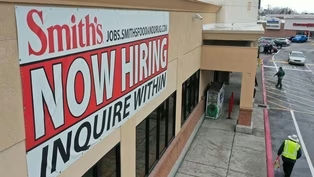
Preview: S3 Ep9 | 30s | Utah businesses are struggling to hire new workers. We examine the ongoing labor shortage. (30s)
Providing Support for PBS.org
Learn Moreabout PBS online sponsorship
- News and Public Affairs

Top journalists deliver compelling original analysis of the hour's headlines.

- News and Public Affairs

FRONTLINE is investigative journalism that questions, explains and changes our world.












Support for PBS provided by:
Utah Insight is a local public television program presented by PBS Utah