LA64
Lafourche Parish
4/9/2026 | 26m 46sVideo has Closed Captions
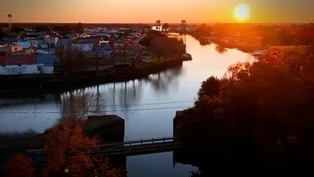
Lafourche Parish is shaped by water and Cajun tradition.
Lafourche Parish follows the winding path of Bayou Lafourche, where Acadian culture and the working wetlands continue to shape the region’s music, language, food, and craftsmanship. The episode explores the Cajun Bayou, from Cajun jam sessions and French table gatherings in Thibodaux to lift bridges in Lockport and master boat builders in Larose.
Problems playing video? | Closed Captioning Feedback
Problems playing video? | Closed Captioning Feedback
LA64 is a local public television program presented by LPB
LA64
Lafourche Parish
4/9/2026 | 26m 46sVideo has Closed Captions
Lafourche Parish follows the winding path of Bayou Lafourche, where Acadian culture and the working wetlands continue to shape the region’s music, language, food, and craftsmanship. The episode explores the Cajun Bayou, from Cajun jam sessions and French table gatherings in Thibodaux to lift bridges in Lockport and master boat builders in Larose.
Problems playing video? | Closed Captioning Feedback
Where to Watch LA64
LA64 is available to stream on pbs.org and the PBS app.
Providing Support for PBS.org
Learn Moreabout PBS online sponsorshipSupport for LA 64 is provided by.
Office of the Lieutenant Governor Billy Nungesser.
Keep.
Louisiana Beautiful and the Louisiana Office of Tourism.
In this episode of LA 64, we follow Biola Fish through La Bush Parish, where wetlands Acadians put down roots and built a culture tied to the water.
From Thibodaux to Port, Fisher will taste our way along the Cajun Bayou food Trail, discovering the flavors that defined each bend in the bayou and meet the craftspeople and culture keepers, preserving traditions.
I'm Karen LeBlanc, a travel journalist and Louisiana native.
Join me on LA 60 for a journey through all 64 parishes, exploring Louisiana's less traveled path and.
We're.
Lafourche Parish calls itself Louisiana's Cajun Bayou.
Its name means the fork in French, and that definition fits.
This place is a branching point of history and heritage.
Land and water.
The parish is part of the Layer National Heritage Area.
Daily life, culture in the economy, all traced back to by you look foolish.
A 106 mile ribbon of water that shapes everything in its path will begin in Thibodaux, the parish seat.
Then follow the bayou south through Raceland, Lockport, and La Rosa, ending where the land meets the gulf.
At Port Food, sharp.
It's Wednesday night at Gina's at the Legion and Tidbit away, and musicians arrive with instruments in hand for the weekly live Cajun music jam.
Clinton Fan to Know and Missy McElroy are founding members of the Cajun Music Preservation Society, which hosted the jams on the first and third Wednesdays of each month.
They've been gathering for more than a decade.
If you look at most of the traditional, like the Cajun triangle, right where they have where the Cajun country is, the food parish is in there.
You know, we're probably the most southeastern portion of that triangle.
We are.
And we have a rich heritage of Cajun music out here.
In fact, there's some people that have told me that if you listen to Cajun traditional Cajun musicians along the bayou, down the bayou, in the food parish, that they had their own dialect, Acadian music, that that, like most people, can't pick it up, but people who really know the music can hear the little things that they doing just a little bit different.
It's the licks.
So it's.
Yeah.
Yeah, exactly.
It's like their own signature song.
That's right, that's right.
Our mission is to, raise awareness of the the Cajun music culture and to sort of revive it because people, they talk about how this is the Cajun area of Louisiana, but we want to feel like we're living it, and music is part of that.
Lafayette Parish connects to the Atchafalaya Basin, not just by geography, but by a shared environmental heritage and French Cajun culture.
This is a community shaped by its bayou and the generations who call this working waterway home.
You'll hear it in the cadence of conversation, in the music and around tables, where neighbors gather regularly to speak French together.
Who thought LaDonna could, grow up or live on Earth?
86 year old Camille Frantz serenades his Tuesday French table gathering at the Wetlands Acadian Cultural Center in Tibbett Oak.
The group of French speakers invited me to join, and we take turns reading aloud All France.
My Cajun French feels rusty and my pronunciation.
It needs work, but the group embraces me with no judgment.
We are all here to learn and preserve the language.
I care.
I grew up on the French table is a South Louisiana tradition and a way for the culture to keep the language alive.
This French table has been meeting for more than 20 years where the wetlands.
Acadians, the majority of the Acadians came here in 1785.
They are the ones who went back to France.
It was sent back to France and then came here 30 years after the grandparents.
More than more than 30 years.
Exposure to French, French, Standard French.
And my theory is we speak better French on this side of the Atchafalaya.
I love my French.
The Wetlands Acadian Cultural Center is housed in a 1912 building.
It's part of the John Lafitte National Historical Park and Preserve network in Louisiana.
The former wholesale grocery warehouse sits on the National Register of Historic Places.
A museum chronicles the region's food, culture, music, and economy, from sugar cane and boat building to oil exploration and its early settlers.
And then obviously, a huge part of our story, here in the wetlands is boats and boat building.
We have a beautiful piece on the side here, which is an old dugout pirogue from the 1984 World's Fair.
Boat building is so important because to get anywhere here.
But I. Bayou is your highway, so you need boats to get to and from school to church.
For shrimping, oysters, all the industries.
And so that beautiful knowledge that all these people had ended up equating into big boat building with Bollinger and North American, that was all born out of this tradition.
So it's really important here.
The center offers walking tours of downtown Thibodaux and boat tours along Bayou La Bouchon.
I head out on the water with Ranger Allen Rodriguez from the John Lafayette National Historical Park and Preserve.
We board at the dock.
We're buying the food and bayou terribles once met.
It's a prehistoric fork in the waterway that once served as a natural crossroads for trade, travel, and settlers.
About 2500 years ago, this was the Mississippi River.
It won't be until the turn of the last century when the kind of dammed, Lafourche and put in a water control structure.
We head down the bayou to the E.D.
White Historic Site, a Louisiana state museum with free admission.
The National Historic Landmark was once the home of two prominent Louisiana political figures Edward Douglass White, Louisiana's governor from 1835 to 1839, and his son Edward Douglass White, who served on the U.S.
Supreme Court.
The home was built in 1825.
The original style was an accounting for your own style, so it was made to be, spacious.
It was meant to be feasible, meant to be functional.
In the late 1840s, a window was White's widow.
Re does it, and she does it into a Greek Revival style, which adds a lot of symmetry to the house.
It adds a lot to the fireplaces, and it adds a lot to the house in terms of square footage.
We walk over to the detached Acadian kitchen, where cornbread is baking and the open hearth and the aroma.
Well, it feels like an invitation to sit a spell with a cup of coffee and chicory.
A warm slice has my name on it, but first I'm told I have to earn it by making butter the old fashioned way.
And now you just shake, shake, shake.
I don't need a butter churn.
That's what you are taking the place of a butter churn.
Who knew?
And how long do I shake said butter before it turns into butter?
So we usually go to the soft butter stage, which is like five minutes.
Five minutes.
But, you know, we'll see how well you do.
Oh, I'm breaking a sweat here after a whole lot of shaking.
I've got creamy butter, and it's time to break cornbread with my new friends.
The keepers of living history on this property.
You.
That evening, I returned to the wetlands Acadian Cultural Center for music on the Bayou, free Tuesday night concerts by local musicians.
On this evening, musician Joe Crown played some of the greatest hits from New Orleans R&B musician Allen Toussaint.
Highway one and highway 308 run along the opposite banks of Bayou La like a spine through the parish, winding paths, centuries old live oaks and sugar cane fields.
Together they formed the Wetlands Cultural Byway, which leads to historic downtown architecture tells stories about its history.
The city put out a map.
It's a self-guided walking tour, so you can check out all of the different styles of architecture, everything from Queen Anne to Greek Revival and Bungalow Beaux Arts, all chronicling different taste and different time periods.
I stop to admire the Saint Joseph Co-Cathedral, a Romanesque Revival architectural jewel, and then on to Saint John's Episcopal Church, one of the oldest Episcopal churches west of the Mississippi, holding services since 1843.
My walking tour leads me to Saint John's Historic Cemetery.
It was founded in 1843.
Now, you might be thinking a cemetery, Karen, really as a visitors experience, but I want you to think of this more like a sculpture garden.
It is filled with history and famous names, including Francis Nichols.
He's buried here, and his namesake was given the Nicholls State University.
He's a two time Louisiana governor.
I continue south on highway 308 to Raceland, where the Laurel Valley General Store is open for business as part of the Laurel Valley Village.
It's the largest surviving 19th century sugar plantation complex in the United States.
This place looks to me like it is frozen in time.
How old is this place?
So this building was originally built in 1905, to replace a previous structure that was on the site.
And so it was originally a general store for the plantation for Laurel Valley, where they would, you know, buy the stuff for the village in the back.
It was originally up along the highway, and they moved it back in in the 70s and kind of refurbished it a little bit, set up the museum in the back and in the front is the consignment store where you can find these locally made crafts and, and and delicacies and whatnot.
Today, Laurel Valley Village's claim to fame is its starring role in many notable movies.
My guide, Gary Aber, takes me on a tour of the property, revealing weathered cabins, old farm equipment and cane fields.
So many structures remain intact, which is why the property sets the scene.
For many films and TV shows, there's been over 29 major motion pictures shot back here, and, one of the most famous ones was in this house right here.
This was a house used in the movie Ray for Ray Charles.
He would have been, the childhood parts of that movie would have been shot back here on Lore Valley.
And then the biggest one is center centers was shot here last summer.
It took them three months on the property to shoot the movie.
And, a lot of people have seen Santa, so when they come here, they're really interested to see the place where sentence was filmed.
I continue down the bayou, passing and occasionally crossing vertical lift bridges that rise to let shrimp, boats and other vessels glide through.
These moveable spans are part of daily life along Bayou La food, where traffic pauses, engines idle and the waterway takes priority.
Soon, Lockport comes into view, a town founded in 1835.
Lockport gets its name from the locks behind me.
You can see that today there are remains are no longer operational, but at one time the brick locks controlled water levels, and it allowed boat traffic to travel along by yellow fish linking to canals and other bayous, eventually making its way to New Orleans.
The lock was built in 1815, turning this small town into a strategic crossroads, moving sugar cane, seafood, and oilfield gear straight into Louisiana's coastal trade routes.
The locks remained operational until 1876, when a levee breach partially destroyed them.
Today, Lockport's historic buildings speak to a bygone era, including this 1910 bank, now home to the town's memory keeper.
Welcome to Lockport, where everyone is friendly.
Debbie, Tara Bowen and Michelle Foray, our volunteer guides at the Bayou LA Jewish Folk Life and Heritage Museum that sits on the National Historic Register.
A visit transports you to early life in Lockport.
From this homestead cottage to the harvesting of cypress lumber with a past par two saw, you can pilot a steamboat wheel that turns a hand-painted panorama depicting different scenes along by a lavish when the building was being restored.
This was discovered in the upstairs.
It was an old switchboard, and at one time the the Lockport had the switchboard that was, to connect all the telephone calls.
It was just coming into being in 1910.
Upstairs.
I'm going to check out the Mardi Gras room with Debbie, who knows all the things about Lockport's Mardi Gras.
Hi, I'm Debbie and hi, Karen.
Welcome to the Lafayette Mardi Gras rhythm.
If you look around, we have past royalty.
Crown crowns and gowns and Mardi Gras colors.
And what I want to explain to you is our first parade was started in 64.
It was established in 63.
But this is our float.
And we like for the kids to come on field trips.
And I love to be up here and play the Mardi Gras music.
I talked to them about the trivia of Lockport Crew of Apollo and let them, of course, throw beads at me.
Okay, throw me something.
Oh.
Thank you.
Today, one of the food parishes major employers is the shipbuilding industry.
It's a legacy rooted in the region's early wooden boat builders.
Craftsmen like Ernie Savoie, a fourth generation boat builder carrying the tradition forward.
He's working to preserve these vessels and secure a permanent home for this historic collection of pyros.
Dugout and hand-built wooden boats.
On the day we visited his Le Rose-Hulman workshop, Ernie was restoring a dugout carved from a sink or log, bringing new life to a piece of Louisiana's maritime past.
I can build you some small beaver logs, lake skiff, stuff like that.
Shuttles, flood boats, basically.
I've never had the opportunity to build anything large, like the large shrimp boats and stuff.
I consider myself, according to boat builder Ernie shed shelters a wooden rowing skiff that once represented Louisiana at the 1984 World's Fair.
Ernie now serves as the caretaker of a collection of historic wooden boats for the center for Traditional Louisiana Boat Building, preserving them until they can find a permanent home on the campus of Nicholls State University.
Why is it so important to you to have this museum?
Well, it's about preserving our cultural heritage by telling the stories of our ancestors about these boat builders.
I continue south to the town of cutoff to stroll the grounds of the South Lafourche Veterans Memorial.
The granite wall is etched with the names of more than 3000 veterans from all of the parish traveling down LA one.
A sign declares the gateway to the Gulf.
As I make my way to the mouth of Vital Bush, where it empties into the Gulf Port, Suzanne powers much of the nation's offshore oil and gas industry.
It also offers something unexpected access to its coastal Wetlands park, where visitors can explore the beauty of Louisiana's working coast.
I met up with Reg Goslin, owner of Go Paddle, who outfits visitors with kayaks to paddle the wetlands trail so I can actually kayak around the port.
Yes, yes, there's access, and trails that you can access around the port and around the local wetlands.
So it's a it's a beautiful scenery.
Ridge helped me launch my kayak on this chilly, windy day.
It took some extra effort to power paddle in these conditions, but up close encounters with nature make it all worthwhile.
I'm showed you what locals love about fish Paris.
Now, if you're planning to visit the area, I suggest to stop here at Louisiana's Cajun Bayou Visitor Center in Raceland.
They'll give you more information about where to go and what to do.
This isn't your typical pick up a brochure, visitor center, multimedia and interactive exhibits, some created with 3D printing like this larger than life snapping crab immerse you in the culture of Lafourche Parish with plenty of photo ops.
For selfies and social media post, you can grab a passport and a map for the Cajun Bayou Food Trail, which is exactly where I'm headed next, I followed the Cajun Bayou Food Trail to Lockport for Gumbo, Cajun Twist and Grill.
They serve a third generation recipe from the owner's grandmother, Albina Toups.
Originally without a roux.
So we got our gumbo rolling.
Right now it's our chicken sausage gumbo.
It's one of our big sellers.
Because of our location, we had to start doing more of a roux in our gumbo because that's their their palate here.
They prefer the roux gumbo.
So it's her base with a little bit of roux added into it, but not too much because we like to keep it light.
All right.
Well, I say serve me a bowl.
My gumbo is loaded with chicken and sausage and served up in a very light colored roux.
Anthony says, as I travel up and down the bayou, all discover different gumbo recipes based on local palates.
You can go ten minutes up the road and have a different type of dish, so if you get the same dish down the bayou that you get up the bayou, they might taste totally different.
And it's because of that family or that recipe that's just that's how it is in that area.
The Cajun Bayou Food Trail invites you to explore participating restaurants with a downloadable passport in hand.
Each stop and you a stamp, and after five, you'll be rewarded with an official t shirt, plus bragging rights for tasting your way throughout the bayou.
I continue on the Cajun Bayou Food Trail to Bourgeois Meat Market, founded in 1891 on the banks of Bayou Terra Bone, today the fourth generation of the extended bourgeois family run the meat market, famous for its beef jerky and boudin.
Today, we're literally going to see how the sausage is made and when we say sausage, you're talking about, hey, didn't sausage you know, Gouda rice, the most important sausage around here?
So I'm looking around and a lot of these employees are extended family.
This is a family run business.
That's right.
I've got three first cousins here and two that are two actually, the fifth generation first cousins that are working here.
Both great grandfather founded the meat market from his front yard across the street from its present day location.
On the day I visited.
Beau's cousin Brody, a skilled butcher, is deboning a cow.
As customers file in to purchase the fresh cuts, we head through the hanging meat freezer and into the kitchen where a large pot is boiling, destined for hogshead cheese and boudin stuffing.
It's still split wood every morning and light fires by hand.
And these old fashioned smoke houses?
No liquid smoke?
No, commercial smokers or anything like that.
Everything we do is old fashioned way.
Going back 100 something years and saw how everything's made.
You saw the back of a house, but now it's time for the best part.
And that's it.
So here's, like about an hour we warmed up and cut out.
And here is a little tray of some other goodies.
So right here we have beef jerky.
We got hogs edges.
Toby.
Cheese, beef sticks, summer sausage.
That's regular.
And, Sabatini cheddar crack ones.
This is the boudin burrito.
You start getting that out, and then some crackers for the cheese.
So I would call this a Cajun breakfast.
Yeah.
Literally bored or where do I. Is there a strategy here.
What do I attack first?
Oh whatever you how are you like?
Well, I got to start with the famous beef jerky.
Right.
So that's a good idea.
Spar seafood in downtown Thibodaux is also on the Cajun Bayou Food trail.
It's up the bayou, and people come here for the catfish chips, which is why I'm going to get my passport stamp.
Legacy restaurants and historic buildings also paved the food trail, including Freeman's and Sinclair and historic downtown Thibodaux.
While exploring Lafourche Parish, I stayed in places that connected me with the region's history, heritage, and landscape.
In Thibodaux, I checked into the Don Saro House, a grand home named after the doctor who built it.
The doctor House is one of only two examples of French Second Empire, so it really was a doctor's office.
And, they would see patients on the first floor and then the family would live on the second and third floor.
Now, one of the odd things is you'll notice there's a cupola up on the very top.
The cupola is fascinating because the doctor needed it for his job.
Doctor Don Soro had to be able to see the traffic, the water traffic coming up and down the the longest street in the world.
Right.
And the reason why is because if someone was ill and needed medical attention, they would fly a flag.
Each morning I sit and I take in the view, imagining the generations who have stood here before me and the history these walls have quietly witnessed.
It was the perfect home base to explore the historic heart of Timoteo, with restaurants and shops all within walking distance.
In Raceland, I stayed along Bilal Bush at Chateau on the Bayou.
Owner Claudette Petrie has operated the bed and breakfast for more than 20 years along the banks of Baie Lafourche.
Now I've been able to market myself, with international companies, and so forth, whereas they'll stay in New Orleans for a few nights and then, come on down to the bayou for a couple nights and then go on to Lafayette.
And I've enjoyed meeting all the people I love meeting all the people from all over the backyard feels like a private retreat.
A hammock sways beneath the trees, a covered deck frames wide bayou views, a back porch inviting me to linger with a good book and let the world slow down.
Here, comfort meets character with warm hospitality and an easy connection to everything this parish has to offer.
The.
Further, I leave Love is Paris with my passport stamped in culinary traditions and new friends.
I consider the region's culture keepers, musicians, boat builders, butchers, historians and innkeepers people who choose to stay below, sing, cook and preserve living history along Louisiana's Cajun Bayou.
They.
Support for LA 64 is provided by office of the Lieutenant Governor Billy Nungesser.
Keep Louisiana Beautiful, and the Louisiana Office of Tourism, and by the Atchafalaya National Heritage Area, the Saint Landry Parish Tourist Commission, Northwestern State University, and by the Foundation for Excellence in Louisiana Public Broadcasting, and viewers like you.
Thank you.
Video has Closed Captions
Lafourche Parish follows the winding path of Bayou Lafourche, where Acadian culture and the working (20s)
Providing Support for PBS.org
Learn Moreabout PBS online sponsorship












Support for PBS provided by:
LA64 is a local public television program presented by LPB