VPM News Focal Point
Land Rights | February 24, 2022
Season 1 Episode 1 | 26m 46sVideo has Closed Captions
Examine how Native American and Black communities preserve land that's precious to them.
Examine Virginia Native American tribes' land ownership and usage rights and see updates from the General Assembly. Peer inside Brown Grove, a historic Black community that has become an environmental justice battleground.
Problems playing video? | Closed Captioning Feedback
Problems playing video? | Closed Captioning Feedback
VPM News Focal Point is a local public television program presented by VPM
The Estate of Mrs. Ann Lee Saunders Brown & Dominion Energy
VPM News Focal Point
Land Rights | February 24, 2022
Season 1 Episode 1 | 26m 46sVideo has Closed Captions
Examine Virginia Native American tribes' land ownership and usage rights and see updates from the General Assembly. Peer inside Brown Grove, a historic Black community that has become an environmental justice battleground.
Problems playing video? | Closed Captioning Feedback
How to Watch VPM News Focal Point
VPM News Focal Point is available to stream on pbs.org and the free PBS App, available on iPhone, Apple TV, Android TV, Android smartphones, Amazon Fire TV, Amazon Fire Tablet, Roku, Samsung Smart TV, and Vizio.
Providing Support for PBS.org
Learn Moreabout PBS online sponsorship>>Angie Miles: In Virginia, there are battles to protect land that is special to a community or sacred to a group of people.
What happens when individuals want to prevent change and keep others out?
And what about the rights of new owners or plans for development that serve the public good?
We'll explore these questions and other stories on "VPM News Focal Point."
Production funding for VPM News Focal Point is provided by Dominion Energy, Actions Speak Louder, the Estate of Mrs. Ann Lee Saunders Brown, and by Thank you for joining us for "VPM News Focal Point" I'm Angie Miles.
Here's what's happening around the Commonwealth.
Charlottesville's police department is changing the way it handles non-emergency calls.
Instead of getting 911 assistance, residents will have to fill out a form online.
The department is dealing with staffing shortages.
Harrisonburg City Council is being challenged by nearly 200 residents to stop a proposed affordable housing development planned for Lucy Drive.
Neighbors say there isn't sufficient infrastructure.
Fluvanna is getting a look at proposed transportation changes for Zion Crossroads.
The area has seen a boom in development over the past decade.
Engineers are working on traffic pattern improvements.
New Kent may be getting 350 new jobs.
Governor Glenn Youngkin says a state grant will partially fund construction of an 800,000 square foot AutoZone distribution facility.
In Williamsburg, the Mellon Foundation has given $5 million to restore the Bray School, the last colonial period school that educated Black students in America.
And in Accomack, NASA's Wallops Island Flight Center was the launching point for a mini greenhouse of chickpea seeds a few days ago.
The seeds are part of a Stanford University study.
Project partner Sabra operates the world's largest hummus factory, located in Chesterfield.
Sabra also supports sustainable food research at Virginia State University.
>>Angie Miles: In Richmond, legislators are halfway through Virginia's General Assembly session.
VPM news reporter, Patrick Larsen, is downtown to bring us our special segment, "Capitol in Focus".
Patrick.
>>Patrick Larsen: Thanks, Angie.
Well, lawmakers are fine-tuning their bills before sending them over to Governor Glenn Youngkin for final approval.
He's actually already signed off on one bill that allows parents to opt their children out of school mask mandates.
That's the hot button issue we've been covering a lot at VPM.
Now, other things are less certain.
For instance, a push from the Senate side to set up a regulatory market for cannabis in Virginia.
Now, one thing that we are looking at for the remainder of session is the budget.
Lawmakers have been going back and forth on this for weeks, and Virginia actually has a lot of money to spend.
We had a $2.5 billion surplus last year, and lawmakers have about two and a half weeks to figure it out.
>>Angie Miles: Patrick, can you talk a little bit about budget proposals that you've been following?
>>Patrick Larsen: Well, Virginia has to meet certain Chesapeake Bay cleanup goals by 2025.
It's part of a multistate agreement that we are in with the Environmental Protection Agency, and lawmakers are currently looking at the budget up until 2024.
So, we're really right up against the edge there, and a lot of programs that previously have been underfunded are getting the full attention that they need now to meet those goals.
>>Angie Miles: Okay, Patrick, how about notes on any other bills that you're tracking?
>>Patrick Larsen: Well, I've been covering some legislation that would change how citizen pollution boards operate in Virginia.
Currently, they're part of the Department of Environmental Quality, but they actually have independent authority to approve or deny certain pollution permits.
Now, Republicans this year are saying that the boards have too much power and that they've taken a sort of activist slant that's bad for business, and they want to hand that permitting power back to the Department of Environmental Quality, and it looks like they're gonna have the votes to do it.
>>Thank you, we appreciate those insights, Patrick.
Patrick Larsen, reporting for "Capitol in Focus."
VPM News "Focal Point" covers a wide range of issues.
We're interested in learning different points of view from all over the Commonwealth.
We asked, and we listened.
Our Keyris Manzanares is here with our "People of Virginia" segment.
Keyris.
>>Thanks, Angie.
When it comes to land rights, how do communities weigh competing interest?
Should our leaders and laws support those who want progress or those want to preserve the places that matter the most to them?
We asked specifically about efforts to protect Native American land.
Here's what some Virginians told us.
- If something that was taken belongs to somebody else, then, I mean, maybe there needs to be some justice, I guess.
- As far as native land owning, I think that that their ownership should definitely take precedent over any kind of governmental infrastructure developments.
- Don't have a lot of faith in the government.
They operate very slowly and things never get resolved.
And we're still listening.
After you watch today's stories, please share your thoughts on our website, vpm.org/focalpoint.
Angie.
>>Thank you, Keyris.
Land rights are currently in focus in Virginia's General Assembly.
Two bills, one introduced in the House, and the other in the Senate, aim to help Black, Indigenous and other people of color to protect land that is important to them.
The legislation builds on pledges made by former governor, Ralph Northam, but extends important protections for nearly a decade.
We spoke with members of Virginia's largest tribe, the Monacan Indian Nation, to find out what access to money and changes to state law might mean to them.
>>Angie Miles: This place in Fluvanna County is known to the Monacan Nation as Rassawek.
It's where Captain John Smith documented the Monacan people in 1607 and was the Monacan capital for thousands of years.
>>Kenneth Branham: I feel like if we cannot protect that site, there's no site in Virginia that we'd be able to protect because of the significance to us.
>>Angie Miles: Monacan Chief Kenneth Branham is talking about the tribe's fight to protect Rassawek from a planned water treatment facility.
He says he and other tribal members have no objection to the project but, There are other places along the James River that is just as good, if not better to put pump stations than on a sacred piece of property that may have our ancestor remains there.
You know, you wouldn't disturb a large cemetery just to put a pump station when you can go a half mile down the road and put it up.
>>Angie Miles: The Monacans, other tribal nations and other people of color have more power behind their convictions because of former Virginia Governor Ralph Northam.
Before leaving office, he pledged 22 million dollars to indigenous, Black and other citizens of color, to protect their culturally significant or sacred places.
Also, Northam ordered that native tribes must have input before the state approves development projects.
>>Ralph Northam: Looking at the Native Americans, they were here long before people came from Europe.
This was their land and that land was taken from them and so I've always felt it important to to respond to, to their needs and requests.
>>Angie Miles: Headquartered in Amherst County the push to protect and preserve history and honor Monacan ancestors has been ongoing.
Years ago they acquired this property in Amherst, the site of a tribal school that dates back centuries, and they established a museum that houses images, artifacts, and untold stories.
>>Lou Branham:So this particular display here of course are pieces of pottery.
This is stuff that was found on archeological digs in Fluvanna County up on the other side of Charlottesville.
>>Angie Miles: The tribal complex was just a start.
A government cares grant has funded this complex with offices, a meeting hall, a community food pantry and both a clinic and a senior center in the works.
>>Adrian Compton: We've found that you can't do anything in a tribe without land.
Land is the basis for everything.
So to actually have funds to buy land that historically was occupied by the Monacan tribe, is a great step forward.
>>Angie Miles: Along with that support and funding the tribe paid more than 5 million dollars for 1,300 acres they refer to as "the farm.
And they have grand plans that may mean a subdivision, a wedding venue, and much more to benefit not only tribal members, but also the community at large.
>>Herb Hicks: I'm not bitter with the state of Virginia, but I think it's been a long time coming but not just for here in Amherst County and Virginia, all over this United States.
We have more or less always been the underdog.
>>Angie Miles: The elders are seeing things beginning to change.
Each says they don't feel entitled and don't expect handouts, but they also recognize there is the reality of what happened to their ancestors.
And they say there is a welcome opportunity for state leaders and laws to try to restore some of what was taken.
House Bill 141 and Senate Bill 158 are still making their way through the chambers.
Both ensure access to land protection funding for Virginia's tribes.
Leaders from other tribes that did not appear in this story tell me they are watching this process closely.
New York based grocery chain, Wegmans, is on track to build a 1.1 million square foot distribution center in Hanover County.
According to former governor Ralph Northam and Hanover's Board of Supervisors, the Wegmans project will create 700 well paying jobs that will boost the tax base significantly.
But in this case, what serves as economic development for some feels like environmental injustice to others.
We introduce part one of a series on the evolving legacy of Black churches in Virginia by taking you to Brown Grove Baptist Church, the beating heart of a historic Black community in Hanover.
The Wegmans facility that promises jobs is being built in the middle of the rural Brown Grove neighborhood, directly across the street from the church.
Many residents are concerned about how it will impact their community.
VPM did request interviews with Wegmans and with Hanover supervisors several times.
They have declined to speak with us.
Here are the people of Brown Grove in their own words.
>>Renada Harris: Brown Grove is a community where everybody knows everybody.
It's a descendant community where everyone still lives here, everyone owns their own home, their own property, and it's the land is passed on from generation to generation.
>>Kenneth Spurlock: You are at Brown Grove Baptist Church, which is in Ashland, Virginia, off of Ashcake Road.
This is a church that's been in existence now some 152 years.
>>Good morning and welcome!
>>Darius Beechaum: The older folks of the congregation would tell you that in the early days, they would walk down a dusty road to a church where the bell was ringing and a potbelly stove kept them warm in the winter, and the windows be open for them in the summer as they praise God all day long.
>>Samantha Willis: In 2019, then Governor Ralph Northam announced a Wegmans regional distribution facility would be built in Hanover County, Virginia.
The 1.1 million square foot facility is sited in Brown Grove, a small Black community founded in the 19th century.
>>Terry Adams: I actually like Wegmans, but I don't feel like the Brown Grove Community is the site for this distribution facility that they're trying to build.
This is a minority owned community and the site that Wegmans proposes to build is huge, and it's going to be open 24/7, 365 days a year and with that type of facility, they're going to be the majority in this minority owned community.
(piano music) ♪ I can't let a day go by ♪ Without praising His name.
>>Diane Smith Drake: I grew up in Brown Grove Community, all of my ancestors are from Brown Grove.
We are descendants of Caroline Morris, which she's my great great grandmother and the membership of this Brown Grove Church is mainly made up of her descendants.
After slavery, the elders, they worked together, they shared everything together in the community and the old people used to say that, you know, we want to leave something for their children's children.
Grandma Caroline gave all of her children land and the Brown family donated land to build a church.
First church, we had six men in a brush harbor, they had a vision that they wanted to worship freely.
Then later on, a wooden church was built and then it was a frame church and from that frame church, there was a school, a two room school, and when the two churches burned down, they worshiped in the two room schoolhouse.
♪ I can't let a day go by ♪ without praising His name.
(applause) >>Darius Beechaum: It is the one thing, especially in America, that we've had that's been our own.
Remember the beginning of the African American church was where folks learn how to read, because at the beginning the pastor was the only one who could read the Bible.
Reading took place, education took place, everything was galvanized around the Black church.
Can you imagine how Noah felt that when the ark was opened again, everything that he had known, had been washed away.
>>Kenneth Spurlock: Black church has a lot of history.
This is where we always came to discuss political issues, issues involving the community, family, you name it, it took place in this church as one.
>>Darius Beechaum: Those who were planting in the fields, the homes that had been built, all of that gone.
>>Diane Smith Drake: Understanding the history of a Black church because that's all they had back then.
They weren't allowed to speak, and there's not a whole lot of written literature.
>>Darius Beechaum: Now God has not changed.
To have this land set aside for church use only, and be a blessing to this community, to have that remembered, all the families from Miss Morris on, to build something special here.
And there's a lot of fond memories, love, blood, sweat and tears that have transpired through the years that we want to see preserved.
>>Kenneth Spurlock: As you can see the church is right behind me.
As far as the Wegmans proposed project, it is just across the road here, busy road that cars are constantly coming through.
It is just basically going to be right there.
You are going to have a driveway where 700 plus employees, 24 hours a day, are coming in and out.
And of course this irregular curve, there's no structural road changes that we know of or widening of the highway, it's just going to be making turns right there where we have a lot of traffic, and frequent accidents happen here, I can almost say on a monthly basis.
It seems to be a historical thing.
It's always been a case from what we've seen, that whenever it comes to industry moving in, or businesses moving in, it comes to a neighborhood of color.
>>Terry Adams: This right here is where my grandfather's homestead was.
This is now my cousin's house a second cousin lives there, and this was his aunt's house, and his, her daughter lives there now.
So all of this is what's so important to me.
My father has about 13 acres back there, that I was hoping to one day build on when I retire.
But as you can see, all of this stuff is just edging closer and closer to what is so, so important to me.
So that's why I'm fighting to preserve the Brown Grove Community.
>>Renada Harris: I knew that things were in my community that were not supposed to be here and I always knew the story of Brown Grove, and oh "such and such" family lives on the other side of the bridge.
But I'm like okay well back in the day, how did y'all walk to people houses?
Did y'all walk across 95?
But now I know 95 was not there.
Then we have a construction debris facility that is 50 feet away from people's homes.
We have a landfill that's in the community that's across the street from people's homes.
We have the airport that you'll hear a plane flying over us.
Then we have a truck stop right across the street from people's homes.
Those are the things that are not supposed to be in a historic community.
When you think about environmental justice, I'm learning that there are so many communities around the United States like Union Hill, and C5, which is Charles City, and they have the same exact issue that we have.
They target communities like ours, because for so many years people have said we don't have a say in anything because they've tried for many years to stop these projects and they're tired of losing.
>>Kenneth Spurlock: It's always just encroachment and more and more 'til the people are steadily moving out or being pushed out, and my fear is that the community, how long would it last?
Who would want to build in a community that's right beside an industrial park or have a warehouse right in front their home and that means that over time the community slowly dies out.
>>Terry Adams: To me environmental justice means respecting the communities that exist today.
The house that is right beside my father has been recently sold and it's been zoned commercial and two doors down from my father it's already encroached across from him there is now a car dealership.
My brother still lives in a home that's very close to my father's property, and all around them they are being encroached on by commercial development.
>>Renada Harris: This whole plan of making Brown Grove an economic zone and this whole thing of industrial gentrification I'm like, no, we have to do something about it.
There are ways that we can fight this and through the power of social media now, we're making them scared.
"Wegmans is trying to offer, we do not want it in our community.
There is an alternative site within Hanover County, so that Hanover County can still get the tax revenue."
We have to show the powers that be that we're not going to lay down and we're not going to allow you to do what you want to do to our community.
"If we don't attend school board meetings, if we don't attend board of supervisors meetings, then we just as well forget all the rest of it."
>>Renada Harris: If we let this company come in, it's going to be more coming right behind it.
♪ Where do I go ♪ When there's no one else to turn to ♪ >>Diane Smith Drake: I think my grandmother would feel wonderful that her descendants have a voice to even speak about Wegmans or other developments trying to come in when they didn't have a voice.
♪ Cause I know He is able ♪ I go to the right.
>>Darius Beechaum: We stand behind this community and their desire for the Wegmans project.
They can come, we just feel it's inappropriate to be across the street from the church.
And in this community, I've seen so much development in it, do we need another development?
And from my understanding the long-range plans has more development which basically take away from the value of this community to a point where it's not even remembered.
♪ Cause I know He's able ♪ I go to the right ♪ Yes, I go to the right.
>>Samantha Willis: An injunction challenging a key project permit issued by the State Water Control Board was denied January 10, 2022.
The agency's permit stands allowing the project to move forward.
A separate lawsuit, challenging the Hanover Board of Supervisor's decision to permit the project was dismissed but has been appealed.
Wegmans and Hanover supervisors declined multiple interview requests for this story.
♪ I go to the right.
(applause) >>Go in peace.
Hallelujah.
God is good.
And He's worthy to be praised.
Love you!
Love you Brown Grove family and friends!
>>Angie Miles: You may be aware there are several other Virginia communities that have fought to stop major developments in recent years and what they deemed campaigns for environmental justice.
You can learn about more of these battlegrounds with an interactive map at vpm.org/focalpoint.
And now we introduce you to Carol and Cordenia Paige, two sisters who plan to revitalize 35 acres of their family's land in King William County.
Black farmers have lost millions of acres of land in the last century and now farm on less than 1% of the nation's total farmland.
The sisters intend to use their inheritance to give Black farmers a fresh start.
>>Cordenia Paige: Purchasing a home during the depression era meant everything to my family.
>>Carol Paige: To have your own property back then meant a lot.
They didn't have their own land.
They didn't have their property.
So for them to have their property and their land, that meant freedom to them.
>>Cordenia Paige: I wasn't overwhelmed to learn that I inherited so much land.
I was honored that my family felt I could be the steward for such a responsibility and so that's why I'm motivated to want to do something with it instead of just keeping it static.
My sister, Carol, and I would love to restore this home and find Black farmers who want to help us farm the land and possibly make this home an artist retreat, a writer's retreat.
The reason my sister and I want to bring Black farmers and Black developers and Black artists to this land that my ancestors bought and built is because this community used to be such a thriving Black community.
Owning land has so many different values.
One, because our, my ancestors and my family were purchased and were treated less human, at some point, then we were able to purchase land.
So it gave us a foundation, but also, this is the land of the Mattaponi and the Powhatan.
And so, in addition to honoring the Africans who were enslaved, we can't ignore, and we must honor the people who were original to this land, who also helped us survive.
We invite your feedback on this and the others we've shared toni Send us your story ideas as well we would like to hear from you.
Visit vpm.org/focalpoint.
That's our show.
I'm Angie Miles We'll see you next time.
Production funding for VPM News Focal Point is provided by Dominion Energy, Actions Speak Louder, the Estate of Mrs. Ann Lee Saunders Brown, and by
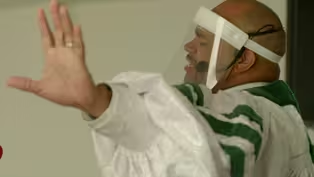
In environmental justice battle, church anchors Brown Grove
Video has Closed Captions
Clip: S1 Ep1 | 10m 44s | Church acts to preserve Brown Grove, historic Black community opposing industry intrusion. (10m 44s)
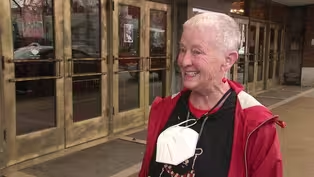
Land Rights | People of Virginia
Video has Closed Captions
Clip: S1 Ep1 | 31s | Virginians comment on efforts to protect Native American land. (31s)
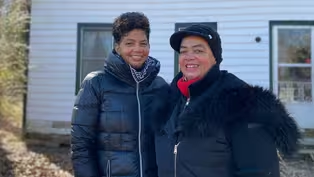
Sisters inherit Black owned land
Video has Closed Captions
Clip: S1 Ep1 | 2m 39s | The Paige sisters are determined to hold on to their ancestors’ land. (2m 39s)
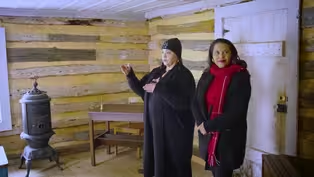
Virginia's tribes may benefit from land protection bills
Video has Closed Captions
Clip: S1 Ep1 | 3m 15s | General Assembly legislation aims to protect land of cultural significance. (3m 15s)
Providing Support for PBS.org
Learn Moreabout PBS online sponsorship
- News and Public Affairs

Top journalists deliver compelling original analysis of the hour's headlines.

- News and Public Affairs

FRONTLINE is investigative journalism that questions, explains and changes our world.












Support for PBS provided by:
VPM News Focal Point is a local public television program presented by VPM
The Estate of Mrs. Ann Lee Saunders Brown & Dominion Energy