
Examining the Supreme Court's birthright citizenship ruling
Clip: 6/30/2026 | 5m 40sVideo has Closed Captions
Examining the Supreme Court's birthright citizenship, campaign finance rulings
The Supreme Court wrapped up its term issuing major rulings in cases centered on some of the nation’s biggest political fights. The most high-profile is a landmark ruling striking down President Trump’s executive order seeking to end birthright citizenship. Geoff Bennett discussed more with Supreme Court analyst and SCOTUSblog co-founder Amy Howe.
Problems playing video? | Closed Captioning Feedback
Problems playing video? | Closed Captioning Feedback
Major corporate funding for the PBS News Hour is provided by BDO, BNSF, Consumer Cellular, American Cruise Lines, and Raymond James. Funding for the PBS NewsHour Weekend is provided by...
Examining the Supreme Court's birthright citizenship ruling
Clip: 6/30/2026 | 5m 40sVideo has Closed Captions
The Supreme Court wrapped up its term issuing major rulings in cases centered on some of the nation’s biggest political fights. The most high-profile is a landmark ruling striking down President Trump’s executive order seeking to end birthright citizenship. Geoff Bennett discussed more with Supreme Court analyst and SCOTUSblog co-founder Amy Howe.
Problems playing video? | Closed Captioning Feedback
Where to Watch PBS News Hour
PBS News Hour is available to stream on pbs.org and the PBS app.
Providing Support for PBS.org
Learn Moreabout PBS online sponsorshipAMNA NAWAZ: Welcome to the "News Hour."
The U.S.
Supreme Court wrapped up its term today, issuing major rulings in cases centered on some of the nation's biggest political fights.
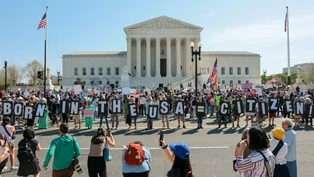
The most high-profile is a landmark ruling striking down President Donald Trump's executive order seeking to end birthright citizenship.
That's the guarantee of citizenship to virtually everyone born in the United States.
In his opinion, Chief Justice John Roberts wrote - - quote -- "Citizenship then and now was the right to have rights, to freely participate in our political community.
The framers of the 14th Amendment extended that promise to every free-born person in this land.
We keep that promise today."
GEOFF BENNETT: The justices also issued two other major rulings today, including upholding state laws that ban transgender athletes from women's and girls' sports.
And the court's conservative majority transformed campaign finance laws, lifting limits on how much political parties can spend on advertising and other expenses in coordination with the candidates.
We're going to break down each of these decisions.
And, to start, we're joined once again by "News Hour" Supreme Court analyst and SCOTUSblog co-founder Amy Howe.
Amy, it's great to see you.
AMY HOWE: Hello again.
GEOFF BENNETT: So, the court's conservative majority has handed President Trump a number of victories this term, but, today, it ruled against one of his chief goals, ending the promise of birthright citizenship to children born on U.S.
soil.
What was Chief Justice John Roberts' reasoning?
AMY HOWE: This was really a history lesson.
He sort of walked us through, starting with early English history.
He said, in Great Britain, if you were born in Britain, then you were a British subject.
He said the colonists brought that rule over with them to the United States, and everyone accepted it as the rule until the notorious 1857 decision by the Supreme Court in the Dred Scott case, in which the court ruled that a formerly enslaved person who was brought to this country was not a U.S.
citizen.
And so he said we enacted the 14th Amendment in 1868, both to ensure that formerly enslaved people were U.S.
citizens, but also to enshrine the broader birthright citizenship rule.
And then in 1898, in a case called Wong Kim Ark, the Supreme Court reaffirmed the idea that everyone who's born in the United States is a U.S.
citizen.
GEOFF BENNETT: We were talking earlier about how this case actually started.
And it was focused on a different legal question.
The administration won that earlier fight.
How did we go from that victory to the ruling against the Trump administration today?
AMY HOWE: Yes, so just about this time last year, we were here talking about a case involving challenges by the Trump administration to what's known as universal injunctions or nationwide injunctions, whether a single district judge could issue an order that bars the government from enforcing a policy or a law anywhere in the country.
And so here we had federal judges all over the country who were ruling that the Trump administration's order striking down birthright citizenship was unconstitutional and barring the government from enforcing it.
So the government came to the Supreme Court last year, asked them to rule that federal judges don't have that power.
The Supreme Court agreed with them, but these cases then went forward in this case as class actions, as groups of parents of would-be children who would be affected by the birthright citizenship order or the children themselves.
And so a federal judge in New Hampshire certified a class temporarily and ruled for the children against the Trump administration, and then the Trump administration appealed the birthright citizenship order to the Supreme Court.
GEOFF BENNETT: We're going to discuss the implications of this transgender athletes case deeper in a moment.
But Justice Kavanaugh wrote that the -- in the majority opinion, he said that states and schools -- quote -- "may maintain women's and girls' sports for biological females."
So what did we learn from this decision and how could it affect students across the country?
AMY HOWE: Yes, so, right now, roughly half the states have laws similar to the ones in West Virginia and Idaho that the Supreme Court upheld today.
They rejected challenges under both federal law and under the Constitution.
But as Justice Kavanaugh said, that the Supreme Court did not weigh in on whether or not other states could have laws or have policies that allowed transgender women and girls to compete on women and girls' sports teams.
Now, some of the lawyers who were involved in some of the cases have said that they will bring litigation challenging some of those policies.
There is already some litigation in the lower courts challenging the policies of allowing transgender athletes to play.
So we could see this issue back up at the Supreme Court soon.
GEOFF BENNETT: And on campaign finance, the court struck down the post-Watergate limits on how much individuals can give to political parties and how much those parties can spend on their candidates.
So that means that parties can now both coordinate with candidates and raise unlimited funds.
What was the reasoning behind that ruling?
AMY HOWE: So the Supreme Court has said that when you're talking about campaign finance restrictions, really, the only rationale for restrictions is to prevent corruption.
And what the Supreme Court said in this case is that there are other tools in place, these base contribution limits, what's known as earmarking rules, and then disclosure obligations, that go far enough to prevent corruption.
And so we don't need to have this, what Justice Kavanaugh in his majority opinion referred to as really sort of severe restriction on speech that these coordinated party limits impose.
GEOFF BENNETT: Amy Howe, thanks so much.
And we're going to hear from you more and a bit so don't go anywhere.
AMY HOWE: OK, thank you.

Dave Portnoy joins Amna Nawaz on 'Settle In'
Video has Closed Captions
Dave Portnoy and Amna Nawaz discuss media and controversies on 'Settle In' (5m 19s)

Hopes of finding earthquake survivors fade in Venezuela
Video has Closed Captions
Rescue efforts continue, but hopes of finding earthquake survivors fade in Venezuela (4m 59s)
How the birthright citizenship ruling impacts Trump's agenda
Video has Closed Captions
How the birthright citizenship decision impacts Trump's immigration agenda (4m 43s)

News Wrap: Central and eastern U.S. face dangerous heat
Video has Closed Captions
News Wrap: Heat wave brings dangerous temperatures to central and eastern U.S. (7m 15s)
Rep. Kean returns to Congress after mysterious absence
Video has Closed Captions
New Jersey Rep. Tom Kean returns to Congress after mysterious absence (5m 48s)
Supreme Court lifts limits on political party spending
Video has Closed Captions
Supreme Court transforms campaign finance rules, lifting limits on party spending (5m 30s)
Trump's response to Supreme Court rulings and what's next
Video has Closed Captions
Trump's response to the landmark Supreme Court rulings and what's next (6m 24s)
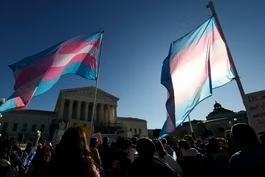
Who is affected by Supreme Court's ruling on trans athletes
Video has Closed Captions
Who is affected by the Supreme Court's ruling on trans athletes in women's sports (6m 24s)
Providing Support for PBS.org
Learn Moreabout PBS online sponsorship
- News and Public Affairs

Today's top journalists discuss Washington's current political events and public affairs.
 New Episode
- News and Public Affairs

FRONTLINE is investigative journalism that questions, explains and changes our world.



 New Episode


 New Episode


 New Episode
Support for PBS provided by:
Major corporate funding for the PBS News Hour is provided by BDO, BNSF, Consumer Cellular, American Cruise Lines, and Raymond James. Funding for the PBS NewsHour Weekend is provided by...