LANDMARKS
LANDMARKS: Classic Fall Colors Road Trip
2/18/2021 | 57m 45sVideo has Closed Captions
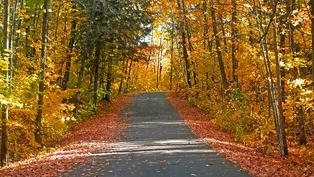
Join Doug Ohman for an adventure to north central Minnesota during the season of autumn.
Join Minnesota photographer and storyteller, Doug Ohman for an adventure to north central Minnesota during the magical season of autumn in the front seat of a classic 1968 Ford Mustang.
Problems playing video? | Closed Captioning Feedback
Problems playing video? | Closed Captioning Feedback
LANDMARKS is a local public television program presented by Pioneer PBS
This program is made possible by contributions from the voters of Minnesota through a legislative appropriation from the Arts and Cultural Heritage Fund and viewers like you.
Support provided by:

LANDMARKS
LANDMARKS: Classic Fall Colors Road Trip
2/18/2021 | 57m 45sVideo has Closed Captions
Join Minnesota photographer and storyteller, Doug Ohman for an adventure to north central Minnesota during the magical season of autumn in the front seat of a classic 1968 Ford Mustang.
Problems playing video? | Closed Captioning Feedback
How to Watch LANDMARKS
LANDMARKS is available to stream on pbs.org and the free PBS App, available on iPhone, Apple TV, Android TV, Android smartphones, Amazon Fire TV, Amazon Fire Tablet, Roku, Samsung Smart TV, and Vizio.

LANDMARKS Premium Gift Items
To order, email yourtv@pioneer.org or call 1-800-726-3178.Providing Support for PBS.org
Learn Moreabout PBS online sponsorship(upbeat instrumental music) - Is there a better time to take a Minnesota road trip than right now?
The heat and humidity of July and August are over.
It's now late September.
This is the most magical time for most people in Minnesota to enjoy the great outdoors.
My name is Doug Ohman.
I'm a Minnesota photographer, historic storyteller and I want to invite you to join me on another "Landmarks" road trip adventure.
We're going to travel through North Central Minnesota.
Again, we're going to see some great landmarks experience some history, and of course those quirky roadside attractions.
We'll find those as well.
And we're going to do it in style.
Once again, we're going to take a 1968 Ford Mustang convertible.
Thanks to my sister Dawn and my brother-in-law Jeff they've loaned me the car so we can really take this trip in style.
So grab your sweatshirt because you see the top is up right now, but the top is going to go down.
We're going to have fun with the top down over the next few days enjoying the best of Minnesota.
(upbeat cheerful music) (car whooshes by) (car engine roaring) (slow calm music) Our trip begins in Central Minnesota near the town of Sauk Center.
(slow calm music) And not far down the road we come to our first historic landmark, the village hall in the small but charming town of Grey Eagle, and it's worth a stop.
(slow calm music) It was built in 1934 as a federally funded new deal project to create jobs during the great depression.
The new deal was introduced by President Franklin Roosevelt to help the United States economy through these difficult years.
(upbeat music) I've seen a lot of new deal buildings in Minnesota but this might be my favorite.
In 1985, it was listed on the National Register of Historic Places.
(upbeat music) Don't you just love the Eagle above the door?
(upbeat music) (upbeat playful music) That was good.
(dramatic music) It's on the winding roads of Todd County that I noticed a vibration noise coming from the Mustang.
I think I need to stop and take a look.
I check the fluids and the tires but I think we should find a local mechanic shop just to make sure the car is in top working order.
We had a little detour today.
Probably a U-joint problem in the Mustang, but the timing couldn't have been better.
We're at Upsala motors, in the great town of Upsala Minnesota.
A friend of mine, Jake Grameth, his family uses this shop here for their auto repairs.
And I call Jake and he said, "You got to go to Upsala motors.
Talk to Dean and his wife and they'll take care of you."
Right away the car's on the hoist.
They have identified the problem.
We'll be on the road shortly.
Always thankful for great people in rural Minnesota that will help you.
- Stay on 230 all the way until you come to Bowlus- - Yeah.
- And there's a stop sign there and you'll see Bowlus kind of off to your right.
- Yes.
- And you go about a quarter mile and the road continues.
It goes... - I'll remember.
- Yeah.
- Heading East.
- You're heading straight East.
(laughs) - All right, take care.
- See you later.
- After saying goodbye to Dean Peterson at Upsala motors, we head East to the small town of Bowlus.
(upbeat music) Another new deal building is waiting for us.
The building was built in the 1930s in this mostly Polish and German community to hold the town jail.
Over the years, it's served as a village hall, and then in the 1950s became home to the fire department.
(upbeat music) (upbeat guitar music diminuendos) (rain pattering) The weather is threatening rain so we better keep the top up on the convertible.
We will cross the Mississippi river heading to our first real tourist stop on her adventure.
(train horn honking) The excitement of buying gifts at Treasure City just makes waiting for the long freight train in Royalton that much harder.
(upbeat music) Here I am at a Minnesota landmark, right along Highway 10, a main highway that takes a lot of people up North from the twin cities.
They pass Treasure city and hopefully you don't pass.
You actually stop.
Maybe get your picture by the big pirate.
It's a souvenir shop here in the great town of Royalton.
It's a great little shop.
We'll go inside and see it today, but then I noticed the door says closed.
They're close today, but we'll be back here at Treasure City Treasure City has been here along Highway 10 since 1962.
So I'm willing to bet we will make it back here on another road trip.
(slow calm music) As we head North on the highway, the rain is still falling but I see some streaks of blue in the sky.
I'm optimistic that the weather on this first day will turn out all right.
(slow calm music) We soon arrive in the town of a legend here in Minnesota.
Little Falls was the home of the famous aviator, Charles Lindbergh.
On the West side of the Mississippi river near the state park is his boyhood home.
The house was built in 1906 in that arts and crafts style, but what I really like about it is the story when young Charles hears a noise in the sky he has never heard before, and after climbing onto the roof of the house he sees his first airplane and most of us know the rest of the story.
(engine roaring) (upbeat bright music) Let's go back into town and see a few more local landmarks.
We can't come to little falls without stopping to see the actual falls.
With the recent rains the water is really moving.
Historically, this location was a sawmill site that used the power of the river.
Now it all makes sense why they located the mill and the town here.
Our next landmark is hard to miss.
In the center of town is the Morrison County historic courthouse.
It certainly is an impressive building.
It was built in 1890 at a cost of $55,000.
I'm not so sure we could even replace half the windows today at that price.
As we walked around the building, we will see a bronze statue of a man with a long beard, Nathan Richardson or better known as Uncle Nate.
He helped organize the County in 1856, but what I like best about Uncle Nate is that he was Morrison county's first historian.
(upbeat bright music) Before leaving Little Falls, a stop at its historic library is a must.
As I sit on the steps of this old Carnegie library here in little falls, Minnesota, I can almost feel the history.
Imagine Charles Lindbergh, maybe the most famous Minnesotan, actually climbed up these stairs and went to this library.
The library was built in 1904.
One of the earliest Carnegie libraries built in Minnesota.
Our first one I believe was 1899 in Duluth.
So this definitely is in the early Carnegie era for our state.
Andrew Carnegie built over 60 libraries here in Minnesota.
Over 2000 worldwide.
But this one is kind of unique because of its architecture and its style.
It's the only one of its kind in Minnesota and maybe only one of 10 in the entire country.
(upbeat bright music) It looks like the rain is almost gone, which is great because I think we should spend some time at a very sacred spot just seven miles North of Little Falls.
(upbeat bright music) Camp Ripley is the location of one of three state veterans cemeteries in Minnesota.
(upbeat bright music) Let's drive in and find a quiet spot to get out of the car and walk the rows of markers reading the names and reflecting on how thankful we are for those who served.
(upbeat bright music) Camp Ripley is at 53,000 acre military training facility that has an amazing museum showcasing some very cool airplanes, tanks and other vehicles.
(upbeat music) I could spend a lot more time here but the weather just doesn't want to cooperate.
We have just a couple more landmark stops before we end day one of our road trip.
We just left Camp Ripley.
Just a few miles further up the road I want to stop and show you the plaque designating Fort Ripley.
Fort Ripley was the beginning of the story that we know as Camp Ripley today.
It was started right here on the banks of the Mississippi river in 1848.
It's really cool to be out here by this plaque knowing what this place was 150, 175 years ago.
(slow calm music) Our last stop of the day is a visit to the oldest standing house North of the twin cities.
On the banks of the Mississippi river, in what today is Crow Wing State Park, is the Clement Beaulieu House.
It was built in 1849 overlooking the village of Crow Wing.
(slow calm music) Where is the village?
It actually faded into history during the 1870s, and this old house is all that remains.
(slow calm music) Looking through the window of the place is almost like being transferred back in time.
(slow calm music) (upbeat bright music) After a quiet night staying in the town of Baxter, let's get out early to explore more Northern Minnesota landmarks.
(upbeat bright music) Our first stop is in the tourist town of Nisswa.
Maybe we can pick up some souvenirs that we didn't get yesterday at Treasure City.
Situated along the Paul Bunyan bike trail, the town attracts tourists year round looking for that special made in Minnesota gift.
(upbeat bright music) Although the morning has started out cloudy and cool let's drive with the top down.
I'm feeling optimistic that the day's weather will only get sunnier and warmer.
(upbeat bright music diminuendos) Speaking of Paul Bunyan, our next stop will showcase Paul's fishing bobber.
After all we are in the heart of fishing country.
(upbeat music) The water tower Pequot Lakes certainly is a Minnesota landmark.
Below the water tower is a miniature version of Paul's sidekick, Babe.
I think we will see the larger version later in the trip.
(upbeat playful music) (upbeat jazz music) Just a few miles up the road we have to stop and get a closer look at a roadside attraction that is sure to bring back memories for many of us.
(upbeat jazz music) Wow.
This is what going up North is all about.
A vintage camper.
Back in the day this is how you went on vacation.
(camera shutter clicks) I love it.
(upbeat jazz music) (camera shutter clicks) (camera shutter clicks) (slow calm music) The road is smooth as we head North along Highway 371.
(slow calm music) I can't wait to get to the s'more capital of Minnesota.
Any idea?
Yes, it's the town of Pine River.
(slow calm music) A s'more is a campfire treat consisting of one or two toasted marshmallows and a layer of chocolate placed between two pieces of Graham Cracker.
Just thinking about having a s'more makes me feel like I'm up North.
(slow calm music diminuendos) The next town is Backus.
There are two landmarks I think are worth a quick stop.
(slow jazz music) The first one is visible right along the highway.
The Scamp is a lightweight travel trailer that is made right here in Backus.
Scamp is family owned and has been in business since 1971.
I'm sure over the next few days, we will see more than one Scamp on the road.
(slow jazz music diminuendos) Before leaving Backus, let's go into town and find another local landmark legend.
(upbeat bright music) Have you ever heard of Colonel Cobber?
Well, if not, you can meet him and read all about him in a small park.
I love that the story is connected to Paul Bunyan.
Best of all, what's his wife's name, Tasseltop.
Yes, you guessed it.
He is a corncob.
(upbeat bright music diminuendos) By mid-morning the temperature's improving and the clouds are clearing just in time for another Paul Bunyan story.
(slow calm music) Most of us know that the legendary Paul Bunyan had a sidekick.
It's Babe the Blue Ox, but how many knew that Paul had another babe?
Here she is on the shore of beautiful Birch Lake in Hackensack is Lucette, Paul's other babe.
(slow dramatic music) (upbeat bright music) We soon arrive at the popular up North destination, Walker, Minnesota.
(upbeat bright music) The town seems to always have a certain positive energy about it.
Maybe it's location on beautiful Leech Lake has something to do with that.
(upbeat bright music) I wish we had time to do some window shopping in Walker but the road is calling us on.
I want to make it over to Itasca State Park this afternoon.
The weather has cleared and I think the colors would be near peak at the park.
Let's head West through the rolling Hills of Hubbard County enjoying the smooth roads and the changing colors from green to orange, yellow and red.
(upbeat bright music) (upbeat bright music) A stop in the small hamlet of Lake George to fill the gas tank and get some road trip snacks allows us to see two fun landmarks.
Thank you, thank you.
Alongside the road, next to the convenience store is a log built post office.
It has been here since 1903, but what I really like about this stop is the large wigwam and totem pole.
It serves as a tourist souvenir shop, but sadly it's not open today.
(camera shutter clicks) Let's take a couple of photos and head down the road to Minnesota's oldest state park.
(upbeat bright music diminuendos) (slow calm music) The park was established in 1891, making it the second oldest state park in the country.
Over a half a million people visit the park annually.
Turning off the highway into the park makes us feel like we are entering a wilderness sanctuary.
The roadway is smooth as it snakes its way through maybe the most beautiful forest in Minnesota.
(slow calm music) The park has some of the oldest trees still standing in the state.
The trees were protected from loggers years ago, and as we admire them it's not hard to say thank you to those who had the foresight to save these landmark treasures.
(slow calm music) The park has a lot to offer, but the most popular attraction is the iconic spot where the Mississippi river begins its long journey through the heart of America.
Of all the landmarks in Minnesota, where I'm standing right now might be the most popular and recognizable in all the state of Minnesota.
I'm standing on the rocks at the beginning of the Mississippi river.
The river flows out of Lake Itasca.
If you follow the river, 2,500 miles it'll flow into the Gulf of Mexico.
I once heard a drop of water would take 90 days to get to the Gulf if it left right here.
Pretty amazing.
I love this spot.
I've always loved coming to Lake Itasca to the headwaters of the Mississippi.
(slow calm music) We continue making our way around the park.
(slow calm music) The days soon comes to an end.
(slow calm music) And the sunset over Lake Itasca seems perfect.
(slow calm music diminuendos) (slow calm music) After spending the night in Park Rapids, and before we explore the town, let's head South a few miles to see another Minnesota legend.
(slow calm music) Our first stop this morning after getting our cup of coffee is at another really fun roadside landmark.
We're here in Menahga, Minnesota and we're going to talk about Saint Urho.
Remember yesterday we were over in Hackensack and we saw Lucette, Paul Bunyan's sweetheart.
Not too many miles away is Saint Urho.
I love this story.
He was the patron Saint of Finland and we celebrate Saint Urho day every year, one day before Saint Patrick's day on March 16th.
The legend of Saint Urho, he saved the vineyards in Finland by chasing and killing the grasshoppers with his rake, and right here in Managua, along Highway 71, we have this great statue of the patron Saint from Finland.
I heard of interesting story.
I'm not even sure it's true, but I like it.
That Saint Urho was actually created by a man in Minnesota.
I love those stories.
We're going to continue our trip up the road.
So come along and let's have some fun.
(slow calm music) Heading North on Highway 71, we soon arrived back in Park Rapids.
Park Rapids is the County seed of Hubbard County, but what I like about it most, it is, I believe, one of only two towns in the entire state of Minnesota that you park your car in the center of main street.
Does anyone know the other town?
Okay, I'll tell you.
It's the town in Southwestern, Minnesota called Slayton.
Even though it's chilly this morning, how about taking the top down on the Mustang?
There is not a cloud in the sky so I think it will be a perfect Minnesota fall day.
It never gets old watching how the bright red Mustang attracts local folks.
Everyone seems to want to take a closer look and I enjoy sharing a few stories about the car and our trip so far.
(upbeat bright music) After spending some time window shopping along the main street.
I think it's time to move on down the road to find some more unique and fun landmarks.
We don't have to travel far.
East of Park Rapids just off of Highway 34.
We have to at least drive into the town of Dorset.
In 1986 it was the smallest town in the United States with a bank.
I think the population today is still less than 25.
The very next year in 1987, Dorset was named restaurant capital of the world.
Too bad we're not ready for lunch yet.
(slow calm music) During the summertime, this place is hopping not only because of dining, but because it is located on the Heartland bike trail.
The trail runs nearly 50 miles between Park Rapids and Cass Lake.
(slow calm music) (wind howling) As we travel further East on Highway 34, we will soon come to a very cool world's largest.
In the town of Nevis is the world's largest tiger muskie right along the bike trail under a picnic shelter.
So next time you're in Nevis, have a picnic next to the big smiling fish.
(upbeat playful music) Do they catch tiger muskies in the nearby Lake called Belle Taine?
Let's drive down by the Lake and see if we can get an answer to that question.
Unfortunately, no one is fishing at the public dock.
So let me check on the DNR sign.
They list a lot of fish, but I don't see tiger Muskie.
I guess we will have to enjoy the big fiberglass one in town or the one painted on the water tower.
(slow jazz music) The day is warming up and it's good that we decided to put the top down on the Mustang back in Park Rapids.
Our next town is Akeley and I think it has one of the coolest landmarks in Minnesota.
I liked this landmark and the town because I have a personal connection here.
Did you know that Paul Bunyan was born in Minnesota right here in the town of Akeley?
Behind me, above me is the world's largest Paul Bunyan.
He stands 30 feet tall, or should I say he kneels 30 feet tall.
If he stood up, he'd be 40 feet.
There's a Paul Bunyan in California that's taller than the Akeley Paul Bunyan, but if our Paul Bunyan stood up, he would be the world's tallest.
So I think our Paul Bunyan is the world's tallest Paul Bunyan.
In 1984, a local man by the name of Dean Kretzer constructed the Paul Bunyan here in Akeley.
Interesting fact.
His hair and beard is one mile of resin soaked twine.
I think that's pretty cool.
I love this little town of Akeley.
My grandmother was born here in 1906, so I feel like it's kind of home.
So I have a connection with Paul Bunyan and his birthplace.
(upbeat bright music) (camera shutter clicks) (camera shutter clicks) (camera shutter clicks) (camera shutter clicks) After taking some photos of Paul Bunyan let's drive by the house that my grandmother was born in.
(slow calm music) What was the town like in 1906?
All I know it was a blooming lumber town from the stories I heard about my great-grandfather.
The town today has a certain charm to it for sure.
(slow calm music) I love the handwritten sign on one of the main street shops.
(slow calm music) Back on the road we will head North to the town of Bemidji.
(slow calm music) Bemidji is home to the original Paul Bunyan.
In a city park along Lake Bemidji stands the 1937 Paul and his partner, Babe the Ox.
You can't come to this town and not stop for a photo op.
This certainly is one of the most recognizable landmarks in the entire state.
I once heard the reason Paul and Babe were brought to Bemidji was to help the town's economy during the great depression of the 1930s when the town started a winter carnival, but whatever the reason, I'm glad they're here to greet us as we explore a little of Downtown.
(upbeat bright music) The clouds are starting to roll in and the wind is picking up.
(tense music) It looks like a major storm is on the way.
I've heard it said that a person only has to wait a couple of minutes in Minnesota and the weather will change.
Let's pull into a local Dairy Queen and put the top back up on the car.
As long as we're here, why not a roadside treat?
(upbeat playful music) (tense music) We are barely back in the car and here comes the rain.
(rain pattering) Thank goodness we stopped for ice cream and put the top up on the car.
As we drive along the lake, we can actually see the line of rain moving out of the North.
Hopefully the rain will stop before we reach our next destination.
We are heading North to the world's largest black duck.
Yes, you guessed it.
We are going to the town of Blackduck.
How did this town get its name?
According to local legend, the name comes from a translation of the Indian name for duck or Cormorant.
If you have ever seen a Cormorant they certainly are black in color.
Okay, now that we've solved that mystery let's get out quickly and take some photos before the rain decides to chase us back into the car.
(camera shutter clicks) (camera shutter clicks) As we leave the duck and drive through town, I am reminded of a local story about an early pioneer, Mr. Henry Funkley, a Minnesota attorney, came to town in December of 1900 and decided to locate here.
Funkley later was quoted, "There is only one country in the world and that is the U.S.
There was only one state in the U.S. and that is Minnesota and there was only one place in Minnesota and that is Blackduck."
(slow calm music) Not far up the road from Blackduck is the smallest town in Minnesota.
(slow calm music) Yes, it was named after that man, Mr. Henry Funkley.
I believe the last count was a population of five.
Although the town sign is on the highway, in order to see the actual town you have to take a road less traveled.
(slow calm music) On the way back South to Bemidji, where we will end our third day on the road, let's make one more stop in another very small town.
(slow calm music) Maybe not as small as Funkley, but Hines is certainly close.
Like a lot of towns in this area of Minnesota they were early logging villages.
It sure is quiet today in Hines, as we check out the country store.
(engine roaring) (slow calm music) We took a chance and it didn't work out to see what they were selling in the pioneer store.
Maybe next time.
Now let's head back to Bemidji.
(upbeat jazz music) After a night in Bemidji, it looks like the rain of yesterday has moved on so let's head out early.
I am excited to see what our final day on the road has in store for us.
For the past three days we have definitely put on some miles and I've seen some of Northern Minnesota coolest landmarks.
Throughout the morning we will be driving almost directly East on U.S. Highway two.
This highway stretches for over 2,500 miles from coast to coast and 264 of those miles are here in Minnesota.
(upbeat jazz music) (upbeat bright music) Our first stop is in the town of Cass Lake.
(upbeat bright music) It's beginning to get light out, but I wanted to show you another landmark library.
What makes it unique, it was one of the last WPA projects built in Minnesota.
I also love that it is one of the state's smallest libraries.
As we pull up in front of the library to take a photo or two it's clear that we have arrived too early to see the inside, but that's okay.
It's still worth a stop.
We have seen a couple depression era buildings so far on our trip, and this is just another great example of incredible stonework.
(upbeat bright music diminuendos) After leaving Cass Lake let's head to another favorite landmark.
We are going to see another big fish.
Yesterday we saw a pretty big fish in the town of Nevis but this one coming up in the town of Bena is even bigger.
It's also a muskie but I think it's the regular one versus a tiger muskie.
(upbeat bright music) I love the story of the big fish.
It was the brainchild of a local man, Wayne Kumpula who owned the cafe next door and thought that a mammoth muskie would draw a younger fun-loving crowd off busy Highway number two.
The fish was a drive-in for a while serving hamburgers and hot dogs from a walk-up window, but the idea flopped.
People did not want to eat food cooked inside a giant fish.
Decades passed, and the big fish reached its 50th birthday showing its age.
In 2009, it got a much needed restoration and now it's a fun place to stop and take pictures.
Check out the big teeth.
(engine roaring) Not far from the big fish, let's stop at my favorite gas station in Minnesota and fill up the Mustang.
It's called the Big Winnie general store.
(upbeat music) Named that because of a large nearby lake called Lake Winnibigoshish.
The store was built in the 1930s in a pagoda style.
Supposedly designed by Frank Lloyd Wright while he was in Bena on vacation.
(upbeat music) Whether the story is true or not, this landmark stop fits right in with many of our fun Minnesota stories that we've discovered so far on the trip.
(car whooshes by) Before reaching our furthest Eastern town on our journey, Grand Rapids, we will pass by the towns of Deer River and Cohasset.
Deer River has a population of around a thousand and is home to the world's largest wild rice festival.
Both Deer River and Cohasset are tourist destinations in all four seasons in Minnesota.
On the outskirts of Grand Rapids, I want to stop in a small park, along the Mississippi river and get some pictures of the Pokegama dam.
(upbeat bright music) Clouds are still hanging around and the temperature is keeping the top up on the car, but I'm hopeful as the day continues the weather will only improve.
The concrete and timber crib dam was constructed in 1884 by the U.S. Army Corps of Engineers.
It was built for flood control and navigation.
The dam was rebuilt in 1936.
Let's take the walkway and get some pictures.
The fall colors are near peak along the riverbank.
(camera shutter clicks) (upbeat bright music) We soon arrive in the hometown of Minnesota's most famous movie star, but before visiting Judy Garland's home I want to show you a really cool landmark in downtown Grand Rapids.
(upbeat bright music) Right along busy Highway two in the center of downtown sits one of the coolest old school buildings in all of Minnesota.
Old central was built in 1895 and served as an elementary school from 1895 to 1972.
A community effort restored the building in 1984 and since it's restoration it serves as a multi-tenant location for commerce, culture and community events.
(slow calm music) I know what you're all thinking at this point on our trip.
Let's go see Judy.
All right, you convinced me that a trip to Grand Rapids without a stop at the Judy Garland House and Museum would simply be wrong.
I'm probably not the best person to introduce you to probably the most famous movie star ever to come out of Minnesota, Judy Garland, the star of the Wizard of Oz.
The reason I say that, I have never even watched the movie but Judy Garland lived in the house I'm sitting on the steps at right now.
Back in the 1920s she spent about four or five years as a young girl in this house.
Her real name is Frances Gumm.
Her movie star name, as we all know, is Judy Garland.
(slow calm music) Let's go in the house in the adjoining new museum to see some amazing local history.
(slow calm music) After seeing this incredible landmark, I should go home and watch the movie.
I could spend a lot more time at the Judy Garland site but the road is calling us on.
(slow calm music diminuendos) (slow calm music) Our next town is South along Highway 169 to the small village of Hill City.
The town's history goes back to the early 20th century as a lumber town.
I love the history of towns, but what is really cool about this town is that it has its own black bear.
(slow calm music) After getting some pictures of the bear, let's continue South to another landmark site.
I want to show you my favorite bridge in Minnesota.
To find it, we will follow the green and white great river road signs to the town of Palisade.
(slow calm music) On the banks of the mighty Mississippi river, in the small town of Palisade, might be the best landmark of the trip so far.
This historic bridge.
I love this bridge.
It was built in 1913.
It was a railroad bridge, but what I really like about it, it's a survivor.
It's one of the last iron trust bridges left on the Mississippi river in America and we have it here in Minnesota.
Again, it was built in 1913.
It was a railroad bridge.
Today, it's a walking trail bridge, a biking trail bridge and in the winter they use it as a snowmobile trail bridge.
So we're still using a 1913 bridge today which I think is really, really neat.
(upbeat bright music) Let's spend some time on the bridge just enjoying the fall colors and the water below.
(upbeat bright music) Not far out of town, we have to stop and get a photo of another survivor.
These landmarks are disappearing every year and sadly before too long, they will be harder and harder to find.
(upbeat music) The weather has certainly improved this afternoon and I'm excited go to the only stoplight town in the entire County of Aitkin.
After the small towns of Hill City and Palisade Aitkin is a nice change of pace.
(upbeat music) Aitkin was founded in the year 1870 and named for William Alexander Aitkin, a partner in the American Fur Company.
(upbeat music) Lets cruise through downtown and see if we can find some interesting landmarks.
Maybe my favorite landmark in Aitkin is the Art Deco Rialto theater.
The Rialto was named after the Rialto theater in New York.
It's pretty cool to think that small town Aitkin Minnesota has a connection to New York city.
(upbeat music) (upbeat bright jazz music) Aitkin's Rialto had its grand opening on April 30th, 1937.
Wouldn't you have loved going to its first movie?
(upbeat bright jazz music) We can't leave town without a quick stop to get two photos.
The first is the County courthouse and right next door is the old town Carnegie Library that is now an art center and gift shop.
It's great to see our landmarks being saved.
(upbeat jazz music) Before our road trip is over, we have one more stop.
South of Aitkin on the shores of beautiful Lake Malax in Garrison is a very recognizable landmark.
Yes, another big fish.
Our road trip is nearly over.
I'm kind of sad about that in one way, but as I think back on the past four days we've had a lot of fun, haven't we?
I want to thank you for joining me riding along, exploring Minnesota landmarks.
We've seen a lot and a great place to end our trip is on the shores of beautiful Lake Malax in front of the state fish, the big walleye.
Once again, thanks for joining me.
Enjoy your own road trips.
Get out and enjoy the beauty of Minnesota.
(upbeat jazz music) - Okay, oh.
- Whoa.
- Rocks.
- Be careful now.
Enjoy some additional footage from the road.
- Here we are somewhere in the- Northern regions - North land.
North land.
- North land.
- Can you guess where we're at?
Do you think they can guess?
We're on the 19th hole.
What year do you think it is kids?
- Oh, I'm looking at the sixties.
- Sixties.
- Tune in.
We'll be doing more of these as we hit the road.
All right, now let's try this again.
After we had some technical difficulties.
Today, here we stand... - At the headwaters of the Mississippi, Lake Itasca state park, Northern Minnesota.
- Lake Itasca, right where you can walk right across the Mississippi river right behind us.
Living in Minnesota my whole life.
Never been here.
Make sure that you tune into "Landmarks", our series, starring Doug Ohman right here.
- Couldn't happen without this guy though.
- I'm behind the scenes.
You won't see me.
Okay.
I think we're on the air.
- We're live.
- We're live on Facebook right now.
And Doug and I thought we'd stop and take a photo 'cause it said old timer photos, but we found out it's old time photo.
- And we're going to see a real special landmark in April.
Do you know what it is?
- I bet you it's something to do with Paul Bunyan.
Maybe.
- The largest Paul Bunyan in America.
- On our '68 Camaro... Or a Camaro.
Should have been a Camaro.
It's a Mustang.
'68 convertible Mustang.
We put the top down.
- You need to get off the show now.
(both laugh) - We're going to let a Ford in on the show but it should have been a Camaro.
But anyway, we're traveling around in this cool car.
All right, I think we're rolling.
We'll get a little closer to the microphone this time.
People didn't hear us.
Getting out of the wind.
- Been a lot of fun though, hasn't it, for four days?
- It's been a struggle.
(both laugh) - We've had to put up with each other.
- Oh, that is the worst part.
- I mean, that's been more of a challenge for me.
- That's the biggest challenge.
- Yeah.
- Then having to go to the mechanics.
First day, get the U-joints replaced.
That baby has been running perfect.
- And no seat belts.
- No seat belts.
- I've been a good driver though.
- It has high beam.
You got to click it with your left foot.
Thanks for coming along.
(upbeat bright music)
LANDMARKS: Classic Fall Colors Road Trip
Join Doug Ohman for an adventure to north central Minnesota. (30s)
Providing Support for PBS.org
Learn Moreabout PBS online sponsorship













Support for PBS provided by:
LANDMARKS is a local public television program presented by Pioneer PBS
This program is made possible by contributions from the voters of Minnesota through a legislative appropriation from the Arts and Cultural Heritage Fund and viewers like you.