
Episode 104: The Fight Against COVID-19
1/28/2021 | 26m 46sVideo has Closed Captions
Hosts discuss the latest in Illinois' fight against COVID-19, and more.
Host Hannah Meisel (NPR Illinois) and guests Charlie Wheeler (UIS) and Peter Hancock (Capitol News Illinois) discuss the latest in Illinois' fight against COVID-19, House not meeting in February except to approve rules, and Heather Steans and Andy Manar leaving the Senate.
Problems playing video? | Closed Captioning Feedback
Problems playing video? | Closed Captioning Feedback
CapitolView is a local public television program presented by WSIU
A production of WSEC-TV/PBS Springfield.
Episode 104: The Fight Against COVID-19
1/28/2021 | 26m 46sVideo has Closed Captions
Host Hannah Meisel (NPR Illinois) and guests Charlie Wheeler (UIS) and Peter Hancock (Capitol News Illinois) discuss the latest in Illinois' fight against COVID-19, House not meeting in February except to approve rules, and Heather Steans and Andy Manar leaving the Senate.
Problems playing video? | Closed Captioning Feedback
How to Watch CapitolView
CapitolView is available to stream on pbs.org and the free PBS App, available on iPhone, Apple TV, Android TV, Android smartphones, Amazon Fire TV, Amazon Fire Tablet, Roku, Samsung Smart TV, and Vizio.
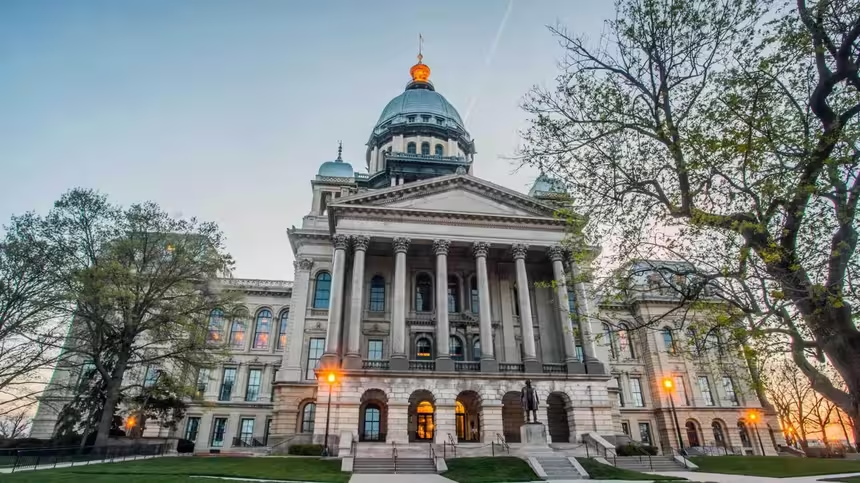
CapitolView
CapitolView is a weekly discussion of politics and government inside the Capitol, and around the state, with the Statehouse press corps. CapitolView is a production of WSIU Public Broadcasting.Providing Support for PBS.org
Learn Moreabout PBS online sponsorship(dramatic music) - Welcome to Capital View.
Where we discuss the latest in state, government and politics.
I'm Hannah Meisel with NPR, Illinois.
Joining us this week is Charlie Wheeler Director Emeritus of the Public Affairs Reporting Program at the University of Illinois Springfield.
Thanks for being here, Charlie.
- Thank you.
It's always my pleasure.
I enjoy doing this.
- And also here is Peter Hancock of Capital News, Illinois.
Glad you're here, Peter.
- Hi Hannah.
It's good to see you.
- So let's get down to it.
Kinda not necessarily the biggest news week in Springfield but definitely some big developments in states fight against COVID-19.
This week on Monday, the state moved to what's called phase 1B of the vaccine distribution.
And phase 1B includes folks who are frontline, essential workers, you know, teachers, first responders, folks who work in the correction system and also controversially, inmates as well.
Daycare workers and other folks.
And then also seniors over 65.
Of course everyone, or most people are eager to get vaccines but that doesn't mean that everyone can get vaccines all at the same time.
There's definitely a much, much much higher demand than there is existing supply.
So Peter, let's start with you.
Where are we now?
You know, the Biden administration this week promised both a vaccine like a boost in vaccine supply to states and earlier notifications to states, but you know, how has the governor and the Pritzker administrations vaccine rollout gone this week?
And do you think that any hiccups and glitches and all that stuff, is that gonna stick to the governor going forward in terms of his leadership on this?
- Well, I think the portion of it that the governor is responsible for has gone as well as can be expected given the amount of supply that's available.
The big hiccup has been in administering doses to residents and the staff of nursing homes.
And that's being administered by a federal partnership with some large retail pharmacies, CVS, Walgreens et cetera.
That's where the big hiccup has been so far.
They haven't been, only very small, relatively, small percentage of that target population has even gotten their first dose yet.
Now the Biden administration has said they're going to, they're ramping up production.
And I think the biggest thing out of the Biden administration was that they're going to tell states on a rolling three-week basis, here's what you can expect in week one, week two and week three.
And so far it's been, you know, you only know how much you're gonna get basically when it arrives or a couple of days in advance.
And so it's really hard to line up appointments for people to come in and get the vaccine 'cause you don't know how many appointments to make or how many doses you're gonna have.
So that plan should start smoothing things out around the country and in Illinois, I suspect - Right, and the Pritzker, I mean, as you mentioned, this CVS and Walgreens federal partnership that was set up under the Trump administration last fall, has not performed as well as was expected.
And Pritzker's far from the only governor complaining about the partnership.
However, as I reported this week, it was the Pritzker administration who actually set.
So there's basically two types of long-term care facilities.
There's build nursing facilities which you traditionally think of as nursing homes.
And then there are assisted living facilities.
And the governor is complaining about the flow rollout but it turns out that the procured administration set that January 25th date for assisted living facilities when other states had set that date for activation of those vaccinations much earlier.
The Pritzker administration still claims that it wasn't them who set that date.
But regardless, you know, that is one, of course, this is all about like logistics are hard.
Like I don't, I certainly don't have a degree in logistics but you know, for the average person trying to get a vaccine appointment, Charlie, I mean, how much do you think this sticks to them when, you know, in the nursing home population or assisted living population, families are really worried and confused and agitated.
And then in general population, there's just a bunch of confusion about where to get a vaccine appointments.
Charlie, do you think that this can be easily fixed?
Or do you think this is gonna be a problem the Pritzker administration is going to have to deal with for months and then stick to him for the 2022 election?
- Yeah, I would think that the, what Peter referred to the fact that we're going to get more doses of vaccine from the federal government.
And it seems like the federal government has finally got its act together.
It's finally decided, yeah, this is pretty serious.
We better start taking things like social distancing and wearing masks.
You know, that's for real.
We really gotta do something like that.
And so when we know how many doses we're gonna get with some certainty and we know three weeks ahead of time, we can start lining things up.
And I think the time to be finger-pointing, yes, it's Pritzker.
No it's Walgreens.
I mean, in my mind, that's secondary.
Let's get the shots in people's arms and we'll worry about who's responsible for what once we've got people more readily vaccinated.
And I think the notion that has been discussed about bringing in national guardsmen to help administer shots, I think that's a good idea.
Having dentist give the vaccine.
I think that's a good idea.
Somebody made the argument, well, dentists don't know how to give shots.
And I'm thinking, man, have you ever had a tooth out?
Have you ever had a root canal?
They sure as heck do know how to give shots.
And so I think things look good moving forward.
But as you said at the opening, Hannah, we're not sure what's gonna, as this vaccine or I'm sorry, as the virus mutates, as they always do, and we get new strains, it's unclear the optimism, I guess and the tiny garden estimate at this point is that the vaccines we now have are gonna work with these new variations that have turned up in the United Kingdom, I think in South Africa, Brazil.
But we don't know that for sure.
The one thing that appears to be true is that it spreads a lot more rapidly and a lot more easily than what we have been used to up to this point.
So I would say that if people are really concerned, what you oughta do is just follow the guidelines.
Wear a mask when you're outside social distance.
Don't go hang out in bars, that kinda thing.
And I would suggest that had we taken Corona virus COVID-19 as seriously from the get-go, as we did say, mobilizing ourselves after Pearl Harbor, we'd be in a much better place today.
- Sure.
I mean, I remember having a thought way back in March, like, okay, this is very scary but maybe everyone will be able to adopt some sort of World War II mentality.
And I feel like the opposite has happened in the corners and you know, but it's also, that's basic human incentives when you're not really given a better option, you're gonna do what's best for you and your family.
And sometimes that is selfish.
And it doesn't encourage cooperation.
But you know, you mentioned this new UK variant.
It's more contagious, some estimates up to 50% more contagious.
And it's kind of like a race between, you know, vaccinations and this new variant.
The CDC, I believe, says that in March, the UK variant is estimated to be the dominant strain in the us.
So, you know, the state is setting up all of these mass vaccination centers.
The governor has visited three so far this week up in the Chicago suburbs.
And he wants there to be, I think, two dozen more or you know, throughout the state, which is that's great.
But you know, of course, supply has to have matched.
But Peter, I mean, at the same time in January we have seen a market, market decrease in COVID metrics throughout the state.
As of now, we film on Thursdays.
All but region four in the Metro East has that gotten back to being able to have indoor dining.
And then also last week, the Pritzker administration announced that youth sports could resume.
And the IHSA this week announced details of that.
But you know, is that really gonna have egg on their face if this new, more contagious variant causes yet another surge?
And we have to go back into, you know, much more strict mitigations?
- I don't know that they'll have egg on their face.
I mean, you can only lock down a society like ours for so long.
But yeah, I mean the new UK variant is very scary.
As far as we know and from everything I've read, they believe the current vaccines will still work against that variant.
It just takes many fewer droplets in the air to pass it from one person to another.
And that is very scary.
And so, yeah, even though most parts of the state are allowed to loosen up a little bit.
And I think the message you're hearing from Dr. ZK and from governor Pritzker is this does not mean it's time to let your guard down.
You still have to wear a mask.
You still have to wash your hands.
You have to do all of those things.
And, you know, I think the thing that really concerns me is that we can vaccinate everybody in the United states.
And we're still not gonna be safe if we don't vaccinate everybody in India and Vietnam and Brazil.
I mean, this has to be a global effort.
The only thing I can compare it with was made back in the 50s when you saw the polio vaccine or the smallpox vaccine.
It has to be done globally.
Otherwise, nobody is gonna be safe from this for a very long time.
- Yeah, that's a good point.
I mean, wealthy countries like the US have been buying up a supply leaving poor countries kind of, could be a few years until they're fully vaccinated.
And then, you can't necessarily stop travel.
You can impose some travel bans, but it gets dicey.
But just, PSA because of this new variant experts are recommending double masking if you're not already wearing a mask with more than a few layers.
So moving on, I mean, we also had, at the end of Lame-duck session earlier this month, the new speaker's chief of staff, which is also the old speakers chief of staff tested positive for COVID and a few others did too, that we never learned their names.
And that was with being in this big downtown convention center, the Bank of Springfield Center.
Which by the way, is expensive to rent.
And so I think lawmakers had a little bit of a scare and some of them have been wanting to get vaccinated, despite, you know, they're not covered by this new phase 1B.
But Charlie, the house has now canceled most of its session through February but they are going to meet on February 10th in Springfield with the sole purpose to pass new house rules which would allow for virtual meetings.
So, I mean, do you think that that's a good idea?
I mean, obviously, it's better than not meeting at all but you know, what kinds of risks does that pose from like a participation standpoint?
And what do you think they need to address first?
I mean, what's most urgent on their plate?
- Well, I would say probably the most urgent is to adopt new house rules that would allow for remote participation.
And particularly that would allow committees to meet via Zoom or via some other method rather than have to try and meet in person.
They can do that in one day and it doesn't require the Senate.
It doesn't take three readings.
It's just, here's the rules and we'll adopt them and that'll be it.
And they're going to attempt to follow the message that the Senate did during the Lame-duck session where members, the full 118 members will not be on the house floor at any given time.
Rather, they'll be in their offices or watching remotely somewhere on their phones, maybe from the local bar, who knows?
But when it's time to vote, they'll come in designated groups.
And the only vote they really have to take, I'm assuming will be to approve the rules.
And then as you guys you've covered the legislature more recently than I can attest, the first couple of months, nothing actually gets passed and sent to the governor.
Most of the work is done in committee.
Where bills that have been introduced, are reviewed.
There is testimony heard, the committee decides whether we should approve this bill as is maybe adding an amendment or two.
And then send it to the full chamber for consideration.
So we can get through maybe the rest of the January, all of February into March without actually having everybody there all at once at the same time.
And by then, if everything goes according to plan, a much broader segment of the populace will have been vaccinated.
And a lot of the legislators, a little bit of vaccinated too, simply because of their age.
And so I think moving forward, it seems to me that that's a sensible plan to deal with.
Now, the only other thing that was on the schedule, of course, as the governor is supposed to give a budget address on February 17th.
And he'll probably combine it with the state of the state but there's no reason he can't do that remotely using Zoom.
In fact, maybe it would be easier because it would also flip up a PowerPoint presentation to go along with his comments.
- Yeah, I mean, I guess I wouldn't hate it.
Like I always like to be in the chamber but PowerPoints are always nice.
(laughs) You know, one of the things that the legislature is gonna have to deal with is it's pretty massive budget hole estimated somewhere between four and $5 billion, depending on who you ask.
But Peter, the Institute of Government and Public Affairs at the University of Illinois this week came out with a study that said that maybe state government revenue losses were not as dire as originally predicted.
What does that mean for the state's budget going forward?
I mean, you know, it's not like the state is flush with cash.
We've had budget problems for decades, but does this put any less pressure on, hope for a federal coronavirus relief package part two?
That would offer aid to states and local governments?
- That is definitely one thing that lawmakers and the governor are hoping for, President Biden has proposed it.
I think that element of it is still meeting a lot of resistance among Senate Republicans.
So there may have to be some negotiation there, but yeah.
The budget hole is significant.
It was helped out in part by the fact that we borrowed what was it like $2 billion from the Federal Reserve to pay down Medicaid bills.
And I think as Charlie has pointed out, for every $1 the state spends on Medicaid, it gets 50 cents back from the federal government.
So we not only borrowed money but we were able to draw down more federal money.
I do think it's interesting that the overall revenue situation did not match what people thought was kind of the worst case scenario going into the pandemic.
I mean, there was a drop-off in revenue in the early months of the pandemic, then it rebounded in the summer.
And part of that was because they pushed the tax filing deadline back from April 15th to, was it July 15th or something like that.
So they got a big bump in the first half of this fiscal year just because the tax deadline was moved back.
But yeah, I mean, overall, it's not as bad as some people were fearing.
It could be.
They're still gonna have to find about a billion dollars or so in the budget that they either have to cut out of the budget or hopefully fill it in with federal revenue.
- Yeah and another thing to remember is having borrowed money to help us through the immediate crisis, according to the controller, we have to pay back before June 30th something $1.3 billion of the money that we borrowed.
And I suppose we could go out and fold another loan, you know, like a payday loan operation or whatever.
But it's still, it's gonna be difficult.
Now the bill backlog towards the end of this week, the control reported was $4.7 billion which is the lowest it's been in years.
But again, part of that is the money that we borrowed to be able to pay off bills.
So I think we still got a ways to go.
- And I think it was in December.
The governor had floated something like $700 million in budget cuts that he could make unilaterally through the executive power.
But then that still left Illinois with something like 1.3 billion that we needed to fill.
And he said, oh, I'm looking for ideas from legislators.
And then the house Republicans have consistently said, well, we asked the governor for his ideas months ago and there seems to be some sort of like stalemate dance there and we still haven't heard much of anything there.
I mean Charlie, what do you think is the likelihood that the governor and lawmakers are gonna be able to find $1.3 billion additional in cuts?
- I would say it'd be pretty difficult simply because you look at where the state spends its money.
I mean, you can sit down with a piece of paper and say, oh yeah, well, we could cut a billion dollars out of school aid.
Now do people really wanna see that?
We could say, okay, we're gonna cut a billion dollars out of healthcare.
Do people want to really see that?
All the survey suggests that people don't wanna see cuts in anything real.
They wanna cut this vague waste and mismanagement which I would say does not exist.
And I'll repeat something I've said for years.
Waste to me is any program from which I personally do not benefit.
And so that's the difficulty.
And the Republicans are in the position, they can say, well, we don't have to suggest anything.
You guys have control.
You have the governor, you have majorities in both chambers.
You do it.
So we'll just sit back here and whatever you suggest, we'll object to.
If you wanna close a prison down in Southern Illinois.
Oh no, we're not gonna be for that 'cause we're gonna lose jobs.
So it's a difficult situation.
And I think as Peter said, one thing that is gonna be very helpful is if the US Congress finally does decide to provide some help to state and local governments to make up for revenues lost not through waste and mismanagement, but through the impact of the Corona virus on their revenue streams.
- Yeah.
And we all, I mean, I feel like we just ended the budget in pass, even though it was almost four years ago at this point.
But we learned a lot of lessons about how the state budget works and doesn't work.
And you know, a lot of things just go on autopilot because they are either constitutionally mandated or they're governed by court orders and consent decrees.
But here at the end, I wanna switch gears to talk about two kinda stalwart senators.
Not that they've served like for decades.
But Andy Manar had served in the Illinois Senate for I think it was eight years.
But became a pretty well-known quantity especially in Central Illinois, a Democrat from Marker Hill.
And then also Heather Steans on North side Chicago, Democrat had served for almost 13 years.
Both resigned.
Well, I guess Heather still has a couple of days left.
But you know, searching for their replacements always becomes one of these things where people cry foul and say, oh, that's not fair that, you know, party bosses get to appoint someone.
And these people aren't elected and there's no mechanism for a special election.
Peter, I mean, is this a fair argument that people mount every single time?
- I there is some fairness to it.
I mean, this seems to be a much more common practice in Illinois than I expected to see.
People will run for reelection, serve out half their term, resign, so that the next person who runs for reelection will get to run as an incumbent.
And I think that voters, it's not just voters but there are other potential candidates out there who say, you know, you're not opening up the process to all potential comers.
So yeah, there could be a mechanism where, you know, if there's more than half of a person's term left, there could be a special election or something like that.
But that's not the way it is in Illinois.
And when people leave, they do it strategically.
So that the people behind them, typically their supporters can choose a replacement.
And then the next time around, that person gets to run as an incumbent.
- But Charlie - I would say one of the difficulties with the notion that well, we should have a special election is that special elections actually cost money.
They don't happen for free.
And so at the same time, when people are talking about we have to cut back and we have to watch our spending.
So if we would have changed the rules and say, okay, Wheeler is retired.
And so we're gonna have to have a special election in his district to replace him.
Outside of the city of Chicago and the Metro region, downstate areas that involves multiple counties where the county election machinery, we have to be geared up, we'd have to go through this whole process, spend a ton of money.
And I would argue that if voters saw through it, they might not be happy about having to spend that much money for a special election.
That chances are, would not have that big of a turnout.
- Sure and you know, yes, the turnout is definitely a big thing, especially because when you don't have a huge turnout, the people who are already in the know have the opportunity to go in there and influence the election but we're gonna have to leave it there.
Thank you so much to my guests.
Charlie Wheeler, Peter Hancock.
Thank you so much for watching Capitol View.
Please tune in next time.
(dramatic music) .

- News and Public Affairs

Top journalists deliver compelling original analysis of the hour's headlines.

- News and Public Affairs

FRONTLINE is investigative journalism that questions, explains and changes our world.












Support for PBS provided by:
CapitolView is a local public television program presented by WSIU
A production of WSEC-TV/PBS Springfield.