
Latinx Tech, Curtis Chin, FAR Friends, One Detroit Weekend
Season 8 Episode 15 | 26m 46sVideo has Closed Captions
Latinx in technology, Curtis Chin’s new book, FAR Friends 2023 and events this weekend.
One Detroit’s Bryce Huffman visited the Detroit Hispanic Development Corporation’s Pasa la Palabra: Latin-X-Tech event for Hispanic Heritage Month. Detroit-born author Curtis Chin talks about his memoir, "Everything I Learned, I Learned in a Chinese Restaurant.” FAR Therapeutic Arts & Recreation gears up for its annual FAR Friends performance. Plus, upcoming events on “One Detroit Weekend.”
Problems playing video? | Closed Captioning Feedback
Problems playing video? | Closed Captioning Feedback
One Detroit is a local public television program presented by Detroit PBS
Latinx Tech, Curtis Chin, FAR Friends, One Detroit Weekend
Season 8 Episode 15 | 26m 46sVideo has Closed Captions
One Detroit’s Bryce Huffman visited the Detroit Hispanic Development Corporation’s Pasa la Palabra: Latin-X-Tech event for Hispanic Heritage Month. Detroit-born author Curtis Chin talks about his memoir, "Everything I Learned, I Learned in a Chinese Restaurant.” FAR Therapeutic Arts & Recreation gears up for its annual FAR Friends performance. Plus, upcoming events on “One Detroit Weekend.”
Problems playing video? | Closed Captioning Feedback
How to Watch One Detroit
One Detroit is available to stream on pbs.org and the free PBS App, available on iPhone, Apple TV, Android TV, Android smartphones, Amazon Fire TV, Amazon Fire Tablet, Roku, Samsung Smart TV, and Vizio.
Providing Support for PBS.org
Learn Moreabout PBS online sponsorship- [Narrator] Coming up on One Detroit.
In recognition of Hispanic Heritage month, we'll examine the future of work in the technology field for Detroit's Latino community.
Plus, a new memoir Details the life lessons learned growing up in a family-owned Chinese restaurant.
Also ahead, we'll see how a local nonprofit uses creative arts therapy to bring out the talents of individuals with disabilities.
And we'll give you some ideas on how to spend this fall weekend in metro Detroit.
It's all coming up next on One Detroit.
- [Announcer] From Delta Faucets to Behr Paint.
Masco Corporation is proud to deliver products that enhance the way consumers all over the world experience and enjoy their living spaces.
Masco, serving Michigan communities since 1929.
Support for this program is provided by: The Cynthia and Edsel Ford Fund for Journalism at Detroit Public TV.
- [Announcer] The DTE Foundation is a proud sponsor of Detroit Public TV.
Among the state's largest foundations committed to Michigan focused giving.
We support organizations that are doing exceptional work in our state.
Visit DTEFoundation.com to learn more.
- [Announcer] Nissan Foundation.
And viewers like you.
(low tempo music) - [Narrator] Just ahead on this week's One Detroit.
Curtis Chin talks about his experience as a child growing up in his family's popular Detroit business, Chung's Restaurant.
Plus an organization that helps people with disabilities discover their creative talents is preparing for a very special event.
And Peter Wharf and Dave Wagner of 90.9 WRCJ run down a list of entertaining activities you may be interested in this weekend.
But, first up, our coverage of National Hispanic Heritage Month continues now with the future of work report on Hispanic-American representation in the technology industry.
A recent Southwest Detroit event celebrated the city's Latino business owners in the tech and digital world.
One Detroit contributor, Bryce Huffman, was there and reports on the successes and challenges facing the city's Latino community when it comes to careers in tech.
- The idea of being more proactive instead of reactive, and realizing the opportunities that are on the table with all the new technology- - [Narrator] Here, at the Detroit Hispanic Development Corporation, on the city's southwest side, several local organizations came together to celebrate and promote Latino businesses.
Anita Zavala, the Entrepreneurship and Wealth Building Director at DHDC, says The Latin-X-Tech event is all about highlighting Latinos and Latinas working in the technology field.
- This event specifically is designed to show our community that we can do more than just, not that there's anything wrong with owning a restaurant, or selling jewelry, or candles, but we do have a place in tech.
And there are already members in our community who are succeeding in the tech space.
- [Narrator] The DHDC, Tech Town Detroit, the Detroit Economic Growth Corporation, Detroit Means Business, the Southwest Detroit Business Association, and more joined forces to make this event possible.
It included live music, food vendors, panel discussions, and guided business development sessions.
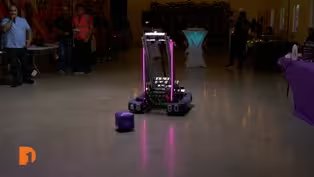
There was even a local school robotics presentation.
But why focus on the tech industry?
Zavala says, it's simple, tech is where the money is.
- I want as many members of my community as possible to get into businesses that have the potential for millions of dollars, and not just hundreds of thousands.
- [Narrator] But getting Detroit's Hispanic community into this field has some barriers.
One that DHDC and other organizations are fighting, Zavala says, is a lack of technology education.
She says many of Detroit schools don't have coding or other tech programs.
- Our schools don't have the funding for those type of programs.
So, a lot of our community didn't grow up with it outside of, like, their phone or their tablet.
That's about it, right?
And then, our older members of our community, they didn't even have that.
- [Narrator] For Zavala, this event is about celebrating ways Detroit's Latino residents have already begun overcoming that barrier.
The Robotics Engineering Center of Detroit, or RECD, is a youth robotics program held at the DHDC.
- We host ten high school robotics teams for first robotics here.
And those high school teams from our community they share all of the machining equipment that they would need to build those robots.
- [Narrator] Zavala watched RECD's demo during Latin-X-Tech.
She was reminded of how great robotics was for her son.
- It really helped him gain confidence.
Technical skills that he uses still to this day.
- [Narrator] Another huge barrier for many in southwest Detroit is language.
Many in the city's Hispanic community are not native English speakers.
- Detroit is a culturally rich city, right?
While the majority population is black American, we have linguistically so many different cultures and languages that are representative.
- [Narrator] This is Jesse Feliz, the founder and lead educator of Spanish Swag, a Spanish language learning program for kids.
Feliz understands how important it is for Latin Detroiters to understand English speakers and vice versa.
- In order to function in this diverse, ever changing world, we're competing on a global scale.
So, we do, it's not about code switching, but it is about navigating this world in a bilingual, multilingual way.
- [Narrator] Another barrier is the current lack of Latino representation in these jobs.
We sat down with Eddie Gonzalez, founder of Eye Breathe Design, a local graphic and website design company.
Gonzalez was the keynote speaker for Latin-X-Tech.
- Representation is always a big deal, regardless of the sector or the background, you know, just having someone there that can, you know, speak to the cultural differences and just the opportunities that are on the table for people, I think is a huge deal.
- [Narrator] Beyond understanding technology for all the good it can do in the city, Gonzalez thinks there is a lesser discussed reason that Latino representation matters.
- The fact is, that a lot of this technology is being used to surveil us and to criminalize us in different ways.
And so, I think it's super important that we're at the table to understand like how these technologies are interacting with us on the day to day.
- See, you got the potatoes.
You got the beef, you got the plantains, and you got the mayo-ketchup.
- Oh, yes, thank you, man.
Thank you.
- You're welcome.
- [Narrator] Beyond big scale surveillance equipment or high-end coding needs, most businesses rely on technology to some degree.
Even food popups, such as Puerto Rican restaurant, Mikey's Cocina.
I sat down with owner Miguel Mendez Roman during Latin-X-Tech.
He said he and his team move their business through social media platforms, such as Facebook and Instagram.
- Because you wanna be able to not only reach the local, you wanna go beyond the local, that way everybody know where you at.
You know, what type of food you have, what you serving the community.
- [Narrator] Aside from running Mikey's Cocina, the longtime chef is also the building manager at DHDC.
He credits the organization with helping him and others take their ideas and turn them into thriving businesses.
- I enjoy the business classes with Anita Zavala.
She was the one helping me out to get my LLC, to get my full handler license, so that way we move everything forward.
- [Narrator] Mendez Roman says his dream of being a business owner became possible thanks to DHDC and the organizations they're partnered with.
- They give me the opportunity, and three years later, we still here.
And we still moving.
- [Narrator] For Mendez Roman, events like Latin-X-Tech are all about coming together to build wealth as a community.
- Give to the community.
Get the community together.
Know your community.
Know who's your people.
You know, help to move Detroit forward.
It's time to move up.
- [Narrator] Technology is only becoming more and more interwoven with our daily lives.
So, Feliz believes business owners should embrace what it can offer.
- Tech is here and is here to stay.
And, as a business owner, if you want to, not only like thrive locally, but if you want to scale your business, there's gonna have to be a tech component to it.
- [Narrator] She says it's important for people beyond just business owners.
- Everyone may not open their own business.
Some people are amazing employees.
Everyone may not be the actual creator or founder of an organization.
However, all of us can benefit from strengthening our skills.
And not just consuming technologia, but actually learning it, exploring it, failing with it a little bit, and then progressing with it too.
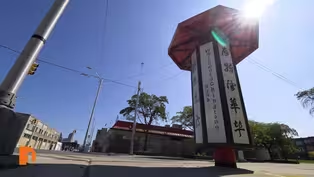
(crowd applauding) - [Narrator] Let's turn now to Detroit's once thriving Chinatown, at the intersection of Cass and Peterboro.
The area was filled with restaurants, grocery stores, and community centers.
One of the most popular family businesses was the now closed Chung's Restaurant, which was a neighborhood anchor for more than 60 years.
The owner's son, Curtis Chin, has a new memoir coming out about his life as a Chinese restaurant kid.
One Detroit Senior Producer, Bill Kabota, and Contributor, Chin Anyung, have the story.
- [Narrator] Writer activist Curtis Chin's new book, "Everything I Learned, I Learned in a Chinese Restaurant."
It's about growing up in Detroit in the 1980s.
Weaving his family's history running Chung's Restaurant, a community anchor in the now vanished Chinatown area of Cass and Peterboro.
Chin recently visited Metro Detroit to preview his book in a series of Q&As, where we caught up with him.
- I just feel like I was the luckiest kid growing up in a Chinese restaurant.
Yeah, it was really, yeah.
It was really a a good time.
Growing up in a Chinese restaurant, being surrounded by your family, and your friends, and your cousins, eating as much free food as you want.
People always ask me like, well, your title of your book is "Everything I Learned in a Chinese Restaurant," so, what did you learn?
And the first thing that I always say to them is, growing up, a lot of parents tell their kids, "Don't talk to strangers."
But my parents actually gave me the exact opposite advice.
And what they were talking about were the strangers in our dining room.
And so, every time my dad met somebody who came from a different occupation, whether it was somebody worked on the factory line, or they were a doctor, or a newspaper reporter, he would pull us over and say, "Talk to this person."
"Ask them who they are."
"Ask them how they got where they were."
And, because of that, it opened up my eyes to, like, other possibilities in life beyond just working in a Chinese restaurant.
- [Narrator] "For decades, we had been feeding Detroit.
Our fans included celebrities like Smokey Robinson and Joni Mitchell, the Earl of Snowden and Senator Eugene McCarthy."
"We were all good at something."
"Specialized in dumplings and sweets."
"Yaya excelled at barbecue pork and homemade tofu."
"In a cross-cultural twist, my immigrant mom made the best American fair, while my native born dad cooked wonderful dishes from Hong Kong."
Chin's book centers the Chinese community's history and struggles within Detroit's history.
He chronicles his family's journey to Detroit, spotlighting an immigrant story so familiar to so many here, and yet, these stories remain hidden in the city's history.
Chin hopes to change that.
- One of my goals in writing the book was really to weave in my family's history with Detroit.
I think a lot of times you can look at literature and, particularly literature of communities of color, and it comes off as like this sidebar to a main story of America.
And I really wanted to tie in my family's experience, the Asian-American experience, with the city itself, so that you can see that they're intertwined.
That you can't have one without the other.
And that was really important for me.
- Happy Thanksgiving!
- "In Chinatown, though, we followed our own headlines."
"It was all about our Vincent."
"Our workers were beside themselves as they felt such guilt for not being there to defend their friend."
"A stream of ahoos and members of the Online Chinese Merchant Association dropped by with updates from the hospital."
"Emotions ping-ponged by the hour."
"From hope, to dread, and then back to hope."
"It was scary and comforting to see so many faces I hadn't seen in years."
"This time, the elders didn't even bring up my grades or report cards."
"As a shock, Chinatown coped with the untimely loss of one of our own."
"My mind kept returning to Vincent's mom, Lily."
"Her face always had a natural smile."
"And I'd seen her slurping my mom's pork bone soup at the kitchen table in our home."
"But, when I saw her on television, her eyes and mouth read only despair."
"It was rare to see any Asians on TV, much less in public exposing their hurt."
"But Lily epitomized the most universal figure in history, the grieving mother."
"How could anyone hear her anguish and not think of their own mom?"
"I know I thought of mine."
- My book talks a lot about Detroit history.
And, amazingly, a lot of students just don't know about the Vincent Chin case, but they also don't know about things like the Detroit riots, or the rebellion, or even Hudson's department store.
There's this rich history of this city that just is not being covered.
And I, that's why I want to talk about these things, and I want to bring up these consciousness to these people, so that they know the history of the city that they're from.
And I tried to do that with my book.
I weave in a lot of Detroit history.
- [Narrator] "The 1980s in Detroit were tumultuous times."
Trying to understand, accept, and establish my own identity by race, class, and sexuality was difficult, especially when these intersections contradicted and collided."
"The important lessons that guided me through my childhood came served like a big Chinese banquet."
"From the highs of cooking with my mom and dad, to the lows of waiting on some of the rudest customers."
"A chorus of sweet and sour, salty and savory, sugary and spicy flavors that counseled me toward a well led and well fed life."
- [Chin] I grew up in Detroit in the '80s.
It was a really tough time period.
It was not just crack, AIDS.
I knew five people that had been murdered by the time I was 18 years old.
But, at the same time, I loved my childhood.
I thought it was a great time growing up in Detroit.
And I was very fortunate.
I had this wonderful restaurant on the corner of Cass and Peterboro that really provided a nurturing space and taught me a lot of values.
I want to commemorate that.
And so, in my memoir, yes, I do talk about the difficulties of growing up in Detroit in the '80s, but, at the same time, I want readers to walk away and say like, "Yes, but good things did come out of that too."
- [Narrator] A local nonprofit is showing that everyone has a hidden talent.
Far Therapeutic Arts and Recreation helps children and adults with disabilities discover and enhance their gifts through creative arts therapy.
Contributor, Deja Moss, has the story on how the organization's clients are the stars of an upcoming entertainment event.
(low tempo music) (drums banging) - [Ayres] I love the history of Far, because we do play a big role in the community for people with disabilities.
But we were founded in 1951 by parents who wanted someplace for their adult children to socialize.
And, over years, those same parents advocated for the Special Needs Act in Michigan to allow kids with disabilities to go to public schools.
So, we kind of closed up very, very briefly.
And then, came back together, because we quickly realized that, they, the kids, weren't still getting the services they needed.
So, the board of directors came together and decided to really focus on creative arts and recreational services for people with disabilities.
We offer all different kinds of creative arts therapy's under one roof.
We do music therapy, art therapy, dance movement therapy, and recreational services.
- [Bowen] At Far, I am a music therapist, as well as the director of the therapeutic staff.
So, half of my week is providing music therapy with clients with a variety of disabilities, mostly with children and adolescents in a school setting.
And the other half of my job is an administrative role supporting new staff as they onboard, and also providing clinical supervision to our therapy team.
Music therapy looks like a lot of fun.
We might be engaged in playing instruments, and making up our own songs, and working on just our own emotional and self-expression.
When you're engaging in music making all day with your clients, there's a vulnerability in that.
And I've really come to appreciate my clients who show up and they're so authentic.
And they inspire me to just come as who I am that day, and to embrace who I am as a person.
- Art Therapy is basically a mixture of counseling and art, and so it helps the clients.
And I, usually, I don't say client.
They're my friends.
I say my friend, my bud, my buddy.
But it helps the clients to take out any frustration through the art.
So, I've learned that I'm not always the teacher 'cause I walk in as the art therapist, and you think that you're the one, you know, giving the lesson, teaching the lesson.
And, a lot of times, they teach you a lot of different things.
It's those little nuggets that we get on a day-to-day basis where you may have a child that's usually nonverbal, and then you'll walk through the door, and they're like, "Hey Ms. Purina, how are you?"
And it just blows your mind and warms your heart at the same time.
So, just those little nuggets that we get day to day, where they just surprise you.
- What really makes FAR so unique is the fact that we provide creative arts therapy for people with disabilities of any age and any diagnosis.
And what's so unique about that is, you can come as a child, and you're always welcome here.
You're never gonna age out of our programs.
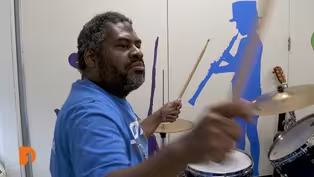
One of the clients, which there are many, that bring me joy here at Far, is Juan.
Juan has been a client here at Far for over 20 years, which is so exciting.
And I think he's pretty much done every therapy that we've offered.
(Juan drumming) - [Bowen] We seek out therapists who are passionate and people who really care about their jobs, and they really care about people, and making a difference in someone's life.
I think Far is a really incredible place for clinical staff to develop our skills and sharpen each other as clinicians, because we have a really strong team.
My coworkers all come from different backgrounds, and different work experiences, and we can teach each other so much about how to be the best therapist that we can be.
- It is wonderful being with an organization with like-minded people that share the same vision for working with children as well as adults that I have.
And we understand what, you know, what we're dealing with on a day-to-day basis, and we can actually communicate with each other when we're having issues ourselves as well.
- We, really, a few years ago, decided that we really wanted to be more of a community center for families with people with disabilities.
So, we started offering all different kinds of opportunities.
On October 19th, is our Far Friends event.
And we, actually, we call it Friends, because one of the most important parts about Far is, of course, the creative arts therapies and the recreational services are so important, but Far as a safe, kind, patient place to make friends and keep friends.
Our event on October 19th, that is really for the community.
It's our clients performing.
But, when you're a parent or a grandparent, and you see your grandchild, or your child, or your niece, or your nephew on stage being empowered and performing in front of four or 500 people, it's really quite amazing.
- Everyone gets to showcase.
I think that's very important to show off what they can do at the end of the day.
And just show people, again, that, yeah, we may have special needs, but we can do a lot of the same things that you can do, when it comes to dancing, singing, art.
(members singing) (crowd cheering) - The process and the development of how they're preparing week to week together, how they're strengthening their friendships and their relationships with one another, and the opportunity to be a part of something bigger than themselves is really special to see.
- Well, the way, I hope, Far combats societal stereotypes is seeing individuals with special needs as people, because they are just that, just people.
And you'd be surprised and amazed at what they can do.
And I think sometimes, when people think of special needs, they think of what people can't do, what they can't do.
And I've worked with some exceptional individuals, some exceptional friends as I call them.
- Because we are so unique, and there's not many organizations like us.
There's actually almost no organizations across the country like us.
I would love to see Far in the future all over, in every major city, in every small city across the country.
(members singing) (crowd cheering) - [Narrator] From Friday the 13th events, to music, theater, and a book fair, there's a lot to do in metro Detroit this weekend.
Peter Wharf and Dave Wagner, from 90.9 WRCJ, are here to help you decide how to spend your free time in today's One Detroit Weekend.
- Hey, Peter, I love this time of year, and I'm glad we have the opportunity to sit and chat, and talk about all the great things that's coming up this weekend.
What do you have for us?
- Well, one of Detroit Public TV's friends, Alexander Zonjic, will be performing at the Dirty Dog Jazz Cafe through Saturday.
He's one of the most entertaining flutists I've seen.
- He certainly is a treasure, Peter.
And, do you know what tomorrow is?
- Yeah, it's Friday.
- Peter, not just any Friday, it's Friday the 13th in October, which is spooky.
To celebrate the date, Michigan Science Center is holding a 21 plus after Dark Friday the 13th event.
Featuring a Stranger Things laser show, alchemically inspired elixirs, captivating music, and so much more.
You can also spend your Friday the 13th at the Detroit Zoo for a night of Spooky Spirits.
Again, for those who are over 21, you can put on fun Halloween costumes.
Check out a screening of Friday the 13th the movie in the 4D theater.
Enjoy a favorite spirited beverage, good food, or walk on the Haunted Trail.
- [Peter] On the 14th and 15th, it's the Detroit Art Book Fair, where dozens of independent publishers, artists, writers, and collectors will present their books, prints, and more to the public.
- [Dave] And if you want to head a little less, get to the Purple Rose Theater in Chelsea, where Diva Royale is running through December 23rd.
The show is written and directed by Jeff Daniels, and the comedy has all of its original cast returning.
- [Peter] A great show by a Michigander who loves his state.
I may have to go check it out.
And here are some other events everyone can partake in.
Have a wonderful weekend.
(low tempo music) - [Narrator] That'll do it for this week's One Detroit.
Thanks for watching.
Head to the One Detroit website for all the stories we're working on.
Follow us on social media.
And sign up for our weekly newsletter.
(low tempo music) - [Announcer] From Delta Faucets to Behr Paint, Masco Corporation is proud to deliver products that enhance the way consumers all over the world experience and enjoy their living spaces.
Masco, serving Michigan communities since 1929.
Support for this program is provided by: The Cynthia & Edsel Ford Fund for Journalism at Detroit Public TV.
- [Announcer] The DTE Foundation is a proud sponsor of Detroit Public TV.
Among the state's largest foundations committed to Michigan focused giving.
We support organizations that are doing exceptional work in our state.
Visit DTEFoundation.com to learn more.
- [Announcer] Nissan Foundation.
And viewers like you.
(low tempo music)
Curtis Chin’s new book shares history of Chung’s restaurant
Video has Closed Captions
Clip: S8 Ep15 | 15m 11s | Curtis Chin’s new memoir chronicles the life lessons he learned in a Chinese restaurant. (15m 11s)
Detroit Hispanic Development Corporation Latin-X-Tech event
Video has Closed Captions
Clip: S8 Ep15 | 6m 39s | The Pasa la Palabra: Latin-X-Tech event celebrates Hispanic and Latino Americans in tech. (6m 39s)
FAR Friends 2023 event celebrates people with disabilities
Video has Closed Captions
Clip: S8 Ep15 | 6m 53s | FAR Therapeutic Arts & Recreation’s FAR Friends 2023 celebrates people with disabilities. (6m 53s)
One Detroit Weekend: October 13, 2023
Video has Closed Captions
Clip: S8 Ep15 | 2m 5s | Here’s what’s happening around town for Friday the 13th and more on “One Detroit Weekend.” (2m 5s)
Providing Support for PBS.org
Learn Moreabout PBS online sponsorship
- News and Public Affairs

Top journalists deliver compelling original analysis of the hour's headlines.

- News and Public Affairs

FRONTLINE is investigative journalism that questions, explains and changes our world.












Support for PBS provided by:
One Detroit is a local public television program presented by Detroit PBS