
Law Enforcement Officials Discuss Recruitment Challenges
Clip: Season 4 Episode 415 | 3m 38sVideo has Closed Captions
Kentucky police say it's getting harder to find people to join and stay on the force.
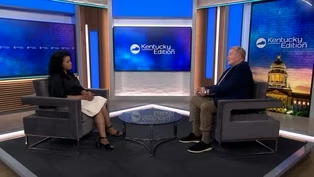
On average, police departments across the country regularly operate with a 10% staffing vacancy. This workforce challenge is no different for departments in Kentucky. Law enforcement officials spoke to state lawmakers about how difficult it is to attract and retain officers in a demanding profession like policing. Here's more from Kentucky Edition's Clayton Dalton.
Problems playing video? | Closed Captioning Feedback
Problems playing video? | Closed Captioning Feedback
Kentucky Edition is a local public television program presented by KET
Law Enforcement Officials Discuss Recruitment Challenges
Clip: Season 4 Episode 415 | 3m 38sVideo has Closed Captions
On average, police departments across the country regularly operate with a 10% staffing vacancy. This workforce challenge is no different for departments in Kentucky. Law enforcement officials spoke to state lawmakers about how difficult it is to attract and retain officers in a demanding profession like policing. Here's more from Kentucky Edition's Clayton Dalton.
Problems playing video? | Closed Captioning Feedback
Where to Watch Kentucky Edition
Kentucky Edition is available to stream on pbs.org and the PBS app.
Providing Support for PBS.org
Learn Moreabout PBS online sponsorshipOn average, police departments across the country regularly operate with a 10% staffing vacancy.
This workforce challenge is no different for departments in Kentucky.
Law enforcement officials spoke to state lawmakers about how difficult it is to attract and retain officers in a demanding profession like policing.
Here's more from Kentucky Edition's Clayton Dalton.
As we've seen, there's a a changing public perception of law enforcement.
Highly publicized police brutality incidents in recent years have changed the way Americans view police officers.
Law enforcement officials testified in Frankfort that this increased negative perception has made recruiting police officers harder than it used to be.
But that's only one piece of the puzzle.
Some major retention challenges are salary and benefits.
Obviously, burnout and the workload that they have.
Mental health and wellness concerns.
All of those things combined create a perfect storm, so to speak.
These recruiting challenges are hitting police departments of all sizes in every part of the state.
You know, we have a 16 officer department, and they lose 2 or 3 officers.
And you're now looking at potentially not being able to provide 24/7 service.
You know, I understand the big agencies, you know, they're down a couple hundred, but they have an opportunity to backfill.
They have the overtime.
This is a critical issue for our smaller and mid-sized police departments.
You know, obviously the application pool has shrunk quite a bit.
When I was police chief, routinely, we would have 3 to 400 people test for one slot.
I retired in 2015, and we were lucky if we had 30.
And talking with some of the Chiefs.
I know I've spoken with the Covington chief multiple times, are about 110 officer department.
Sometimes they get 10 or 20 people to compete for one spot.
And by the time you do the background process and you wash those folks out, you might be picking from an applicant pool of five people to fill that one or multiple spots.
Louis County Sheriff Johnny Bivins said hiring qualified officers is an acute problem for his small department in eastern Kentucky.
I do think that sometimes we settle for less, you know, if we send them for their pops and everything comes back good.
It might not be the candidate we want, but, Louis County is a 482 square mile, and I have seven full time deputies, and that's one of my life.
If one leaves, these guys, we're talking about 10 to 12 applicants.
I would be blessed with two if I could get them.
These staffing issues aren't isolated to the local level.
Kentucky State Police Commissioner Phillip Burnett said his agency faces the same issue.
The current training class for KSP started at 80 people in May.
Now only 48 remain.
Since 1998, our applicant numbers have went down and our attrition rates have went up.
You know, we've been hit hard and trying to grapple with the change of the pension benefits.
And we have seen that that has been a detriment towards bringing in men and women in our in our agency.
But this is not just a KSP problem.
This is just not a Kentucky problem.
This is a problem across our country.
For Kentucky edition I'm Clayton Dalton.
Terry Brooks Shifts Roles After Decades Advocating for Kids
Video has Closed Captions
Clip: S4 Ep415 | 11m 54s | Head of Kentucky Youth Advocates on changing role and helping Kentucky's kids. (11m 54s)
Providing Support for PBS.org
Learn Moreabout PBS online sponsorship New Episode
- News and Public Affairs

Top journalists deliver compelling original analysis of the hour's headlines.
 New Episode
- News and Public Affairs

Today's top journalists discuss Washington's current political events and public affairs.
 New Episode
 New Episode
 New Episode
 New Episode
 Recently Added
 New Episode
 New Episode

 New Episode
 New Episode
Support for PBS provided by:
Kentucky Edition is a local public television program presented by KET