
Lawmakers Debate Reining in Kentucky's Medicaid Costs
Clip: Season 4 Episode 354 | 5m 39sVideo has Closed Captions
Lawmakers debate how to cut costs and implement federal changes to Medicaid in Kentucky.
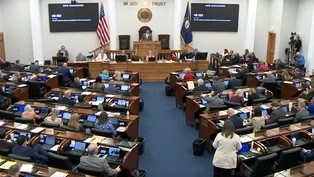
The 2026 lawmaking session of the Kentucky General Assembly is nearing the end and lawmakers are putting in long hours to pass a number of bills ahead of the 10-day veto period that begins Thursday. One of those bills, House Bill 2, is Kentucky's attempt to cut costs and implement federal changes to Medicaid.
Problems playing video? | Closed Captioning Feedback
Problems playing video? | Closed Captioning Feedback
Kentucky Edition is a local public television program presented by KET
Lawmakers Debate Reining in Kentucky's Medicaid Costs
Clip: Season 4 Episode 354 | 5m 39sVideo has Closed Captions
The 2026 lawmaking session of the Kentucky General Assembly is nearing the end and lawmakers are putting in long hours to pass a number of bills ahead of the 10-day veto period that begins Thursday. One of those bills, House Bill 2, is Kentucky's attempt to cut costs and implement federal changes to Medicaid.
Problems playing video? | Closed Captioning Feedback
How to Watch Kentucky Edition
Kentucky Edition is available to stream on pbs.org and the free PBS App, available on iPhone, Apple TV, Android TV, Android smartphones, Amazon Fire TV, Amazon Fire Tablet, Roku, Samsung Smart TV, and Vizio.
Providing Support for PBS.org
Learn Moreabout PBS online sponsorshipThe 2026 lawmaking session of the Kentucky General Assembly is nearing its end.
This is day 56 of the 60 day session, and lawmakers are putting in some extra hours to pass a number of bills ahead of the ten day veto period that begins Thursday.
One of those bills, House Bill two, is Kentucky's attempt to cut costs and implement federal changes to Medicaid.
As our June LaFleur reports, the Senate's version of an omnibus Medicaid bill has won over more health advocates and even Democrats than what was proposed in the House.
That begins tonight's legislative update.
A Senate committee reduced the copays that the House proposed for Medicaid expansion recipients.
$5 for all health care services in $1 for prescription.
Drugs, just $1.
And Northern Kentucky Republican asks.
Maybe a dollar in 1958 would have had meaning.
But why even a dollar?
Why not just let them?
What's the dollar mean now?
Nowadays.
You know, we're trying to change behavior.
So rather than go into the emergency room for your primary care, we want to try to have you find your primary care home outside of the emergency room.
So what we felt was more appropriate is to have all of those behavioral changes happen.
But with a lower fee.
Reduced copays will lower the burden on patients and the medical providers who collect those payments.
This rural Republican says.
We learned very quickly that, a co-pay is the same as no pay.
And even we're looking at, say, $20 a co-pay.
It's not just $20.
There's got to be in a collection expense involved in the burden, administrative expense.
And you really talking to providers more like 40, $50.
The Senate moderated House Bill two in other ways, extending the timeline for changes and easing some eligibility and paperwork requirements for patients.
House Republicans earlier took a more aggressive approach, going above and beyond in many ways, what Congress voted for last year.
Gallant effort to try to just what needed to be addressed, but not go beyond any further than that.
I think we have taken huge steps forward with this bill.
Health advocates and Democrats still raise one concern frequent checks on a person's eligibility based on potentially inaccurate or out of date data.
This would apply to all Medicaid recipients, not just the expansion population.
Any data that can be verified without asking a household to do more paperwork is always the right approach, but the balance to that approach is to make sure that we're not letting one conflicting data source determine a person to be an eligible for Medicaid.
Apparently, what I'm being told is 12 different databases don't line up automatically.
I'm worried about how many people are just going to get lost through no fault of anybody's other than the system.
The Senate Health Services Committee approved House Bill two unanimously and now heads to the Senate floor.
If passed, it would need concurrence in the House.
For Kentucky edition, I'm Jim Leffler.
Thank you.
June.
The latest version of the state's two year budget plan includes $290 million in a special Medicaid fund that's being referred to as a lockbox.
We talked about how this lockbox would work.
On last night's Kentucky Tonight, right here on Wkyt.
There is no area of the state government where the costs are increasing nearly as quickly as they are in the Medicaid space, and we really need to bring some cost control into that space.
And so what we did is we put that $290 million there for the administration to be able to return to us and, you know, hopefully work on some cost containment measures.
But if they aren't able to fully contain them there, there is some available funds for them to come to us and to at the beginning of the 2027 session.
So just keep in mind, you know, right now they will only be six months into the fiscal year.
Ideally, they're able to find some savings.
And that really should be the challenge that this administration takes up is how do we make Medicaid a more affordable program in the Commonwealth.
And so there will be this fund there for them to come back to the General Assembly.
If they're not able to figure out how to execute some savings and asked to get into it.
I think the lockbox is an interesting concept, and I'm glad to know that there are earmarked funds available.
Should we run into budget issues with Medicaid?
I don't think it's really a question, though.
If we're going to run into those budget issues, the question is not so much if, but when.
And I hope, just as Senator McDaniels has said, that we'll be able to contain the cost of the Medicaid program.
But unfortunately, not to sound too radical here, as long as we have multiple macOS and we are not moving toward a single payer system, the costs are just going to continue to increase.
The federal government is not doing us any favors either.
The cuts from the federal level through H.R.
one are going to be felt in Kentucky.
And so I think we need to be really ready with that lockbox and have very clear standards by which it can be opened.
You can check out last night's full one hour discussion about where Kentucky's state budget stands at this point, and what's in it.
That conversation is available online on demand at CT.
Org Dawgs K-Y tonight.
 New
NewBill Criminalizing 'Grooming' Heads to Governor's Desk
Video has Closed Captions
Clip: S4 Ep354 | 2m 30s | Lawmakers pass bill that sets criminal penalties for child "grooming." (2m 30s)
 New
NewCity of Covington Hits Economic Milestone
Video has Closed Captions
Clip: S4 Ep354 | 3m 33s | Covington's mayor talks about the keys to the city's economic success. (3m 33s)
 New
NewSweeping Elections Bill Moves Forward
Video has Closed Captions
Clip: S4 Ep354 | 3m 39s | Omnibus bill looks to cut down on number of alternate IDs for voters. (3m 39s)
Providing Support for PBS.org
Learn Moreabout PBS online sponsorship
- News and Public Affairs

Top journalists deliver compelling original analysis of the hour's headlines.

- News and Public Affairs

FRONTLINE is investigative journalism that questions, explains and changes our world.












Support for PBS provided by:
Kentucky Edition is a local public television program presented by KET