
Lawmakers Return, Leader Will Barclay, NY's Justice System
Season 2021 Episode 1 | 26m 46sVideo has Closed Captions
The state Legislature returns to Albany for the start of this year's legislative session.
Assembly Republican Leader Will Barclay reacts to this week's events in Washington, D.C., thoughts on the budget deficit, & more. Reporters Kate Lisa and Anna Gronewold have the latest on the slow rollout of the COVID-19 vaccine and a preview of Gov. Andrew Cuomo's State of the State address. Tom Stebbins of Lawsuit Reform Alliance tells us why New York City is being labeled a "Judicial Hellhole."
Problems playing video? | Closed Captioning Feedback
Problems playing video? | Closed Captioning Feedback
New York NOW is a local public television program presented by WMHT
Support for New York NOW is provided by WNET/Thirteen and the Dominic Ferraioli Foundation.
Lawmakers Return, Leader Will Barclay, NY's Justice System
Season 2021 Episode 1 | 26m 46sVideo has Closed Captions
Assembly Republican Leader Will Barclay reacts to this week's events in Washington, D.C., thoughts on the budget deficit, & more. Reporters Kate Lisa and Anna Gronewold have the latest on the slow rollout of the COVID-19 vaccine and a preview of Gov. Andrew Cuomo's State of the State address. Tom Stebbins of Lawsuit Reform Alliance tells us why New York City is being labeled a "Judicial Hellhole."
Problems playing video? | Closed Captioning Feedback
How to Watch New York NOW
New York NOW is available to stream on pbs.org and the free PBS App, available on iPhone, Apple TV, Android TV, Android smartphones, Amazon Fire TV, Amazon Fire Tablet, Roku, Samsung Smart TV, and Vizio.
Providing Support for PBS.org
Learn Moreabout PBS online sponsorship[ THEME MUSIC ] >> On this week's edition of "New York Now," this year's legislative session began in New York this week.
We'll have details.
Then assembly Republican leader will Barclay joins us with reaction to the week in D.C. and his priorities for this year's session.
The COVID-19 vaccine is getting a slow rollout in New York and Governor Cuomo is turning up the heat.
>> The vaccination rate has tripled since Monday.
>> We'll discuss that and a look ahead to Cuomo's state of the state next week with Anna Gronewold from politico and Kate Lisa from Johnson newspapers; and Tom Stebbin from the lawsuit reform Alliance tells us why New York City is called a judicial hellhole.
I'm Dan Clark and this is "New York Now."
>> Welcome to this week's edition of "New York Now."
I'm Dan Clark.
It was a week of chaos in Washington, D.C., but back in Albany, lawmakers kicked off this year's legislative session.
If you don't know, session usually runs from January through June in New York and this year, it's expected to get messy.
Not only is the state facing a $15 billion budget deficit, Democrats now hold a supermajority and they could use that leverage on a few key issues.
Including ways to fill the budget gap.
But for lawmakers this is a year like no other.
Take a look.
This is the New York state Senate.
Usually these seats would be full, but the COVID-19 pandemic has driven the state legislature to convene virtually since last spring and this year is no different.
Lawmakers kicked off this year's legislative session at the state Capitol Wednesday in a building that would usually be full of energy.
>> Usually, the chamber would be buzzing with activity.
The hallways filled with smiling faces.
This year, as you know, it's different.
>> Senate majority leader, Andrea Stewart-Cousins, entered the state Senate for the first time with a new supermajority of democrats.
They now hold 43 seats.
That's more than two-thirds of the chamber and she said the economy will be a top priority for democrats as the state grapples with a $15 billion budget deficit.
>> Our State's finances are in desperate shape, and we have a budget deficit to tackle.
>> Stewart-Cousins said democrats would back higher taxes on the wealthy and the legalization of both marijuana and mobile sports betting as ways to help the State's finances.
That would likely happen in the state budget which is due at the start of April.
We need to make sure that more of the millionaires and billionaires who have gotten even richer step up during this pandemic.
>> Governor Andrew Cuomo, meanwhile, threw cold water on the idea this week.
Saying tax hikes on the rich wouldn't generally generate nearly enough revenue to fill the State's budget gap.
>> Highest rate any millionaire, it only raises 1.5, $1.6 billion.
>> On the other side of the aisle, Senate Republican Rob Ortt said democrats should find areas to cut spending, instead of creating new taxes.
>> We have $170 billion budget.
You'll never convince me that New York's primary problem is a revenue problem.
It is a spending problem.
>> The state assembly didn't see as much action this week.
Assembly speaker Carl Heastie was re-elected to the top position in the chamber which has been led by democrats for decades.
>> Our accomplishments over the past year are testament to our perseverance in getting work done on behalf of the people of New York.
>> Lawmakers are back in Albany Monday for Cuomo's state of the state address and the second week of what's expected to be a tumultuous legislative session.
And we will be taking Governor Cuomo's state of the state address live here on PBS Monday.
Keep an eye out for that.
In the meantime, let's break down the week with Anna Gronewold from politico and Kate Lisa from Johnson newspapers.
Thank you both for being here.
>> Thank you.
>> You no.
>> Session started this week.
It was on Wednesday, the first day of session.
It was not eventful, I will say.
Anna, were you in the building?
I don't remember who was there.
>> I was.
>> I was in the Capitol.
I was in the Senate.
I didn't see what happened in the assembly.
It was a lot of fanfare as we just showed on the show.
>> Typically the first day of session is, but you would see new members normally, in a normal year walking around the halls looking for the bathrooms, trying to figure out what is going on.
It's the first day of school vibe.
We didn't get that at all.
The halls were super empty and kind of quiet.
It was a huge juxtaposition because we were watching what was happening in Washington which was obviously a night and day difference.
>> It feels like that happened two weeks ago, the chaos in Washington compared to session.
Session was Wednesday, obviously.
Kate, what do you think about what's going to happen this session?
I mean, everything is kind of revolving around the budget deficit, but we have other issues out there as well.
>> Absolutely.
I think, really, the biggest thing I anticipate, I think the budget will be the focus probably first.
The revenue raisers that people have been talking about, raising taxes.
I know that the assembly speaker kind of hinted at that at the end of the year and I think everyone's been kind of excited or-- well, not as excited to hear what that tax raise might be, but so I feel like that might be the-- those conversations have to start sooner rather than later, right.
So that's what I'm most looking forward to hearing about.
>> Right.
We have three months and so the budget is due at the end of march.
You know, the end of march is a flexible term sometimes.
It's due at the end of march.
Sometimes it comes the first week of April.
Anna, what do you see as coming up in this year's session?
Obviously, the budget is going to be the biggest thing this year.
But what other key things are you watching?
>> The Governor has also indicated that this is tied into the budget but that legalizing recreational marijuana might finally happen this year after multiple years of working on it and saying it was too tricky to get done.
Right now, that something that could raise money in the long-term future and it's a little bit more of a push for that.
And I think he also talked about sports betting, which will be another big issue that folks have been working on for a while.
I don't know that anything can actually be discussed without putting it in the context of the idea that there's not that much money to do very much.
>> Right.
That's the thing.
These issues like marijuana and sports betting are going to the front of the line right now because of the huge deficit that we're in.
I should note that the Cuomo administration had thought the online sports betting was unconstitutional a few years ago which is why they didn't sign it.
Now that we need the money, they found a way to make it happen.
>> There's always a way.
>> I want to stick with you because we had the discussion about the vaccine rollout and how it's slow.
The vaccine rollout is controlled by the state.
The federal government gives us the vaccine.
The state kind of takes it from there.
The Governor had some views this week about why it's being rolled out so slow.
What has he said?
>> The Governor is prioritizing health care workers saying that's the first line of defense.
Those folks need to be vaccinated first so they're not spreading to others.
Counties, localities, New York City and county leaders across the state have said that not only do they have ways to distribute their vaccines that they've been issued more efficiently, but they also think it should go to different types of-- more vulnerable populations, like nursing homes and on the very elderly.
There's been a bit of a disagreement there and so far, we haven't seen the Cuomo administration indicate that they are looking to tweak the plan at all from getting the health care workers.
>> It's such a weird situation to be in.
I feel like everybody's clamoring.
Everybody wants a vaccine.
Not everybody, but a lot of people want vaccines and it seems like we're go so slow, and there's these hospitals that have a surplus of the vaccine.
I think a lot of people at home are wondering if you have too many and you can't get them to people in this group, why aren't we moving on to the next group?
So that's the question that I think that's on everybody's minds right now.
>> I can't imagine the logistics of this.
You have to keep vaccines at certain temperatures.
The way that this actually rolls out, the coordination, I'm sure,far beyond anything you can imagine.
It seems like there's just not been as much communication among all parties as might make it go more efficiently.
>> Which is kind of like the M.O.of the Cuomo administration, I should say.
That's what they like to do is just take something and have total control and no coordination with anybody else because I think that they think they're best suited for it, which sometimes they are.
Kate, looking ahead to next week, speaking of the comb Cuomo administration, the state of the state is coming up on Monday.
We don't know what it's going to look like because the governor may give multiple speeches.
He may have several proposals.
what are you watching for?
>> Again, I think while we've all been waiting with baited breath with more details from him, I know he said that he's waiting on the federal government.
When president-elect Joe Biden takes off January 20th, to see what kind of federal aid the state will get, and so I guess we won't have that information for this, but maybe he'll hint, I'm sure, messages of hope and unity as we're going forward because we are starting a new chapter here.
And I also think that he will maybe start to talk about some things that he hinted at last spring with talking about like infrastructure and those big kinds of projects to revitalize the economy, similar to how FDR did with the new deal back in the great depression because we could be looking at such a deep recession.
We could head unfortunately there.
I'm excited to see how he frames that.
Economists say that usually the second year of an economic downturn is worse than the first year.
So we've gone through the first year almost, and so we're entering the second year.
>> We have to buckle up.
>> We've got to buckle up.
It's going to be very tough on everybody.
Unless some magic happens with math.
I'm not a budget person.
[LAUGHTER] And the last word.
What are you expecting to get from the state of the state this year?
It's going to be very different.
It's going to be virtual, we know.
So there's not going to be quite as much fanfare.
What are you looking for?
>> Like you said, it's normally a big who's who event and people just pack into the egg down here in Albany, and it's kind of, again, it's kind of this like first day of school thing where everyone is together trying to figure out what's going on.
I think there will be like a lot of issues that we have already seen before but probably a good number of them because there will be a couple very contentious measures.
I think a good number of them will be things that can bring people together, the environments, the infrastructure projects.
I think that will make a lot of sense because we need something to all be happy about.
>> I hope so.
We'll leave it there.
Anna Gronewold from politico and Kate Lisa from Johnson newspapers.
Thank you so much.
>> Thank you.
>> A lot of big issues are expected to come up in Albany this year but Chief among them is the state budget deficit as we said.
Democrats control both houses of the legislature and they're considering new taxes on the rich and a series of other revenue raisers, but Republicans are hoping to add their voice to negotiations as well.
Assembly Republican leader will Barclay joined me this week for an update.
Leader Barclay, thanks so much for being here.
>> Great to be on your show.
Thanks for having me.
>> Of course.
Before we get to session, I want to touch on what happened in Washington, D.C. this week.
A lot of democrats blamed the president and some Republican members of Congress for what happened at the Capitol, the violence.
I'm wondering, as one of the State's leading Republicans, how do you respond to that?
>> Well, I think, first of all we condemn what happened in Washington.
We don't mind protests but pro- protests need to be peaceful.
We all need to step forward and say this is not right.
Whether it's democrat protesters or Republican protesters, that's fine.
Can't have tremendous violence and the tragedy of having deaths down there was too bad-- really bad.
>> Definitely.
Moving on to this year's session because that's what I want to primarily talk to you about, the state is facing a $15 billion budget deficit.
It's going to be a tough haul for lawmakers in this year's budget process.
Republicans are in the minority in the assembly but they often voice how they would like to balance the budget.
From your perspective, how could the state come out of this $15 billion budget gap if the federal government doesn't provide us with enough aid to fill that hole?
>> Well, first of all, that is going to be a huge issue, I think going through.
We do have a new administration coming into Washington.
I'm still optimistic that there may be more aid.
I would like 0 see that go directly to localities and not filtered through the state.
I think localities are the ones that are suffering in their budget shortfalls going forward.
The one thing I feel and I know my conference feels is certainly we can't be raising taxes.
New York already has incredibly high tax rate whether it's income tax, sales tax, property tax, you name it.
We lead the country in taxes, and unfortunately, my colleagues on the other side of the aisle, that's their first choice, COVID or non-COVID, they always want to raise taxes.
We push back on that.
But we're going to have to make tough decisions ultimately.
We spend a lot of money in New York state.
That probably is not going to be able to continue because like you said we're facing 14, 15, $16 billion shortfall and that's not going to be sustainable.
>> You know, we're looking at places where the state may be able to cut spending.
Are there areas that your conference has identified that you might want democrats to take a closer look at to try to save some money so they don't have to raise taxes and raise revenue in different ways?
>> Sure.
Some of these things we were suggesting before COVID, I think they're more appropriate now than ever.
How about some of the economic programs that we have seen that we haven't seen great return on?
The tax credit for Hollywood movie studios, things like that.
That won't necessarily get to the $15 billion, but I think it's a good start.
I think there's a lot of stuff that we can do more efficiently in New York state.
I've talked about for years school aid formula where we put a lot of aid to higher wealth districts and not as much to low wealth.
We may have more equitable school aid formula, the state wouldn't have to pump as much month my into school aid as we do now.
There's things like that that we can do.
It's going to be tough.
I don't think any of us can be naive that there are difficult decisions to be made going forward.
We obviously created the Governor some extraordinary powers back in the spring that he still has and there's no reason now that we're working remotely.
We had our first session.
There's no reason the assembly can't reassert itself especially when the budget issues coming up.
That's when we need to have a strong voice >> I have to ask you.
The democrats have the majority in the assembly and the Senate, and we see in big and small issues, democrats can't even agree on them.
If we give power back to the legislature, do you think that they can have as an effective response to the pandemic as the Governor had in the spring?
>> I think they're going to have to.
I want to work with my colleagues in our conference to accomplish that, but do we want just one person running New York state?
You know, maybe when they're addressing an emergency situation and the COVID pandemic, maybe.
But I think when we talk about bigger issues like the budget, certainly I was elected to come down here and represent my constituency, and assume that's the case with all my colleagues in the legislature.
So we ought to have a voice in that.
I look to work with them.
And also they can work and hopefully we can get some sort of good outcome and it won't be similar to what we see happening out of places like in Washington.
>> Besides new taxes, democrats have some ideas to raise revenue for the state.
Two of them that were in the news this week were the legalization of marijuana for recreational use and the legalization of online sports betting.
Two very big controversial issues in the state.
I want to ask you about online sports betting first.
So Republicans in the Senate, I know, are in support of legalizing that.
Where do Republicans in the assembly stand?
>> So, first of all, I'm just a little bit hesitant-- I don't have a problem looking at both these issues but I do have a problem when we're looking at it as a way to raise revenue.
I think if we're just doing that, then we're looking at it from a wrong perspective from a policy standpoint.
We have to let the standards fall on their own basis and not because we're putting money on the state.
Our conference was sports betting.
We haven't conferenced it.
I don't even know where I stand on it.
I would like to see more detail.
This isn't something that will happen overnight.
This will take a lot of legislating, frankly.
I want to see what the details are on that and we'll conference it at some point.
I don't know if we can get unanimity.
Some will be opposed to it.
Some will probably be in favor.
Do you see that changing?
>> It could.
I still think probably for the majority of our members, again, we haven't conferenced this, but I would guess the majority of our members are probably opposed.
I am opposed for it.
We're outlawing vaping.
We're trying to push back on smoking.
We obviously have problems with alcohol.
It seems to me that we're heading in the complete wrong direction of legalizing another drug.
But people might have different opinions and also we want to see again the devil can be in the details, and there's obviously what they're going to do with the revenue and they're talking about expunging people's records, et cetera.
We want to see all the details of what's being proposed there before we take a position.
>> Before I let you go, the Republicans in the assembly had a top priority since I've been covering the Capitol of trying to make state government more transparent, especially in the assembly and also in the Senate.
And trying to provide more access to the state government for the people of the state.
I know it's going to be a priority for you again this year.
Tell me about the changes that you would like to see in the assembly to improve that transparency and the ethics there.
>> Well, I appreciate you asking that question, Dan.
First of all, just yesterday in opening session, we renewed the last year's rules that limited our ability to be from 30 minutes to 15 minutes, and we just think that's a complete backwards way to go.
One of the strongest things we do as minority is debate bills and point it out where we think legislation's bad or where we think legislation is good.
By taking our voice away, I think it's completely the wrong direction.
One of the rule changes that we will continue to push back is to get back to the 30-minute debate, period.
I think that's critical.
You know, transparency, you know, that is critical that we push that away.
The budget process has been historically three men, as you know, be behind closed doors.
Other government bodies do it in a more transparent, open way.
If we can do that, we think ultimately it will be a better product at the end of the day.
We have a whole host of rules changes that will help provide that or accomplish that.
>> All right.
Assembly Republican leader will Barclay, thanks so much for being here.
>> Thank you.
>> We'll speak with assembly speaker Carl Heastie next week.
First, a look at the State's justice system.
New York City is currently ranked as the second worst judicial hellhole in the country by the American tort reform foundation, and there are broader issues in New York's courts as well.
I spoke this week with Tom Stebbins from the lawsuit reform Alliance.
Tom, thanks so much for being here.
>> Great to be with you, Dan.
>> So tell me why the American tort reform foundation considers New York City to be a, quote, judicial hellhole.
>> I mean, the question is, why do we only get number two?
We are number one on so many categories.
We are the highest for medical liability payouts.
We're the highest for construction insurance.
We are the highest on per CAPITA tort tax, which is the cost that everybody pays for our system.
New York City spends more on lawsuits than the next 19 largest U.S. cities combined.
I don't know how we didn't get number one, but we got number two from this national organization, the American tort reform foundation, and we're perennially on this list.
We're frequently here.
It's been a long time.
We're seeking in our organization to get us off this list, try to get some fixes in the system, so that we can bring those costs on everybody down.
>> So when you say that we spend the most on litigation, what do you mean?
Are our courts clogged up?
Are there too many lawsuits, I guess, is what we're looking at?
>> Yeah, there's too many lawsuits and too many lawyers.
We have more lawyers per CAPITA than any other state, and you see this when you drive down the highway.
You know, you see these billboards for personal injury lawyers.
You see this when you're up late watching television and you see ads for trial lawyers and personal injury lawyers.
We just have a lot of lawyers and a lot of lawsuits and that costs us all a lot of money.
Whether you're going to the hospital or you're driving down the highway, you're paying for this.
And so that's why we're trying to bring those costs down.
>> So I have to ask because the flip side of this is people might ask, well, we're so litigious in New York state, we have this access to litigation that maybe other people don't have in other states.
Unfortunately, that results in New York City being a judicial hell hole.
Tell me why it's sort of a bad thing that we have this access to litigation that other places don't have.
>> Sure.
I mean, it's important.
Hey, if you are wrong, if you are injured through the negligence of another, you should sue them, and you should recover.
We're not trying to take that right away.
That right is important.
It's fundamental.
It's constitutional.
And we strongly believe that people should recover.
But the numbers show that New York is far and away higher than everywhere else.
Fact that New York City spends more than the next 19 largest U.S. cities combined should be alarming to everyone.
Anybody who lives in New York City but anybody who lives in, no, we're paying those taxes and we're paying for those lawsuits, and again, if you have a reasonable lawsuit to recover, go get 'em.
Recover.
We believe in that.
The numbers show that we're so far out of whack from the rest of the country >> You know, another side of this, the civil justice side of New York, we have this other problem where some people just don't have access to civil justice.
That's where we talk about things like civil legal services across the state.
How do we create more access to civil litigation for people who need it without running into this problem where we're clogging up the Courts with litigation that might not seem necessary, or just may not be needed?
>> Yeah.
I mean, one of the things that we've seen is the prevalence of these lawsuit loans that allow people to get money in advance of their loans.
And I would caution anybody watching this to read the fine print.
One of the things that we're advocating for is caps on the interest rates that these lenders charge.
The criminal usery rate in New York, for which you go to jail, is 25%.
And yet because these lawsuits operate in this backwater of regulation, they are, on average, charging 68%.
So people need to be careful about loans like this.
They do-- we believe that the loan should exist, improve people's access to justice, but they shouldn't get victimized again when the loan comes due.
>> So is anything on the table on the legislature to try to regulate the lawsuit lending industry?
I was going to ask you about that.
I'm glad you brought it up.
Is anything cooking on it?
>> Yeah, Senator Kaplan and Assemblyman Magnarelli have a bill to cap the interest rates and it does lots of other things.
It provides transparency on the loans.
It makes sure the lawyer isn't involved in one of these loans.
It allows for a lot of extra protections, but the key is the interest rate cap.
So we're thrilled with Senator Kaplan and assemblyman Magnarelli for carrying these bills.
It passed the Senate unanimously in 2016 back when the Republicans controlled it and Senator or the was carrying that bill.
Now we have the democrats and we hope they do it.
I love Senator Ortt on the bill and you have Senator Skoufis on the bill as well.
Those two don't agree on much, but I'm glad they agree on this issue.
>> That's something we'll be watching.
Tom Stebbins from the lawsuit reform Alliance.
Thank you very much.
>> Dan Clark, thank you so much.
>> Before we let you go, a reminder that we'll be hosting live coverage Monday of Governor Cuomo's state of the state address.
That's live Monday on your local PBS station.
We'll also be streaming it on our website.
That's at NYnow.org.
Until then, thanks for watching this week's "New York Now."
have a great week and be well.
[ THEME MUSIC ]
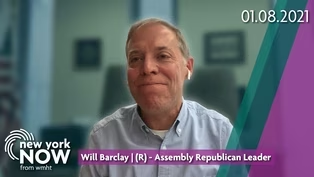
Assembly GOP Leader Will Barclay: Washington D.C., Budget
Video has Closed Captions
Clip: S2021 Ep1 | 7m 59s | Leader Will Barclay reacts to this week's events in Washington, D.C., state budget deficit (7m 59s)
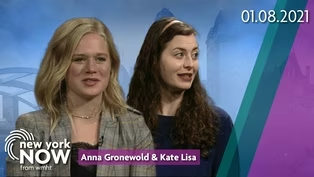
Reporter's Roundtable: Kate Lisa, Anna Gronewold, COVID-19
Video has Closed Captions
Clip: S2021 Ep1 | 9m 40s | The latest on the slow rollout of the COVID-19 vaccine and a State of the State preview. (9m 40s)
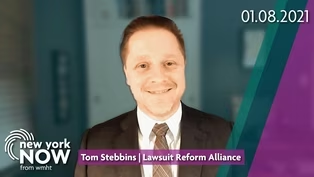
Tom Stebbins on New York's Justice System
Video has Closed Captions
Clip: S2021 Ep1 | 5m 21s | Tom Stebbins provides an analysis on the state's justice system. (5m 21s)
Providing Support for PBS.org
Learn Moreabout PBS online sponsorship
- News and Public Affairs

Top journalists deliver compelling original analysis of the hour's headlines.

- News and Public Affairs

FRONTLINE is investigative journalism that questions, explains and changes our world.












Support for PBS provided by:
New York NOW is a local public television program presented by WMHT
Support for New York NOW is provided by WNET/Thirteen and the Dominic Ferraioli Foundation.