
Leader of the organization “Encourage Me I’m Young” discusses programs designed to empower African American children
Clip: Season 54 Episode 10 | 12m 11sVideo has Closed Captions
Dr. Calvin Mann said he focuses on Black boys and their families because of challenges they face.
The nonprofit organization “Encourage Me I'm Young” has a mission of empowering African American children. Host Stephen Henderson sits down with Founder and President Dr. Calvin Mann to talk about two of the organization’s initiatives. One is a reading program which encourages African American fathers to read books to children. The other is National Respect Day, which will be observed on April 6.
Problems playing video? | Closed Captioning Feedback
Problems playing video? | Closed Captioning Feedback
American Black Journal is a local public television program presented by Detroit PBS
Leader of the organization “Encourage Me I’m Young” discusses programs designed to empower African American children
Clip: Season 54 Episode 10 | 12m 11sVideo has Closed Captions
The nonprofit organization “Encourage Me I'm Young” has a mission of empowering African American children. Host Stephen Henderson sits down with Founder and President Dr. Calvin Mann to talk about two of the organization’s initiatives. One is a reading program which encourages African American fathers to read books to children. The other is National Respect Day, which will be observed on April 6.
Problems playing video? | Closed Captioning Feedback
How to Watch American Black Journal
American Black Journal is available to stream on pbs.org and the free PBS App, available on iPhone, Apple TV, Android TV, Android smartphones, Amazon Fire TV, Amazon Fire Tablet, Roku, Samsung Smart TV, LG TV, and Vizio.
Providing Support for PBS.org
Learn Moreabout PBS online sponsorship- Welcome to "American Black Journal," I'm your host, Stephen Henderson.
The nonprofit organization, Encourage Me I'm Young, or EMIY for short, has a mission of empowering children and families to reach their full potential.
It has two initiatives underway right now.
One is a reading program, which encourages African-American fathers to read books to children and families.
The other is Respect Day, which will be observed on April 6th.
Here to tell us more, is the founder of EMIY, Dr.
Calvin Mann.
Welcome to "American Black Journal."
- Oh, well, thank you for having me.
- Yeah, so before we get to the work that you're doing, I want to pick up on something we were talking about before the cameras started rolling, and that's just the tough environment for nonprofits right now.
I'm not sure everybody is really aware of how hard it is to do the kind of work that you do, which is, it is in that nonprofit space, that public-service space.
Because the economy is changing and has gotten so bad, nonprofit organizations like yours are really struggling to, just to keep going and doing the work that you do.
- Oh, yeah, we are most definitely filling the brunt because we weren't on the scale of a number of the nonprofits who might have a surplus- - Yeah.
- That could sustain.
- A reserve that- - A reserve could sustain.
- Kind of to and through.
- We didn't have that, we've never had that type of support.
- Mm-hm.
- So, we were, in the beginning, as a volunteer nonprofit where we were 1.2, 1.4 million in volunteer hours.
But for 19 years, we tried several times to move to that area, but we understand there's a lot of competition- - Yeah.
- In the format of grants.
And because we focused on boys and family, it was different.
You know, we've heard that it was, your cycle has passed.
We've heard it all.
But with us having the success that we've had, 98% parental involvement, 16,000 males since 2007, all our boys are husbands and fathers and leaders, and families have been restored, we thought maybe that that was something that was worth being invested in, right?
And so, when we transitioned as we have, we have to do it in pieces and places.
So, we have all these traditions that we've created for families.
But we recognize that we are not the crim de la crim as far as when it comes to supporting our boys.
- Yeah, yeah.
- And in southeastern Michigan, boys, as you well know, are most definitely in a considerable amount of trouble.
Even when we did the "Smash Suicide" campaign for boys 5 to 11, recognizing that boys were number one in suicide crickets, right?
So, what we have had to do, is take these little tidbits and then bring the success to the community.
- Yeah, yeah.
Let's talk about that focus on boys.
Obviously, boys are in lots of trouble, but I think, a lot of times, people don't quite understand why that's true and why that's different from what goes on with other children.
What is it about the way we react to, the way we interact with boys, especially African-American boys, that is causing these outcomes that we see?
- Well, most boys in the State of Michigan, across the State of Michigan, they're the least fathered.
- Yeah.
- They doesn't have a high interaction with their dads.
- With their dads, yeah.
- And in this area, when you look at the single household, those environments, the boy is spending a considerable amount of time with his mom, aunties, right?
Because of the other pieces of violence and biasness.
I mean, like in the study in the State of Michigan, Black boys were 44 times likely to be removed from my daycare.
- Mm-hmm.
- Right?
And followed by White boys, right?
And then when we get into the areas of what's happening to all boys, we recognize literacy is an issue- - Yeah.
- We recognize those are very, that literacy is very, very, which is why we named the program Reading is Life.
- Mm-hmm.
- We understand that that falls into the man, husband, and the father.
- Mm-hmm.
- So, if I can't read at the boy level, it's gonna be very difficult at the man level.
- To read to your kids, yeah.
- And so, relationships are impacted by literacy, family stand together is impacted by literacy.
So, we knew that we had to make a move because our Reading is Life program was such a powerful program.
- Mm-hmm.
- We had one 6-year-old read 84 books in six weeks.
- Wow, wow.
(chuckles) - Right?
And so, when we took that to the marketplace, we even did tried to do a crowdfunding, it wasn't, the support wasn't there.
And so, we were trying to figure out, who is really gonna take the time to say that these boys actually matter?
- Mm-hmm.
- And so, that's where, you know, we kinda stayed.
- Yeah, yeah.
Let's talk about this April event, what's the idea there?
- So, April 6th, Respect Day was created when, in our mentoring program, we sent our boys to school to get the schools involved, right?
Where our young men, because our program is called EMIY Future Leaders, where we teach our boys 11 pillars of character, those types of things, responsibility, our boys are cooking, cleaning supporting the home, we sent them to the schools, the schools never responded.
So, in 2016, we kicked off EMIY National Respect Day, and what we discovered was powerful.
So, for years, because it's April 6, it impacts education and the community.
So, because of Respect Day, the schools and the people that, you know, invested in Respect Day, we had these outcomes.
Mumford had their highest male graduation population rate two years in a row under Angela Prince, who was the principal at the time.
We saw where the kids who had their RESPECT me RESPECT you RESPECT we T-shirts, it cut into violence, the young men started opening the door for the young ladies, the communication increased throughout the community, elderly people were approached respectfully by kids.
So, the second, that last part of school was impacted all the way across, all the way through the community, right through the summer.
So, we noticed in the last, this is our 10th-year anniversary, which we got the word we are gonna kick it off again at DSA.
- Yeah.
- Detroit School of Arts has been one of our strategic partners in this work and for Respect day.
And so, we're excited about it because now we got Ferndale at the table, we have Detroit Prep at the table, and we have Southfield Christian at the table, and we are building a committee that the kids can run from this point on.
- Yeah, yeah.
When you're interacting with young men, you know, and I'm always asking folks this who spend a lot of time with young people, what are they telling you about what they need and what they're missing?
What do you hear from them?
- So, (chuckles) because we work in the prevention, right?
They bring, Reading is life is for boys, three to seven, EMIY Future Leaders is for boys 8 to 24.
When you bring them to us, our secret sauce is fatherhood.
So, our mentors are fathers, because it takes two mentors to equal one father.
- Right.
- So, in that sequence of them being with us, we kind recognize the things that they're going through early.
- Mm-hmm.
- So, in prevention, if you get a EMIY boy from my program, my boys have gone on to be all Americans, academic, just across the board.
But what we do, what we recognize is that the drama, we take that out of them, right?
- Mm-hmm.
- We put the physical in them, the exercise, which is all cognitive, I got a cursive writing book so they have to learn to write their signature.
- No one's teaching that anymore in school other than signing your name.
Right?
(chuckles) - Right, and how are you, signing your name when you saw the, that's what made us pivot was because I saw that the kids didn't even have signatures, which was crazy.
So, I put together, I have a cursive writing book.
And so our boys, when they go through the cursive writing book, when they get to the end- - Mm-hmm.
- Sign your signature like a star.
- Hmm.
- That's even impacted sports, because a lot of athletes don't have signatures no more.
- Right.
- Right?
And so, that means that their apparel is gonna take a hit.
- Yeah, right.
- Right?
- As part of the branding and the franchise.
- Right, so I can't really resell a heart and and a dot, you know what I mean?
- Yeah.
- So, we teach our boys all of that, get 'em in shape, they have to do a community-service project.
So, what we are hearing from our boys, is thanks.
- Hmm, wow.
- We are hearing thanks- - Yeah.
- I love you, coach.
You know, they call over, you know, our kids are in constant contact and we challenge them.
Even when they hit high school, even some in college, we challenge 'em.
In our mentoring, we don't mentor to hold them, we meant them to set 'em free.
- Yeah.
- Then that way, he can become a man, husband, and a father.
Restoring order for the boy is very, very strategic for us.
- Yeah, there's something hopeful about that, right?
That you're hearing, thanks, right?
As opposed to, help me or I can't find help.
- Yeah, no, we get a lot of calls about, you know, I need a mentor for my son, right?
- Mm-hmm, mm-hmm.
- But we are not in that position, so to speak, to just take you in for 14 weeks.
You know, we've had to charge, right?
But in that, we got a 98% parental involvement.
Our kids have gone places that they would've never gone.
We fundraise together, the families, we do Family Day.
So, inside of that 14 weeks, is the family restoration.
The mother comes into our BOS sessions, which is Build Our Sons.
So, we teach the mothers, which is headed up by, what we teach the mothers, is by Dr.
Heather, where we teach the mothers how to get out of the way of helping their sons grow.
We do a lot when it comes to our boys of trying to dictate their decision making, right?
And sometime, we give our boys too many choices.
And what I discovered, is we hand our boys video games, and our girls books.
Who's excelling?
(Stephen chuckling) - Right.
- So, the one that should, who should be having the books, right?
Is both.
- Mm-hmm.
- So, make sure your sons and your daughters are getting the books, because the one thing I don't believe in is that one is smarter than the other.
- Yeah, yeah.
- I don't believe in that philosophy at all.
- Yeah, we gotta support all of them, right?
- All the way.
And if a boy doesn't have, you know, and I speak on fatherhood all the time, but if a boy doesn't have his father, right?
You are creating him just for the system.
- Yeah, yeah, yeah.
Well, it was great to have you here.
And the work that you're doing is just- - I'm hanging on, brother.
- Right?
(chuckles) - Yeah, (chuckles) I'm hanging on, I really am, but- - Things will turn at some point.
- Yeah, hopefully, and we can get the support, because right now it's- - It's a struggle.
- It's a very big struggle for us to do anything.
- Yeah.
- So, yeah.
- Well, thanks for being here.
- Thank you for having me.
- Mm-hmm.
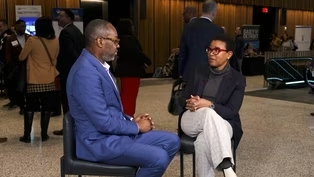
Sarida Scott of The Skillman Foundation discusses philanthropy at the Detroit Policy Conference
Video has Closed Captions
Clip: S54 Ep10 | 7m 23s | A discussion about the importance of philanthropy in fostering economic development in Detroit. (7m 23s)
Providing Support for PBS.org
Learn Moreabout PBS online sponsorship
- News and Public Affairs

Top journalists deliver compelling original analysis of the hour's headlines.

- News and Public Affairs

Today's top journalists discuss Washington's current political events and public affairs.












Support for PBS provided by:
American Black Journal is a local public television program presented by Detroit PBS