
Leadership Strategist Stresses the Benefits of Curiosity
Clip: Season 4 Episode 64 | 8m 45sVideo has Closed Captions
Kelsey Starks sits down with local businesswoman and leadership strategist Dr. Debra Clary.
Kelsey Starks sits down with local businesswoman and leadership strategist Dr. Debra Clary to discuss her new book “The Curiosity Curve.”
Problems playing video? | Closed Captioning Feedback
Problems playing video? | Closed Captioning Feedback
Kentucky Edition is a local public television program presented by KET
Leadership Strategist Stresses the Benefits of Curiosity
Clip: Season 4 Episode 64 | 8m 45sVideo has Closed Captions
Kelsey Starks sits down with local businesswoman and leadership strategist Dr. Debra Clary to discuss her new book “The Curiosity Curve.”
Problems playing video? | Closed Captioning Feedback
How to Watch Kentucky Edition
Kentucky Edition is available to stream on pbs.org and the free PBS App, available on iPhone, Apple TV, Android TV, Android smartphones, Amazon Fire TV, Amazon Fire Tablet, Roku, Samsung Smart TV, and Vizio.
Providing Support for PBS.org
Learn Moreabout PBS online sponsorshipA local business.
A woman says the best skill when it comes to leadership isn't about having all the answers.
It's about asking questions.
And tonight's business Beat our Kelsey Starks introduces us to Louisville resident and leadership strategist doctor Deborah Cleary, whose new book, The Curiosity Curve, explores that concept.
Well, welcome to Doctor Cleary.
Thank you so much for being here.
You've held executive roles in companies like Coca-Cola, Frito Lay, Humana, here in Louisville.
So tell us a little bit about your background and the experience that led you to create this book.
Yeah.
Yeah.
So thank you for having me.
It's my pleasure to be here and to talk about a topic I so passionately love.
I started my career right out of business school, driving a route truck for Frito-Lay.
I went from business schools to being a teamster.
And of course, my parents were so proud.
Like, but I really wanted to work for a large organization.
And at that time they were only hiring route drivers.
So I took a shot and I this was the mid 80s.
And so I was a teamster for about nine months and then got promoted into managing the route drivers.
And it sounds really glamorous at the age of 22.
But if the route driver didn't show up, you were back on the truck, right?
But driving a route.
Chuck really taught me how to run a business.
And it became my classroom.
And I learned then that I was I was experiencing things differently than my girlfriends that were working for Procter and Gamble and Colgate, although I loved that they had a company car and a briefcase, and I had a truck and a clipboard.
It really began to set me on a trajectory, and I spent about ten years at Frito-Lay and sales and marketing roles, and then I joined the Coca-Cola company in first in Philadelphia and then in Atlanta.
And I spent a decade there.
Managing a global account.
And then I went to the hard stuff.
I came to Louisville to work for Brown-Forman.
So I mix my Coke and my Jack Daniels.
And, when I was at Brown-Forman, I was in strategy, and it was there that I began to realize that the people were leaders, were different, cultures were different depending on the organization that you were in.
And I didn't know how to quite put words around that.
So what I did was I went back to school to get my doctorate in leader development in org design.
I really wanted to understand how leaders could get better and also how we could create different cultures.
And so after I graduated, I went to work for Humana just down the street here about a block, and I spent almost 17 years there running the Leadership Institute and developing leaders and culture.
Wow.
So the book is the curiosity curve and the premise is that being curious, asking questions fuels innovation, resilience and connection.
Yes.
Explain how so.
Yeah.
So how I started on this was it was in 2019.
And my CEO turned to me and you know, of a fortune, you know, 50 company, $100 billion in revenue.
And he said to me, do you think curiosity can be learned or is it innate?
And I said, I don't know, but I was curious.
And so I spent the next week, which just happened to be a holiday, 4th of July.
And I just dug into literature and research on that question.
And I came back that following Monday, and I said, guess what?
Curiosity can be learned.
And that began this, this path of how could curiosity really change organizations.
And so I started doing my own research.
I then commissioned a group of researchers to to look at, do primary studies on what is the relatedness between leadership performance and curiosity.
And guess what?
There's a direct correlation.
And that's when I knew that was the work I was called to go to.
And that's the the book and the beginning of writing that book.
That's amazing.
And I think, the one of the quotes here I want to read, most of us have become so focused on having the answers that we've forgotten how to ask questions.
And I think that's so interesting because when you do ask questions, some of the examples in your book of employees, it not only comes up with great ideas, but it also has that that buy in.
Right?
Yes.
Yeah.
So you think about who doesn't want to be a part of solving a problem, you know?
And unfortunately, leaders have become incurious over the years for a lot of different reasons.
But one is that we have time constraints and we have huge pressure to hit huge numbers.
And so when somebody comes to us and has a problem as opposed to helping, helping them think through it by asking them questions, we give them the answer because that is the fastest way to get something done.
Leadership is about playing the long game, and leadership is about developing those that work for you to be able to solve problems on their own.
So I want to dive more into the book itself.
And so when when you're teaching leaders how to be more curious, what are some of the ways that people can develop what?
I mean, like you said, it's a skill.
It's not an innate thing.
What are some of the ways that people can learn to be more curious?
Yes.
So the the most important thing is the idea is to understand how to ask questions, you know, to ask genuine questions that you're really trying to find the answer to.
It's not like you're an attorney and you've got a witness on on the stance, right?
It is really one about asking genuine, authentic questions so that you're leading the person forward and you're also learning at the same time.
The best thing a leader can do when someone asks them a question is to say, I don't know, let's let's work on it.
Why don't we try to discover this ourselves?
So what you're doing as a leader is you're showing vulnerability, that I don't have all the answers.
But together, I think if we work on this, we're going to come up with a solution or a I don't know, what do you think?
I use that with my kids a lot.
It's it that is such a perfect thing.
Yeah.
And what we do in organizations is that we actually have a curiosity assessment and we can measure curiosity at the individual, team and organizational level.
Wow.
Because curiosity can be learned, we know that we can teach it and we can measure it.
And then we can go back months later to see have we improved in that.
And so the work that I do with, with teams is helping them understand curiosity.
And it's, it's it's there's a richness there.
There is a science behind it.
There are four factors that make up curiosity.
And so we help leaders and teams understand those four factors and then how to model it and to teach it.
What do you think is the biggest mistake that leaders do sometimes fall into?
You know, a lot of times organizations are just organized with, you know, a hierarchy.
And it is kind of a, you know, a mandate from the top down.
What do you think is the biggest mistake when, leaders get into that?
Like, what are they doing wrong most of the time and how can they correct it?
Yes.
What I have seen is that they become tellers.
I'm telling you what to do.
Versus let's solve this together or what are ideas that you have when you get a group of people in a room and you begin to problem solve, you're going to go you're going to increase speed to good ideas and to execute.
And not to mention the the by and from employees when they take some ownership.
On coming up with some of the solutions, I imagine that's what makes everything just skyrocket.
Absolutely.
You've just nailed it.
Yeah.
Interesting.
It's so cool.
Thank you so much for being here.
We appreciate it.
It's my pleasure.
Doctor Claire.
His new book, The Curiosity Curve Leaders Guide to Growth and Transformation Through Bold Questions, comes out October 7th, and you can find her Curiosity Curve Assessment, that tool that helps leaders and organizations measure and reignite career curiosity in the workplace.
It is all at Deborah cleary.com.
Back to you.
Thank you Kelsey.
Louisville's Actors Theater is hosting An Evening with Doctor Deborah Clary on October 9th that will include a conversation and Q&A with Actors Theater leadership to celebrate the book release.
Governor Blasts New White House Advice for Pregnant Women
Video has Closed Captions
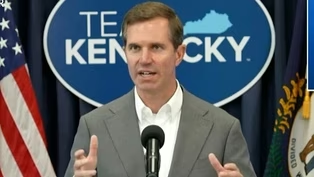
Clip: S4 Ep64 | 1m 12s | Gov. Beshear weighs in on the Trump administration’s claims of a link between Tylenol and autism. (1m 12s)

Kentucky Congressmen on Possible Government Shutdown
Video has Closed Captions
Clip: S4 Ep64 | 3m 58s | Paul and Massie talk government shutdown, senate race at forum. (3m 58s)
Pediatric Cancer Research Gets Boost From State
Video has Closed Captions
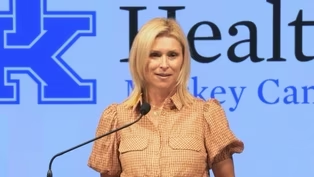
Clip: S4 Ep64 | 3m 49s | U.K.'s Markey Cancer Foundation receives funding from the state for pediatric cancer research. (3m 49s)
Program Welcomes New U.S. Citizens in Bowling Green
Video has Closed Captions
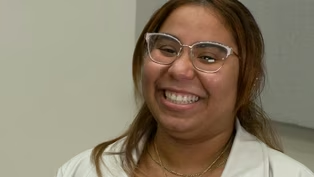
Clip: S4 Ep64 | 3m 16s | Dozens of newly naturalized U.S. citizens were recognized in Bowling Green. (3m 16s)
Providing Support for PBS.org
Learn Moreabout PBS online sponsorship
- News and Public Affairs

Top journalists deliver compelling original analysis of the hour's headlines.

- News and Public Affairs

FRONTLINE is investigative journalism that questions, explains and changes our world.












Support for PBS provided by:
Kentucky Edition is a local public television program presented by KET