
Leah Wilson, Executive Director, Kidzeum of Health & Science
1/19/2023 | 25m 57sVideo has Closed Captions
Leah Wilson, Executive Director, Kidzeum of Health & Science
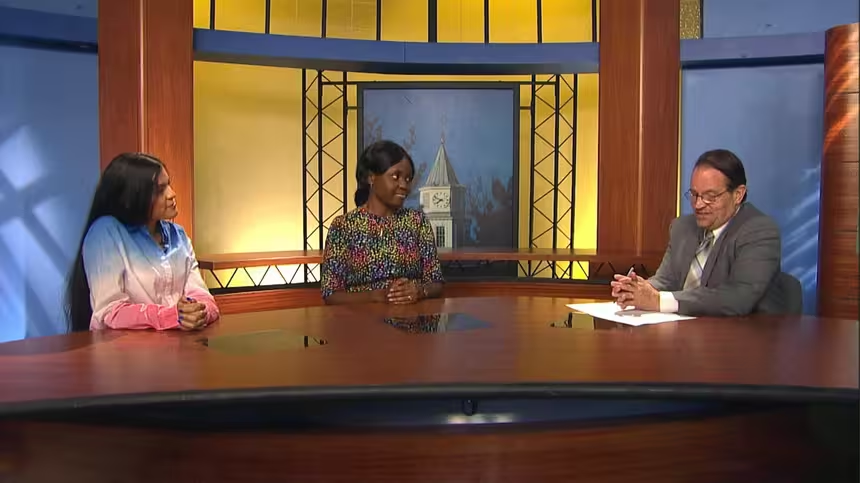
On “Saluki Sleuths,” a rare journey inside the clocktower at Pulliam Hall on the Southern Illinois University campus, one of the best-known places in Carbondale. Fred Martino talks with Leah Wilson, Executive Director – Kidzeum of Health and Science in Springfield, Illinois.
Problems playing video? | Closed Captioning Feedback
Problems playing video? | Closed Captioning Feedback
Eye on Education is a local public television program presented by WSIU
Leah Wilson, Executive Director, Kidzeum of Health & Science
1/19/2023 | 25m 57sVideo has Closed Captions
On “Saluki Sleuths,” a rare journey inside the clocktower at Pulliam Hall on the Southern Illinois University campus, one of the best-known places in Carbondale. Fred Martino talks with Leah Wilson, Executive Director – Kidzeum of Health and Science in Springfield, Illinois.
Problems playing video? | Closed Captioning Feedback
How to Watch Eye on Education
Eye on Education is available to stream on pbs.org and the free PBS App, available on iPhone, Apple TV, Android TV, Android smartphones, Amazon Fire TV, Amazon Fire Tablet, Roku, Samsung Smart TV, and Vizio.
Eye on Education
Eye on Education features interviews with people making a difference in all facets of learning. From Pre-K through higher education, we highlight efforts to prepare students to become the world's future leaders in every discipline.Providing Support for PBS.org
Learn Moreabout PBS online sponsorship(bright upbeat music) (camera clicking) (bright upbeat music) (bright uplifting music) - "Eye on Education."
I'm Fred Martino.
Upfront this week, a rare look inside one of the most recognizable places in Carbondale.
The clock tower at Pulliam Hall on the Southern Illinois University campus.
Here's Anna Twomey from the SIU Alumni Association.
(tower bells tolling) - Pulliam Hall is one of the most distinct structures in Carbondale, known for its clock tower overlooking campus.
What lies inside the clock tower has captured the curiosity of many for decades.
Can just anyone get inside?
You're about to see how we did it.
- I'm Brian Gorecki.
I'm an architect here.
I've been here since about 1994.
And so we're here today to take a look at the clock tower, go up in the very top.
It takes a number of stairs to get there from here.
We're on the ground floor currently.
- [Anna] Brian Gorecki leads us through hallways where decades of SIU history is preserved.
- So now we're on the third floor of Pulliam Hall and we're about to enter the door that'll take us to a winding stairs that'll eventually lead to the clock tower.
- [Anna] We go through a door you'd hardly notice if you walked by.
- So now we're at the base of a ladder that'll take us up to the next level close to the clock tower.
- [Anna] The ladder is tall, completely vertical, and makes your palms sweat.
Brian is the first to make the climb.
- [Brian] Don't look down.
- [Anna] Takin' it nice and slow.
(laughs nervously) - [Brian] Yeah, it starts wobbling on you a little bit.
You can do it.
- I can do it.
- [Anna] Director of communications Caleb Hale and Alumni Association Executive Director Jeff Gleim also make the climb.
- That was pretty cool.
- [Anna] We continue on to the next level.
- Yeah, so Anna, we're now at the next level closest to the actual clocks, which is what I like to call the window level.
- Yeah.
- In the tower.
So you see around us the wood structure, that's original.
- [Anna] The clock tower is a time capsule for the brave maintenance crews that venture up here year after year to keep it running.
- So some of the graffiti, shall we say, that we can see on the wood structure is actually dates when various painters have painted the outside of the clock tower.
I'm looking around, there's a 1954, there's a 1960-something, there's a 2013.
(bells tolling) - [Anna] The sound of the bells is much more robust from inside the tower, encouraging us as we make the final ascent to the top, one that would take us up another vertical ladder, this time with no guardrails.
- See this metal ladder?
(Anna laughs) And you go up to a wood platform.
So if you wanna abort the mission, I understand.
- [Anna] We go for it.
It's a now or never opportunity.
This is as high as you can go in the clock tower without climbing a ladder on the outside.
- So now we're finally at the level of the building behind the clocks.
It's pretty dark up here as you may see.
There's quite a bit of ventilation, however, from the large louvers that a lot of the public has seen over the years between each clock face.
- [Anna] From the inside you can barely see out of the tiny slits we all recognize looking at the tower from the ground level.
- The four clock faces are all controlled by a central mechanism.
There's long gears and a long gear shaft connected to gears connecting the back of each clock face to the central control unit, and it's automated.
- [Anna] Our journey into the tower included some interesting stops along the way.
Brian says the clock tower is built to withstand natural disasters like earthquakes and even lightning strikes.
- So the clock tower has some lightning protection much like most, I shall say, of the major buildings on campus.
And there's lightning rods up on the roof, and there's copper cables that connect those to a copper line that comes down and it finds its way to the ground.
- [Anna] There's a doorway that will take you out onto the roof of the third floor.
- We're on the roof of the third floor roof of Pulliam Hall.
And behind me are some of the lights that in 1996 were installed to light the clock tower.
- [Anna] The Alumni Association spearheaded the effort to give the clock tower light and sound.
Dede Lingle-Ittner, an SIU historian and lifetime Alumni Association board member, remembers campaigning for the funds.
- Didn't have lights and it didn't have sound, and it needed to be able to be seen and see and it needed to be heard.
- [Anna] The chimes were installed about the same time as the lights.
- An automatic system and the speakers are up actually behind the clocks in that tower behind the clocks.
- Pulliam Hall has a history that dates back to the 1950s.
Back then it was called University School, a place where students studying to become a teacher could practice on actual kids.
- So in 1949, that's when the cornerstone was set for what was then to be called University School.
And in 1951 it was dedicated.
- [Anna] University School started out in Old Main, one of SIU's former flagship buildings.
As campus expanded, University School got its own building, built in stages and completed in 1954.
About 10 years after that, University School was renamed Pulliam Hall, after SIU's sixth president Roscoe Pulliam.
- I had family there and I went there, and one summer two of my children took summer classes there.
So that was kind of neat.
- [Anna] Dede's connection to University School goes back more than a century.
Her grandfather, William Furr, was hired as the superintendent of the K-12 Laboratory School in the early 1900s.
Her mother and sister went to high school there, and Dede herself attended in the 1940s.
Her memories of University School start before Pulliam Hall was built.
- And so we really started out with a kindergarten class, and the kindergarten class was in Old Main.
We had a bachelor's degree, we had a master's degree.
And as that happened, the campus kept growing and growing and growing from the center campus out.
And the building that is discussed now as Pulliam Hall didn't come along until much later.
- [Anna] Dede says University School was one of a kind.
- All of the teachers who were going to be in, for example, K through three, would take a hitch at University School, and those students would come and they would observe the classes, and then generally in their junior year, their senior year, they would come back and they would practice, teach.
- [Anna] Since then, Pulliam Hall has gone through many renovations that have changed the building's identity.
- So the first major renovation after it was considered University School was about 1985 and '86 to '87.
All the design and drawings are being worked on.
- [Anna] Brian says many of the renovations were done to create more classroom and office space.
University architects have been careful to preserve as much historical pieces of the building as possible.
On the first floor there's one corner that will quickly catch your eye, the bas-relief sculptures featuring nursery rhymes.
- Hello, I'm Eric Jones from Property Control.
I first learned about these bas-relief sculptures when I was working with the university museum.
They're considered museum artifacts even now that they're in the wall.
- The artist is Alvin Meyer, who was well known in Chicago for his sculpture work.
- Meyer had made a name for himself in the 1930s doing figural sculptures for the outside of the Chicago Board of Trade.
- [Anna] At some point, Meyer found his way to southern Illinois.
His sculptures were placed outside University School classrooms so small kids could remember where they were supposed to go.
- This one is the Mad Hatter, White Rabbit, Alice in Wonderland.
This one's Hansel and Gretel.
Here we have Cinderella and her Prince Charming.
- [Anna] Many of the classrooms in Pulliam Hall are original and have been adapted to now fit office space.
In one office area a unique feature from the 1950s still stands.
- So we're in what was originally the kindergarten class, and during some of the major renovations, the university decided to maintain one of these features, which is kind of cute, I would say.
It's a fountain.
It no longer functions, but I'm glad we were able to maintain it just for historical reasons.
- [Anna] One of the biggest questions many still ask today, what happened to the Pulliam Hall pool?
- So around 2010, the university received some funding, state money to renovate what was the gymnasium, as well as the pool, the swimming pool.
- [Anna] Brian leads us back to the area where it once stood, and along the way we passed through the old gymnasium.
- What I'm standing in now once was the gymnasium.
Part of that renovation was to maintain some of the original features such as the gym floor.
You can see behind me they were able to do that.
And basically they carved this up for classroom and office space to better accommodate the change in need and use of this building.
- [Anna] The pool is located just a bit further along.
- So now we're entering what once was the swimming pool wing.
So back in 1951, you know, this is operational.
So this used to be the main entry to the pool area.
And then you would turn here and you'd go right into the pool itself.
Now it's part of design.
So they created this nice lounge for the students, and then studio space.
- [Anna] Dede remembers personally using that pool for swim classes.
- The one thing about the pool that was never missed, and this will appeal to the alums, female particularly, we had woolen swimsuits and we had 'em for years, and they were itchy and scratchy.
The university pool was there, and so that enabled all of us that wanted to to get our beginning lifesaving and our standard lifesaving.
And some of the kids even went on and did a third level of lifesaving.
- [Anna] Large parts of Furr Auditorium, which is named after Dede's Grandfather William Furr, were left intact.
High school students at University School used to put on plays, shows and more here.
- The stage itself is original, as far as I know.
We have refinished it and maintained it, replaced boards, et cetera over the years.
So I'm seated in one of the original seats in this auditorium, Furr Auditorium.
We maintained the cast iron structure, had it refinished, basically sandblasted and repainted.
And then the original wood tablets are still intact.
We refinished those.
However, we were careful not to change some of the original scribing.
Wait a minute, I think that's my initials from 1976.
No, but anyway, I'm sure there's some original graffiti from the fifties even in here, most likely.
- [Anna] For many years, Pulliam Hall was used as a symbol for the Alumni Association and then eventually the entire university.
- It sort of did for a while take the place of what we would've called our own, our main building.
- [Anna] Its lights, its sounds, and its sheer height guides Salukis' past, present, and future.
- Thanks to Anna Twomey from the SIU Alumni Association for that report.
Now we move to Springfield and a great resource for children throughout the state.
It's the Kidzeum of Health and Science, and I am very pleased to welcome executive director Leah Wilson.
Leah, thanks for being here.
- It's a pleasure.
Thank you.
- Good to have you with us.
Well you know, to start off with very general, tell us more about the mission of the Kidzeum of Health and Science and the exhibits that are available.
- Absolutely.
Well, you said part of our mission when you announced our name.
Our museum is focused on educating children through experiential play, and we do focus on health and science in Kidzeum, so our exhibits reflect that content.
When kids first walk in, they're greeted by Active Alex, a three-story child that teaches all about the human body, and kids can climb from toe to head and experience all of the different body systems along the way.
Then we move into our Healthy Earth Gallery, which teaches about agriculture, water systems, and you can even milk a cow if you are so inclined.
Not something that many kids get to do these days in real life.
Moving to our second floor, we have our Healthy Community Gallery, which covers a lot of the careers that children encounter in their communities that help to keep them safe and healthy.
We have a veterinary clinic, we have a a meteorology center, a dentist's office, an ambulance.
And then we also explore Active Alex again on the second floor with the digestive tract, which is always very amusing for kids.
On our third floor, we have traveling exhibit space.
This spring we're going to be bringing a dinosaur exhibit from Minnesota to that space, and we're very excited to share that.
- So much happening and such a great resource for children and families.
I know one of your key partners is the Springfield School District 186.
Tell us about your program with the district.
- Well, that was born out of necessity during the pandemic.
Many organizations and businesses have had to rethink their business models, and it was no different for us.
But it was a great opportunity for our museum, which is still fairly young, to think about ways we could be more essential to education.
And so we looked at several models.
One that got us very excited is called My Primary School Is at the Museum, and it's based in the UK.
And what they're doing there is taking their cultural assets, like, you know, different kinds of museums and historic sites, and they're using those sites to hold school.
And we thought, wow, what a great opportunity here in Springfield for us to engage children in a very immersive learning environment.
And so with the school district, we developed a curriculum that is meant to address equity issues and education and also focus on STEM, which is science, technology, engineering, and math.
We add art to make it STEAM.
And kids get to come for a week at a time.
Their teachers come with them, and they are taught their regular curriculum, but they get to do some really exciting things in our exhibits, like make boats at the water table to learn about physics.
And we take them all through Active Alex to learn about the human body.
We also have a pollinator exhibit that we bring to them.
And then it culminates in a really interesting project for the kids.
They get to make their own exhibits.
So at the end of that week they will have researched a topic and presented it to their classmates.
So the idea there is to get kids really excited about these STEM fields and hopefully interested in learning more as they progress through their schooling and to consider STEM careers.
- That is amazing.
What a resource, again.
This is something else, and it just keeps going.
Kidzeum received an Illinois grant to create a lab center for science education, another thing that I'd like to learn more about.
- We are really excited about this next step.
We received a grant from the Illinois Department of Natural Resources to renovate two storefronts that are attached to our current museum.
We have about 5,000 square feet of space that has not yet been renovated, and so we're going to begin by renovating about 2,200 square feet and turn it into a center for STEAM education.
And that's gonna allow us to expand our programming with District 186 to get more kids through the STEAM residency program during the week, and then also to expand our afterschool programs and summer camps.
- Well, speaking of summer camps, I know you partner with organizations for those.
Tell us about that aspect of your work and what is on tap.
- We just had our first full year of summer camps.
And again, the district was a great partner for us.
And what we do is we create themes for each week so that kids are getting new content.
Whether they're only here for one week or they're here for the whole summer, we always have something new every week.
One of our favorite weeks was called Fairy Tale STEM, and so kids were able to take fairy tales and then do some exciting science activities that go along with their favorite fairy tales.
For this next year we have a partnership with Southwind Park, which is going to allow us to use some outdoor space since, you know, we're downtown, we don't have a lot of green space around us.
We'll go out to Southwind Park and we will do a two-week flight school, also in partnership with our Abraham Lincoln Capital Airport.
They'll be helping us to provide the curriculum.
And then we'll be going out to the airport for some exciting activities, as well.
And we're also gonna do some more pollinator-based learning out at Southwind Park.
Many who have been out there know that they've got butterfly gardens and other natural spaces that kids can explore.
And so we're really eager to take advantage of that opportunity to get Kidzeum off campus.
- So much happening, and I'm glad that we could let parents know a little early that this is a place to check out in person and also think about summer camp opportunities.
Leah, this is a tough question 'cause there is so much to talk about, but what stands out most to you about the Kidzeum?
- Well, of course Active Alex stands out as you walk in as a very large, interesting, engaging exhibit.
Beyond the exhibits that we have on site, I think what stands out is that the community is really looking to us now as an asset for education.
I think many of us know how education is changing, has changed a lot since Covid.
You know, we've certainly learned what's important, and a lot of what we're seeing is that kids really benefit from being together.
They benefit from play.
They need that social-emotional learning component along with literacy and math and science so that they can be well-rounded students and also just productive citizens, as well.
So for us to have the opportunity to provide an informal learning space where we can use all of these really interesting objects and get kids working together on science projects and doing learning in a new and engaging space just sets us a little bit apart, I think, from some other learning spaces.
- How did you get involved with the organization?
- I found the opportunity in 2017 to help open this new children's museum, and so I came to Springfield to do that, and have just been moving on from one exciting project to the next ever since.
- And I know that the museum started with support from a volunteer group.
Tell us how people can get involved in helping the Kidzeum.
- We have lots of ways for people to engage with Kidzeum, and, you know, when you think about a children's museum, you may have a certain idea of what those opportunities are, but of course there are a lot of things that we do.
We have a marketing component, we have people keeping the books, there's always administrative work to be done.
There's work out in the exhibits to make sure that they're engaging and that visitors are having a great experience.
We also, because of the great amount of work that we're doing with the school district with education, have opportunities for retired teachers and others to come in and work directly with students.
And I think that's an opportunity, especially post-Covid, where we see learning gaps occurring.
We would love to have more people come in and provide more support for our students because we feel that that one-on-one interaction is what really makes the difference in their learning.
- Yeah, it is so important.
We've talked on this program many times about the importance of the one-on-one interaction, the in-person activities, the exhibits at museums, and used in the educational setting.
At the same time, we're all used to the online element much more than we have been in the past.
This interview, as an example.
And I know during Covid, you had online opportunities for folks who were unable to to get out to the museum in person.
- Yes, we did.
That was one of the great pivots, I think, during Covid is that we all learned how to do things online that we couldn't before.
And those technologies are not going away.
And I'm sure that learning is always going to include some kind of component of online, you know, using online technology.
However, what we have learned, especially with younger kids, is that you just can't replace in-person learning.
And so we do have that content online for students, but we have now gone back to and even intensified our focus on helping kids to learn when they're together.
And that's, of course, an easy thing to do and a fun thing to do at a children's museum.
- So much to talk about.
I so appreciate you for joining us today, Leah.
Thank you for being with us.
- I really appreciate it.
Thanks so much.
- My guest was Leah Wilson.
She is the executive director of the Kidzeum of Health and Science in Springfield.
That's "Eye on Education."
For all of us at WSIU, I'm Fred Martino.
Thank you for joining us and have a great week.
(dramatic inspiring music)














Support for PBS provided by:
Eye on Education is a local public television program presented by WSIU