
Leaked Draft SCOTUS Decision
5/6/2022 | 26mVideo has Closed Captions
Leaked draft SCOTUS decision and Illinois credit rating.
CapitolView Host Jennifer Fuller is joined by Dan Petrella of the Chicago Tribune and Charlie of the UIS PAR Program. In this episode, a look at how the leaked draft SCOTUS decision on abortion rights may play out in this year’s elections, as well as how Illinois will be an outlier in the Midwest when it comes to access to abortions. Plus, the state’s credit ratings are going up.
Problems playing video? | Closed Captioning Feedback
Problems playing video? | Closed Captioning Feedback
CapitolView is a local public television program presented by WSIU
CapitolView is a production of WSIU Public Broadcasting.
Leaked Draft SCOTUS Decision
5/6/2022 | 26mVideo has Closed Captions
CapitolView Host Jennifer Fuller is joined by Dan Petrella of the Chicago Tribune and Charlie of the UIS PAR Program. In this episode, a look at how the leaked draft SCOTUS decision on abortion rights may play out in this year’s elections, as well as how Illinois will be an outlier in the Midwest when it comes to access to abortions. Plus, the state’s credit ratings are going up.
Problems playing video? | Closed Captioning Feedback
How to Watch CapitolView
CapitolView is available to stream on pbs.org and the free PBS App, available on iPhone, Apple TV, Android TV, Android smartphones, Amazon Fire TV, Amazon Fire Tablet, Roku, Samsung Smart TV, and Vizio.
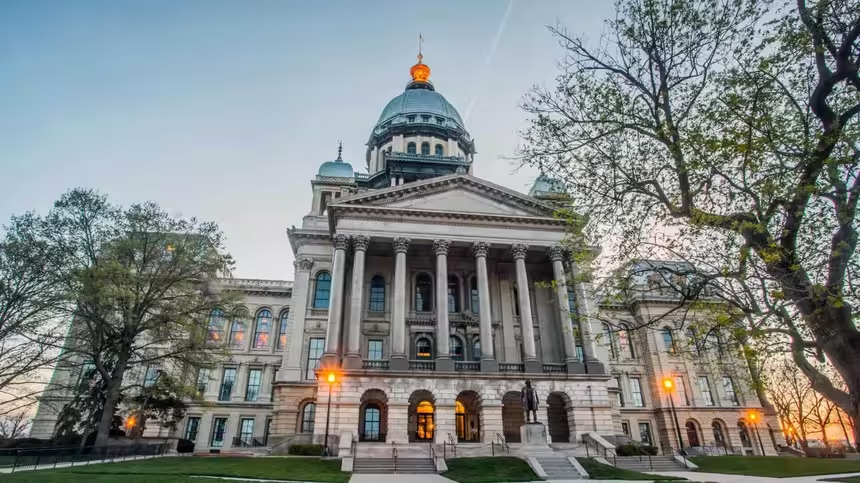
CapitolView
CapitolView is a weekly discussion of politics and government inside the Capitol, and around the state, with the Statehouse press corps. CapitolView is a production of WSIU Public Broadcasting.Providing Support for PBS.org
Learn Moreabout PBS online sponsorship(ambient contemporary music) (upbeat classical music) - Welcome to "Capitol View", a weekly look at the happenings inside and outside the Illinois State Capital.
I'm your host, Jennifer Fuller.
Our guests this week include Charlie Wheeler, the Emeritus director of the public affairs reporting program at the University of Illinois, Springfield, and Dan Petrella, of the Chicago Tribune.
Gentlemen, thanks so much for joining us.
- My pleasure.
- We'll start with the news that has captured headlines all over the globe this week and that is the leak of the draft opinion from the US Supreme Court that, if it is enacted later this summer, could overturn the "Roe versus Wade" decision.
I was hoping we could start with how this impacts Illinois politics.
Dan, how does this change what Democrats and Republicans are working for with a little over six weeks to go before the Illinois primary?
- Yeah, it really rolled a whole new issue into the center of an already heated election year, where there were a lot of tense debates going on about crime and the economy and corruption in the Illinois government, and then you take this very contentious social issue and thrust it into the middle of all of that.
You know, I think Illinois being a reliably democratic state that has worked over the last several years, especially to strengthen protections for abortion rights in preparation just for this particular eventuality that Roe might be struck down.
You have Democrats sort of rallying around that and it might actually energize some of their base voters in a year where things were looking kind of tough for them.
you know, looking at the possibility in November of some losses of seats in the suburbs and places like that and this might be an issue that might get people out to the polls who might have otherwise sat on the sidelines.
On the Republican side, it's also a way to energize their base although interestingly, one of their gubernatorial candidates is taking a hands off approach to even commenting up until this point on the draft decision that was leaked.
- Do you think that something this large, this changing will force those candidates to eventually have to say something?
And of course you're talking about Richard Irvin, one of the Republican candidates for governor.
- Yes, yeah.
Aurora mayor, Richard Ivin, I think perhaps the calculus on their side is that there's a chance the final ruling, which is what they said they're waiting for, won't come out until after the Republican Primary, and he can get through that without really having to say much more on the issue and then worry about it in the general election where he's going to be trying to court more moderate "middle of the road" voters who might be sort of split on the issue.
I think they're gonna continue to be asked about it if and when candidates appear in public which is another whole issue in this election, but I think it's definitely something, you know, especially with it happening this close to the Primaries, when people are really starting to pay attention, that's gonna become a central issue and people are gonna have to answer for it.
- Sure.
Charlie, Dan touched on this just a little bit in terms of the history of how Illinois approaches abortion rights and reproductive rights in this state.
You covered the State House for a long time before you were the director of the Public Affairs Reporting Program.
And as I recall, you were covering the legislature when Roe came out in the first case in 1973.
Can you talk a little bit about the evolution of how this state has changed?
- Yeah.
The question of abortion... Let me back up and say, I started covering state government at the time of the Constitutional Convention in 1970.
That was my first, I guess, real exposure to Illinois government.
And the whole question of abortion never came up at all during the Constitutional Convention because it was kind of settled law.
The state, like I believe virtually every other state in the union, banned abortions except in the case of if it was necessary for the life of the mother.
And so, it wasn't really an issue until "Roe V. Wade" came down and then suddenly, the state was left without any regulation at all dealing with abortion.
And so the, I guess in today's terms, the progressives who were in favor of abortion rights had to make some provisions regulating abortion so it couldn't be the kind of thing that you could get it at the corner grocery store, for example.
It had to be done by a medical professional in a healthcare setting, that kind of stuff, just "bare bones" regulation.
And the conservatives, to provide the votes necessary, to put in place a structural framework, demanded that legislation also be enacted that would say, should "Roe V. Wade" ever be overturned, Illinois would go back to what it had before, where almost from the beginning of our statehood, we banned abortions and provided criminal penalties for women who sought them and doctors who provided them.
And so, that was the status.
And all throughout the time after "Roe V. Wade", up until, I wanna say the early 1990s, the drill was just so familiar.
The pro-life people would introduce legislation.
They'd get it through the general assembly.
Governor Thompson would veto it.
The general assembly would override it.
The pro-rights folks would take it to the federal courts.
It would be thrown out.
And I would say back then, the vast majority of lawmakers really didn't care a whole lot, one way or the other.
They were more interested in things that they thought impacted their constituents more broadly, but the people who were for abortion rights and the people who were "right to lifers" were very, very adamant, very persistent.
So me as kind of a "middle of the road" lawmaker, easiest thing for me to do is say, "Yeah."
You tell the "right to life" people.
"Yeah, I'll vote for these restrictions," knowing in my mind, they're not gonna go anywhere.
And the "pro-choice" people would give me a pass, say, "Yeah, we understand.
You gotta do this to satisfy those wackos on the right and we know it really doesn't mean anything 'cause the federal courts are gonna throw it out."
That all changed with the decision, I believe it was in 1992, the Casey decision, - Mm-hmm - that, where the Supreme Court kind of carved out some exceptions to "Roe V. Wade" and said that there are certain things that the states can do to regulate abortion.
And from that point on, none of the "right to life" stuff could get through the general assembly because the people in the middle, the lawmakers in the middle realized, "Hey, this is serious now."
And as a matter of fact, all the Republican governors that I covered, which would've been, well, Jim Thompson, Jim Edgar, George Ryan, they all, to greater or lesser extent, supported abortion rights.
Ryan was a "right to lifer" but on the other hand, he vetoed legislation that would've prohibited public funds to be used for abortions and his argument was, he didn't think it was fair that rich women could have avail themselves of this procedure, poor women couldn't.
And so that's where things stood until, well, I guess until, what would it be, early summer, if in fact this leaked draft opinion becomes the law of the land when a majority of the Supreme court adopts it and publishes it.
- Sure, and you mentioned in that history, something that Illinois had, a lot of other states have, which is something called a Trigger Law, which is, if "Roe versus Wade" has ever overturned, the states will return to their previous status when it comes to abortion.
Now, Illinois enacted new legislation just within the last year or so that pretty much makes the state a safe haven for reproductive health, for abortion rights, and a lot of people are looking at Illinois as kind of an outlier in the Midwest.
Dan, how does that change such a complicated web in terms of the economy?
You always hear about people moving in and out of Illinois for whatever reason.
Does this status change things at all?
- Just backing up a little bit, it was actually another Republican governor, Bruce Rauner, in 2017, who signed a bill that repealed the Trigger Law.
So, it's an interesting history, partisan history there, here in Illinois.
You know, I think there are definitely advocates on the pro-abortion rights side of the debate who really want to strengthen Illinois's role and place as a safe haven.
We just saw statistics this morning that New York and Illinois are like the leading providers of those services in the entire country.
And as we see the likelihood that states around us clamp down with further restrictions, I think we'll see more and more people coming from out of state.
They've seen figures in the tens of thousands of possibly people coming from states that restrict or completely ban abortions, coming to Illinois to have those services, and I think, sort of the advocates and service providers are really gearing up for being able to help as many of those people as they can.
- Another issue that has has come out of the fact that this document was leaked in the first place is that of judicial ethics.
We're seeing Republicans calling for a strong investigation into who leaked the document and how it got leaked.
I wanted to go over a piece of video that we have from Illinois' senior Senator, Dick Durbin, who happens to chair the Judiciary Committee.
They were preparing a hearing this week on Judicial Ethics and he had this to say before that hearing even got started.
- I do not take anything near a hands-off attitude toward that branch of government known as the Judiciary.
As a matter of fact, we just completed an "advise and consent" procedure for a nominee to the highest court of the land.
We do that for judicial nominees at the federal level.
We actually determine how many of those judges will be sitting on circuit benches and district court benches.
We have the power though it's been a long time since it's been actively debated or discussed to even change the composition of the courts.
We have many authorities, including the power of the purse when it comes to dealing with the judiciary, so I don't take a hands-off attitude.
While we're on the subject, I think we should consider the ethical implications of Supreme Court nominees repeatedly coming before this committee and testifying under oath that they will respect precedent and then doing exactly the opposite when they're confirmed.
We must work to ensure as Justice Steven said, the true backbone of the rule of law, the confidence in the men and women who administer it.
I believe that confidence has been shaken and we must face that alarming reality.
- There's a lot to unpack here.
Senator Durbin talks about the ethics of Justices who, as he mentioned, go before the Judiciary Committee and say, "No, we will uphold precedent," and it appears that what he's saying here is that they're not going to do that.
Charlie, do you think there's room here for the Judicial Committee or for Congress to make changes in terms of Judicial Ethics that might sway how this decision is received?
- I suspect that the reason this hearing was scheduled had more to do with the role that Justice Thomas's wife played in the whole attempt to discredit the election in favor of Donald Trump.
She was very active in the group that was trying to figure out a way to keep Trump in power.
And I think that's probably what the Senate Judiciary was focusing on before this draft report was leaked.
And as a practical matter, I'm not really sure what Congress can do to rein in the court, and the reason I say that is because the court is the ultimate arbiter, going back to the very early days of the Republic.
So, the Congress, they never get the votes to do this, but the Congress, for example, could require much greater disclosure on behalf of the Justices.
They could say, "You can't do this.
You can't do that.
You have to retire at whatever age," and somebody would come in and sue and would go before the Supreme Court and they'd say, "No, you can't do that.
We're an independent branch of the Judiciary.
We do what we want."
So, I'm not sure that there's really a practical way to do it.
And I see what his complaint is after this document was leaked because the three appointees of President Trump came before the committee and they were asked if they believed in the notion that precedent should count, and they said, "Yes."
And I don't recall if they were asked specifically about "Roe V. Wade", but they gave the impression that settled law is gonna stay settled.
Now, according to this leaked document, those three Justices appear ready to scuttle "Roe V. Wade" and it occurs to me, there's been a lot of complaints from the Republicans, "Who leaked this document?"
Well, it struck me that was probably leaked by someone who favors getting rid of "Roe V. Wade", and it was leaked to cement in position the Justices who had already kind of informally voted to do away with it so that they would not be, what would you say, swayed to have their minds changed.
Justice Roberts, for example, probably doesn't want his legacy to be that we did away with all these individual rights.
And so he could be talking to some of the newbies saying, "Well, let's not throw the whole thing out.
Let's kinda tailor it and leave the basic law in place and provide more exception," something like that.
And now that it's out in the public, nowhere will one of these justices moderate their opinion, I don't think, because they're not gonna say, "Oh yes, I was swayed by public opinion."
So I don't think it was leaked by some democratic operative because in my mind, for the Democrats, the closer to the election that this comes out, the better it is for their ability to organize people who thought that this was not really an issue and now suddenly it is.
- This appears, and Senator Durbin mentions it a little bit in his statement here, appears to rekindle the thought of perhaps reconstituting the US Supreme Court, perhaps adding members or adding guidelines to how those members are selected.
Dan, do you think that becomes an election issue, talking again about whether or not justices are added to the US Supreme Court?
- I think there will be some people who discuss it.
It seems like a pretty, I don't wanna say far-fetched, but a long shot, you know.
I think it's hard enough to get anything, even small pieces of legislation, even things that people generally agree on, like aid for Ukraine through Congress.
So, you know, a major structural change like this on a highly polarized partisan issue is just, you know, something that's hard to see actually happening in Congress.
The same with, you know, if they were to try to impeach a Supreme Court Justice over, you know, Senator Durbin maybe didn't quite go this far but, you know, potential perjury or lying under oath to Congress about their views on these issues.
You know, I look back at when Senator Durbin was having exchange with Justice Gorsuch during his confirmation hearing and was asked about the fact that "Roe versus Wade", you know, established court precedent says the fetus is not a person under the constitution, and he asked Gorsuch, "Do you accept that?"
And Gorsuch said, "This is the law of the land.
I accept the law of the land, Senator.
Yes."
So, given the implication that he would uphold precedent but obviously if the draft is what ends up being the final decision, that isn't necessarily the case.
- Sure.
There's certainly more to talk about when it comes to this issue, but there's also more to talk about in terms of what's happening in and outside the State Capitol, The Fed increased interest rates this week by a half of a percentage point.
It comes around the same time that Illinois is actually celebrating the fact that it's received two credit upgrades in the recent couple of weeks, perhaps couple of months.
Charlie, what does this mean as the country is staring down what could be another recession?
Illinois is no longer, appears, headed toward junk bond status.
- No, I think it's safe to say that we're moving the opposite direction.
We've already had I believe three upgrades in recent years.
The expectation is that the performance of the state's economy and the budget that was put together for the coming fiscal year is gonna get us another couple, so we'll be in much better shape.
And what the upgrade means is that when we go to the markets to sell bonds, to borrow money, the interest rates we get are lower than if we had a lower credit rating.
And I've said this many times on this show and elsewhere, the credit ratings in a sense are phony.
They're supposed to measure whether or not you'll be able to pay what you borrow.
If I go out to buy a car and I have to get a credit check, what the credit union is considering, how likely is it that Wheeler will default on this loan?
And in the case of the state of Illinois, the chances of its defaulting on its bonds are virtually zero.
We did once upon a time back, I believe it was an 1840, and the governor then and the general assembly went to a special session, enacted a special property tax to make the bond holders, to give the bond holders what they were supposed to get.
So, as a practical matter, we're not gonna default, but having a higher credit rating enables us to sell bonds and I believe we're going to the market this week or next to borrow a billion dollars for Capitol projects and other purposes.
It allows us to get better interest rate.
And I might add that just a couple days ago, the legislature's fiscal gurus commission on government forecasting and accountability reported that the... With two months remaining in our fiscal year, fiscal year ends June 30th, and I'll quote from the report, "Overall, base receipts are up an astonishing $5,965,000,000 over last year."
And they also pointed out that in the month of April, which just ended obviously, the receipts to the general funds grew by more than $3 billion and the total eight+ billion dollars that was receded in April was the highest base revenue total in any month in the state's history.
So we're really in very good fiscal shape for the moment but of course, next year we'll see what happens.
And Jen, as you suggest, the fact that interest rates are going up, is this gonna cause an economic slowdown?
People are talking about this stagflation where the economy stagnates, inflation continues like we had, what, a generation or so ago.
And so, there's a lot of uncertainty for the future but at the moment, we're in pretty good shape.
- Dan, as Charlie points out, you know, you're seeing some criticism of the report or at least of the budget plan, saying you can't count this as ongoing revenue.
This is one-time revenue.
Will this factor in, do you think, as budget negotiations get started next spring?
- Yeah.
You know, I think what the budget makers would tell you, what the Pritzker administration would tell you, is that they estimated their revenues for the coming year conservatively, understanding that there was a lot going on in the economy this past year that was pushing revenues up, lots of federal stimulus working its way through the economy.
I wanna separate that from the direct federal aid to the state but, you know, direct checks going to people that they're spending and, you know, paying sales tax and income tax on.
I think that the question is, how much revenues drop off in the future if they do?
And one thing, that also the Democrats and the legislature and the governor's office will tell you is that for the first time in recent memory, they put a billion dollars in the rainy day fund to help sort of cushion that potential drop off in revenue in the future.
So, you know, it's a hard argument for Republicans to make.
They're definitely trying to make it that our fiscal health is not improving, you know.
The federal aid, I think the bond rating agencies have looked very closely at that and said, you know, they're not baking this one time influx of money into ongoing programs, things that are going to need to continue to be funded years down the road when the money's gone.
So, I think it's important to know that that stuff is all part of those ratings decisions.
- Sure.
Just a minute or two remaining and Dan, I did wanna touch base with you.
The city of Chicago is formally throwing its hat in the ring to host the Democratic National Convention in 2024.
We've seen some in the past that have been unsuccessful.
Where does Chicago stand, do you think, in hosting that?
- You know, I think it's interesting.
It's a tense time for Chicago right now, especially coming off the previous presidential administration.
I like to use it sort of as a poster child for crime and other problems.
Obviously crime is a huge issue in the city right now, but I think what leaders here in Chicago and in Illinois are hoping to demonstrate, is Chicago's role is really this force for democratic and progressive politics in the Midwest, a state that's representative of the country as a whole.
And so I think, you know, there'd be a lot of interest in bringing Democrats from across the country to town to kick off the next presidential race.
- And of course they need to get through this election cycle first.
- Yes.
- Sure.
As we close up the show, it's worth noting that the Illinois Auditor General's office is out with its closer look at the Lasalle Veteran's Home and what happened there when it comes to COVID 19 cases and overall throughout veteran's homes, looking at Legionnaire's disease and other issues.
We wanna give people time to digest that information and we look forward to talking about it next week here on "Capitol View".
Until then, I'd like to thank Dan Petrella and Charlie Wheeler, our guests this week.
Thank you so much for joining us.
I do appreciate it.
I'm your host, Jennifer Fuller.
Thanks for joining us on "Capitol View" and we'll see you again next week.
(upbeat classical music)

- News and Public Affairs

Top journalists deliver compelling original analysis of the hour's headlines.

- News and Public Affairs

FRONTLINE is investigative journalism that questions, explains and changes our world.












Support for PBS provided by:
CapitolView is a local public television program presented by WSIU
CapitolView is a production of WSIU Public Broadcasting.